Page 500 of 608
500 5-1. Essential information
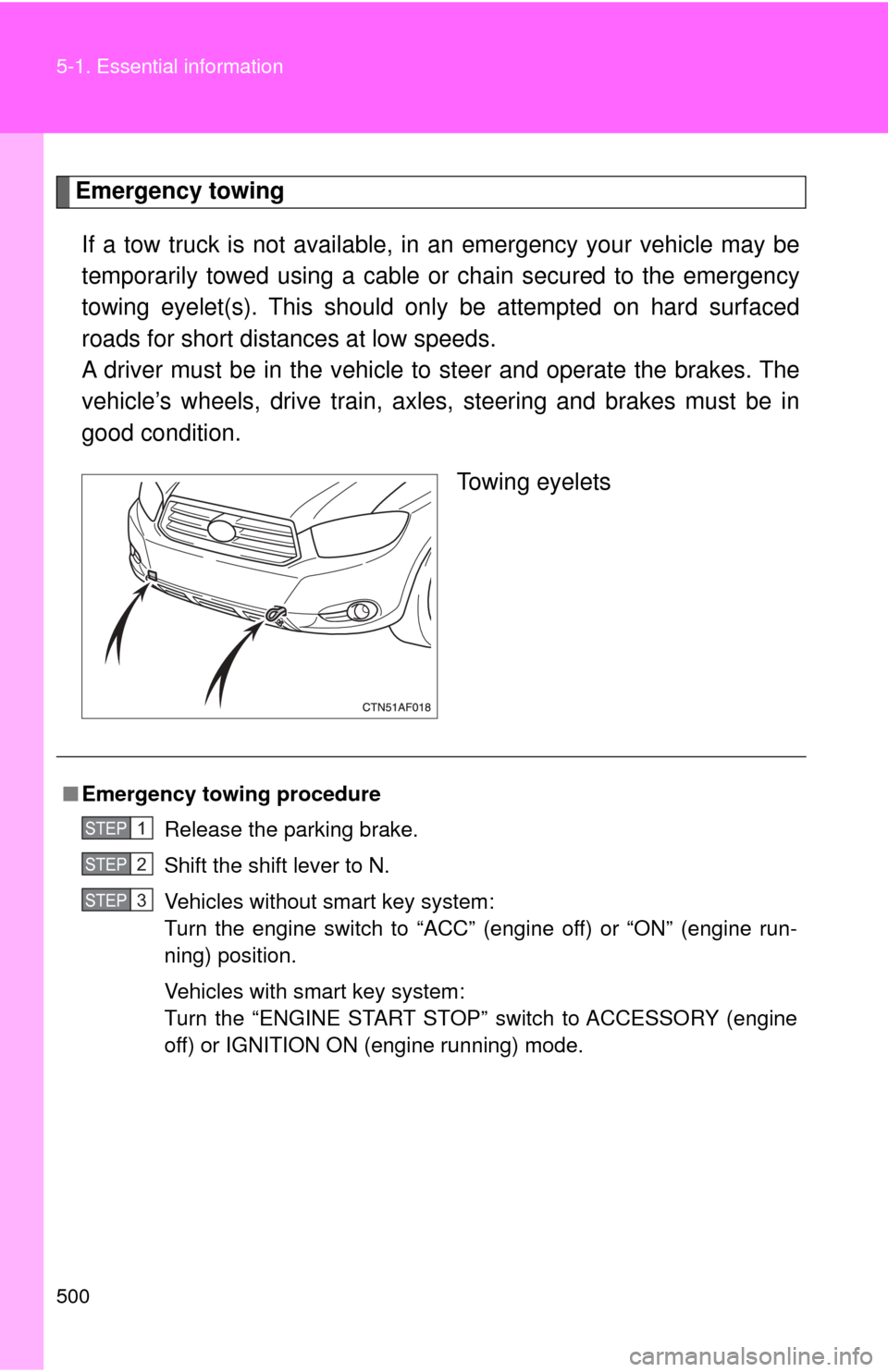
Emergency towingIf a tow truck is not available, in an emergency your vehicle may be
temporarily towed using a cable or chain secured to the emergency
towing eyelet(s). This should only be attempted on hard surfaced
roads for short distances at low speeds.
A driver must be in the vehicle to steer and operate the brakes. The
vehicle’s wheels, drive train, axles, steering and brakes must be in
good condition.
Towing eyelets
■Emergency towin g procedure
Release the parking brake.
Shift the shift lever to N.
Vehicles without smart key system:
Turn the engine switch to “ACC” (engine off) or “ON” (engine run-
ning) position.
Vehicles with smart key system:
Turn the “ENGINE START STOP” switch to ACCESSORY (engine
off) or IGNITION ON (engine running) mode.
STEP1
STEP2
STEP3
Page 501 of 608
5
When trouble arises
501
5-1. Essential information
Installing towing eyelet
Remove the eyelet cover while
pushing it.
Insert the towing eyelet into the
hole and tighten partially by
hand.
CAUTION
■Caution while towing
●Use extreme caution when towing the vehicle.
Avoid sudden starts or erratic driving maneuvers which place excessive
stress on the emergency towing eyelets and the cables or chains.
● If the engine is not running, the power assist for the brakes and steering
will not function, making steering and braking more difficult.
NOTICE
■To prevent causing serious damage to the transmission
Never tow this vehicle from the rear with the front wheels on the ground.
This may cause serious damage to the transmission.
STEP1
STEP2
Page 502 of 608
502 5-1. Essential information
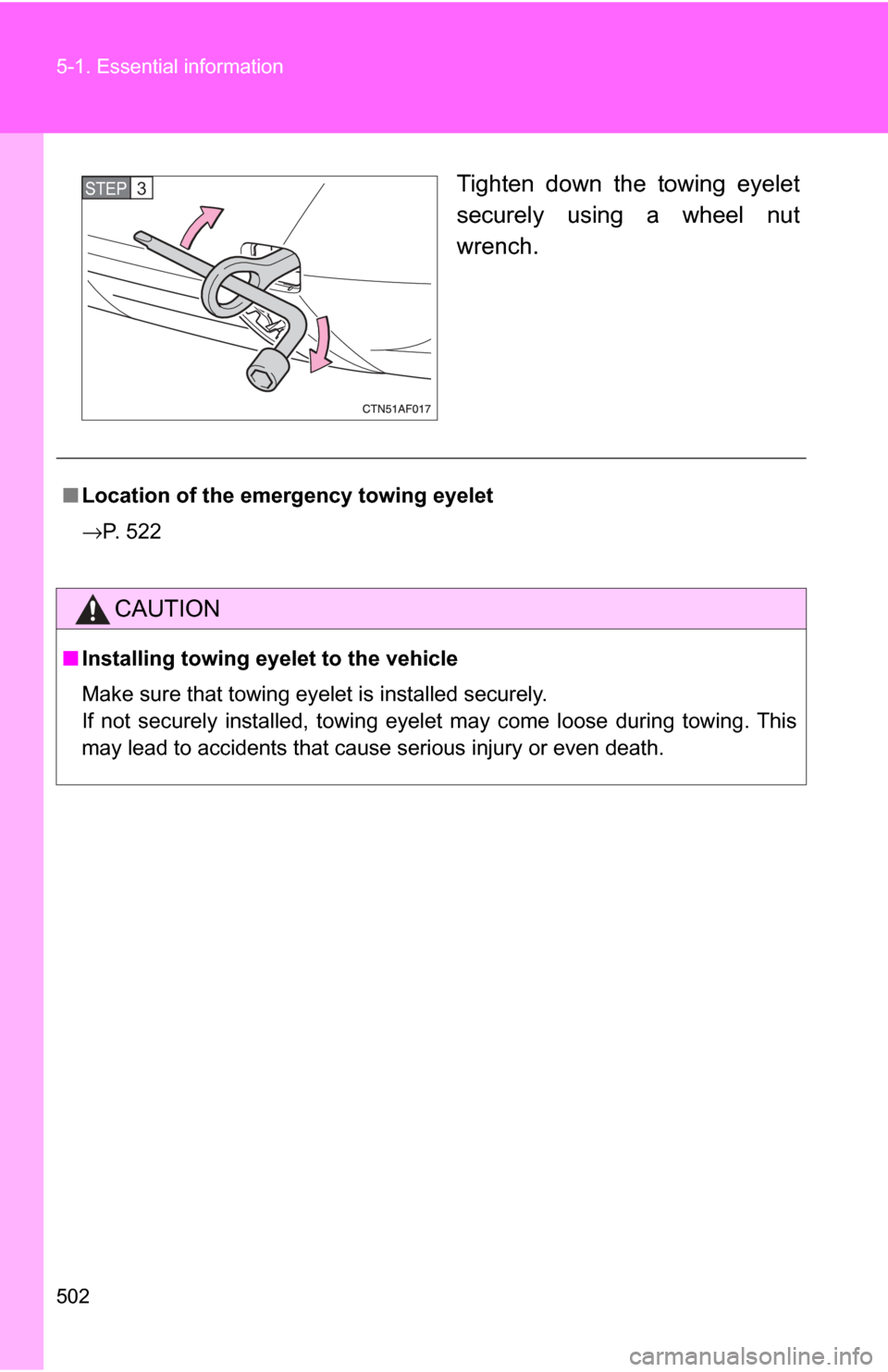
Tighten down the towing eyelet
securely using a wheel nut
wrench.STEP3
■Location of the emergency towing eyelet
→P. 522
CAUTION
■Installing towing eyelet to the vehicle
Make sure that towing eyelet is installed securely.
If not securely installed, towing eyelet may come loose during towing. This
may lead to accidents that cause serious injury or even death.
Page 503 of 608
5
When trouble arises
503
5-1. Essential information
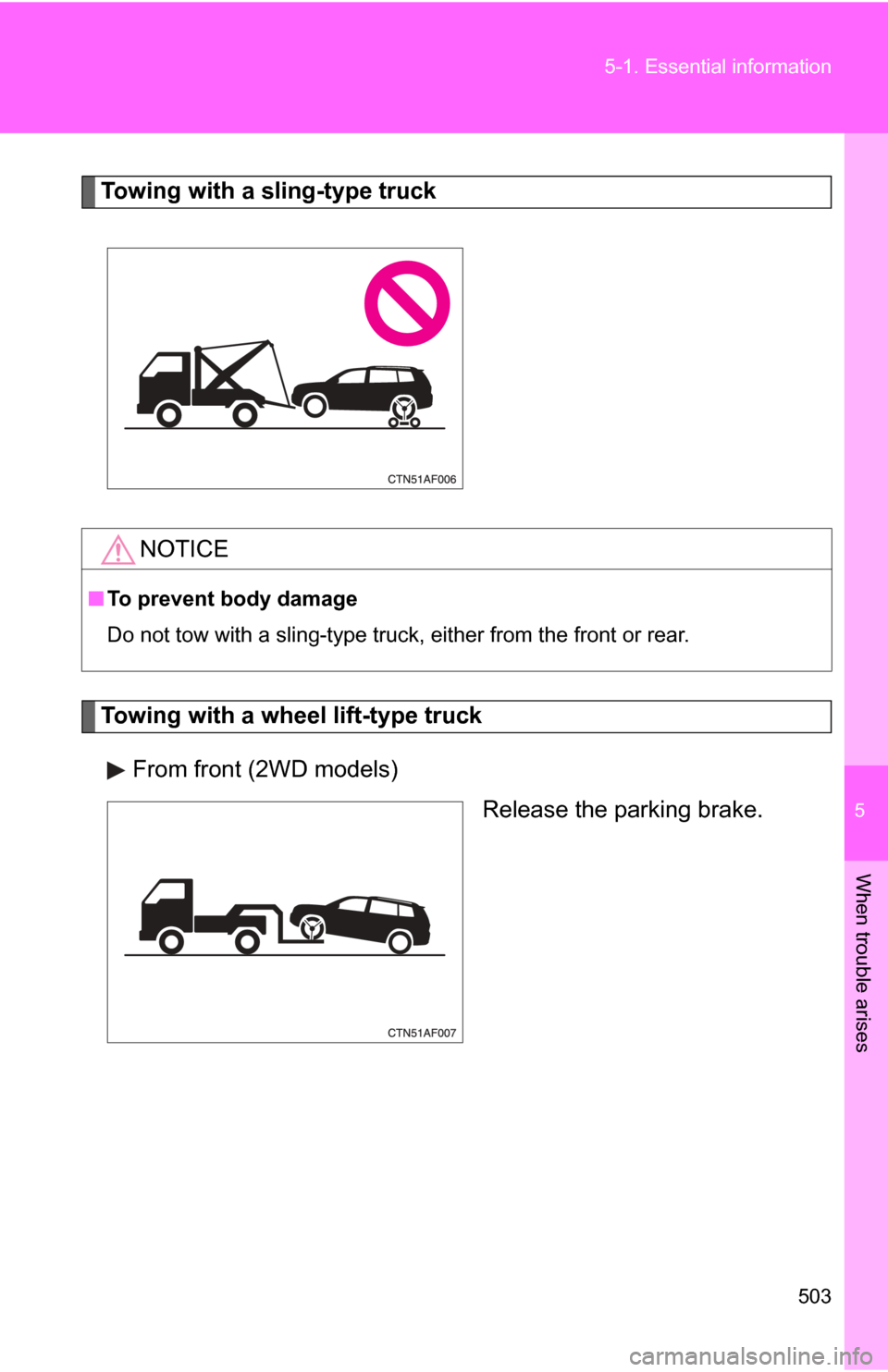
Towing with a sling-type truck
Towing with a wheel lift-type truck
From front (2WD models) Release the parking brake.
NOTICE
■To prevent body damage
Do not tow with a sling-type truck, either from the front or rear.
Page 504 of 608
504 5-1. Essential information
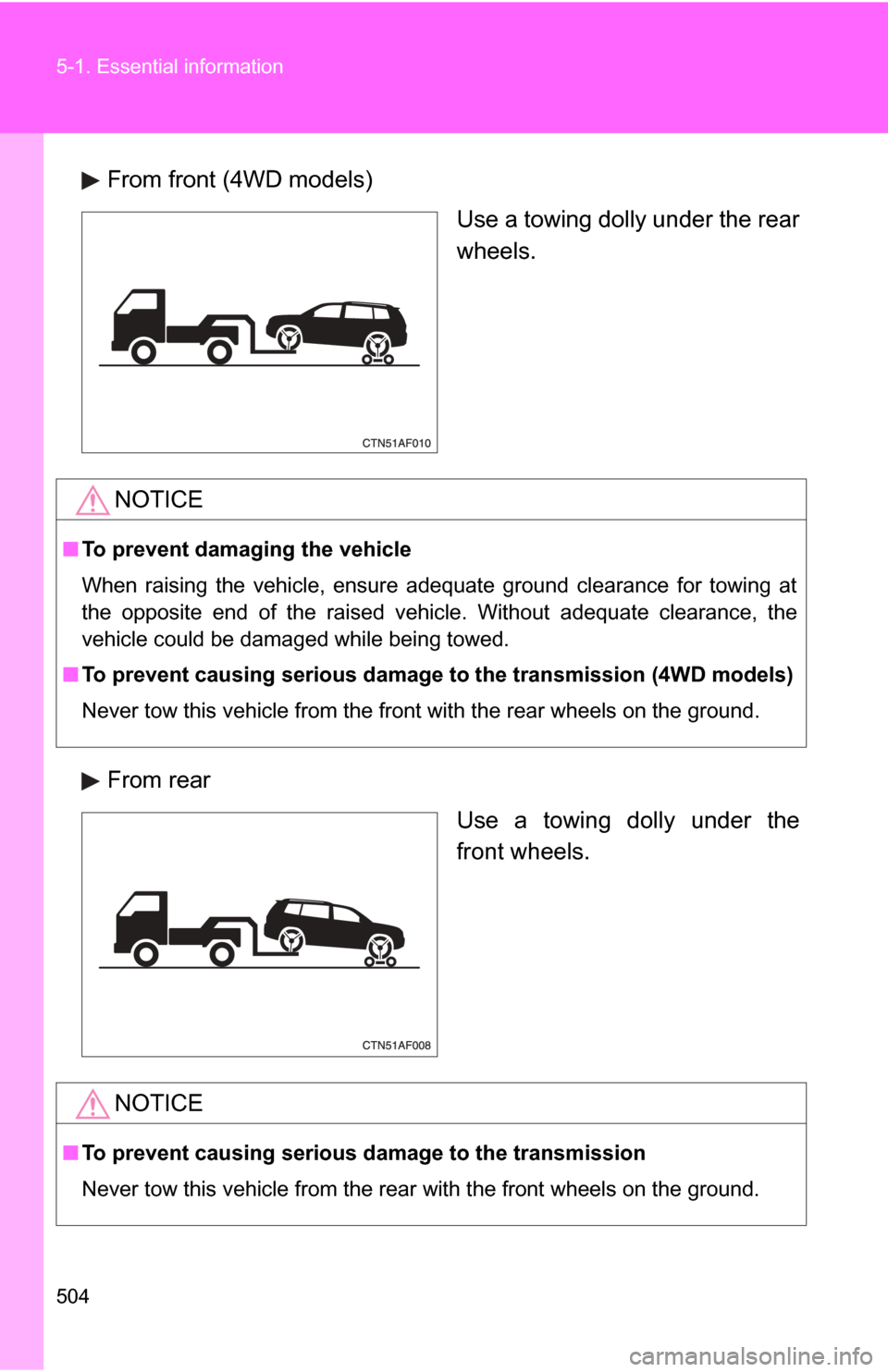
From front (4WD models)Use a towing dolly under the rear
wheels.
From rear Use a towing dolly under the
front wheels.
NOTICE
■To prevent damaging the vehicle
When raising the vehicle, ensure adequate ground clearance for towing at
the opposite end of the raised vehicle. Without adequate clearance, the
vehicle could be damaged while being towed.
■ To prevent causing serious damage to the transmission (4WD models)
Never tow this vehicle from the front with the rear wheels on the ground.
NOTICE
■To prevent causing serious damage to the transmission
Never tow this vehicle from the rear with the front wheels on the ground.
Page 522 of 608
522
5-2. Steps to take in an emergency
If you have a flat tire
Remove the flat tire and replace it with the spare provided.
■Before jacking up the vehicle
●Stop the vehicle on a hard, flat surface.
● Set the parking brake.
● Shift the shift lever to P.
● Stop the engine.
● Turn on the emergency flashers.
■ Location of the spare tire, jack and tools
Jack handle
Adapter
socket Towing eyelet
Jack handle
Wrench
Spare tire
Jack
Page 529 of 608
5
When trouble arises
529
5-2. Steps to take in an emergency
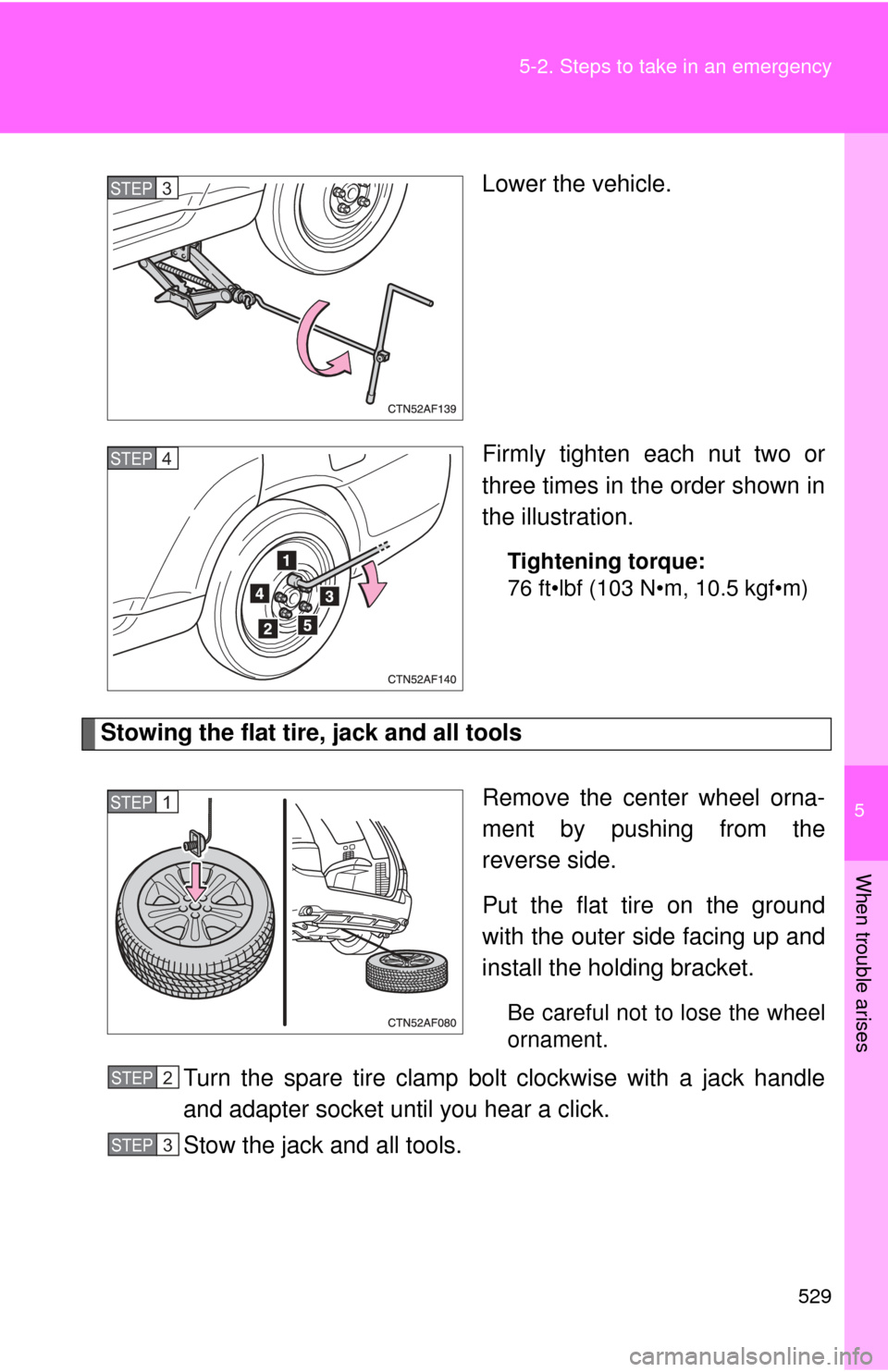
Lower the vehicle.
Firmly tighten each nut two or
three times in the order shown in
the illustration.
Tightening torque:
76 ft•lbf (103 N•m, 10.5 kgf•m)
Stowing the flat tire
, jack and all tools
Remove the center wheel orna-
ment by pushing from the
reverse side.
Put the flat tire on the ground
with the outer side facing up and
install the holding bracket.
Be careful not to lose the wheel
ornament.
Turn the spare tire clamp bolt clockwise with a jack handle
and adapter socket until you hear a click.
Stow the jack and all tools.
STEP3
STEP4
STEP1
STEP2
STEP3
Page 534 of 608

534 5-2. Steps to take in an emergency
NOTICE
■Do not drive the vehicle with a flat tire.
Do not continue driving with a flat tire.
Driving even a short distance with a flat tire can damage the tire and the
wheel beyond repair.
■Be careful when driving over bumps with the compact spare tire
installed on the vehicle.
The vehicle becomes lower when driving with the compact spare tire
compared to when driving with standard tires. Be careful when driving
over uneven road surfaces.
■Driving with tire chains and the compact spare tire
Do not fit tire chains to the compact spare tire.
Tire chains may damage the vehicle body and adversely affect driving
performance.
■When replacing the tires
When removing or fitting the wheels, tires or the tire pressure warning
valve and transmitter, contact your Toyota dealer as the tire pressure
warning valve and transmitter may be damaged if not handled correctly.
■To avoid damaging the tire pressure warning valves and transmit-
ters
Do not use liquid sealants on flat tires.
■When stowing the flat tire
●Ensure that there is no object caught between the tire and the vehicle
underbody.
●Tighten the spare tire clamp bolt to hold the spare wheel carrier by the
hook securely.