2009 TOYOTA COROLLA trailer
[x] Cancel search: trailerPage 174 of 468
174 2-5. Driving information
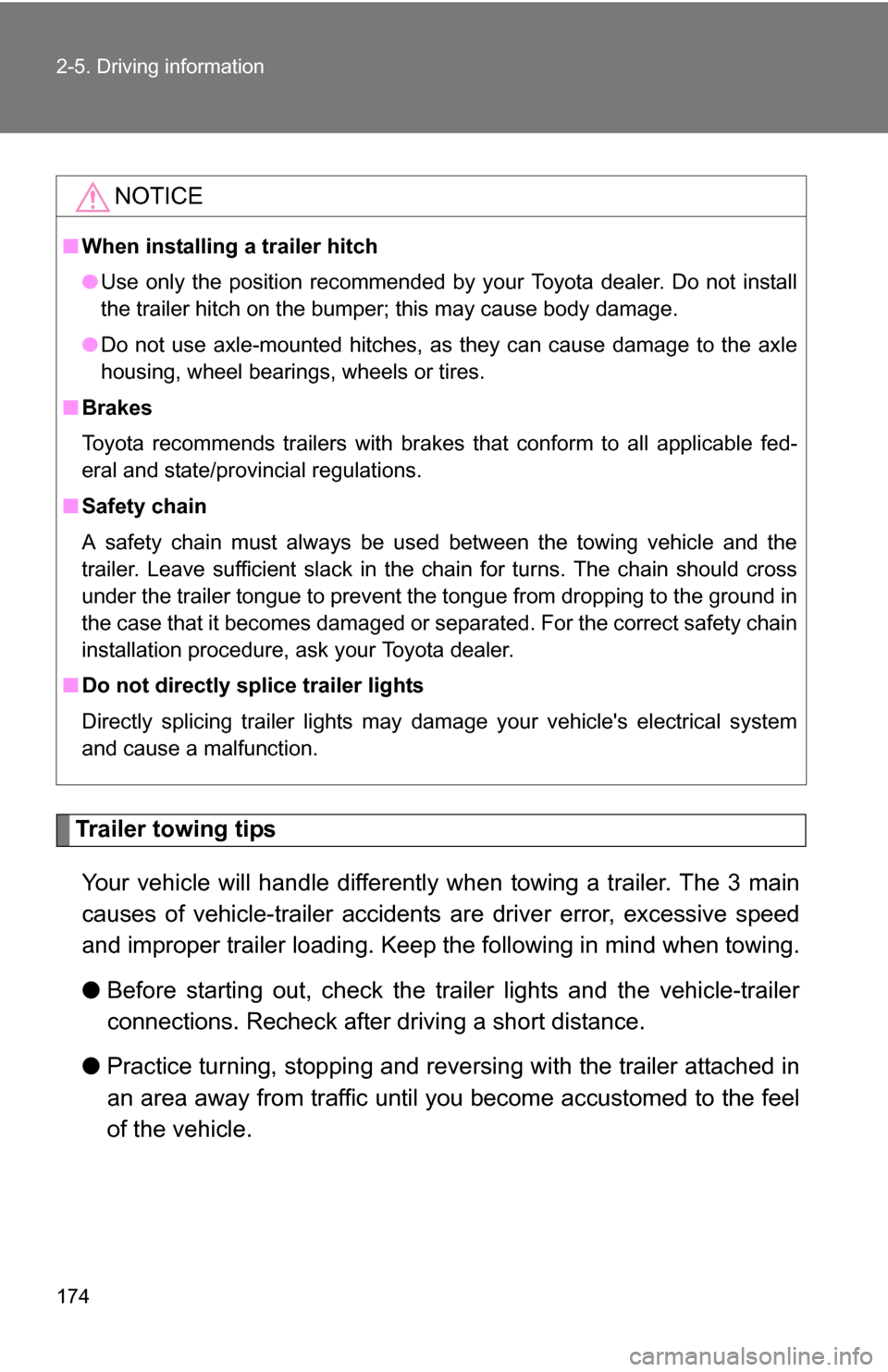
Trailer towing tipsYour vehicle will handle differently when towing a trailer. The 3 main
causes of vehicle-trailer accidents are driver error, excessive speed
and improper trailer loading. Keep the following in mind when towing.
● Before starting out, check the trailer lights and the vehicle-trailer
connections. Recheck after driving a short distance.
● Practice turning, stopping and reve rsing with the trailer attached in
an area away from traffic until you become accustomed to the feel
of the vehicle.
NOTICE
■ When installing a trailer hitch
●Use only the position recommended by your Toyota dealer. Do not install
the trailer hitch on the bumper; this may cause body damage.
● Do not use axle-mounted hitches, as they can cause damage to the axle
housing, wheel bearings, wheels or tires.
■ Brakes
Toyota recommends trailers with brakes that conform to all applicable fed-
eral and state/provincial regulations.
■ Safety chain
A safety chain must always be used between the towing vehicle and the
trailer. Leave sufficient slack in the chain for turns. The chain should cross
under the trailer tongue to prevent the tongue from dropping to the ground in
the case that it becomes damaged or separated. For the correct safety chain
installation procedure, ask your Toyota dealer.
■ Do not directly splice trailer lights
Directly splicing trailer lights may damage your vehicle's electrical system
and cause a malfunction.
Page 175 of 468
175
2-5. Driving information
2
When driving
●
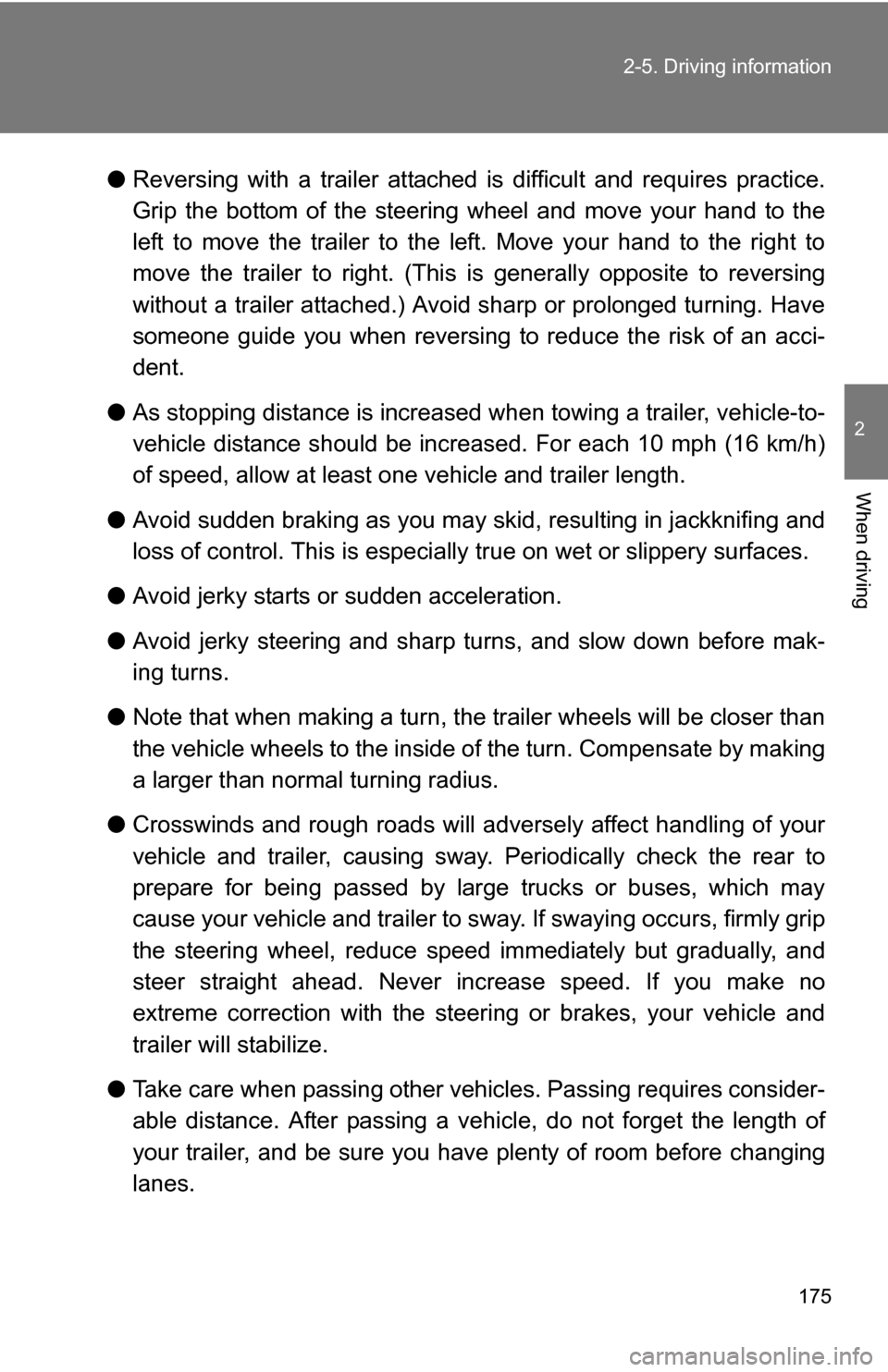
Reversing with a trailer attached is difficult and requires practice.
Grip the bottom of the steering wheel and move your hand to the
left to move the trailer to the left. Move your hand to the right to
move the trailer to right. (This is generally opposite to reversing
without a trailer attached.) Avoid sharp or prolonged turning. Have
someone guide you when reversing to reduce the risk of an acci-
dent.
● As stopping distance is increased when towing a trailer, vehicle-to-
vehicle distance should be increased. For each 10 mph (16 km/h)
of speed, allow at least o ne vehicle and trailer length.
● Avoid sudden braking as you may skid, resulting in jackknifing and
loss of control. This is especiall y true on wet or slippery surfaces.
● Avoid jerky starts or sudden acceleration.
● Avoid jerky steering and sharp turns, and slow down before mak-
ing turns.
● Note that when making a turn, th e trailer wheels will be closer than
the vehicle wheels to the inside of the turn. Compensate by making
a larger than normal turning radius.
● Crosswinds and rough roads will adversely affect handling of your
vehicle and trailer, causing sway . Periodically check the rear to
prepare for being passed by large trucks or buses, which may
cause your vehicle and trailer to sway. If swaying occurs, firmly grip
the steering wheel, reduce speed immediately but gradually, and
steer straight ahead. Never increase speed. If you make no
extreme correction with the stee ring or brakes, your vehicle and
trailer will stabilize.
● Take care when passing other vehicles. Passing requires consider-
able distance. After passing a vehicle, do not forget the length of
your trailer, and be sure you hav e plenty of room before changing
lanes.
Page 176 of 468

176 2-5. Driving information
●In order to maintain efficient engine braking and electrical charging
performance, do not use overdrive (automatic transmission) or the
5th gear (manual transmission).
● Due to the added load of the trailer, your vehicle's engine may
overheat on hot days (at temper atures over 85°F [30°C]) when
driving up a long or steep grade. If the engine coolant temperature
gauge indicates overheating, immediately turn off the air condition-
ing (if in use), pull your vehicle off the road and stop in a safe spot.
( P. 4 1 1 )
● Always place wheel blocks under both the vehicle and the trailer
wheels when parking. Apply the parking brake firmly, and put the
transmission in P (automatic transmission) or in 1 or R (manual
transmission). Avoid parking on a slope, but if unavoidable, do so
only after performing the following:
Apply the brakes and keep them applied.
Have someone place wheel bloc ks under both the vehicle and
trailer wheels.
When the wheel blocks are in place, release the brakes slowly
until the blocks absorb the load.
Apply the parking brake firmly.
Shift into 1 or R (manual transmission) or P (automatic trans-
mission) and turn off the engine.
● When restarting after parking on a slope:
With the transmission in the P position (automatic transmis-
sion) or the clutch pedal (m anual transmission) depressed,
start the engine. On vehicles with an automatic transmission,
be sure to keep the brake pedal pressed.
Shift into a forward gear. If reversing, shift into the R position.
Release the parking brake (also brake pedal on vehicles with
an automatic transmission), and slowly pull or back away from
the wheel blocks. Stop and apply the brakes.
Have someone retrieve the blocks.
STEP1
STEP2
STEP3
STEP4
STEP5
STEP1
STEP2
STEP3
STEP4
Page 177 of 468
177
2-5. Driving information
2
When driving
CAUTION
■
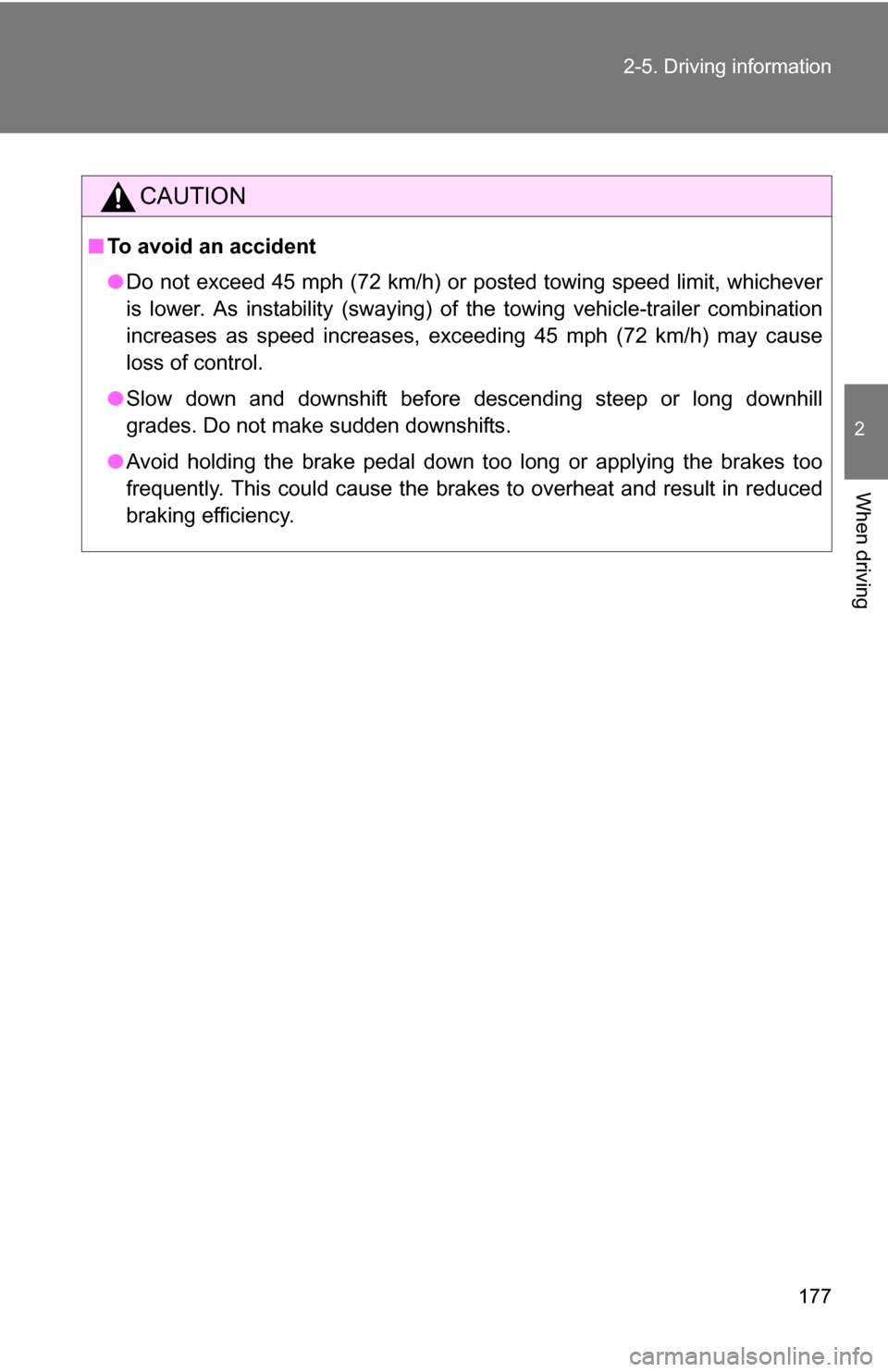
To avoid an accident
●Do not exceed 45 mph (72 km/h) or posted towing speed limit, whichever
is lower. As instability (swaying) of the towing vehicle-trailer combination
increases as speed increases, exceeding 45 mph (72 km/h) may cause
loss of control.
● Slow down and downshift before descending steep or long downhill
grades. Do not make sudden downshifts.
● Avoid holding the brake pedal down too long or applying the brakes too
frequently. This could cause the brakes to overheat and result in reduced
braking efficiency.
Page 416 of 468
416
6-1. Specifications
Maintenance data (fuel, oil level, etc.)
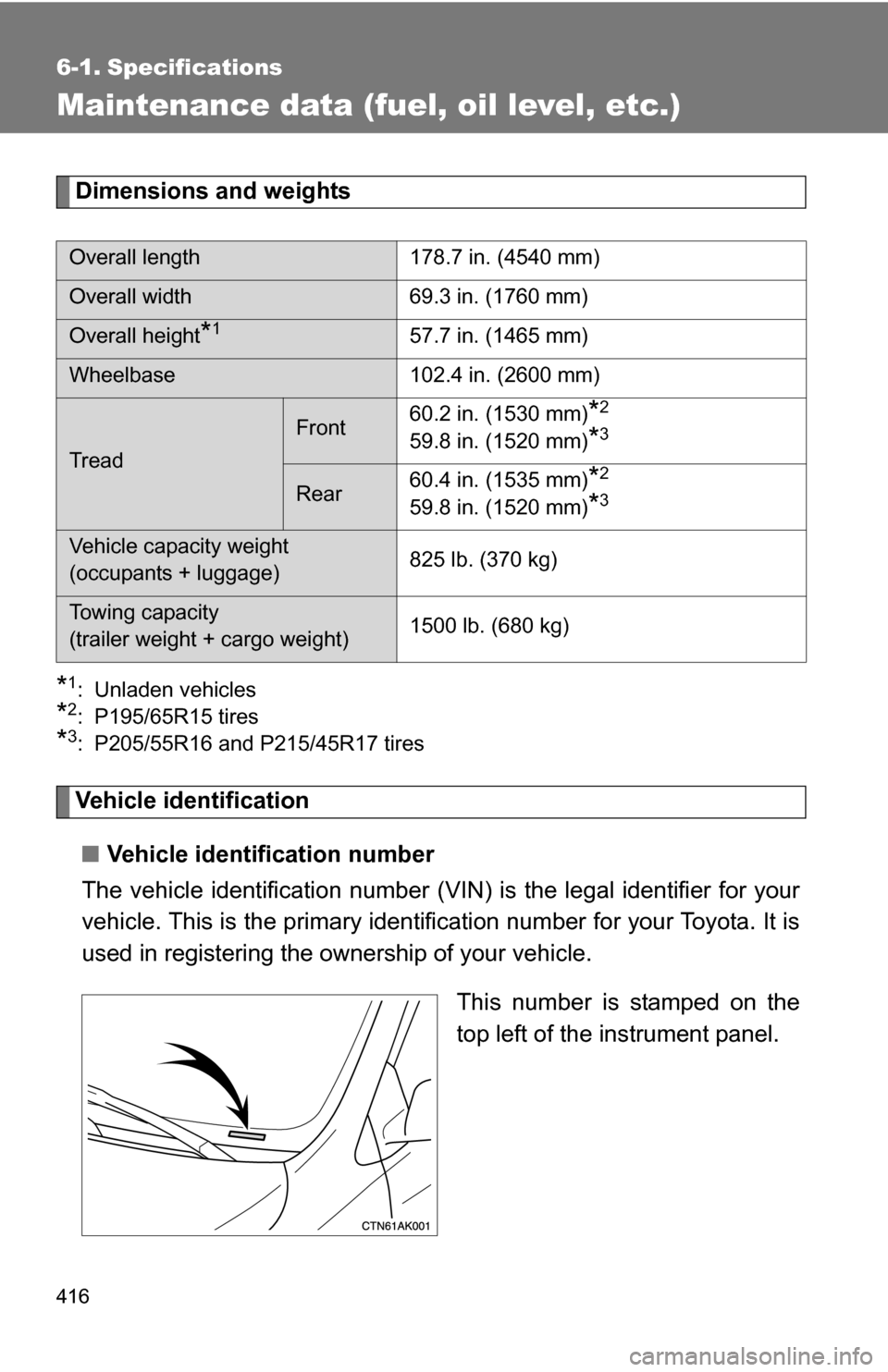
Dimensions and weights
*1: Unladen vehicles
*2: P195/65R15 tires
*3: P205/55R16 and P215/45R17 tires
Vehicle identification■ Vehicle identification number
The vehicle identificati on number (VIN) is the legal identifier for your
vehicle. This is the primary identification number for your Toyota. It is
used in registering the ownership of your vehicle.
This number is stamped on the
top left of the instrument panel.
Overall length 178.7 in. (4540 mm)
Overall width69.3 in. (1760 mm)
Overall height*157.7 in. (1465 mm)
Wheelbase102.4 in. (2600 mm)
Tread
Front60.2 in. (1530 mm)*2
59.8 in. (1520 mm)*3
Rear60.4 in. (1535 mm)*2
59.8 in. (1520 mm)*3
Vehicle capacity weight
(occupants + luggage) 825 lb. (370 kg)
Towing capacity
(trailer weight + cargo weight)1500 lb. (680 kg)
Page 463 of 468

463
Alphabetical index
Side mirror
Adjusting and folding .............. 64
Smart key system Entry function ......................... 22
Starting the engine ............... 122
Spare tire Inflation pressure .................. 335
Spare tire .............................. 388
Spark plug................................ 422
Specifications .......................... 416
Speech command switch ....... 232
Speedometer ........................... 138
Steering Column lock release ..... 124, 128
Steering wheel Adjustment ............................. 61
Audio switches ..................... 225
Stop lights Replacing light bulbs ............ 357
Wattage ................................ 427
Storage box ............................. 283
Storage feature ........................ 264
Storage precautions ............... 162
Stuck If your vehicle becomes stuck................................... 414
Sun visors ................................ 272
Sunshade Roof ........................................ 69
Switch Engine switch ............... 122, 126
Fog light switch..................... 152
Ignition switch ............... 122, 126
Light switches ....................... 150
Power door lock switch........... 38
Power window switch ............. 66
Window lock switch ................ 66
Wiper and washer switch ..... 153 Tachometer...............................138
Tail lights
Replacing light bulbs .............357
Switch....................................150
Wattage .................................427
Talk switch................................232
Telephone switch .....................232
Theft deterrent system Engine immobilizer system .....75
Theft prevention labels..............77
Tire inflation pressure .............335
Tire information Glossary ................................437
Size .......................................434
Tire identification number ......433
Uniform tire quality grading ................................435
Tires Chains ...................................166
Checking ...............................326
If you have a flat tire ..............388
Inflation pressure...................335
Inflation pressure sensor .......327
Information ............................431
Replacing ..............................388
Rotating tires .........................326
Size .......................................425
Snow tires .............................166
Spare tire...............................388
Tools .........................................388
Total load capacity...................165
Towing Dinghy towing................178, 179
Emergency towing.................369
Trailer towing.........................170
TRAC .........................................158
Traction control........................158
Trip information .......................146
Trip meter .................................138T