Page 364 of 468
364 4-3. Do-it-yourself maintenance
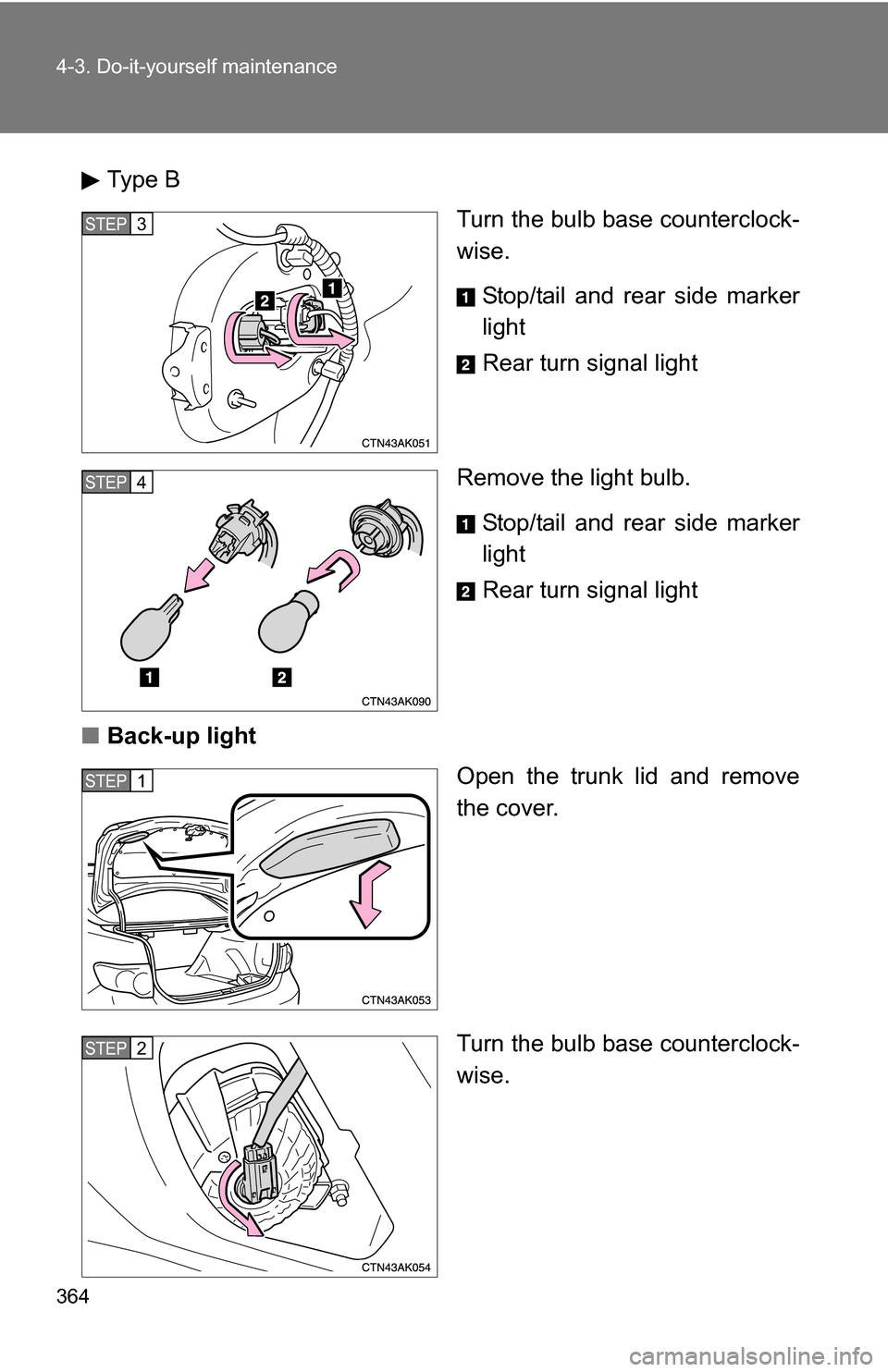
Type BTurn the bulb base counterclock-
wise.
Stop/tail and rear side marker
light
Rear turn signal light
Remove the light bulb. Stop/tail and rear side marker
light
Rear turn signal light
■ Back-up light
Open the trunk lid and remove
the cover.
Turn the bulb base counterclock-
wise.
STEP3
STEP4
STEP1
STEP2
Page 365 of 468
365
4-3. Do-it-yourself maintenance
4
Maintenance and care
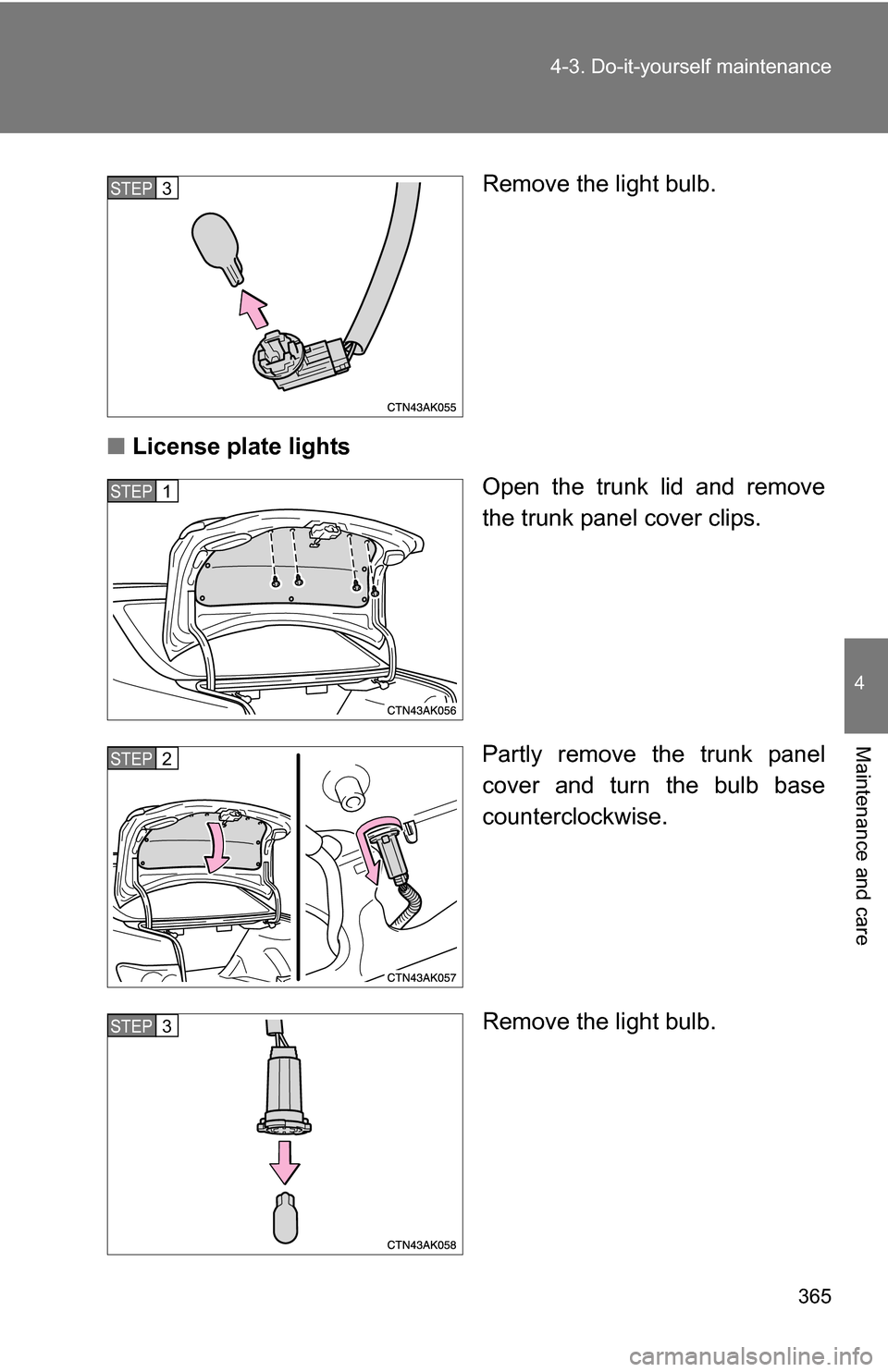
Remove the light bulb.
■ License plate lights
Open the trunk lid and remove
the trunk panel cover clips.
Partly remove the trunk panel
cover and turn the bulb base
counterclockwise.
Remove the light bulb.STEP3
STEP1
STEP2
STEP3
Page 366 of 468
366 4-3. Do-it-yourself maintenance
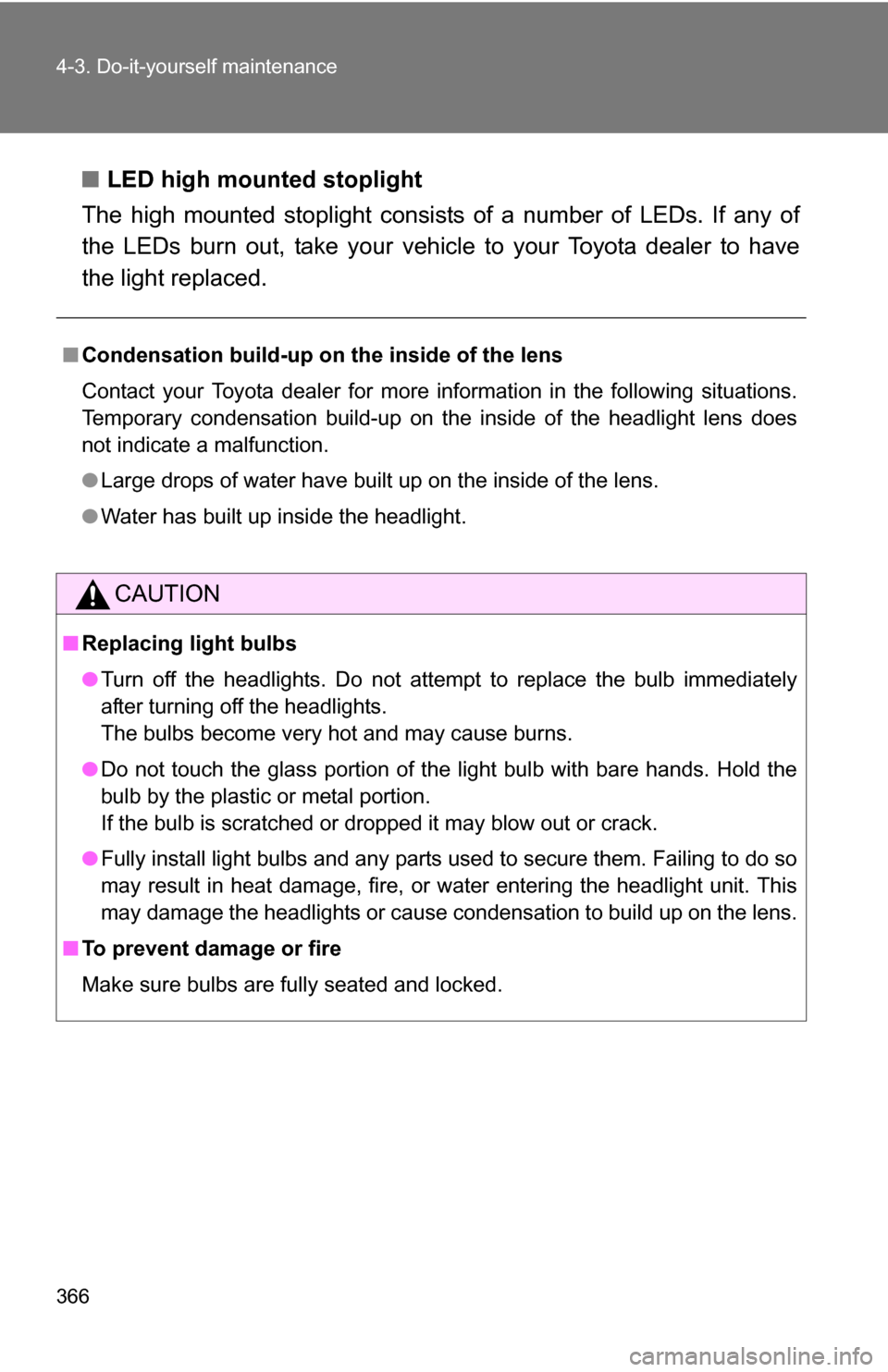
■LED high mounted stoplight
The high mounted stoplight consists of a number of LEDs. If any of
the LEDs burn out, take your vehicl e to your Toyota dealer to have
the light replaced.
■ Condensation build-up on th e inside of the lens
Contact your Toyota dealer for more information in the following situations.
Temporary condensation build-up on the inside of the headlight lens does
not indicate a malfunction.
● Large drops of water have built up on the inside of the lens.
● Water has built up inside the headlight.
CAUTION
■Replacing light bulbs
●Turn off the headlights. Do not attempt to replace the bulb immediately
after turning off the headlights.
The bulbs become very hot and may cause burns.
● Do not touch the glass portion of the light bulb with bare hands. Hold the
bulb by the plastic or metal portion.
If the bulb is scratched or dropped it may blow out or crack.
● Fully install light bulbs and any parts used to secure them. Failing to do so
may result in heat damage, fire, or water entering the headlight unit. This
may damage the headlights or cause condensation to build up on the lens.
■ To prevent damage or fire
Make sure bulbs are fully seated and locked.
Page 384 of 468
384 5-2. Steps to take in an emergency
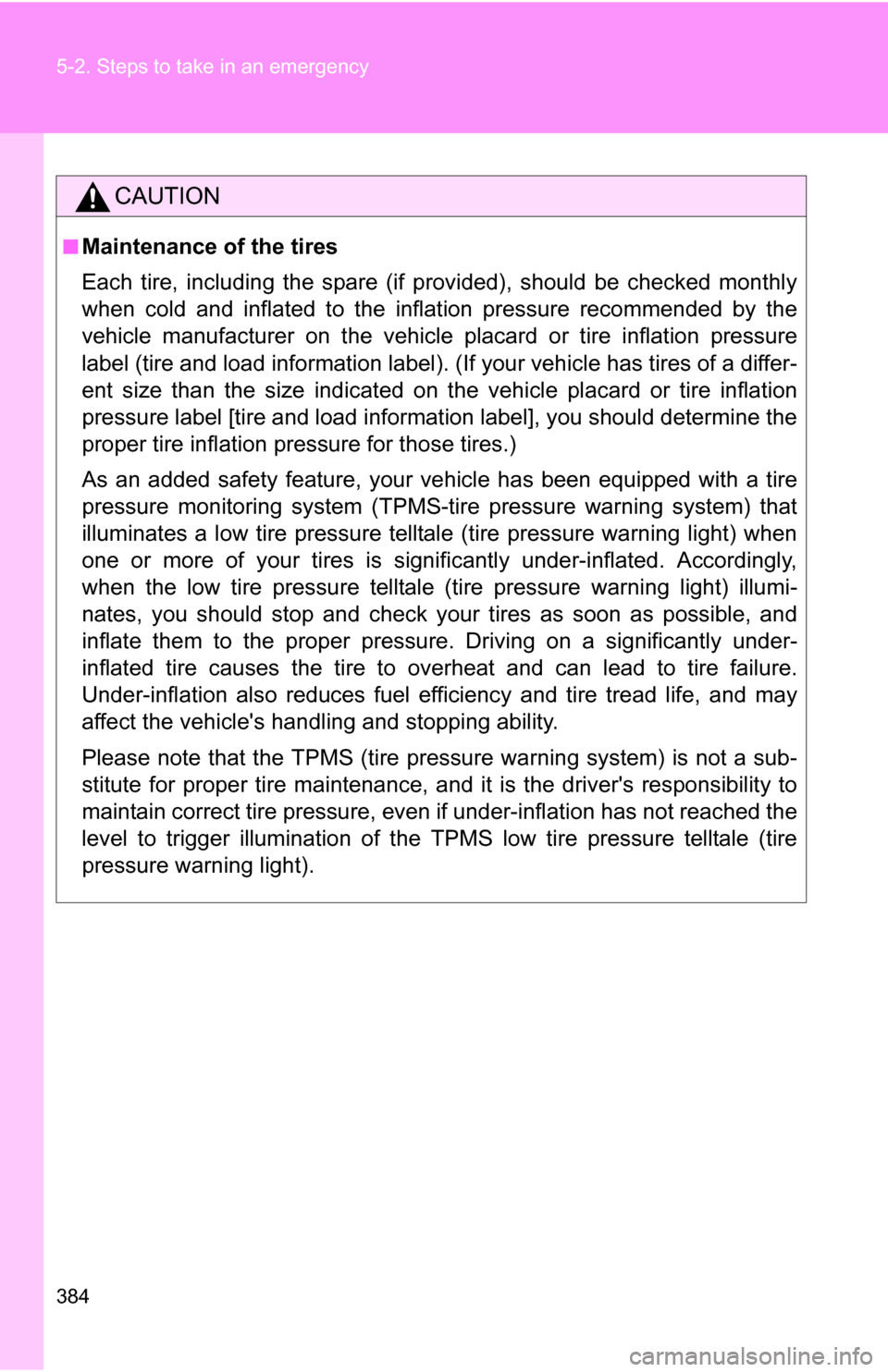
CAUTION
■Maintenance of the tires
Each tire, including the spare (if provided), should be checked monthly
when cold and inflated to the inflation pressure recommended by the
vehicle manufacturer on the vehicle placard or tire inflation pressure
label (tire and load information label). (If your vehicle has tires of a differ-
ent size than the size indicated on the vehicle placard or tire inflation
pressure label [tire and load information label], you should determine the
proper tire inflation pr essure for those tires.)
As an added safety feature, your vehicle has been equipped with a tire
pressure monitoring system (TPMS-ti re pressure warning system) that
illuminates a low tire pressure telltal e (tire pressure warning light) when
one or more of your tires is significantly under-inflated. Accordingly,
when the low tire pressu re telltale (tire pressure warning light) illumi-
nates, you should stop and check your tires as soon as possible, and
inflate them to the proper pressure. Driving on a significantly under-
inflated tire causes the tire to overheat and can lead to tire failure.
Under-inflation also reduces fuel effi ciency and tire tread life, and may
affect the vehicle's hand ling and stopping ability.
Please note that the TPMS (tire pressure warning system) is not a sub-
stitute for proper ti re maintenance, an d it is the driver's responsibility to
maintain correct tire pressure, even if under-inflation has not reached the
level to trigger illu mination of the TPMS low tire pressure telltale (tire
pressure warning light).
Page 415 of 468
Vehicle specifications6
415
6-1. Specifications................. 416Maintenance data (fuel, oil level, etc.) ......... 416
Fuel information ............... 428
Tire information ................ 431
6-2. Customization ................ 443 Customizable features ..... 443
6-3. Initialization .................... 447 Items to initialize .............. 447
Page 416 of 468
416
6-1. Specifications
Maintenance data (fuel, oil level, etc.)
Dimensions and weights
*1: Unladen vehicles
*2: P195/65R15 tires
*3: P205/55R16 and P215/45R17 tires
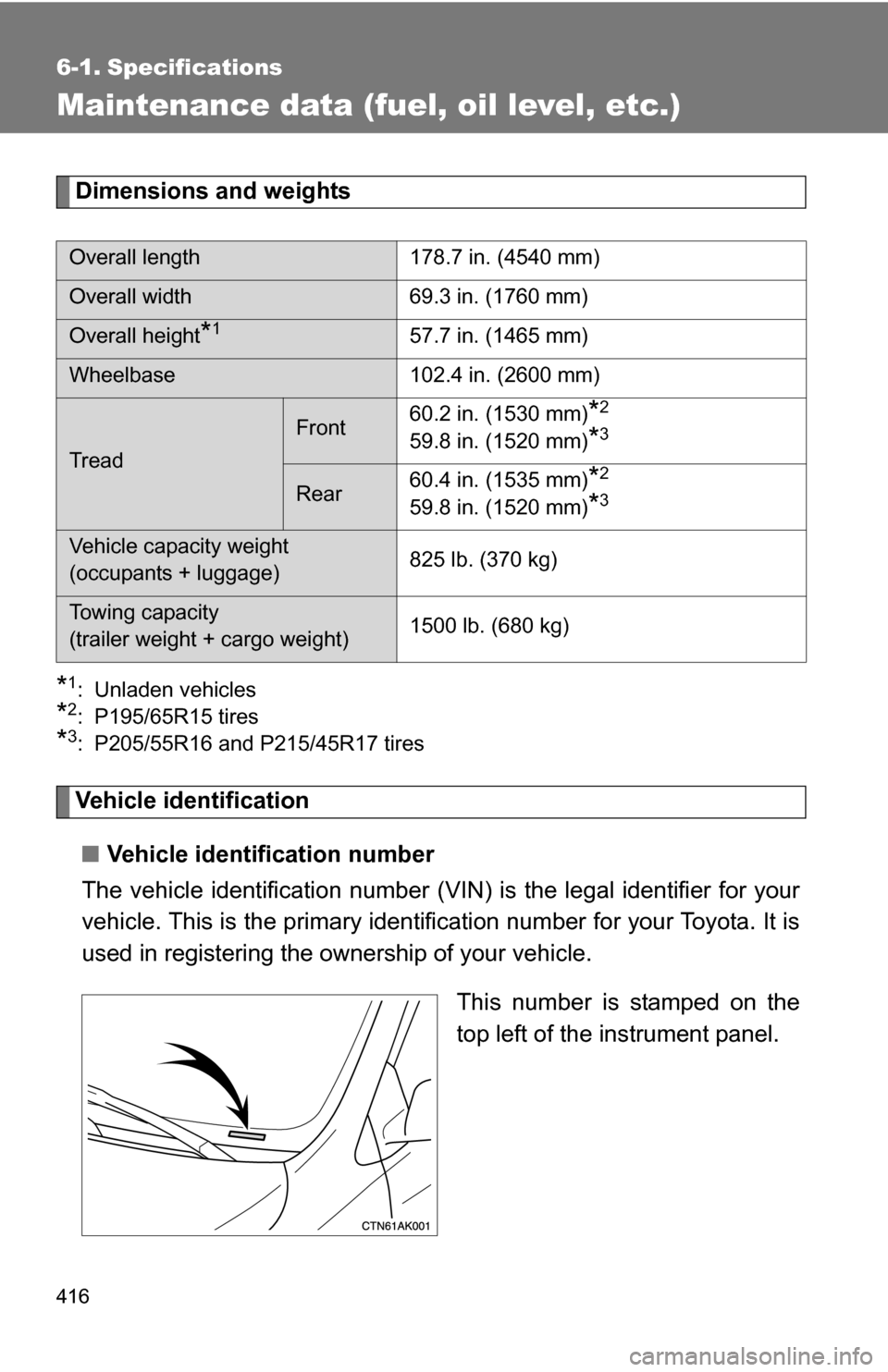
Vehicle identification■ Vehicle identification number
The vehicle identificati on number (VIN) is the legal identifier for your
vehicle. This is the primary identification number for your Toyota. It is
used in registering the ownership of your vehicle.
This number is stamped on the
top left of the instrument panel.
Overall length 178.7 in. (4540 mm)
Overall width69.3 in. (1760 mm)
Overall height*157.7 in. (1465 mm)
Wheelbase102.4 in. (2600 mm)
Tread
Front60.2 in. (1530 mm)*2
59.8 in. (1520 mm)*3
Rear60.4 in. (1535 mm)*2
59.8 in. (1520 mm)*3
Vehicle capacity weight
(occupants + luggage) 825 lb. (370 kg)
Towing capacity
(trailer weight + cargo weight)1500 lb. (680 kg)
Page 447 of 468
447
6
Vehicle specifications
6-3. Initialization
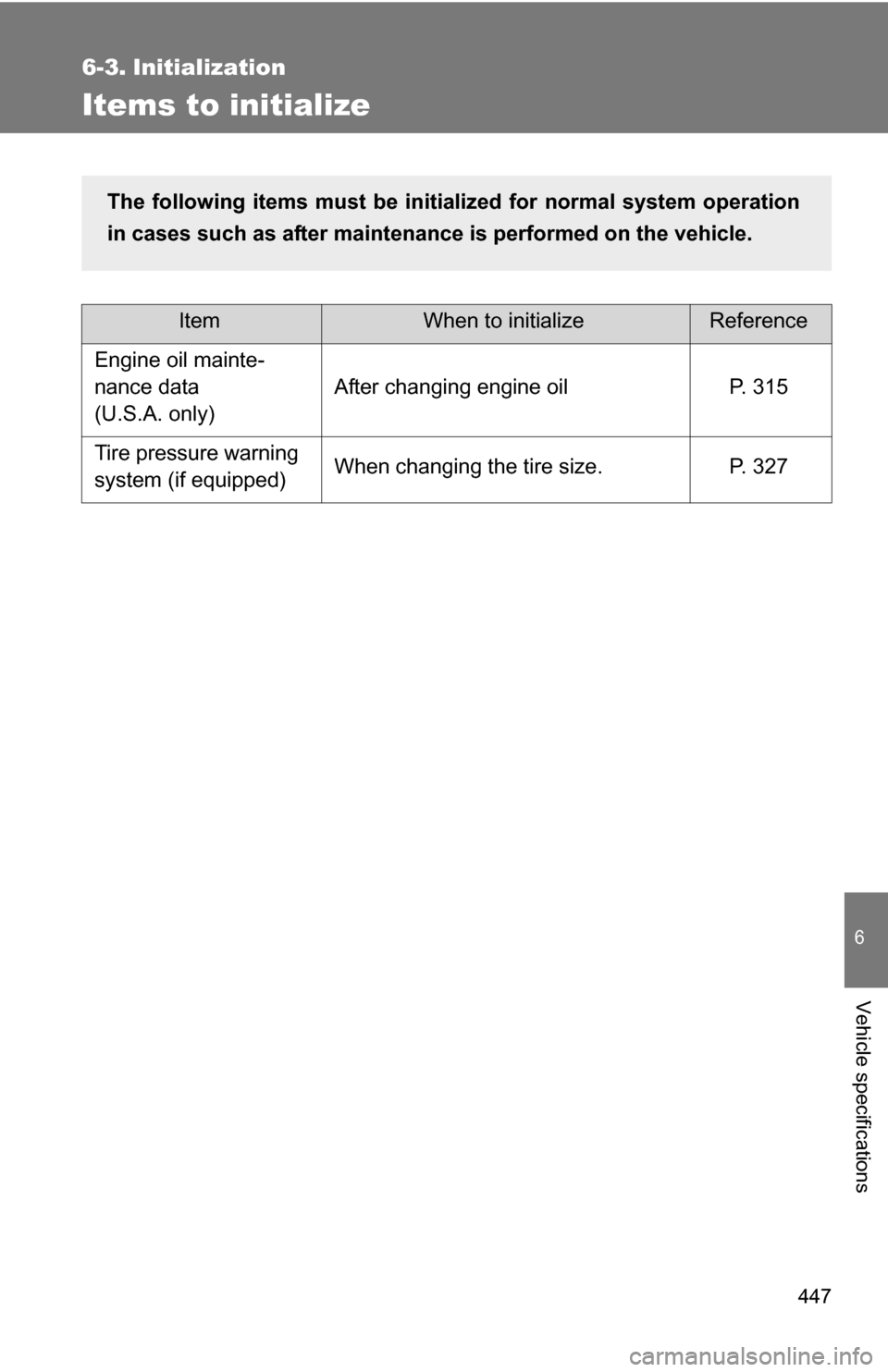
Items to initialize
ItemWhen to initializeReference
Engine oil mainte-
nance data
(U.S.A. only) After changing engine oil P. 315
Tire pressure warning
system (if equipped) When changing the tire size. P. 327
The following items must be initia
lized for normal system operation
in cases such as after maintenance is performed on the vehicle.
Page 456 of 468
456
Abbreviation list
Abbreviation/Acronym list
ABBREVIATIONSMEANING
A/C Air Conditioning
ABS Anti-lock Brake System
ACC Accessory
ALR Automatic Locking Retractor
CRS Child Restraint System
ECU Electronic Control Unit
EDR Event Data Recorder ELR Emergency Locking Retractor
EPS Electric Power Steering
GAWR Gross Axle Weight Rating
GVWR Gross Vehicle Weight Rating I/M Emission inspection and maintenance
LED Light Emitting Diode
MMT Methylcyclopentadienyl Manganese Tricarbonyl
M + S Mud and Snow
MTBE Methyl Tertiary Butyl Ether
OBD On Board DiagnosticsSRS Supplemental Restraint System TIN Tire Identification Number
TPMS Tire Pressure Warning System TRAC Traction Control VIN Vehicle Identification Number
VSC Vehicle Stability Control