Page 409 of 520
409
4-3. Do-it-yourself maintenance
4
Maintenance and care
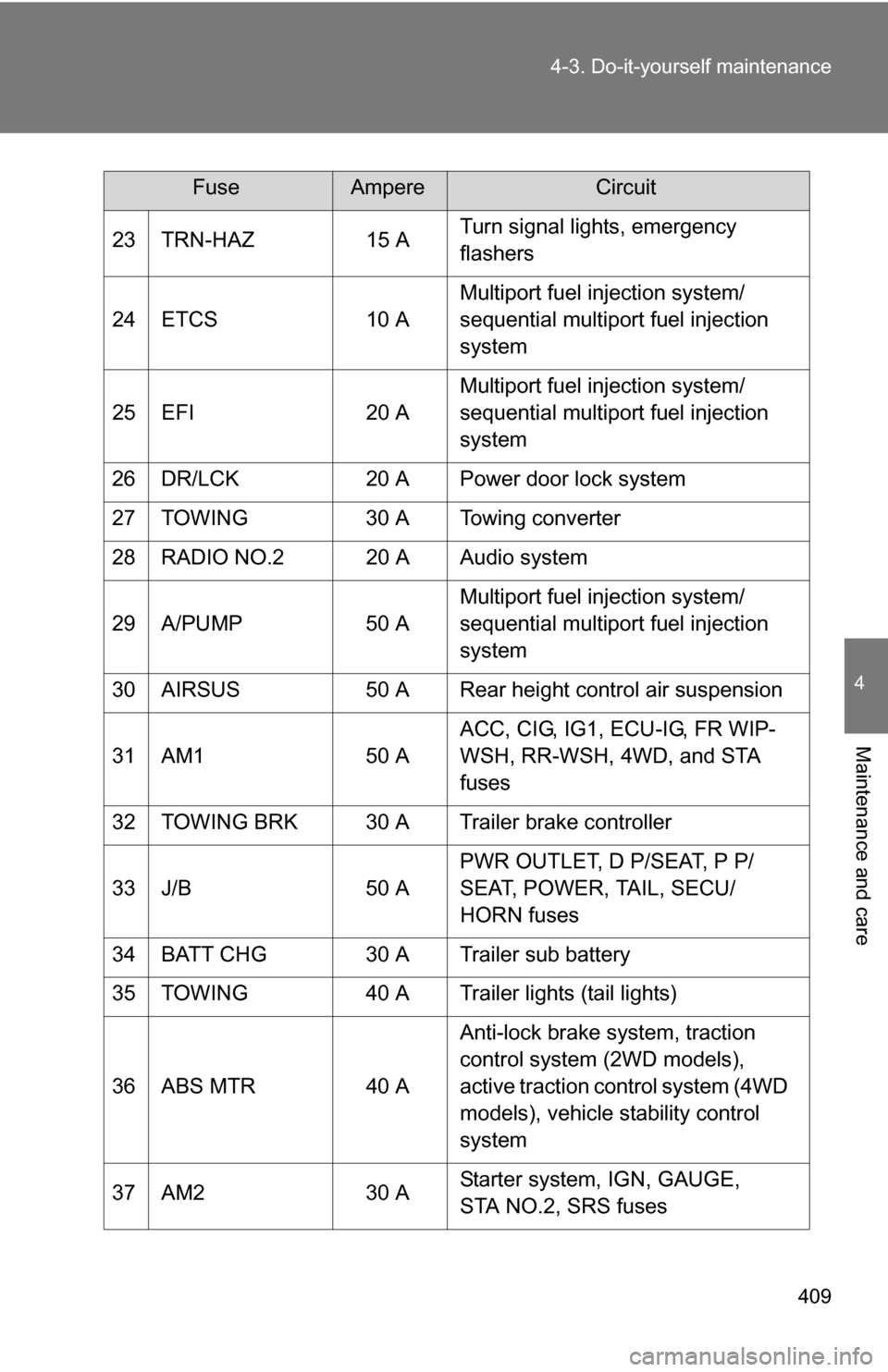
23 TRN-HAZ
15 ATurn signal lights, emergency
flashers
24 ETCS 10 AMultiport fuel injection system/
sequential multiport fuel injection
system
25 EFI 20 AMultiport fuel injection system/
sequential multiport fuel injection
system
26 DR/LCK 20 A Power door lock system
27 TOWING 30 A Towing converter
28 RADIO NO.2 20 A Audio system
29 A/PUMP 50 AMultiport fuel injection system/
sequential multiport fuel injection
system
30 AIRSUS 50 A Rear height control air suspension
31 AM1 50 AACC, CIG, IG1, ECU-IG, FR WIP-
WSH, RR-WSH, 4WD, and STA
fuses
32 TOWING BRK 30 A Trailer brake controller
33 J/B 50 APWR OUTLET, D P/SEAT, P P/
SEAT, POWER, TAIL, SECU/
HORN fuses
34 BATT CHG 30 A Trailer sub battery
35 TOWING 40 A Trailer lights (tail lights)
36 ABS MTR 40 AAnti-lock brake system, traction
control system (2WD models),
active traction control system (4WD
models), vehicle stability control
system
37 AM2 30 AStarter system, IGN, GAUGE,
STA NO.2, SRS fuses
FuseAmpereCircuit
Page 412 of 520

412 4-3. Do-it-yourself maintenance
10 RR WSH15 ABack window washer, multiplex
communication system
11 ECU-IG 10 AShift lock control system, power
windows, anti-lock brake system,
traction control system (2WD mod-
els), active traction control system
(4WD models), vehicle stability
control system, electric moon roof,
multiplex communication system,
theft deterrent system, rear height
control air suspension, tire pres-
sure warning system, driving posi-
tion memory system
12 IG1 15 AAnti-lock brake system, traction
control system (2WD models),
active traction control system (4WD
models), vehicle stability control
system, air conditioning system,
charging system, back window
defogger, back-up lights, emer-
gency flashers, seat heaters, AC
inverter, instrument panel light con-
trol, auto anti-glare inside rear view
mirror, seat belt tension reducer
13 STA 7.5 A No circuit
14 SECU/HORN 10 A Theft deterrent system
15 TAIL 10 ATail lights, license plate lights, park-
ing lights, instrument panel light
control, multiport fuel injection sys-
tem/sequential multiport fuel injec-
tion system, instrument panel
lights, meter and gauge, glove box
light
FuseAmpereCircuit
Page 423 of 520
423
4-3. Do-it-yourself maintenance
4
Maintenance and care
■
Lights other than the above
If any of the lights listed below has burnt out, have it replaced by
your Toyota dealer.
• Stop/tail and rear side marker lights
• High mounted stoplight (vehicles with rear spoiler)
■ Condensation build-up on th e inside of the lens
Contact your Toyota dealer for more information in the following situations.
Temporary condensation build-up on the inside of the headlight lens does
not indicate a malfunction.
● Large drops of water are built up on the inside of the lens.
● Water has built up inside the headlight.
■ LED lights
The stop/tail and rear side marker lights, and high mounted stoplight (vehi-
cles with the rear spoiler) consist of a number of LEDs. If any of the LEDs
burn out, take your vehicle to your Toyota dealer to have the light replaced.
If two or more LEDs in a stop light burn out, your vehicle may not conform to
local laws (SAE).
CAUTION
■Replacing light bulbs
●Turn off the headlights. Do not attempt to replace the bulb immediately
after turning off the headlights.
The bulbs become very hot and may cause burns.
● Halogen bulbs have pressurized gas inside and require special handling.
Do not touch the glass portion of the light bulb with bare hands. Hold the
bulb by the plastic or metal portion.
If the bulb is scratched or dropped it may blow out or crack.
● Fully install light bulbs and any parts used to secure them. Failing to do so
may result in heat damage, fire, or water entering the headlight unit. This
may damage the headlights or cause condensation to build up on the lens.
■ To prevent damage or fire
Make sure bulbs are fully seated and locked.
Page 427 of 520
5
When trouble arises
427
5-1. Essential information
If your vehicle needs to be towed
Before towingThe following may indicate a problem with your transmission. Contact
your Toyota dealer before towing.
● The engine is running, but the vehicle will not move.
● The vehicle makes an abnormal sound.
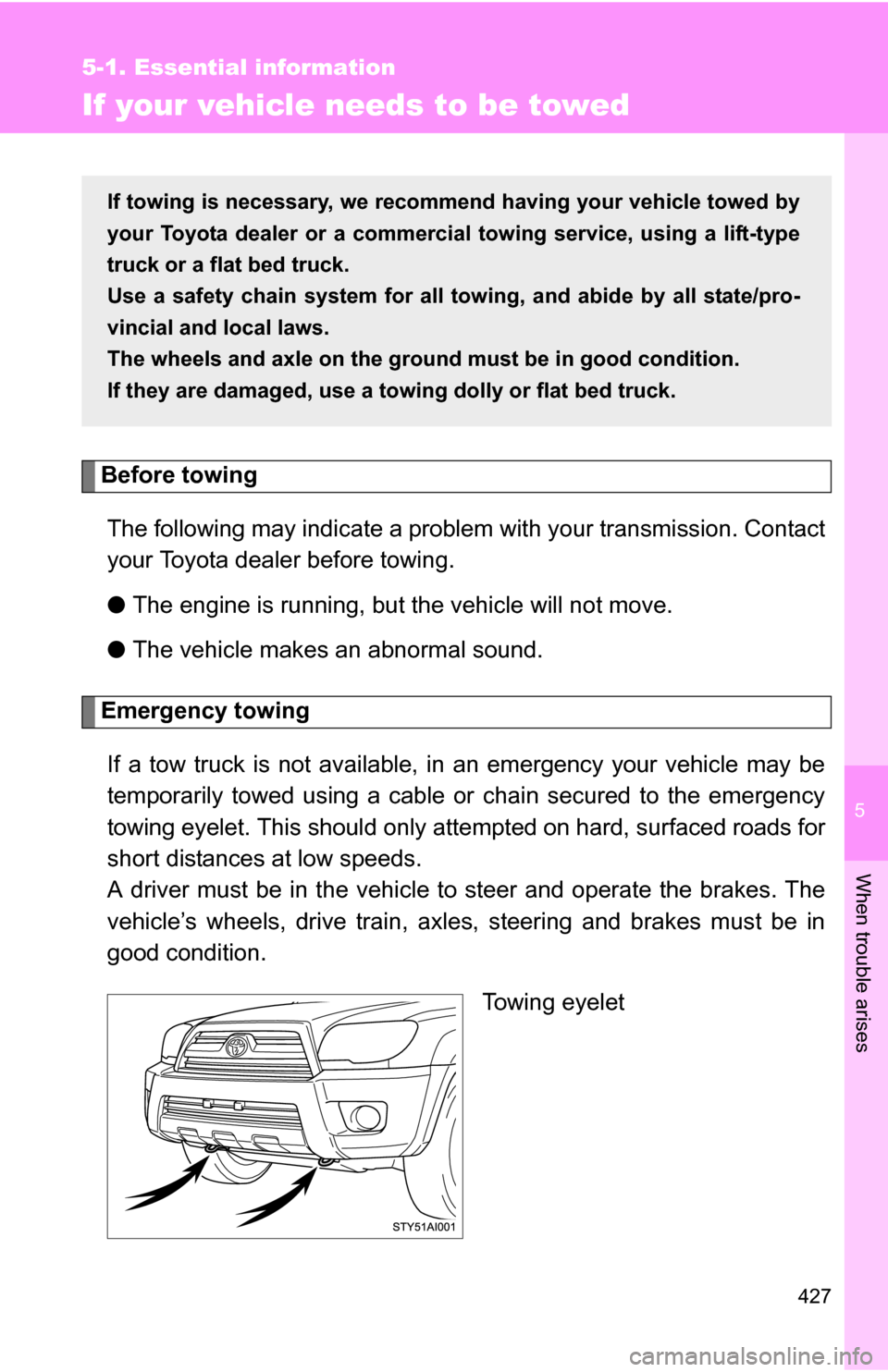
Emergency towing
If a tow truck is not available, in an emergency your vehicle may be
temporarily towed using a cable or chain secured to the emergency
towing eyelet. This should only attempted on hard, surfaced roads for
short distances at low speeds.
A driver must be in the vehicle to steer and operate the brakes. The
vehicle’s wheels, drive train, axles, steering and brakes must be in
good condition.
Towing eyelet
If towing is necessary, we recommend having your vehicle towed by
your Toyota dealer or a commerci al towing service, using a lift-type
truck or a flat bed truck.
Use a safety chain system for all to wing, and abide by all state/pro-
vincial and local laws.
The wheels and axle on the groun d must be in good condition.
If they are damaged, use a towing dolly or flat bed truck.
Page 428 of 520
428 5-1. Essential information
■Emergency towin g procedure
The engine switch must be in the ACC (engine off) or the ON
(engine running) position.
4WD models:
On multi-mode 4WD models, put the four-wheel drive control switch
in H2.
On full-time 4WD models, unlock the center differential.
Put the shift lever in N.
Release the parking brake.
CAUTION
■ Caution while towing
●Use extreme caution when towing the vehicle.
Avoid sudden starts or erratic driving maneuvers which place excessive
stress on the emergency towing eyelet and the cables or chains.
● If the engine is not running, the power assist for the brakes and steering
will not function, making steering and braking more difficult.
NOTICE
■To prevent causing serious damage to the transmission
Never tow this vehicle from the rear with the four wheels on the ground.
This may cause serious damage to the transmission.
■ Emergency towing eyelet precautions
● Before emergency towing, check that the eyelet is not broken or damaged.
● Fasten the towing cable or chain securely to the eyelet.
● Do not jerk the eyelet. Apply steady and even force.
● To avoid damaging the eyelet, do not pull from the side or at a vertical
angle. Always pull straight ahead.
Page 441 of 520

5
When trouble arises
441
5-2. Steps to take in an emergency
■
Key reminder buzzer
The buzzer indicates that the key has not been removed (with the engine
switch in the ACC or LOCK position and the driver’s door opened).
■ If the malfunction indicator lamp comes on while driving
First check the following:
● Is your vehicle low on gas?
If it is, refuel the vehicle immediately.
● Is the fuel tank cap loose?
If it is, tighten it securely.
The light will go off after taking several driving trips.
If the light does not go off even after several trips, contact your Toyota dealer
as soon as possible.
■ Front passenger detection sensor and passenger seat belt reminder
If luggage or other load is placed on the front passenger seat, depending on
its weight, the reminder light to flash and buzzer to sound.
■
When the tire pressure warning light comes on
Check the tire inflation pressure and adjust to the appropriate level.
■The tire pressure warning light may turn on due to natural causes
The tire pressure warning light may turn on due to natural causes such
as natural air leaks or tire inflation pressure changes caused by temper-
ature. In this case, adjusting the ti re inflation pressure will turn off the
warning light (after a few minutes).
■When a tire is replaced with a spare tire
The spare tire is also equipped with the tire pressure warning valve and
transmitter. The tire pressure warning li ght will turn on if the tire inflation
pressure of the spare tire is low. If a tire goes flat, even though the flat
tire is replaced with the spare tire, the tire pressure warning light does
not turn off. Replace the spare tire with the repaired tire and adjust the
proper tire inflation pressure. The ti re pressure warning light will turn off
after a few minutes.
Page 446 of 520
446 5-2. Steps to take in an emergency
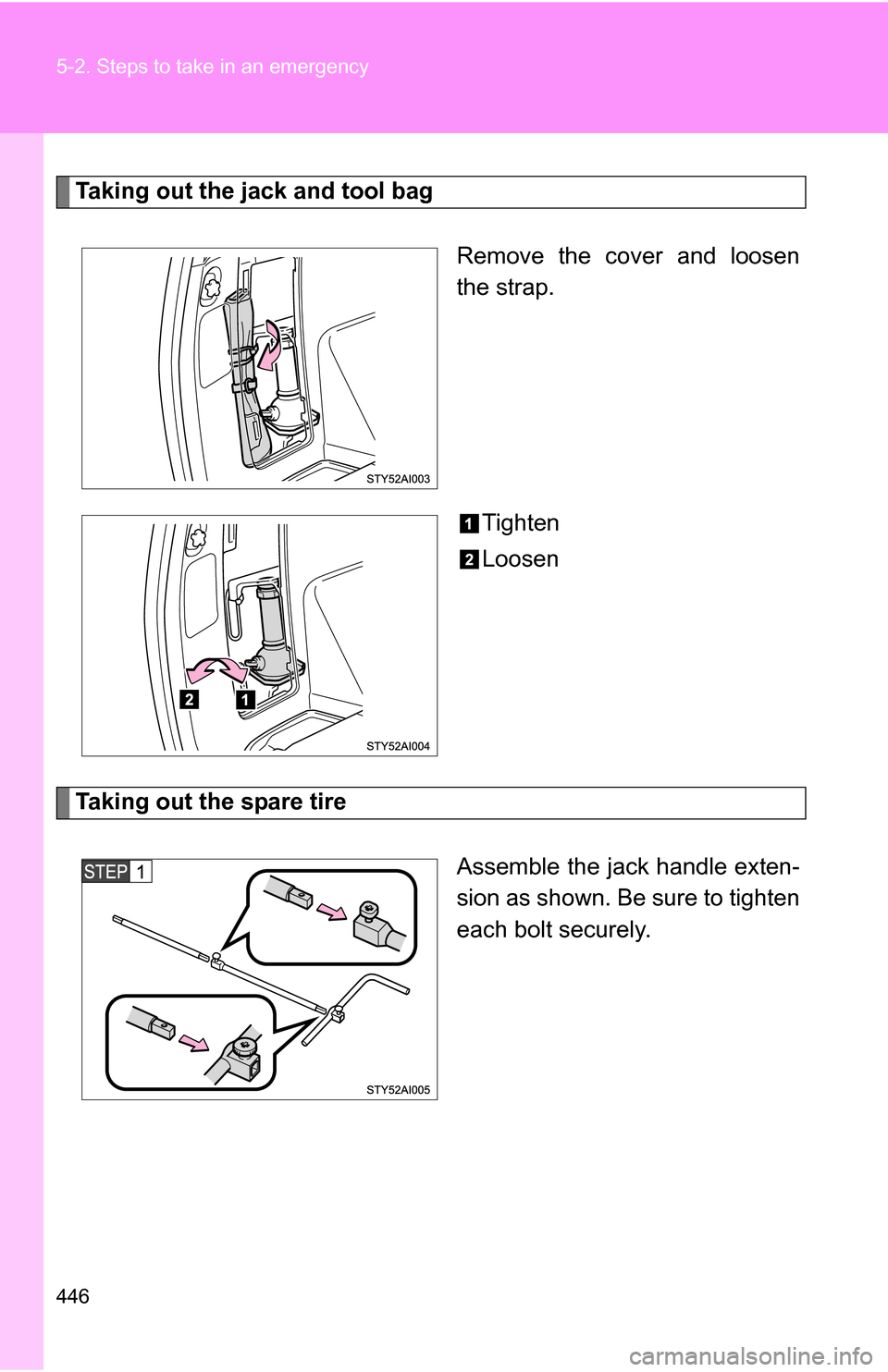
Taking out the jack and tool bagRemove the cover and loosen
the strap.
Tighten
Loosen
Taking out the spare tire Assemble the jack handle exten-
sion as shown. Be sure to tighten
each bolt securely.
Page 450 of 520
450 5-2. Steps to take in an emergency
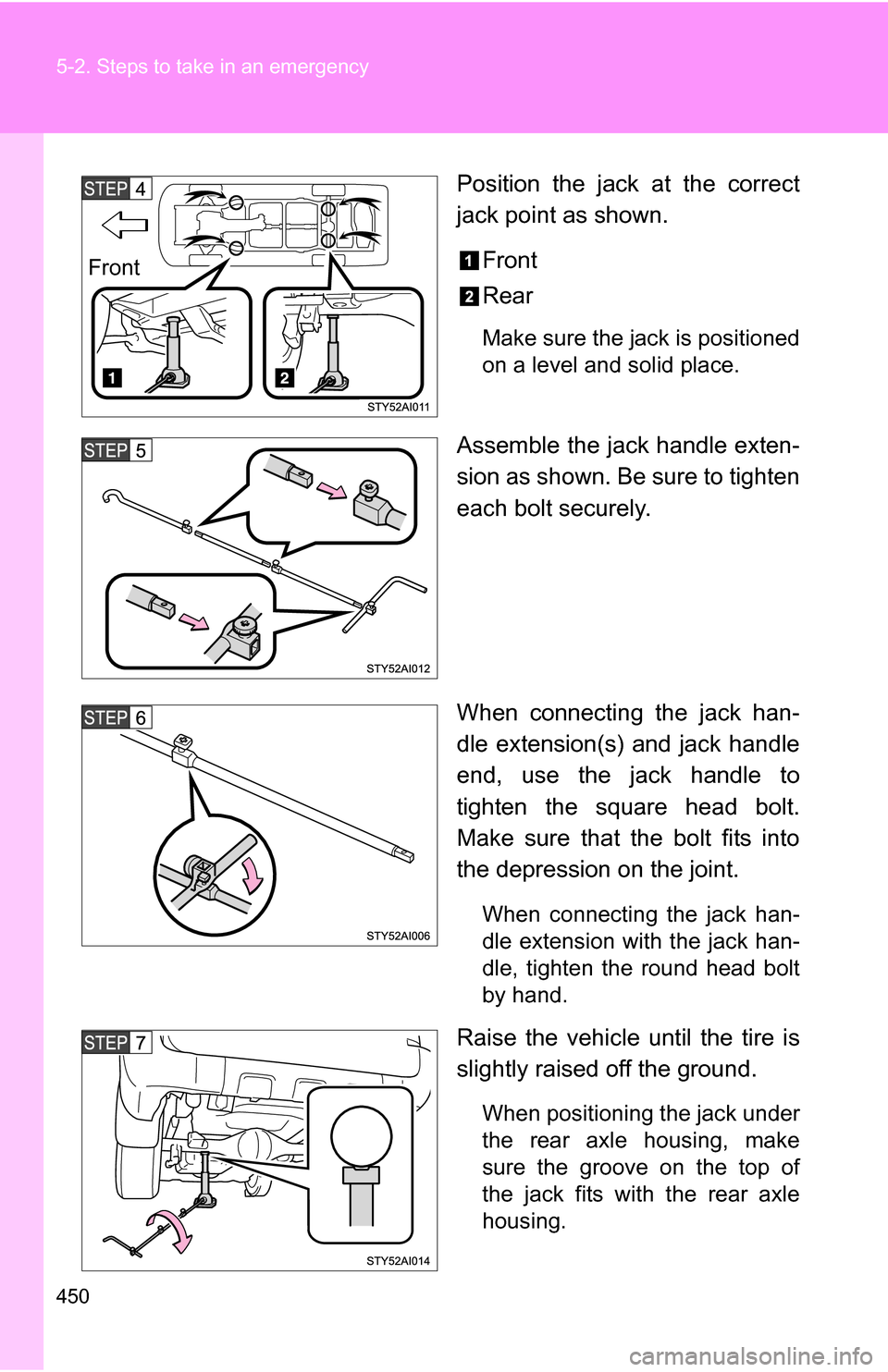
Position the jack at the correct
jack point as shown.Front
Rear
Make sure the jack is positioned
on a level and solid place.
Assemble the jack handle exten-
sion as shown. Be sure to tighten
each bolt securely.
When connecting the jack han-
dle extension(s) and jack handle
end, use the jack handle to
tighten the square head bolt.
Make sure that the bolt fits into
the depression on the joint.
When connecting the jack han-
dle extension with the jack han-
dle, tighten the round head bolt
by hand.
Raise the vehicle until the tire is
slightly raised off the ground.
When positioning the jack under
the rear axle housing, make
sure the groove on the top of
the jack fits with the rear axle
housing.
Front