2009 SUBARU FORESTER manual transmission
[x] Cancel search: manual transmissionPage 275 of 384

9-4In case of emergency
1) Spare fuse
2) FWD connector
3. Put a spare fuse inside the FWD
connector located in the cabin and confirm
that the All-Wheel Drive warning light“
” illuminates. The All-Wheel-Drive
capability of the vehicle has now been deactivated. NOTE
After reinstalling the conventional tire,
remove the spare fuse from the FWD
connector in order to reactivate All-
Wheel Drive. Make sure to restore the
removed spare fuse in the spare fuse
holder located in the engine compart-ment. Flat tires
If you have a flat tire while driving, never
brake suddenly; keep driving straight
ahead while gradually reducing speed.
Then slowly pull off the road to a safeplace. &
Changing a flat tire
WARNING
. Do not jack up the vehicle on an
incline or a loose road surface.
The jack can come out of the
jacking point or sink into the
ground and this can result in a
severe accident.
. Use only the jack provided with
your vehicle. The jack supplied
with the vehicle is designed only
for changing a tire. Never get
under the vehicle while support-
ing the vehicle with this jack. .
Always turn off the engine before
raising the flat tire off the ground
using the jack. Never swing or
push the vehicle supported with
the jack. The jack can come out
of the jacking point due to a jolt
and this can result in a severeaccident.
1. Park on a hard, level surface, when-
ever possible, then stop the engine.
2. Set the parking brake securely and
shift a manual transmission vehicle in
reverse or an automatic transmission
vehicle in the “P ”(Park) position.
3. Turn on the hazard warning flasher
and have everyone get out of the vehicle.
4. Put wheel blocks at the front and rear
of the tire diagonally opposite the flat tire.
Page 286 of 384
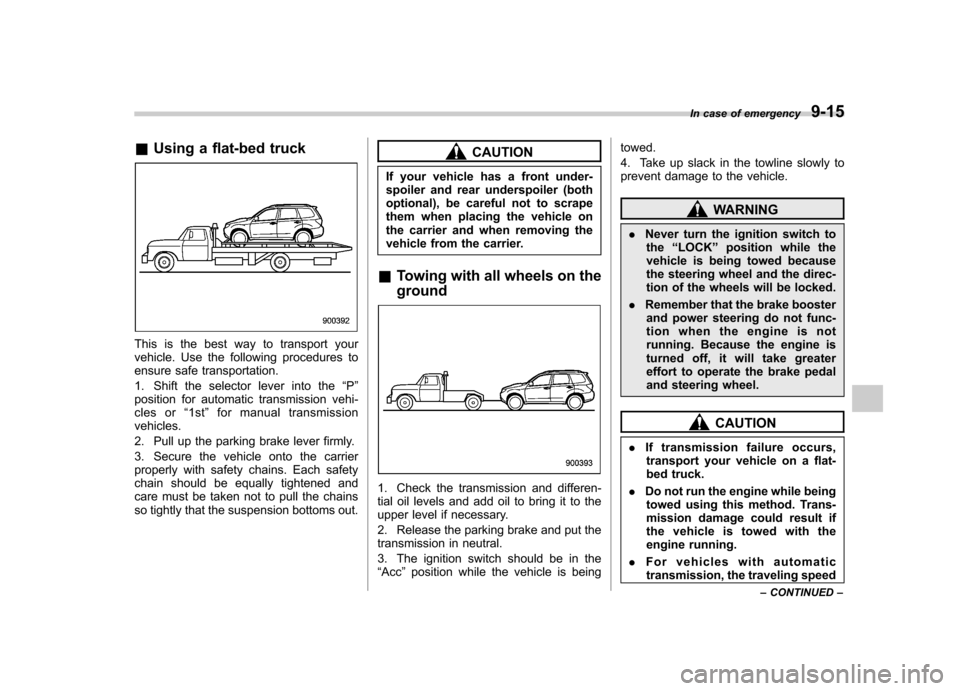
&Using a flat-bed truck
This is the best way to transport your
vehicle. Use the following procedures to
ensure safe transportation.
1. Shift the selector lever into the “P ”
position for automatic transmission vehi-
cles or “1st ”for manual transmission
vehicles.
2. Pull up the parking brake lever firmly.
3. Secure the vehicle onto the carrier
properly with safety chains. Each safety
chain should be equally tightened and
care must be taken not to pull the chains
so tightly that the suspension bottoms out.
CAUTION
If your vehicle has a front under-
spoiler and rear underspoiler (both
optional), be careful not to scrape
them when placing the vehicle on
the carrier and when removing the
vehicle from the carrier.
& Towing with all wheels on the ground
1. Check the transmission and differen-
tial oil levels and add oil to bring it to the
upper level if necessary.
2. Release the parking brake and put the
transmission in neutral.
3. The ignition switch should be in the “Acc ”position while the vehicle is being towed.
4. Take up slack in the towline slowly to
prevent damage to the vehicle.
WARNING
. Never turn the ignition switch to
the “LOCK ”position while the
vehicle is being towed because
the steering wheel and the direc-
tion of the wheels will be locked.
. Remember that the brake booster
and power steering do not func-
tion when the engine is not
running. Because the engine is
turned off, it will take greater
effort to operate the brake pedal
and steering wheel.
CAUTION
. If transmission failure occurs,
transport your vehicle on a flat-
bed truck.
. Do not run the engine while being
towed using this method. Trans-
mission damage could result if
the vehicle is towed with the
engine running.
. For vehicles with automatic
transmission, the traveling speed In case of emergency
9-15
– CONTINUED –
Page 296 of 384

Maintenance schedule....................................... 11-3
Maintenance precautions ................................... 11-3
Before checking or servicing in the engine compartment .................................................... 11-4
When you do checking or servicing in the engine compartment while the engine is running .......... 11-4
Engine hood ....................................................... 11-5
Engine compartment overview .......................... 11-6
Non-turbo models .............................................. 11-6
Turbo models ..................................................... 11-7
Engine oil ............................................................ 11-8
Checking the oil level ......................................... 11-8
Changing the oil and oil filter .............................. 11-9
Recommended grade and viscosity .................. 11-11
Recommended grade and viscosity under severe driving conditions .......................................... 11-12
Synthetic oil ..................................................... 11-12
Cooling system ................................................ 11-12
Cooling fan, hose and connections ................... 11-12
Engine coolant ................................................. 11-13
Air cleaner element .......................................... 11-15
Replacing the air cleaner element ..................... 11-16
Spark plugs ...................................................... 11-18
Recommended spark plugs .............................. 11-18
Drive belts ........................................................ 11-18
Manual transmission oil .................................. 11-19
Checking the oil level ....................................... 11-19
Recommended grade and viscosity .................. 11-20
Automatic transmission fluid .......................... 11-20
Checking the fluid level .................................... 11-20 Recommended fluid
......................................... 11-21
Front differential gear oil (AT vehicles) .......... 11-21
Checking the oil level ...................................... 11-21
Recommended grade and viscosity .................. 11-22
Rear differential gear oil .................................. 11-22
Checking the gear oil level ............................... 11-22
Recommended grade and viscosity .................. 11-23
Power steering fluid ........................................ 11-24
Checking the fluid level .................................... 11-24
Recommended fluid ......................................... 11-25
Brake fluid ........................................................ 11-25
Checking the fluid level .................................... 11-25
Recommended brake fluid ............................... 11-26
Clutch fluid (MT vehicles) ............................... 11-26
Checking the fluid level .................................... 11-26
Recommended clutch fluid ............................... 11-27
Brake booster .................................................. 11-27
Brake pedal ...................................................... 11-28
Checking the brake pedal free play .................. 11-28
Checking the brake pedal reserve distance....... 11-28
Clutch pedal (MT vehicles) .............................. 11-28
Checking the clutch function ............................ 11-28
Checking the clutch pedal free play .................. 11-29
Hill start assist system (MT vehicles) ............ 11-29
Replacement of brake pad and lining ............ 11-29
Breaking-in of new brake pads and linings ....... 11-30
Parking brake stroke ....................................... 11-30
Tires and wheels .............................................. 11-31
Types of tires ................................................... 11-31
Maintenance and service
11
Page 301 of 384
11-6Maintenance and service
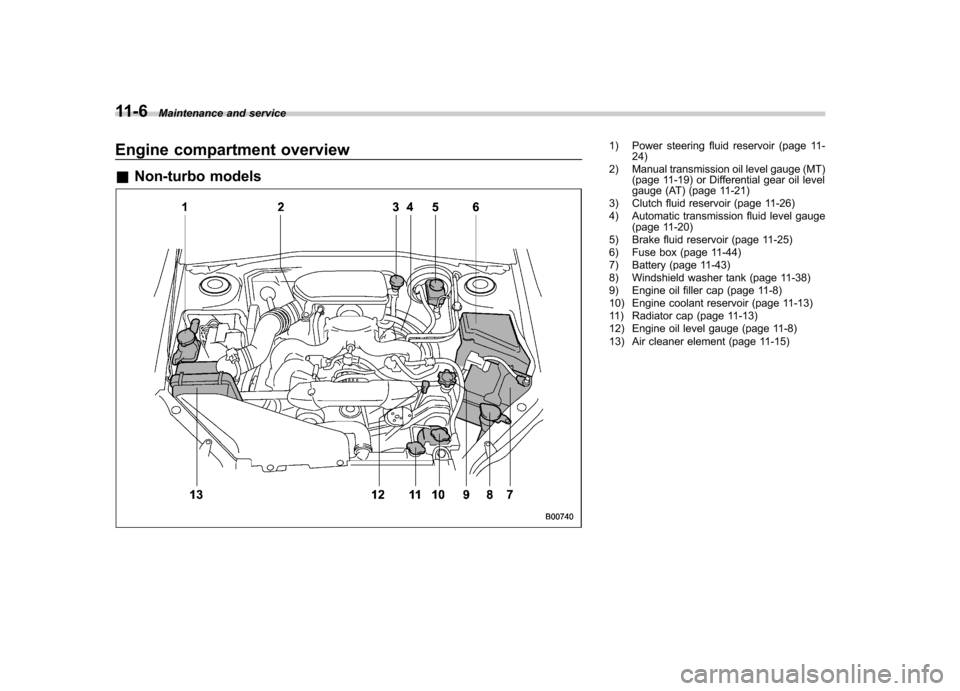
Engine compartment overview &Non-turbo models1) Power steering fluid reservoir (page 11-
24)
2) Manual transmission oil level gauge (MT) (page 11-19) or Differential gear oil level
gauge (AT) (page 11-21)
3) Clutch fluid reservoir (page 11-26)
4) Automatic transmission fluid level gauge (page 11-20)
5) Brake fluid reservoir (page 11-25)
6) Fuse box (page 11-44)
7) Battery (page 11-43)
8) Windshield washer tank (page 11-38)
9) Engine oil filler cap (page 11-8)
10) Engine coolant reservoir (page 11-13)
11) Radiator cap (page 11-13)
12) Engine oil level gauge (page 11-8)
13) Air cleaner element (page 11-15)
Page 302 of 384
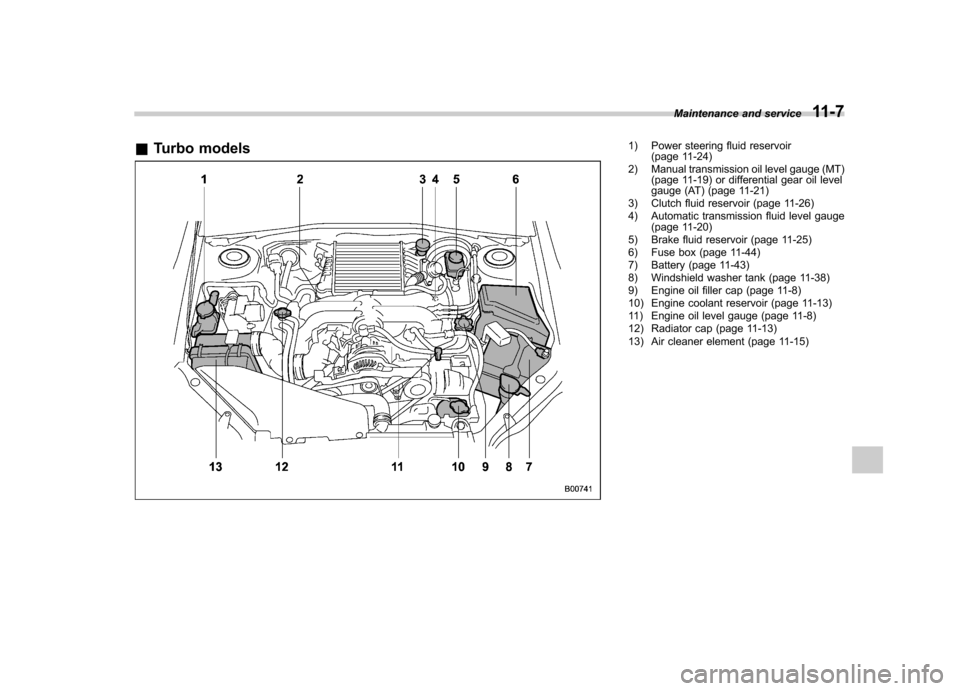
&Turbo models1) Power steering fluid reservoir
(page 11-24)
2) Manual transmission oil level gauge (MT) (page 11-19) or differential gear oil level
gauge (AT) (page 11-21)
3) Clutch fluid reservoir (page 11-26)
4) Automatic transmission fluid level gauge (page 11-20)
5) Brake fluid reservoir (page 11-25)
6) Fuse box (page 11-44)
7) Battery (page 11-43)
8) Windshield washer tank (page 11-38)
9) Engine oil filler cap (page 11-8)
10) Engine coolant reservoir (page 11-13)
11) Engine oil level gauge (page 11-8)
12) Radiator cap (page 11-13)
13) Air cleaner element (page 11-15) Maintenance and service
11-7
Page 314 of 384
using a spring scale. Belt deflection
should be the amount specified. If the
front side belt is loose, cracked, or worn,
contact your SUBARU dealer.in (mm)
Deflection
New belt Used belt
A 0.28
–0.35
(7.0 –9.0) 0.35
–0.43
(9.0 –11.0)
The rear side belt is a stretch-type belt,
and the deflection and tension do not
need to be checked. If there are cracks or
wear confirmed on the belts and a
squeaking sound is heard from them,
contact your SUBARU dealer. Manual transmission oil &
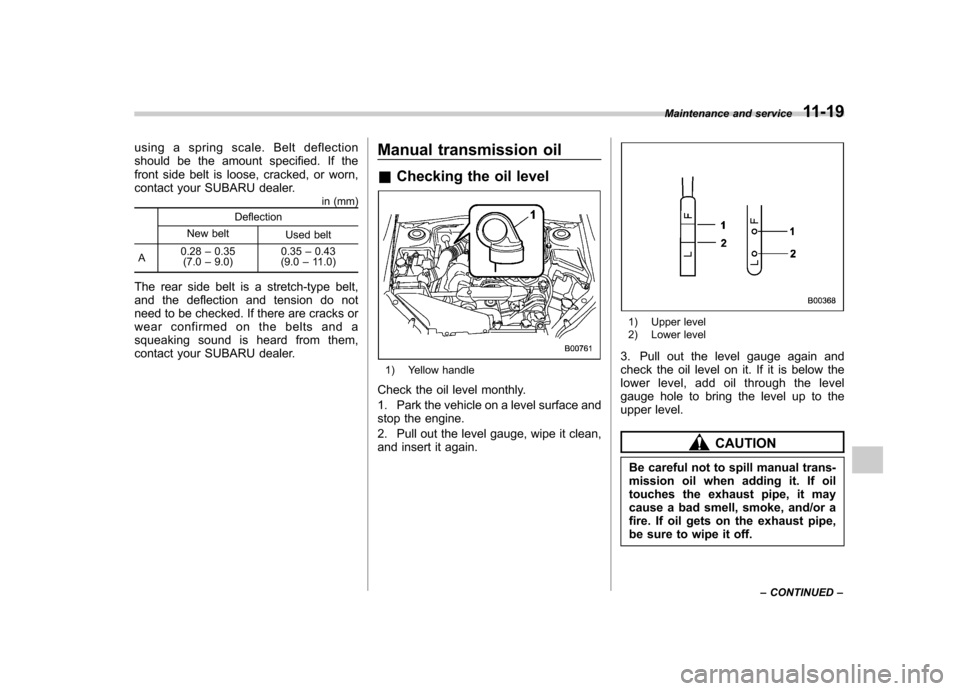
Checking the oil level
1) Yellow handle
Check the oil level monthly.
1. Park the vehicle on a level surface and
stop the engine.
2. Pull out the level gauge, wipe it clean,
and insert it again.
1) Upper level
2) Lower level
3. Pull out the level gauge again and
check the oil level on it. If it is below the
lower level, add oil through the level
gauge hole to bring the level up to the
upper level.
CAUTION
Be careful not to spill manual trans-
mission oil when adding it. If oil
touches the exhaust pipe, it may
cause a bad smell, smoke, and/or a
fire. If oil gets on the exhaust pipe,
be sure to wipe it off. Maintenance and service
11-19
– CONTINUED –
Page 349 of 384

12-2Specifications
Specifications
These specifications are subject to change without notice. &Dimensions
in (mm)
Item 2.5-liter non-turbo 2.5-liter turbo
2.5X 2.5X Premium 2.5X Touring 2.5X
LLBean 2.5X
Limited 2.5XT2.5XT
Limited
Drive system AWD
Transmission type AT MT AT MT AT MT AT AT AT AT
Overall length 179.5 (4,560)
Overall width 70.1 (1,780)
Overall height without roof rail 65.9 (1,675)
with roof rail 66.9 (1,700)
Wheel base 103.0 (2,615)
Tread Front 60.2 (1,530)
Rear 60.2 (1,530)
Ground clearance*
18.7 (220) 8.9 (225)
*1: Measured with vehicle empty
AT: Automatic transmission
MT: Manual transmission
Page 350 of 384

&Engine
Engine model EJ253
(2.5-liter, SOHC, non-turbo) EJ255
(2.5-liter, DOHC, turbo)
Engine type Horizontally opposed, liquid cooled 4 cylinder, 4-stroke gasoline engine
Displacement cc (cu-in) 2,457 (150)
Bore 6Stroke in (mm) 3.963.1 (99.5 679.0)
Compression ratio 10.0 : 18.4 : 1
Firing order 1
–3–2 –4
& Electrical system
Battery type and capacity (5HR) MT 12V-48AH (55D23L)
AT 12V-52AH (75D23L)
Alternator Non-turbo models 12V-90A
Turbo models 12V-110A
Spark plugs Non-turbo engine
FR5AP-11 (NGK)
Turbo engine SILFR6A (NGK)
AT: Automatic transmission
MT: Manual transmission Specifications
12-3
– CONTINUED –