2009 SKODA ROOMSTER Light
[x] Cancel search: LightPage 197 of 263
Inspecting and replenishing 196“Quick-charging” a battery is dangerous ⇒ in “Working on the battery” on
page 192. It requires a special charger and appropriate knowledge. We therefore
recommend that you have your battery quick-charged only by your specialist
garage.
A discharged battery may already freeze at temperatures just below 0°C ⇒. We
recommend that you no longer use a battery which has thawed out because the
casing of the battery may be cracked through the formation of ice and this would
allow battery electrolyte to flow out.
The vent plugs of the battery should not be opened for charging.
WARNING
Never charge a frozen or thawed battery - risk of explosion and caustic
burns! Replace a frozen battery.Disconnecting and reconnecting the batteryOn disconnecting and reconnecting the battery the following functions are initially
deactivated or are no longer able to operate fault-free.
We recommend having the vehicle checked by a specialist garage to ensure full
functionality of all electrical systems.
Replacing the batteryYou should only replace a battery with a new battery of the same capacity, voltage
(12 V), amperage and of the same size. Specialist garages have a range of suitable
batteries available.
We re c o m m e nd t h a t y o u o n l y ha v e a n o l d b a t te r y d i s p o s e d o f b y a s p e c i a l i s t g a ra g e
since it does require special disposal.
For the sake of the environment
Batteries contain poisonous substances such as sulphuric acid and lead. They must
be disposed of in accordance with local environmental protection regulations and
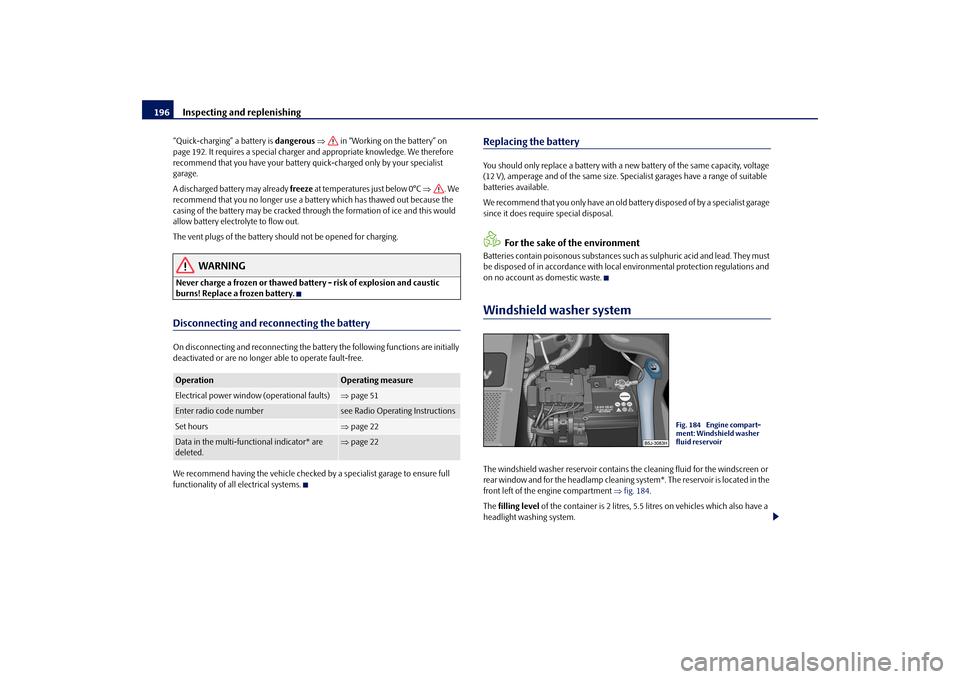
on no account as domestic waste.Windshield washer systemThe windshield washer reservoir contains the cleaning fluid for the windscreen or
rear window and for the headlamp cleaning system*. The reservoir is located in the
front left of the engine compartment ⇒fig. 184.
The filling level of the container is 2 litres, 5.5 litres on vehicles which also have a
headlight washing system.
Operation
Operating measure
Electrical power window (operational faults)
⇒page 51
Enter radio code number
see Radio Operating Instructions
Set hours
⇒page 22
Data in the multi-functional indicator* are
deleted.
⇒page 22
Fig. 184 Engine compart-
ment: Windshield washer
fluid reservoir
s29g.4.book Page 196 Wednesday, June 17, 2009 9:54 AM
Page 198 of 263

Inspecting and replenishing197
Using the system
Safety
Driving Tips
General Maintenance
Breakdown assistance
Praktik
Technical Data Clear water is not sufficient to intensively clean the windscreen and headlights. We
therefore recommend using clean washing water together with the screen cleaner
from Škoda genuine accessories (in winter additionally with antifreeze) which is
capable of removing stubborn dirt. Follow the instructions for use on the packaging
when using screen cleaning products.
You should always add antifreeze to the cleaning water in winter even if your
vehicle is fitted with heated windscreen washer nozzles*.
It is also possible in exceptional cases to use methylated spirits when no screen
cleaner with antifreeze is available. The concentration of methylated spirits must
not be more than 15 %. Please note, however, that the antifreeze protection at this
concentration is only adequate down to -5°C.
WARNING
Read and observe the warning notes ⇒page 185, “Working in the engine
compartment” before working in the engine compartment.
Caution
•
On no account should you add radiator antifreeze or other additives to the
windscreen washer fluid.
•
If the vehicle is fitted with headlight cleaning system, you should only add
cleaning products which do not attack the polycarbonate coating of the headlights
to the windscreen washer fluid. Please contact your specialist garage, who will tell
you which cleaning agent you can use.Note
Do not take the filter out of the windscreen wash container when filling it up again
with liquid otherwise dirt can get into the liquid transportation system and can lead
to faults in operation of the windscreen wash system.
s29g.4.book Page 197 Wednesday, June 17, 2009 9:54 AM
Page 202 of 263

Wheels and Tyres201
Using the system
Safety
Driving Tips
General Maintenance
Breakdown assistance
Praktik
Technical Data The date of manufacture is also stated on the tyre wall (possibly only on the inside
of wheel).
DOT ... 22 09...
means, for example, that the tyre was manufactured in the 22nd week of the year
2009.
Any spare wheel which differs from the tyres fitted to the vehicle (e.g. winter tyres
or low-profile tyres) should only be used for a short time in the event of a puncture
and when adopting an appropriately cautious style of driving. It should be replaced
as quickly as possible by a normal wheel.
WARNING
•
Only use those tyres or wheel rims which have been approved for your
model of Škoda Auto vehicle. Failure to observe this instruction will
adversely affect the road safety of your vehicle - risk of accident! Approval
and licencing of your vehicle on public roads may also become void as a
result.
•
You must on no account drive at a higher speed than is permissible for
your tyres - risk of an accident resulting from tyre damage and loss of control
over your vehicle.
•
Tyres which are 6 years old or more should only be fitted in exceptional
cases and when adopting an appropriately cautious style of driving.
•
Never fit tyres which have already been used without having adequate
knowledge of their previous history. Tyres age even if they have not been
used at all or only very little. A spare tyre must only be used in exceptional
cases and only then when adopting an appropriately cautious style of
driving.
•
Do not, where possible, replace individual tyres but at least replace them
on both wheels of a given axle at the same time. Always fit the tyres with the
deeper tread depth to the front wheels.For the sake of the environment
Old tyres must be disposed of in conformity with the appropriate regulations.
Note
It is not normally possible to fit wheels from other models of cars for technical
reasons. This may also apply in certain circumstances to the wheels of the same
type of vehicle.Wheel boltsWheels and wheel bolts are matched to each other in terms of design. Each time
you fit other wheels - e.g. light alloy wheels or wheels with winter tyres - you must
therefore also use the matching wheel bolts of the correct length and shape of
spherical cap. This is essential to ensure that the wheels are tightly fitted and that
the brake system operates properly.
If you retrofit wheel trims (or have this done), please also ensure that an adequate
flow of air remains assured for cooling the brake system.
The specialist garages are informed about the technical possibilities which exist
regarding converting or retrofitting wheels, tyres and wheel trims.
WARNING
•
In case of incorrect treatment of the wheel bolts, the wheel can loosen
when the car is moving - risk of accident!
•
The wheel bolts must be clean and must turn easily. However, they must
never be treated with grease or oil.
•
If the wheel bolts are tightened to a too low tightening torque, the rim
can lossen when the car is moving - risk of accident! A tightening torque
which is too high can damage the bolts and threads and this can result in
permanent deformation of the contact surfaces on the rims.Caution
The prescribed tightening torque of the wheel bolts for steel and light alloy wheels
is 120 Nm.
s29g.4.book Page 201 Wednesday, June 17, 2009 9:54 AM
Page 210 of 263

Breakdown assistance209
Using the system
Safety
Driving Tips
General Maintenance
Breakdown assistance
Praktik
Technical Data Unidirectional tyres*
If you have such tyres on your vehicle, please refer to the notes below:
•
The spare wheel provided with a car fitted with unidirectional tyres has different
dimensions. The wheel is provided with a warning sticker.
•
The warning label must not be covered after installing the wheel.
•
Do not drive faster than 80 km/h with this spare wheel and pay particular atten-
tion while driving. Avoid accelerating at full throttle, sharp braking and fast
cornering.
•
The inflation pressure for this spare wheel is identical to the inflation pressure
of the standard tyres.
•
Use this spare wheel only to reach the nearest specialist garage as it is not
intended for continuous use.
Changing a wheelPreliminary workThe following steps should be carried out before actually changing the
wheel.
– If it is necessary to change a wheel, park the vehicle as far away as
possible from the traffic flow. The place you choose should be level.
– Have all the occupants get out. While changing a wheel, the occu-
pants of the vehicle should not stand on the road (e.g. behind a crash
barrier).
– Apply the handbrake firmly.
–Engage 1st gear or if your vehicle is fitted with an automatic gearbox,
position the selector lever into position P.
– If a trailer is coupled, uncouple it.
– Take the vehicle tool kit and the spare wheel ⇒page 208 out of the
luggage compartment.
WARNING
•
If you find yourself in flowing traffic switch on the hazard warning lights
system and place the warning triangle on the side of the road at the
prescribed distance from your vehicle while observing all national legal
provisions. In this way you are protecting not only yourself but also other
road users.
•
Never start the engine with the vehicle sitting on the raised jack - danger
of suffering injury.Caution
If you have to change a wheel on a slope first block the opposite wheel with a stone
or similar object in order to secure the vehicle from unexpectedly rolling away.
Note
Comply with the national legal regulations.Changing a wheelAlways change a wheel on a level surface as far as possible.
– Take off the full wheel trim* ⇒page 210 or the caps ⇒page 211.
– Slacken the wheel bolts ⇒page 211.
– Jack up the vehicle until the wheel to be changed is clear of the ground
⇒page 212.
– Unscrew the wheel bolts and place them on a clean surface (cloth,
paper etc.).
– Take off the wheel.
– Fit on the spare wheel* and tighten the wheel bolts slightly.
– Lower the car.
s29g.4.book Page 209 Wednesday, June 17, 2009 9:54 AM
Page 211 of 263
Breakdown assistance 210
– Tighten the wheel bolts firmly, alternately and diagonally using the
wheel wrench ⇒page 211.
– Mount the full wheel trim/wheel trim cap or the caps.
Note•
All bolts must be clean and must turn easily.
•
You must never grease or oil the wheel bolts!
•
When fitting on unidirectional tyres, ensure that the tyres rotate in the correct
direction ⇒page 198.
Subsequent stepsAfter changing the wheel, you must perform the following steps.
– Stow and attach the replaced wheel in the spare wheel well.
– Stow the vehicle tool kit in the space provided.
–Check the tyre pressure on the spare wheel just mounted as soon as
possible.
– Have the tightening torque of the wheel bolts checked with a torque
wrench as soon as possible. The tightening torque for steel and light
alloy wheels must be 120 Nm.
– Have the defective tyre repaired as soon as possible.
WARNING
It is necessary to observe the guidelines given on ⇒page 200, “New tyres
and wheels” if the vehicle is subsequently fitted with tyres which are
different to those it was fitted with at the works.
Note
•
If you find, when changing the wheel, that the wheel bolts are corroded and
difficult to turn, the bolts must be replaced before checking the tightening torque.
•
Drive cautiously and only at a moderate speed to a workshop where the tight-
ening torque can be checked.
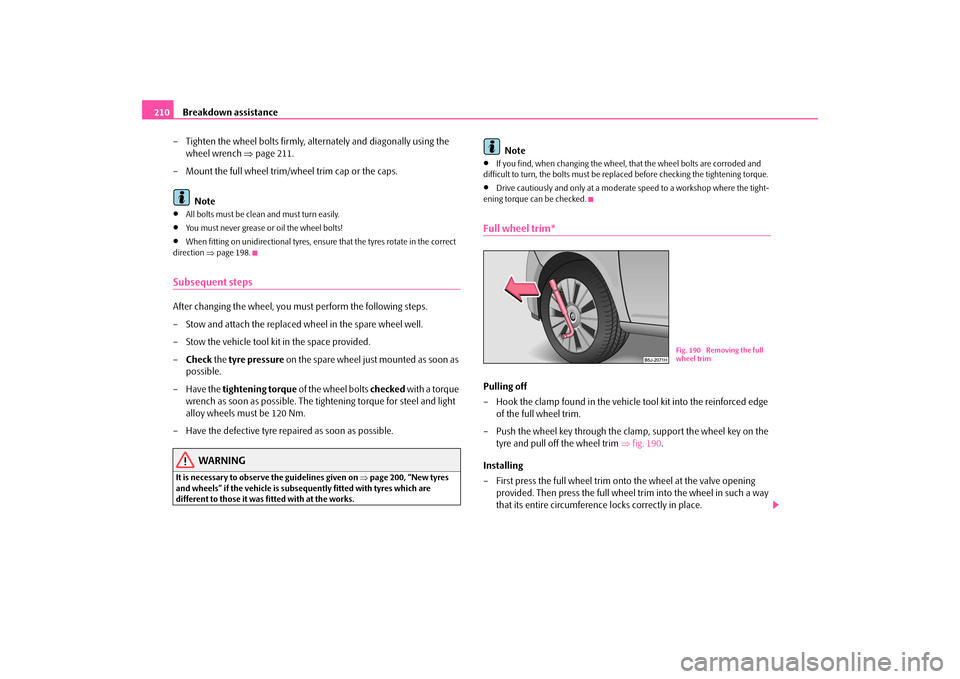
Full wheel trim*Pulling off
– Hook the clamp found in the vehicle tool kit into the reinforced edge
of the full wheel trim.
– Push the wheel key through the clamp, support the wheel key on the
tyre and pull off the wheel trim ⇒fig. 190.
Installing
– First press the full wheel trim onto the wheel at the valve opening
provided. Then press the full wheel trim into the wheel in such a way
that its entire circumference locks correctly in place.
Fig. 190 Removing the full
wheel trim
s29g.4.book Page 210 Wednesday, June 17, 2009 9:54 AM
Page 214 of 263

Breakdown assistance213
Using the system
Safety
Driving Tips
General Maintenance
Breakdown assistance
Praktik
Technical Data
– Pull off the full wheel trim/cap from the wheel hub or cap from the
safety wheel bolt.
– Insert the adapter with its toothed side fully into the inner toothing
of the safety wheel bolt right down in such a way that only the
outer hexagon is jutting out ⇒page 212, fig. 194.
– Insert the wheel wrench fully onto the adapter .
– Slacken the wheel bolt, or tighten it firmly ⇒page 211.
– Reinstall the full wheel trim/wheel cap after removing the adapter or
place the cap onto the safety wheel bolt.
–Have the tightening torque checked w i t h a t o rq u e w re n c h a s s o o n a s
possible. Steel and light alloy wheels must be tightened to a tightening
torque of 120 Nm.The safety wheel bolts on vehicles fitted with them (one safety wheel bolt per
wheel) can only be loosened or tighten up by using the adapter provided.
It is meaningful to note the code number hammered into the rear side of the
adapter or the rear side of the safety wheel bolts. You can obtain a replacement
adapter from a specialist garage, if necessary, by quoting this number.
We recommend that you always carry the adapter for the wheel bolts with you in
the vehicle. It should be stowed in the vehicle tool kit.
Caution
•
Damage can occur to the adapter and safety wheel bolt if the safety wheel bolt
is tightened up too much.
•
On steel wheels, the theft-deterrent wheel bolt must always be installed in the
hole, which is close to the valve. Otherwise the full wheel trim cannot be mounted
and the full wheel trim can be damaged during the assembly.Note
The set of safety wheel bolts can be obtained from a specialist garage.
Jump-startingInitial stepsYou can use the battery of another vehicle for jump-starting yours if the engine
does not start because the battery on your vehicle is flat. You will require jump-start
cables for this purpose.
Both batteries must have a rated voltage of 12 V. The capacity (Ah) of the battery
supplying the power must not be significantly less than the capacity of the
discharged battery in your vehicle.
Jump-start cables
Only use jump-start cables which have an adequately large cross-section and insu-
lated terminal clamps. Please pay attention to the manufacturer's instructions.
Positive cable - colour coding in the majority of cases red.
Negative cable - colour coding in the majority of cases black.
WARNING
•
A discharged battery may already freeze at temperatures just below 0°C.
In case of frozen battery carry out no jump-starting - risk of explosion! Also
after thawing of the battery there is a risk of caustic burns due to leaking
acid. Replace the frozen battery.
•
Please pay attention to the warning instructions relating to working in
the engine compartment ⇒page 185.Note
•
There must not be any contact between the two vehicles otherwise current may
flow as soon as the negative terminals are connected.
•
The discharged battery must be properly connected to the system of the
vehicle.
•
Switch off any installed telephone and also pay attention to the instructions for
use of the telephone in such a situation.
AB
AA
AB
s29g.4.book Page 213 Wednesday, June 17, 2009 9:54 AM
Page 216 of 263

Breakdown assistance215
Using the system
Safety
Driving Tips
General Maintenance
Breakdown assistance
Praktik
Technical Data
Tow-starting and towing vehicleGeneralPlease pay attention to the following instructions if you are going to use a
tow rope:
Driver of the towing vehicle
– Do not drive off until the tow rope is taught.
– Release the clutch particularly gently when starting off.
Driver of the towed vehicle
– Switch the ignition on so that the steering wheel is not blocked and
you can also operate the turn signal lights, the headlight flasher, the
windscreen wipers and windscreen washer system.
– Take the vehicle out of gear or move the selector lever into position N
if your vehicle is fitted with an automatic gearbox.
– Note that the brake servo unit and power steering only operate if the
engine is running. You will require significantly greater physical force
to depress the brake pedal and to steer the vehicle if the engine is not
running.
– Ensure that the tow rope is always kept taught.Tow rope or tow bar
A tow bar is safest way of towing a vehicle and also minimizes any shocks. You can
use a tow rope only if a suitable tow bar is not available.
The tow rope must be elastic to protect the vehicle. Thus one should only use
plastic fibre rope or a rope made out of a similarly elastic material.
Attach the tow rope or the tow bar only to the towing eyes provided for this
purpose ⇒page 215, “Front towing eye” and ⇒page 216, “Rear towing eye”.Driving style
Towing another vehicle requires a certain amount of practice. Both drivers should
be familiar with the particular points about towing a vehicle. Unskilled drivers
should not attempt to tow in another vehicle or to be towed in.
One should be constantly vigilant not to allow impermissibly high towing forces or
jerky loadings. There is always a risk of excessive stresses and damage resulting at
the points to which you attach the tow rope or tow bar when you attempt to tow a
vehicle which is not standing on a paved road.
Caution
If the gearbox of your vehicle no longer contains any oil because of a defect, your
vehicle must only be towed in with the driven wheels raised clear of the ground, or
on a special vehicle transporter or trailer.
Note
•
Please comply with any legal requirements particularly regarding the switched
on signal systems, when towing in or tow-starting another vehicle.
•
The tow rope must not be twisted as it may in certain circumstances result in the
front towing eye being unscrewed out of your vehicle.
Front towing eye
The towing eye is stored in the box for the vehicle tool kit.
Fig. 196 Front bumper:
Protective grille
s29g.4.book Page 215 Wednesday, June 17, 2009 9:54 AM
Page 219 of 263

Fuses and light bulbs 218Fuses and light bulbsElectric fusesReplacing fuses in the dash panel
Defect fuses must be replaced.Individual electrical circuits are protected by fuses. The fuses are located
on the left side of the dash panel behind the safety cover.
– Switch the ignition off and also the electrical component affected.
– Carefully swivel the cover in the direction of arrow and pull it out
⇒fig. 199.
– Find out which fuse belongs to the component which is not operating
⇒page 219, “Fuse assignment in the dash panel”.
– Take the plastic clip out of its fixture in the fuse cover, insert it onto the
respective fuse and pull out this fuse.
– Defect fuses can be detected by their melted metal strips. Replace the
defect fuse by a new fuse of the same ampere number.– Insert the fuse cover into the dash panel in such a way that the guide
lugs are guided into the openings of the dash panel and then lock
them by pressing.
We recommend that you always have the small box of replacement fuses in your
vehicle. You can obtain replacement fuses from Škoda original accessories or from
a specialist garage
10).
Colour coding of fuses
Caution
•
Never attempt to “repair” fuses and also do not replace them with a fuse of a
higher amperage - risk of fire! This may also cause damage at another part of the
electrical system.
•
Have the electrical system checked as quickly as possible by a specialist garage
if a newly inserted fuse blows again after a short time.
Fig. 199 Bottom side of the
dash panel: fuse cover
10)The small box with replacement fuses is part of the basic equipping of the vehicle in some
countries.
Colour
Maximum amperage
light brown
5
brown
7,5
red
10
blue
15
yellow
20
white
25
green
30
s29g.4.book Page 218 Wednesday, June 17, 2009 9:54 AM