2009 SKODA OCTAVIA TOUR oil change
[x] Cancel search: oil changePage 5 of 224
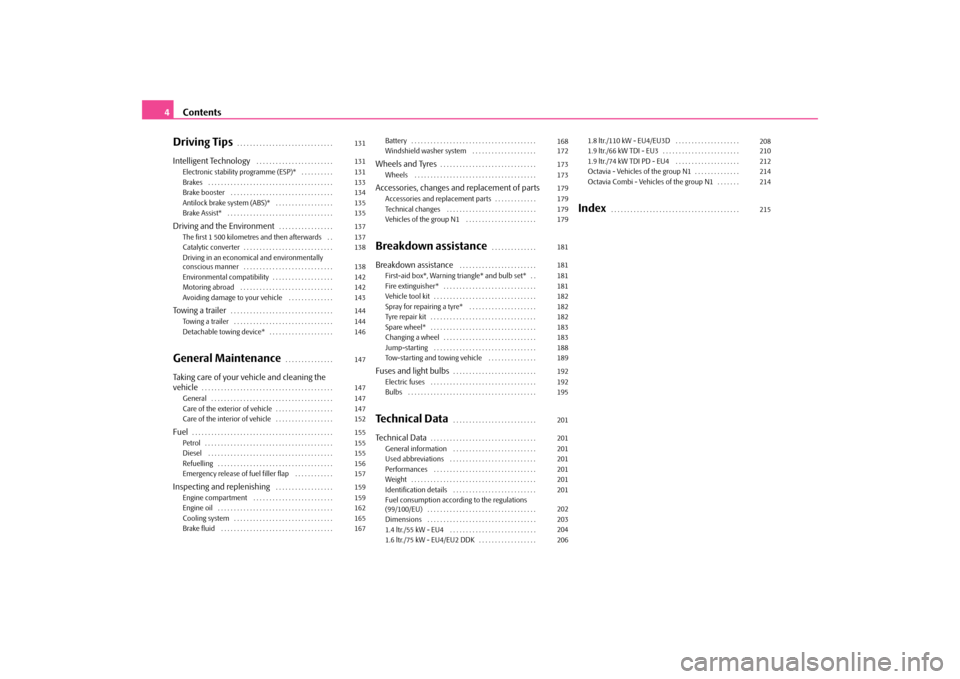
Contents
4Driving Tips
. . . . . . . . . . . . . . . . . . . . . . . . . . . . . .
Intelligent Technology
. . . . . . . . . . . . . . . . . . . . . . . .
Electronic stability programme (ESP)* . . . . . . . . . . Brakes . . . . . . . . . . . . . . . . . . . . . . . . . . . . . . . . . . . . . . . Brake booster . . . . . . . . . . . . . . . . . . . . . . . . . . . . . . . . Antilock brake system (ABS)* . . . . . . . . . . . . . . . . . . Brake Assist* . . . . . . . . . . . . . . . . . . . . . . . . . . . . . . . . . Driving and the Environment
. . . . . . . . . . . . . . . . .
The first 1 500 kilometres and then afterwards . . Catalytic converter . . . . . . . . . . . . . . . . . . . . . . . . . . . . Driving in an economical and environmentally conscious manner . . . . . . . . . . . . . . . . . . . . . . . . . . . . Environmental compatibility . . . . . . . . . . . . . . . . . . . Motoring abroad . . . . . . . . . . . . . . . . . . . . . . . . . . . . . Avoiding damage to your vehicle . . . . . . . . . . . . . . To w i n g a t r a i l e r
. . . . . . . . . . . . . . . . . . . . . . . . . . . . . . . .
Towing a trailer . . . . . . . . . . . . . . . . . . . . . . . . . . . . . . . Detachable towing device* . . . . . . . . . . . . . . . . . . . . General Maintenance
. . . . . . . . . . . . . . .
Taking care of your ve
hicle and cleaning the
vehicle
. . . . . . . . . . . . . . . . . . . . . . . . . . . . . . . . . . . . . . . . .
General . . . . . . . . . . . . . . . . . . . . . . . . . . . . . . . . . . . . . . Care of the exterior of vehicle . . . . . . . . . . . . . . . . . . Care of the interior of vehicle . . . . . . . . . . . . . . . . . . Fuel
. . . . . . . . . . . . . . . . . . . . . . . . . . . . . . . . . . . . . . . . . . . . Petrol . . . . . . . . . . . . . . . . . . . . . . . . . . . . . . . . . . . . . . . . Diesel . . . . . . . . . . . . . . . . . . . . . . . . . . . . . . . . . . . . . . . Refuelling . . . . . . . . . . . . . . . . . . . . . . . . . . . . . . . . . . . . Emergency release of fuel filler flap . . . . . . . . . . . . Inspecting and replenishing
. . . . . . . . . . . . . . . . . .
Engine compartment . . . . . . . . . . . . . . . . . . . . . . . . . Engine oil . . . . . . . . . . . . . . . . . . . . . . . . . . . . . . . . . . . . Cooling system . . . . . . . . . . . . . . . . . . . . . . . . . . . . . . . Brake fluid . . . . . . . . . . . . . . . . . . . . . . . . . . . . . . . . . . .
Battery . . . . . . . . . . . . . . . . . . . . . . . . . . . . . . . . . . . . . . . Windshield washer system . . . . . . . . . . . . . . . . . . . .Wheels and Tyres
. . . . . . . . . . . . . . . . . . . . . . . . . . . . . .
Wheels . . . . . . . . . . . . . . . . . . . . . . . . . . . . . . . . . . . . . .Accessories, changes and replacement of partsAccessories and replacement parts . . . . . . . . . . . . . Technical changes . . . . . . . . . . . . . . . . . . . . . . . . . . . .Vehicles of the group N1 . . . . . . . . . . . . . . . . . . . . . .Breakdown assistance
. . . . . . . . . . . . . .
Breakdown assistance
. . . . . . . . . . . . . . . . . . . . . . . .
First-aid box*, Warning triangle* and bulb set* . . Fire extinguisher* . . . . . . . . . . . . . . . . . . . . . . . . . . . . .Vehicle tool kit . . . . . . . . . . . . . . . . . . . . . . . . . . . . . . . .Spray for repairing a tyre* . . . . . . . . . . . . . . . . . . . . .Tyre repair kit . . . . . . . . . . . . . . . . . . . . . . . . . . . . . . . . .Spare wheel* . . . . . . . . . . . . . . . . . . . . . . . . . . . . . . . . .Changing a wheel . . . . . . . . . . . . . . . . . . . . . . . . . . . . .Jump-starting . . . . . . . . . . . . . . . . . . . . . . . . . . . . . . . .Tow-starting and towing vehicle . . . . . . . . . . . . . . .Fuses and light bulbs
. . . . . . . . . . . . . . . . . . . . . . . . . .
Electric fuses . . . . . . . . . . . . . . . . . . . . . . . . . . . . . . . . . Bulbs . . . . . . . . . . . . . . . . . . . . . . . . . . . . . . . . . . . . . . . .Technical Data
. . . . . . . . . . . . . . . . . . . . . . . . . .
Technical Data
. . . . . . . . . . . . . . . . . . . . . . . . . . . . . . . . .
General information . . . . . . . . . . . . . . . . . . . . . . . . . . Used abbreviations . . . . . . . . . . . . . . . . . . . . . . . . . . .Performances . . . . . . . . . . . . . . . . . . . . . . . . . . . . . . . .Weight . . . . . . . . . . . . . . . . . . . . . . . . . . . . . . . . . . . . . . .Identification details . . . . . . . . . . . . . . . . . . . . . . . . . .Fuel consumption according to the regulations (99/100/EU) . . . . . . . . . . . . . . . . . . . . . . . . . . . . . . . . . . Dimensions . . . . . . . . . . . . . . . . . . . . . . . . . . . . . . . . . .1.4 ltr./55 kW - EU4 . . . . . . . . . . . . . . . . . . . . . . . . . . .1.6 ltr./75 kW - EU4/EU2 DDK . . . . . . . . . . . . . . . . . .
1.8 ltr./110 kW - EU4/EU3D . . . . . . . . . . . . . . . . . . . . 1.9 ltr./66 kW TDI - EU3 . . . . . . . . . . . . . . . . . . . . . . . .1.9 ltr./74 kW TDI PD - EU4 . . . . . . . . . . . . . . . . . . . .Octavia - Vehicles of the group N1 . . . . . . . . . . . . . .Octavia Combi - Vehicles of the group N1 . . . . . . .Index
. . . . . . . . . . . . . . . . . . . . . . . . . . . . . . . . . . . . . . . .
131 131 131 133134135135 137 137 138 138 142142143 144 144 146 147 147 147 147152 155 155 155156157 159 159 162165167
168 172 173 173 179 179 179179 181 181 181 181182182182183183188189 192 192 195 201 201 201 201201201201 202 203204206
208 210 212214214 215
s2g8.b.book Page 4 Tuesday, April 7, 2009 8:53 AM
Page 111 of 224

Seat belts
110
•
No two persons (also not children) should ever use a single seat belt
together.•
The maximum protection which seat belts can offer is only achieved if
you are correctly seated
⇒page 104, “Correct seated position”.
•
The belt webbing must no
t run across solid or fragile objects (e.g. spec-
tacles, ball-point pens, keys etc.) as this may be a cause of injuries.•
Bulky, loose clothing (e.g. a winter coat over a jacket) does not allow you
to be correctly seated and impairs proper operation of the seat belts.•
It is prohibited to use clamps or other objects to adjust seat belts (e.g. for
shortening the belts for smaller persons).•
The lock tongue should only be insert
ed into the lock which is the correct
one for your seat. Wrong use of the safety belt will reduce its capacity to protect and the risk of injury increases.•
The seat backrests of the front seats must not be tilted too far to the rear
otherwise the seatbelts can
lose their effectiveness.
•
The belt webbing must always be ke
pt clean. Soiled belt webbing may
impair proper operation of the inertia reel
⇒page 153, “Seat belts”.
•
The slot of the belt tongue must not be blocked by paper or similar
objects otherwise the belt tongue will not lock in place properly.•
Inspect the seat belts regu
larly to ensure they are
in good condition. If
you find seat belts which have damage to the seat belt webbing, seat belt connections, to the inertia reels or to the lock, the relevant safety belt must be replaced by a specialist garage.•
The seat belts must not be removed or changed in any way. Do not make
an attempt to repair the seat belts yourself.•
Damaged seat belts which have been subjected to stress in an accident
and were therefore stretched, must be replaced - this is best done by a specialist garage. The anchorage points
of the belts must also be inspected.
The anchorage points for the be
lts should also be checked.
•
In certain countries it is possible to use seat belts which differ in terms of
their operation from the seat belts wh
ich are described on the pages which
follow.
How are seat belts correctly fastened?Fastening three-point seat belts Fasten your seat belt before starting!– Correctly adjust the front seat and
the head restraint before fastening
your seat belt
⇒
page 60.
WARNING (continued)
Fig. 116 Routing of webbing over the shoulders and the lap beltFig. 117 Routing of belt webbing for an expectant mother
s2g8.b.book Page 110 Tuesday, April 7, 2009 8:53 AM
Page 154 of 224

Taking care of your vehicle and cleaning the vehicle
153
Using the system
Safety
Driving Tips
General Maintenance
Breakdown assistance
Technical Data
Removing stains – Remove fresh stains which are
water-based
(e.g. coffee, tea, juices,
blood etc.) with an absorbent cloth or household paper or use the cleaner from the care set for a
stain which has already dried in.
– Remove fresh stains on a
fat base
(e.g. butter, mayonnaise, chocolate
etc.) with an absorbent cloth or household cleaning paper or with the cleaner from the care set if the stain has not yet penetrated into the surface.
– Use a grease dissolver for
grease stains which have dried in
.
–Eliminate
special stains
(e.g. ball-point pens, felt pen, nail varnish,
dispersion paint, shoe cream etc.) with a special stain remover suit-able for leather.
Leather care – Treat the leather every six months with the leather care product avail-
able from specialist garages.
– Apply only a small amount of the care product.– Dry the leather off with a soft clothWe recommend that you consult a speciali
st garage if you have any questions
regarding cleaning and care of the
leather interior in your vehicle.
Caution
•
You must on no account treat the leather with solvents (e.g. gasoline, turpen-
tine), floor wax, shoe cream or such like.•
Avoid leaving your vehicle for lengthy pe
riods in bright sunlight in order to
avoid bleaching the leather. If
you leave your vehicle parked in the open for lengthy
periods, protect the leather from the direct
rays of the sun by covering it over.
•
Sharp-edged objects on items of clothing
such as zip fasteners, rivets, sharp-
edged belts may leave permanent scratche
s or signs of rubbing on the surface.
Note
•
Use a care cream with light blocker and impregnation effect regularly and each
time after cleaning the leather. The cream no
urishes the leather, allows it to breathe
and keeps it supple and also provides moisture. It also creates surface protection.•
Clean the leather every 2 to 3 months, remove fresh soiling each time this
occurs.•
Remove fresh stains such as those from
ball-point pens, ink, lipstick, shoe
cream etc., as quickly as possible.•
Care also for the leather dye. Refreshen
areas which have lost their colour with
a special coloured leather cream as required.•
The leather is a natural material with specific properties. During the use of the
vehicle, minor optical change
s can occur on the leather parts of the covers (e. g
wrinkles or creases as a result of the stress of the covers).Seat belts– Keep the seat belts clean! – Wash seat belts which have become
soiled using a mild soapy solu-
tion.
– Inspect the seat belts regularly to
ensure they are in good condition.
Belt webbing which has become severely so
iled may prevent the inertia reel from
reeling up the belt properly.
WARNING
•
The seat belts must not be removed for cleaning.
•
Never clean the seat belts chemically
as dry cleaning may destroy the
fabric. The seat belts must also not be allowed to come into contact with corrosive liquids (such as acids etc.).•
Seat belts which have damage to
the webbing, the connections, the
inertia reel or the lock should be
replaced by a specialist garage.
s2g8.b.book Page 153 Tuesday, April 7, 2009 8:53 AM
Page 163 of 224

Inspecting and replenishing
162
Engine oilEngine oil specifications The grade of engine oil should be selected in accordance with precise specifications.The engine of your vehicle has been fact
ory-filled with a high-grade oil which you
can use throughout the year - exce
pt in extreme climatic regions.
You can mix various oils together with each other when refilling with oil. This does not, however, apply for models with
flexible service intervals (QG1).
Engine oils are, of course, undergoing co
ntinuous further deve
lopment. Thus the
information stated in this Owner's Manual is only correct at the time of publication. Specialist garages are informed by Škoda Auto about current changes. We recom- mend having this oil change und
ertaken by a specialist garage.
The specifications (VW standards) stated in the following must be indicated sepa- rately or together with other specifications on the bottle. Engine oil specifications for vehicles with fixed service intervals (QG0, QG2)
Engine oil specifications for models with flexible service intervals (QG1)
Caution
Only the above-mentioned oils may be used on vehicles with flexible service inter- vals (QG1). We recommend always refilling with oil of the same specification since this will maintain the properties of the oi
l. In exceptional cases, you must top up
only once engine oil complying with Specification VW 502 00 (only for petrol engines) or Specification VW 505 01 (only for diesel engines) to maximum 0.5 litres. You must not use other engine oi
ls - risk of engine damage!
Note
•
Before a long drive we recommend th
at you purchase and carry with you
engine oil which complies with the specif
ication for your vehi
cle. Consequently,
you will always have the corr
ect engine oil for refilling.
•
We recommend using a preservative fr
om the Škoda original accessories
offered by your Škoda dealer.•
For further information - see Service shedule.
Engine oil specifications
Petrol engines
VW 501 01 VW 502 00 VW 504 00
ACEA A2
a) or A3
a)
a)Only to be used in exceptional cases if
the oils specified above are not available.
Diesel engines
VW 505 00
b)
VW 505 01 VW 507 00
ACEA B3
a) or B4
a)
b)Except PD engine (unit injector engine).
Engine oil specifications
Petrol engines
VW 503 00 VW 504 00
Diesel engines
VW 506 01 VW 507 00
s2g8.b.book Page 162 Tuesday, April 7, 2009 8:53 AM
Page 165 of 224

Inspecting and replenishing
164
– Inspect the oil level
⇒
page 163.
– Carefully screw on the cap of the
filler opening and push the dipstick
in fully.
WARNING
•
Avoid dripping oil onto hot parts of the engine when topping up will oil -
a risk of fire!•
Read and observe the warning notes
⇒page 160, “Working in the engine
compartment” before working in the engine compartment.
For the sake of the environment
The oil level must on no account be above the range
⇒page 163. Oil will other-
wise be drawn in through the crankcas
e ventilation and may pass through the
exhaust system to atmosphere. The oil ma
y combust in the cata
lytic converter and
damage it.Changing engine oilThe engine oil must be changed at the intervals stated in the Service schedule or according to the service interval indicator
⇒page 18.
WARNING
•
Only carry out the engine oil change, if you have the required profes-
sional knowledge!•
Read and observe the warning notes
⇒page 160, “Working in the engine
compartment” before working in the engine compartment.•
Let the engine cool down - risk of burning from hot oil.
•
Wear an eye protection - risk of
caustic burns due to oil splashes.
•
Oil is toxic! Store old oil in a safe place out of the reach of children and
unauthorized persons until you dispose of it properly.
Caution
You must not pour any additives into th
e engine oil - risk of engine damage!
Damage, which results from such produc
t, are excluded from the warranty.
For the sake of the environment
•
You must on no account pour oil into
the ground or into the sewage system.
•
In view of the problems involved in prop
erly disposing of old oil, the material,
equipment and the knowledge required fo
r such work, we recommend that you
have the oil and oil filter change carried out by a specialist garage.
Note
After your skin has come in contact with the oil, you must thoroughly wash your skin.Power steeringThe reservoir for hydraulic oil of power stee
ring is located in the front right of the
engine compartment
⇒page 161, fig. 151
.
Aa
Fig. 153 Hydraulic oil dipstick
s2g8.b.book Page 164 Tuesday, April 7, 2009 8:53 AM
Page 180 of 224

Accessories, changes and
replacement of parts
179
Using the system
Safety
Driving Tips
General Maintenance
Breakdown assistance
Technical Data
Accessories, changes and replacement of partsAccessories and replacement partsŠkoda vehicles have been bu
ilt according to the latest discoveries in safety engi-
neering. Thus one should no
t change the condition in which the vehicle was deliv-
ered from the manufacturer without some thought. The following guidelines should be observed when a vehicle is to be retrofitted with accessories, have technical ch
anges made to it or a par t has to be replaced at some
time in the future.•
Advise should always be obtained from a specialist garage
before
buying any
accessories and
before
making any technical changes
⇒
.
•
This is particularly the case when acce
ssories are bought in a foreign country.
•
Škoda Genuine Accessories which have b
een released for use and Skoda orig-
inal parts can be bought from specialist
garages that professionally undertake the
assembly of parts which were purchased there.•
All Škoda original accessories which are listed in the catalogue of original acces-
sories such as sliding/tilting roofs, sp
oilers, wheel rims et
c. are homologized.
•
Radios, aerials and other electrical acce
ssories should only be installed by a
specialist garage.•
The guidelines issued by Škoda Auto must be observed when making technical
changes.•
This is to ensure that no technical damage
occurs to the vehicle, that travelling
and operating safety are maintained and that the chnages are permissible. The specialist garages also undertake this work professionally or refer it to another specialist garage in special cases. Any damage which is done caused by technical changes made without consulting a Skoda dealer is
excluded from the guarantee.
WARNING
•
We advise you, in your own interest, to only use Škoda Genuine Accesso-
ries and Škoda original parts which have
been expressly approved for use on
your Škoda. Reliability, safety and su
itabiliity have been established for
these Škoda original parts.•
We cannot guarantee suitability of installation into your vehicle of other
products despite keeping a constant ey
e on market developments (also not
in the case where there is an attestation or permission can be produced).Technical changesInterference on the electronic components and their software can lead to opera-tional faults. This interference can also impair not directly affected systems because of the networking of the electronic co
mponents. This means that the operating
safety of your vehicle can
be considerably jeopardized,
a greater wear of vehicle
parts can occur and finally the vehi
cle registration documents expire.
We trust that you will understand that
Škoda Auto cannot be liable for damage
resulting from unprofessional work. We therefore recommend that you have all work carried out with Škoda original parts at specialist garages.
WARNING
Work or modifications on your vehicle, which have been carried out unpro-fessionally, can cause operational faults - risk of accident!Vehicles of the group N1The vehicle of the group N1 is a box car wh
ich is designed and manufactured for the
transportation of goods.
WARNING (continued)
s2g8.b.book Page 179 Tuesday, April 7, 2009 8:53 AM
Page 185 of 224

Breakdown assistance
184
prescribed distance from your vehicl
e while observing all national legal
provisions. In this way you are protecting not only yourself but also other road users.•
Never start the engine with the vehicle
sitting on the raised jack - danger
of suffering injury.
Caution
If you have to change a wheel on a slope
first block the opposite wheel with a stone
or similar object in order to secure th
e vehicle from unexpectedly rolling away.
Note
Comply with the national legal regulations.Changing a wheelAlways change a wheel on a level surface as far as possible. – Take off the full wheel trim*
⇒
page 185 or the caps
⇒
page 185.
– In the case of light alloy wheels remove the wheel trim cap
⇒
page 186.
– Slacken the wheel bolts
⇒
page 186.
– Jack up the vehicle until the wheel to
be changed is clear of the ground
⇒
page 187.
– Unscrew the wheel bolts and place them on a clean surface (cloth,
paper etc.).
– Take off the wheel.– Fit on the new spare wheel* and tighten the wheel bolts slightly. –Lower the car.
– Tighten the wheel bolts firmly, al
ternately and diagonally using the
wrench* (crosswise)
⇒
page 186.
– Mount the full wheel trim/w
heel trim cap or the caps.
Note
•
All bolts must be clean
and must turn easily.
•
You must never grease or oil the wheel bolts!
•
When fitting on unidirectional tyres, ensure that the tyres rotate in the correct
direction
⇒page 173.
Subsequent stepsAfter changing the wheel, you must perform the following steps. – Stow and attach the replaced wheel in the spare wheel well. – Stow the vehicle tool kit in the space provided.–
Check
the
tyre pressure
on the spare wheel* just mounted as soon
as possible.
– Have the
tightening torque
of the wheel bolts
checked
with a torque
wrench as soon as possible. Steel and light alloy wheels must be tight-ened to a tightening torque of
120 Nm
.
– Have the defective tyre repaired as soon as possible.
WARNING
It is necessary to observe the guidelines given on
⇒page 175, “New tyres
and wheels” if the vehicle is subseq
uently fitted with tyres which are
different to those it was fitted with at the works.
WARNING (continued)
s2g8.b.book Page 184 Tuesday, April 7, 2009 8:53 AM
Page 206 of 224

Technical Data
205
Using the system
Safety
Driving Tips
General Maintenance
Breakdown assistance
Technical Data
Capacities (in liter) Weight (in kg)Fuel tank capacity/of which spare
55/7
Reservoir for windscreen washer system/ with headlight cleaning system
3/5,5
Engine oil
a)
a)Oil capacity with oil filter change. Inspect oil
level according to filling - see Owner's Manual.
3,2
Cooling system of the vehicle
5,5
OCTAVIA - M5
COMBI - M5
Permissible gross weight
1750
1770
Unloaden weight ready for work
1230
1245
Loading capacity
520
525
Loading capacity when using the TLC
470
475
Permissible front axle load
1000
1000
Permissible rear axle load
990
1000
Permissible trailer loads, trailer braked
850
a)/850
b)
a)For uphills up to 12%.b)Only country specific up to 8% uphill.
850
a)/850
b)
Permissible trailer loads, trailer unbraked
500
500
s2g8.b.book Page 205 Tuesday, April 7, 2009 8:53 AM