2009 SKODA OCTAVIA Headlight
[x] Cancel search: HeadlightPage 65 of 304

Lights and Visibility
64
when driving. Vehicles which are equipp
ed with Xenon bulbs* do not have a
manual headlight range adjustment control.Switch for hazard warning lights
– Press switch
⇒
fig. 59
to switch the hazard warning light system on
or off.
All the turn signal lights on the vehicle
flash at the same time when the hazard
warning light system is switched on. The in
dicator light for the turn signals and the
indicator light in the switch also flash at
the same time. You can also switch on the
hazard warning light system if the ignition is switched off. The hazard warning light system is swit
ched on automatically if an airbag is
deployed in the event of an accident. Please comply with any legal requirements when using the hazard warning light system.
Note
Switch on the hazard warning light system if, for example:•
you encounter traffic congestion,
•
your vehicle breaks down or an emergency situation occurs.
The turn signal
and main beam lever
The parking lights and headlight flasher are also switched on and off using the turn signal and main beam lever.The turn signal and main beam lever perform the following functions: Right
and left
turn signal light
– Push the lever upwards or downwards
⇒
fig. 60
.
– If you only wish to flash three time
s* (the so-called convenience turn
signal), push the lever briefly up to
the upper or lower pressure point
and release it. This function can be activated/deactivated in the infor-mation display*
⇒
page 26.
– Turn signal for changing lanes - in order to only flash briefly, move the
lever up or down to the pressure point and hold it in this position.
Main beam
– Switch on the low beam. – Push the lever forwards.– Pull the lever back into the initial po
sition in order to switch the main
beam off again.
Fig. 59 Dash panel: Switch for hazard warning lights
Fig. 60 Turn signal and main beam lever
se0.1.book Page 64 Friday, April 10, 2009 3:19 PM
Page 66 of 304

Lights and Visibility
65
Using the system
Safety
Driving Tips
General Maintenance
Breakdown assistance
Technical Data
Headlight flasher
– Pull the lever towards the steering wheel (spring-tensioned position)
- the main beam and warning light
in the instrument cluster come
on.
Parking light
– Switch off the ignition. – Push the lever up or down - the ri
ght-hand or left-hand parking light
is switched on.
Information concerning the function of the lights.•
The
turn signal system
only operates when the ignition is switched on. The
corresponding indicator light
or in the instrument cluster also flashes.
•
The turn signal is automatically cancelled after negotiating a curve.
•
The indicator light flashes at twice its normal
ra te if a bulb of the turn s ignal lig ht
fails.•
The side light and rear light on the appropriate side of the vehicle are switched
on when the
parking light
is selected. The parking light only operates if the ignition
is switched off.
Caution
Use main beam or the headlight flasher only
if this does not risk dazzling other road
users.
Note
•
If you have switched on the right or left
turn signal light and you switch off the
ignition, the parking light is
not automatically switched on.
•
Use only in accordance with the legal
requirements the described lighting and
signal systems.
Interior lightingvehicle interior lighting front and rear*The same principles apply for the lighti
ng of the front and rear part of the
vehicle. Switching the interior light on – Press the switch to the left, the symbol
⇒
fig. 61
appears.
Switching the interior light off – Press the switch into the middle position
O.
– On the version without reading lights press the switch to the right,
the symbol
O appears.
Door contact setting – Press the switch to the right, the symbol
appears.
– On the version without reading lights press the switch into the
middle position
.
Fig. 61 Detail of the head- liner: Front and rear interior lighting
AAAA
AA
AA
AA
se0.1.book Page 65 Friday, April 10, 2009 3:19 PM
Page 71 of 304

Lights and Visibility
70
Switching windscreen wipers off – Move the lever back into its home position .After the windscreen wiper switches off each
time or the igniti
on switches off for
the third time, the position of the windscreen wiper changes, this counteracts an early fatigue of the wiper rubbers. The windscreen wipers and the wash system only operate if the ignition is switched on and the bonnet is closed
11).
If the intermittent wipe is switched on, the intervals are also controlled depending on speed. The rain sensor* automatically regulates
the break between the individual wiper
strokes depending on the intensity of the rain. The rear window will be
wiped again if the front wi
ndow wipers are on when
reverse gear is selected. The windscreen washer nozzles are heated* when the ignition is switched on.Top up with wash liquid
⇒page 236.
Winter position If the windscreen wipers are in rest posi
tion, they cannot be folded out from the
windscreen. For this reason we recommend
adjusting the windscreen wipers in
winter so that they can be folded out fr
om the windscreen easi
ly. You can set this
rest position as follows:•
Switch on the windscreen wipers.
•
Switch off the ignition. The windscreen wi
pers remain in the position in which
they were when switching off the ignition. You can also use the service position
⇒page 71 as a winter position.
WARNING
•
Properly maintained windscreen wiper
blades are essential for clear visi-
bility and safe driving
⇒page 71.
•
Do not use the windscreen
washer system at lo
w temperatures, without
heating the windscreen beforehand.
Otherwise the window cleaner could
freeze on the windscreen and re
strict the view to the front.
•
The rain sensor only operates as a support. The driver is not released
from the responsibility to set the function of the windscreen wipers manu- ally depending on the visibility conditions.
Caution
In frosty weather, please first of all check whether the windscreen wiper blades are not frozen to the windscreen before switching them on. Switching on windscreen wipers when the blades are frozen to the windscreen may result in damage both to the blades and the motor of the windscreen wipers!
Note
•
If the slower or the faster wiper setting is switched on
⇒page 69, fig. 68
and the vehicle speed decreases to below 4
km/h, the lower wiper step is switched
on automatically. At a speed increase of
more than 8 km/h the previous wiper
setting is established again.•
If there is an obstacle on the windscreen, the wiper will try to push away the
obstacle. If the obstacle continues to bloc
k the wiper, the wiper stops after 5 cycles,
in order to avoid a damage to the wiper.
Remove the obstacle and and switch on
the wiper again.Headlight cleaning system*The headlights are being cleaned after the
windscreen has been sprayed for the first
time and fifth time, the low beam or ma
in beam are switched on and the wind-
screen wiper lever was held in the position
⇒page 69, fig. 68
for about 1
second.
11)On vehicles which do not have a contact swit
ch for the bonnet, the windshield wiper and
wash system operates also when the bonnet is opened.
A0
A2
A3
A5
se0.1.book Page 70 Friday, April 10, 2009 3:19 PM
Page 72 of 304

Lights and Visibility
71
Using the system
Safety
Driving Tips
General Maintenance
Breakdown assistance
Technical Data
The headlight washer nozzles are moved forward out of the bumper by the water pressure for cleaning the headlights. You should remove stubborn dirt (such
as insect residues) from the headlight
lenses at regular intervals, for example when refuelling. Please refer to the following guidelines
⇒page 214, “The headlight lenses”.
You should remove any snow from the fixt
ures of the washer nozzles and clear ice
in winter with a de-icing spray in order to
ensure proper operation of the cleaning
system.Replacing wiper blades fo
r the windscreen wipers
One cannot fold out the wiper arms in the rest position from the wind- screen. Before replacing the wiper
arms you must put them into the
service position. Service position for changing wiper blades – Close the bonnet. – Switch the ignition on and then again off. – Then press the windscreen wiper lever in the position
⇒
page 69,
fig. 68
within 20 seconds - the wiper ar
ms move into the service posi-
tion.
Taking off the wiper blade – Fold windscreen wiper arm out from
the windscreen and position the
wiper blade at right angles to the wiper arm
⇒
.
– Take off the wiper blade in direction of arrow
⇒
fig. 69
⇒
.
Attaching a wiper blade – Push the new wiper blade over the wiper arm and turn the wiper blade
into the vertical position.
– Check whether the wiper blade is correctly attached.– Fold the windscreen wiper arms onto the window and switch on the
ignition. By pressing the window wi
per lever into the sprung position
⇒
fig. 69
or when driving at a speed greater than 4 km/h, the wind-
screen wiper arms move back into the rest position.
Wiper blades in proper condition are esse
ntial to obtain good visibility. Wiper
blades should not be allowed to become
dirtied by dust, insect remains and
preserving wax. Juddering or smearing of the wiper blades
could then be due to wax residues left
on the windscreen by vehicle washing in
automatic vehicle wash systems. It is
therefore important to
degrease
the lips of the wiper blades after every pass
through an
automatic vehicle wash system
.
WARNING
•
The ignition must not be switched on if the front windscreen wiper arms
are folded out. The wiper blades would move back into their rest position and while doing so damage th
e paintwork of the bonnet.
•
If the windscreen wipers are handled carelessly, there is a risk of damage
to the windscreen.•
You should clean the wiper blades regularly with a windscreen cleaner in
order to avoid any smears. Clean a wiper blade with a sponge or cloth if it is very dirty, for example from insect residues.
Fig. 69 Wiper blade for the windscreen wiper
A4
A4
se0.1.book Page 71 Friday, April 10, 2009 3:19 PM
Page 140 of 304
Communication
139
Using the system
Safety
Driving Tips
General Maintenance
Breakdown assistance
Technical Data
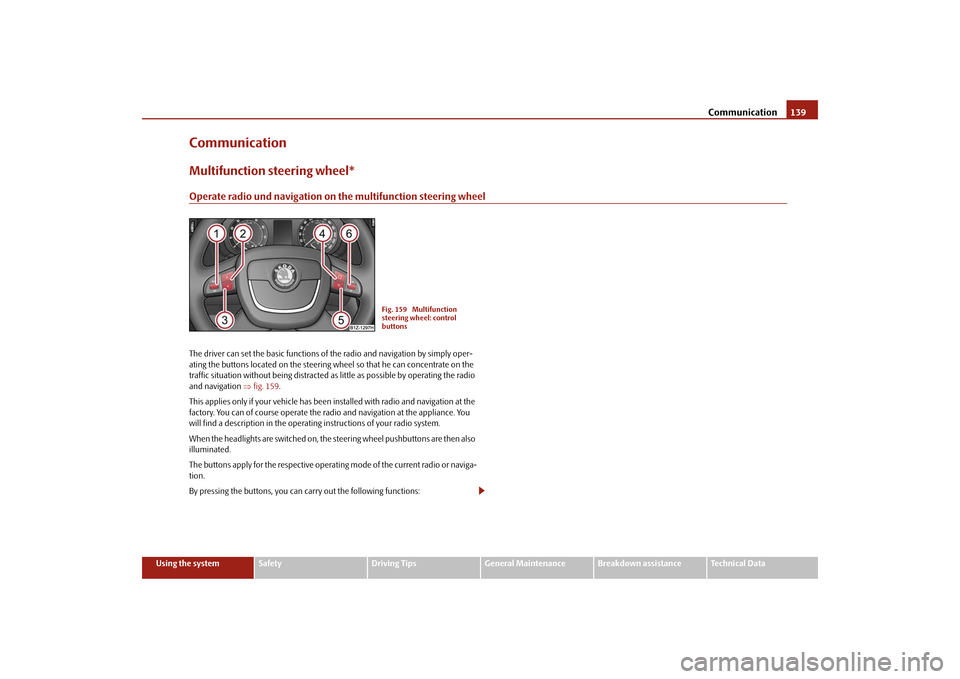
CommunicationMultifunction steering wheel*Operate radio und navigation on the multifunction steering wheelThe driver can set the basic functions of
the radio and navigation by simply oper-
ating the buttons located on the steering wheel so that he can concentrate on the traffic situation without being distracted as little as possible by operating the radio and navigation
⇒fig. 159
.
This applies only if your vehicle has been installed with radio and navigation at the factory. You can of course operate the radio and navigation at the appliance. You will find a description in the operating instructions of your radio system. When the headlights are switched on, the
steering wheel pushbuttons are then also
illuminated. The buttons apply for the respective operating mode of the current radio or naviga- tion. By pressing the buttons, you can
carry out the following functions:
Fig. 159 Multifunction steering wheel: control buttons
se0.1.book Page 139 Frida
y, April 10, 2009 3:19 PM
Page 207 of 304

Driving and the Environment
206
Keeping a log of your fuel consumptionIf you really wish to ke
ep a close check on your
fuel consumption
, it is best to enter
the figures in a logbook. This does not take
much time but is a very worthwhile exer-
cise. It enables you to detect any change
(positive and negative) at an early stage
and to take any appropriate action. If you find that your fuel
consumption is too high, you sh
ould reflect on how, where
and in what conditions you have driven
the vehicle since you last refuelled.
Environmental compatibilityEnvironmental protection has played a majo
r role in the design, selection of mate-
rials and manufacture of your new Škoda.
Particular emphasis
has been paid to a
number of aspects, including: Design measures•
Joints designed to
be easily detached.
•
Simplified disassembly due to the modular structure system.
•
Improved purity of differ
ent classes of materials.
•
Identification of all plastic parts in
accordance with VDA Recommendation°260.
•
Reduced fuel consumption
and exhaust emission CO
2.
•
Minimum fuel leakage during accidents.
•
Reduced noise.
Choice of materials•
Extensive use of recyclable material.
•
Air conditioning filled wi
th CFC-free refrigerant.
•
No cadmium.
•
No asbestos.
•
Reduction in the “vaporisation” of plastics.
Manufacture•
Solvent-free cavity protection.
•
Solvent-free protection of the vehicle for transportation from the production
plant to the customer.•
The use of solvent-free adhesives.
•
No CFCs used in the production process.
•
Without use of mercury.
•
Use of water-soluble paints.
Motoring abroadGeneral Other circumstances may exist abroad.It is also possible, in certain countries, that the Škoda Service Partner network is limited or has not been established yet.
This is the reason why obtaining certain
spare parts may be somewhat complicate
d and specialist garage personnel may
o n l y b e a b l e t o m a ke l i m i te d re p a i rs . Š ko d a A u to i n t h e C z e c h R e pu b l i c a n d re l e v a n t importers are happy to provide information
about technical aspects of the vehicle,
required maintenance work and possibilities for getting repairs done.Unleaded petrolA vehicle fitted with a petrol engine must always be refuelled with unleaded petrol ⇒ page 202. The automobile associations can provide you with information regarding the locations of filling stations which offer unleaded petrol.HeadlightThe low beam of your headlights is set asym
metrically. It illuminates the side of the
road on which you are driving to a greater
extent. If you drive abroad on the other
side of the road, you wi
ll dazzle oncoming traffic.
In order to prevent the dazzling of oncoming
traffic, it is necessary that an adjust-
ment of the headlights is carried out by
your authorised Škoda Service Partner.
se0.1.book Page 206 Frida
y, April 10, 2009 3:19 PM
Page 208 of 304

Driving and the Environment
207
Using the system
Safety
Driving Tips
General Maintenance
Breakdown assistance
Technical Data
The adaptation of the headlights with Xenon lights* (applies only to vehicles which are designed for driving on the right and on the left) is performed in the menu Setup
Tra v e l m o d e
in the main menu of th
e Information display*
⇒page 26.
Avoiding damage to your vehicleWhen driving on poor roads and lanes or when driving over kerbstones, steep ramps etc., you must pay particular attent
ion to ensuring that any low-slung parts
of the vehicle, such as spoiler and ex
haust, do not touch the ground and get
damaged. This particularly applies to models with
a lowered suspension (sport suspension)
and also when your vehicle is fully laden.
se0.1.book Page 207 Frida
y, April 10, 2009 3:19 PM
Page 210 of 304

Towing a trailer
209
Using the system
Safety
Driving Tips
General Maintenance
Breakdown assistance
Technical Data
should be attached to folding arms. Adjust
the mirrors so that they provide you with
an adequate field of view to the rear. Headlights Before starting off with a hitched trailer, also check the setting of the headlights. Alter the setting as necessary with th
e aid of the headlight beam adjuster
⇒ page 63. Detachable ball head The ball rod is detachable on vehicles which feature a factory-fitted towing device. It is stowed together with separate fitting instructions in the spare wheel well in the luggage compartment of the vehicle. Further information on the towing device
⇒page 210.
Note
•
We recommend that you also have yo
ur vehicle inspected between service
intervals if you tow a trailer frequently.•
The handbrake on the towing vehicle
must be put on when coupling and
decoupling the trailer.Driving Tips Particular caution is required when towing a trailer.– Do not, as far as possible, drive
with your vehicle unladen and the
trailer laden.
– Do not make full use of the legal maximum speeds. This applies in
particular to downhill sections.
– Apply the brakes in good time.– Keep a check on the coolant temper
ature gauge if the outside temper-
ature is high.
Distribution of weight The distribution of the weight is very poor
if your vehicle is
unladen and the trailer
is laden. Maintain a particularly low speed if you cannot avoid driving with this combination. Driving speed Do not drive faster than 80 km/hour for safety reasons. This also applies for coun- tries in which higher speeds are allowed. The fact that the driving stability of the vehicle + trailer combination reduces with increasing speed means that the legally allowed speed should not be used when there are unfavourable road, weather or wind
conditions, particul
arly near accident
black spots. You must always reduce your speed immedi
ately as soon as you detect even just
the
slightest swaying
of the trailer. On no account attempt to stop the trailer from
“swaying” by
accelerating.
Apply the brakes in good time! If the trailer is fitted with a
trailer brake
, apply the
brakes gently at first and then brake firmly
. This will avoid brake jolts resulting from
the trailer wheels locking. Shift down gears
in good time before negotiating a down-
hill section to allow the engine to also act as a brake. Engine overheating Please keep a check on the coolant temperature gauge if you have to negotiate a lengthy slope in a low gear at a high engine speed when the outside temperature is very high
⇒page 18, “Coolant temperature gauge”.
If the needle of the coolant temperature gauge moves into the right-hand area or even the red area of the scale, reduce yo
ur speed immediately. Stop and switch off
the engine if the warning light
in the instrument cluste
r begins flashing. Wait a
few minutes and check the level of coolant in the coolant expansion bottle ⇒ page 229, “Inspecting the coolant level”. Please refer to the following guidelines
⇒page 36, “Coolant temperature/ Coolant
quantity
”.
The coolant temperature can be reduced by switching on the heating.Any increase in the cooling effect of the coolant fan through shifting down a gear and increasing the engine speed is not possible since the fan speed is independent
se0.1.book Page 209 Frida
y, April 10, 2009 3:19 PM