Page 213 of 259

Breakdown assistance 212•
We recommend purchasing jump-start cables from Škoda Service Partners as a
Škoda original accessory or from retailers who sell branded batteries.
Start engineIt is important to connect the jump-start cables in the correct order.
Connecting positive terminals
– Attach one end to the positive terminal ⇒fig. 200 of the
discharged battery .
– Attach the other end to the positive terminal of the battery
supplying the power .
Connecting negative terminal and engine block
– Attach one end to the negative terminal of the battery supplying
the power .
– Attach the other end to a solid metal part which is connected
firmly to the engine block, or to the engine block itself ⇒.Starting engine
– Start the engine of the vehicle providing current and run the engine at
idling speed.
– Now start the engine of the vehicle with the discharged battery.
– Interrupt the attempt at starting an engine after 10 seconds if it does
not start right away and wait for about 30 seconds before repeating
the attempt.
– Disconnect the cables on the engine in exactly the reverse order they
were connected up.
WARNING
•
The non-insulated parts of the terminal clamps must never make contact
with each other. Furthermore, the cable connected to the positive terminal
of the battery must not come into contact with electrically conducting parts
of the vehicle - risk of a short circuit!
•
Do not affix the jump starting cables to the negative terminal of the
discharged battery. There is the risk of detonating gas seeping out the
battery being ignited by the strong spark which results from the engine
being started.
•
Do not affix the cable end to parts of the fuel and brake system.
•
Run the jump-start cables so that they cannot be caught by any rotating
parts in the engine compartment.
•
Do not bend over the batteries - risk of caustic burns!
•
The vent screws of the battery cells must be tightened firmly.
•
Keep any sources of ignition (naked flame, smouldering cigarettes etc.)
away from the battery - risk of an explosion!
•
Never jump-start the batteries which have a too low electrolyte level -
risk of explosion and caustic burns!
Fig. 200 Jump-starting using
the battery from another
vehicle: A - flat vehicle
battery, B - battery providing
current
A1AAA2AB
A3
AB
A4
A4
s3f4.1.book Page 212 Thursday, June 18, 2009 11:07 AM
Page 216 of 259

Breakdown assistance215
Using the system
Safety
Driving Tips
General Maintenance
Breakdown assistance
Technical Data
WARNING
There is high risk of having an accident when tow-starting a vehicle, when
for example the towed vehicle runs into the towing vehicle.
Caution
Vehicles which are fitted with a catalytic converter should not be tow-started over
a distance of more than 50 metres. Unburnt fuel may get into the catalytic converter
and damage it.Towing in a vehicle fitted with a manual gearboxPlease refer to the notes ⇒page 213.
The vehicle can be towed in with a tow bar or a tow rope or with the front or rear
wheels raised. The maximum towing speed is 50 km/h.Towing of a vehicle with an automatic gearboxPlease refer to the notes ⇒page 213.
The car can be towed in with a tow bar or a tow rope. Refer at the same time to the
following guidelines:•
Move selector lever into N.
•
The maximum towing speed is 50 km/h.
•
The maximum permissible towing distance is 50 km. The gear oil pump does
not operate when the engine is not running; the gearbox would not be adequately
lubricated at higher speeds and over longer towing distance.Caution
If the vehicle is towed in by a recovery vehicle, it should only be towed in with the
front wheels raised. If the vehicle is raised at rear, the automatic gearbox is
damaged!
Note
The vehicle must be transported on a special vehicle or trailer if it is not possible to
tow in the vehicle in the way described or if the towing distance is greater than
50 km.
s3f4.1.book Page 215 Thursday, June 18, 2009 11:07 AM
Page 219 of 259
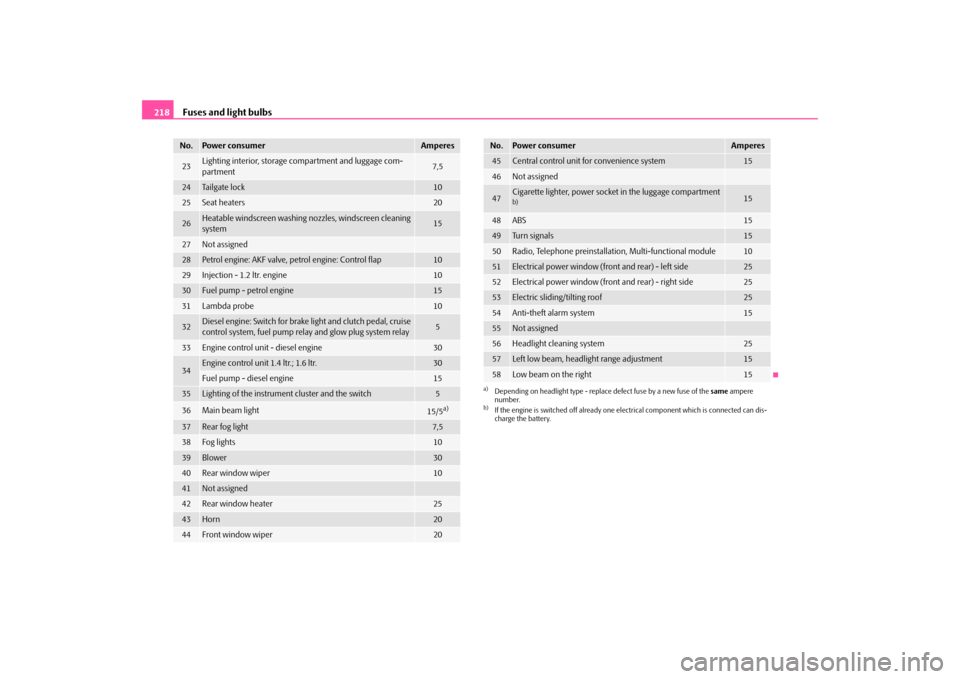
Fuses and light bulbs 21823
Lighting interior, storage compartment and luggage com-
partment
7,5
24
Tailgate lock
10
25
Seat heaters
20
26
Heatable windscreen washing nozzles, windscreen cleaning
system
15
27
Not assigned
28
Petrol engine: AKF valve, petrol engine: Control flap
10
29
Injection - 1.2 ltr. engine
10
30
Fuel pump - petrol engine
15
31
Lambda probe
10
32
Diesel engine: Switch for brake light and clutch pedal, cruise
control system, fuel pump relay and glow plug system relay
5
33
Engine control unit - diesel engine
30
34
Engine control unit 1.4 ltr.; 1.6 ltr.
30
Fuel pump - diesel engine
15
35
Lighting of the instrument cluster and the switch
5
36
Main beam light
15/5
a)
37
Rear fog light
7,5
38
Fog lights
10
39
Blower
30
40
Rear window wiper
10
41
Not assigned
42
Rear window heater
25
43
Horn
20
44
Front window wiper
20
No.
Power consumer
Amperes
45
Central control unit for convenience system
15
46
Not assigned
47
Cigarette lighter, power socket in the luggage compartment b)
15
48
ABS
15
49
Tu r n s i g n a l s
15
50
Radio, Telephone preinstallation, Multi-functional module
10
51
Electrical power window (front and rear) - left side
25
52
Electrical power window (front and rear) - right side
25
53
Electric sliding/tilting roof
25
54
Anti-theft alarm system
15
55
Not assigned
56
Headlight cleaning system
25
57
Left low beam, headlight range adjustment
15
58
Low beam on the right
15
a)Depending on headlight type - replace defect fuse by a new fuse of the same ampere
number.b)If the engine is switched off already one electrical component which is connected can dis-
charge the battery.No.
Power consumer
Amperes
s3f4.1.book Page 218 Thursday, June 18, 2009 11:07 AM
Page 228 of 259

Technical Data227
Using the system
Safety
Driving Tips
General Maintenance
Breakdown assistance
Technical Data
Technical DataTechnical DataGeneral informationThe details given in the official vehicle registration documents always take prece-
dence over the details in the Owner's Manual. Please refer to the official vehicle
registration documents or consult a specialist garage concerning the engine with
which your vehicle is equipped.Used abbreviationsPerformancesThe listed performance values were determined without performance-reducing
equipment, e.g. air conditioning system.
WeightThe loading capacity is reduced in line with the range of the special equipment. The
unloaden weight contains a fuel tank topped up to 90%. A driver with a weight of
75 kg is also included in the value.Identification detailsVehicle data sticker
The vehicle data sticker ⇒fig. 221 is located on the floor of the luggage compart-
ment and is also stated in the Service schedule.
The vehicle data sticker contains the following data:
Vehicle identification number (VIN)
Vehicle type
Gearbox code, paint number, interior equipment number, engine output,
engine code
Abbreviation
Importance
kW
Kilowatt, measuring unit for the engine output
rpm
Engine revolutions per minute
Nm
Newton meter, measuring unit for the engine torque
CO2 in g/km
discharged quantity of carbon dioxide in grams per driven kilom-
eter
RON
Research octane number, measuring unit for the knocking resist-
ance of petrol
DPF
Diesel particle filter
M5
5-speed manual gearbox
AG6
6-speed automatic gearbox
Fig. 221 Vehicle data sticker
A1A2A3
s3f4.1.book Page 227 Thursday, June 18, 2009 11:07 AM
Page 229 of 259

Technical Data 228Partial description of the vehicle
7GG, 7MB, 7MG - vehicles with DPF ⇒page 162
Vehicle identification number (VIN)
The vehicle identification number - VIN (vehicle body number) is stamped into the
engine compartment on the right hand shock absorber dome. This number is also
located on a sign on the lower left hand edge below the windscreen (together with
a VIN bar code).
Engine number
The engine number is stamped into the engine block.
Type plate (production plate)
The type plate is located in the engine compartment at the front on the left hand
shock absorber dome.
Homologation sign
The homologation sign is located on the lock carrier. Vehicles for certain countries
do not have an homologation sign.
Sticker on inside of fuel filler flap
The sticker is affixed to the inside of the fuel filler flap. They contain the following
data:
•
the prescribed type of fuel;
•
tyre size;
•
Tyre pressure.
Fuel consumption according to the regulations (99/100/EU)Depending on the range of the special equipment, style of driving, traffic situation,
weather influences and vehicle condition, the consumption values which in prac-
tice result when using the vehicle can deviate from the indicated values.Urban traffic
The consumption measurement in urban traffic begins with starting of the cold
engine. Afterwards the normal urban traffic is simulated.
Non-urban traffic
For the consumption measurement in non-urban traffic the vehicle, as in daily
motoring, is accelerated and braked several times in all gears. The vehicle speed
changes within the range from 0 to 120 km/h.
Combined traffic
The consumption value in the combined traffic consists of 37% from the value for
the urban traffic and of 63% from the value for the non-urban traffic.
Note
•
Please note that the information stated in the official vehicle registration
documents always takes priority.
A4A5s3f4.1.book Page 228 Thursday, June 18, 2009 11:07 AM
Page 232 of 259
Technical Data231
Using the system
Safety
Driving Tips
General Maintenance
Breakdown assistance
Technical Data
1.2 ltr./44 kW - EU 4/EU 2DDKEngine
Performances
Fuel consumption (in ltr./100°km) and CO
2 emission (in g/km)
Power output
kW per rpm
44/5200
Maximum torque
Nm per rpm
108/3000
Number of cylinders/Displacement (cm
3)
3/1198
Fuel - unleaded petrol min. RON
95
FA B I A
COMBI
Maximum speed
km/h
155
156
Acceleration 0 - 100 km/h
s
16,5
16,8
Urban
7,8
Non-urban
4,8
Combination
5,9
CO2 emission - combination
140
s3f4.1.book Page 231 Thursday, June 18, 2009 11:07 AM
Page 233 of 259
Technical Data 232Capacities (in liter)
Weight (in kg)Fuel tank capacity/of which spare
45/7
Reservoir for windscreen washer system/ with headlight cleaning system
2/4,5
Engine oil
a)
a)Oil capacity with oil filter change. Inspect oil level when filling; do not fill up too much. The oil level must be between the markings ⇒page 187, “Check engine oil level”.
2,9
Cooling system of the vehicle
5,5
FA B I A
COMBI
Permissible gross weight
1560
1580
Unloaden weight ready for work
1105
1125
Loading capacity
455
455
Loading capacity when using the TLC
405
405
Permissible front axle load
920
920
Permissible rear axle load
840
840
Permissible trailer load, trailer braked/unbraked
800/500
a)
900/500b)
a)Uphills up to 12%b)Uphills up to 8%
775/450
a)
875/450b)
s3f4.1.book Page 232 Thursday, June 18, 2009 11:07 AM
Page 234 of 259
Technical Data233
Using the system
Safety
Driving Tips
General Maintenance
Breakdown assistance
Technical Data
1.2 ltr./51 kW - EU 4/EU 2DDKEngine
Performances
Fuel consumption (in ltr./100°km) and CO
2 emission (in g/km)
Power output
kW per rpm
51/5400
Maximum torque
Nm per rpm
112/3000
Number of cylinders/Displacement (cm
3)
3/1198
Fuel - unleaded petrol min. RON
95
FA B I A
CO M B I
Maximum speed
km/h
163
164
Acceleration 0 - 100 km/h
s
14,9
15,1
Urban
7,7
Non-urban
4,9
Combination
5,9
CO2 emission - combination
140
s3f4.1.book Page 233 Thursday, June 18, 2009 11:07 AM


