2009 SKODA FABIA abs
[x] Cancel search: absPage 187 of 259

Inspecting and replenishing 186•
Do not let objects, such as e.g cleaning cloth or tools lie in the engine
compartment.
•
If you wish to work under the vehicle, you must secure the vehicle from
rolling away and support it with suitable supporting blocks: the car jack is
not sufficient for this - risk of injury!
•
In cases where it be necessary to carry out inspection work when the
engine is running there is an additional risk from rotating parts (e.g. the V-
ribbed belt, alternator, radiator fan) and from the high-voltage ignition
system. Please observe in addition the following:
−Never touch the electrical cables of the ignition system.
−Absolutely avoid any jewellery, loose items of clothing or long hair
from getting into the rotating parts of the engine - Hazard! Therefore
remove any jewellery beforehand, tie up your hair and wear tight fitting
clothing.
•
Please also comply with the warning instructions stated below when
carrying out any essential work on the fuel system or on the electrical
system:
−Always separate the car battery from the electrical system.
−Do not smoke.
−Never carry out any work close to naked flames.
−Always keep a working fire extinguisher at hand.Caution
When replenishing fluids in the engine, always ensure that the fluids are on no
account mixed up. This may result in major operating problems and also vehicle
damage!
Overview of the engine compartment
The main inspection points.Fig. 182 Diesel engine 1.9 litre/77 kW
Coolant expansion bottle . . . . . . . . . . . . . . . . . . . . . . . . . . . . . . . . . . .
Windshield washer fluid reservoir . . . . . . . . . . . . . . . . . . . . . . . . . . .
Engine oil filler opening . . . . . . . . . . . . . . . . . . . . . . . . . . . . . . . . . . . . .
Engine oil dipstick . . . . . . . . . . . . . . . . . . . . . . . . . . . . . . . . . . . . . . . . . .
Brake fluid reservoir . . . . . . . . . . . . . . . . . . . . . . . . . . . . . . . . . . . . . . . .
Battery (below a cover) . . . . . . . . . . . . . . . . . . . . . . . . . . . . . . . . . . . . . Note
The location of the inspection points in the engine compartment of petrol and
diesel engines is practically identical.
WARNING (continued)
A1
189
A2
197
A3
188
A4
187
A5
191
A6
192
s3f4.1.book Page 186 Thursday, June 18, 2009 11:07 AM
Page 193 of 259

Inspecting and replenishing 192
WARNING
•
Read and observe the warning notes ⇒page 185, “Working in the engine
compartment” before working in the engine compartment.
•
If the fluid level has dropped below the MIN marking, do not drive any
further - risk of accident! Obtain professional assistance.
Replacing brake fluidBrake fluid absorbs moisture. This causes the fluid to absorb moisture from the
surrounding air over a period of time. Excessive water in the brake fluid may be the
cause of corrosion in the brake system. The water content also lowers the boiling
point of the brake fluid. This is why brake fluid must be replaced every two
years.
One may only use new genuine brake fluid from Škoda Auto. The specification for
the brake fluid is “FMVSS 116 DOT 4”.
We recommend that you have the brake fluid replaced by a specialist garage as
part of an Inspection Service.
WARNING
•
Using old brake fluid can result in severe stress on the brakes because of
the formation of vapour bubbles in the brake system. This greatly impairs
the braking efficiency and thus also the safety of your vehicle.
•
Brake fluid is toxic! It must therefore be kept safely in closed original
containers and well away from children and unauthorized persons.Caution
Brake fluid damages the paintwork of the vehicle.
For the sake of the environment
In view of the problems involved with proper disposal of brake fluid, the special
tools and the professional knowledge required, we recommend you have the brake
fluid replaced by a specialist garage.BatteryWorking on the batteryThe battery is located in the engine compartment below a plastic box.
Fig. 186 The battery: pull up
the cover (automatic
gearbox)Fig. 187 The battery: pull up
the cover (manual gearbox)
s3f4.1.book Page 192 Thursday, June 18, 2009 11:07 AM
Page 218 of 259

Fuses and light bulbs217
Using the system
Safety
Driving Tips
General Maintenance
Breakdown assistance
Technical Data
Note
We recommend that you have these fuses replaced by a specialist garage.Fuse assignment in the dash panelCertain electrical components are only standard on certain vehicle model versions
or only suppliable as optional equipment for certain models.
Fig. 205 Schematic repre-
sentation of the fuse box for
vehicles with left-hand
steering.Fig. 206 Schematic repre-
sentation of the fuse box for
vehicles with right-hand
steering.
No.
Power consumer
Amperes
1
Not assigned
2
Not assigned
3
Instrument cluster, headlight range adjustment
5
4
ABS control unit
5
5
Petrol engine: Brake light switch, cruise control system
5
6
Not assigned
7
Engine control unit 1.2 ltr.
15
8
Injection valves - 1.4 ltr.; 1.6 ltr.
10
9
Operating controls for the heating, control unit for air condi-
tioning system, parking aid, control unit for cornering lights
5
10
Not assigned
11
Electrically adjustable rear mirror, power windows
7,5
12
Reversing light
7,5
13
Engine control unit (for vehicles with automatic gearbox)
10
14
Motor for cornering lights
10
15
Navigation PDA
5
16
Electrohydraulic power steering, engine control unit - petrol
engine
5
17
Left parking light, licence plate light
5
18
Right parking light
5
19
Radio, central control unit
5
20
Engine control unit 1.4 ltr.; 1.9 ltr. - diesel engine
5
21
Brake lights
10
22
Operating controls for the heating, control unit for air condi-
tioning system, parking aid, mobile phone, instrument clus-
ter, steering angle sender, ESP, vehicle voltage control unit
7,5
s3f4.1.book Page 217 Thursday, June 18, 2009 11:07 AM
Page 219 of 259
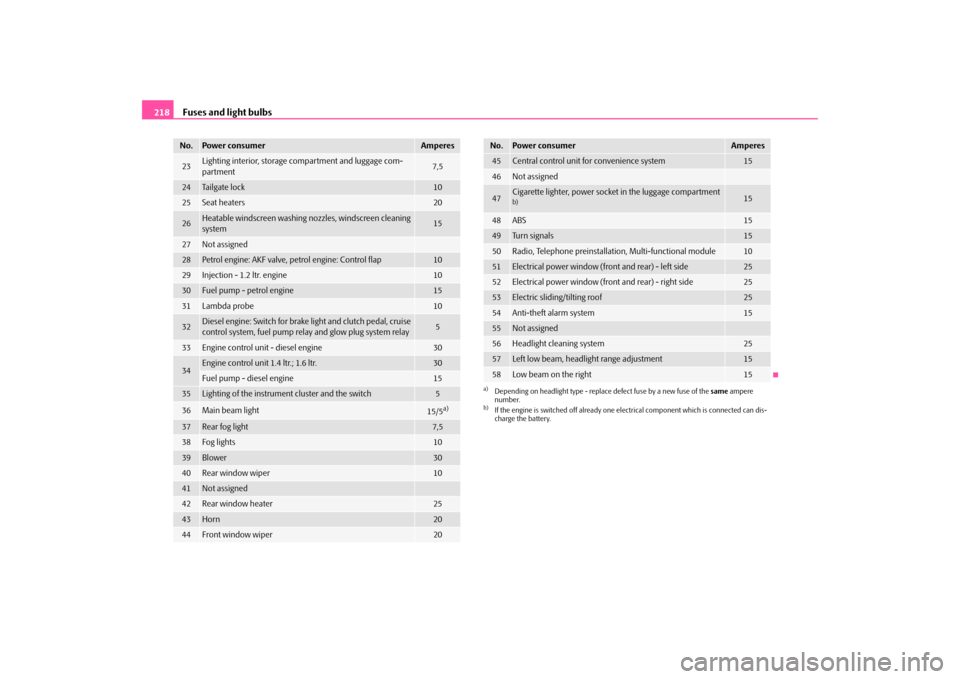
Fuses and light bulbs 21823
Lighting interior, storage compartment and luggage com-
partment
7,5
24
Tailgate lock
10
25
Seat heaters
20
26
Heatable windscreen washing nozzles, windscreen cleaning
system
15
27
Not assigned
28
Petrol engine: AKF valve, petrol engine: Control flap
10
29
Injection - 1.2 ltr. engine
10
30
Fuel pump - petrol engine
15
31
Lambda probe
10
32
Diesel engine: Switch for brake light and clutch pedal, cruise
control system, fuel pump relay and glow plug system relay
5
33
Engine control unit - diesel engine
30
34
Engine control unit 1.4 ltr.; 1.6 ltr.
30
Fuel pump - diesel engine
15
35
Lighting of the instrument cluster and the switch
5
36
Main beam light
15/5
a)
37
Rear fog light
7,5
38
Fog lights
10
39
Blower
30
40
Rear window wiper
10
41
Not assigned
42
Rear window heater
25
43
Horn
20
44
Front window wiper
20
No.
Power consumer
Amperes
45
Central control unit for convenience system
15
46
Not assigned
47
Cigarette lighter, power socket in the luggage compartment b)
15
48
ABS
15
49
Tu r n s i g n a l s
15
50
Radio, Telephone preinstallation, Multi-functional module
10
51
Electrical power window (front and rear) - left side
25
52
Electrical power window (front and rear) - right side
25
53
Electric sliding/tilting roof
25
54
Anti-theft alarm system
15
55
Not assigned
56
Headlight cleaning system
25
57
Left low beam, headlight range adjustment
15
58
Low beam on the right
15
a)Depending on headlight type - replace defect fuse by a new fuse of the same ampere
number.b)If the engine is switched off already one electrical component which is connected can dis-
charge the battery.No.
Power consumer
Amperes
s3f4.1.book Page 218 Thursday, June 18, 2009 11:07 AM
Page 220 of 259

Fuses and light bulbs219
Using the system
Safety
Driving Tips
General Maintenance
Breakdown assistance
Technical Data
Replace fuses at the battery (manual gearbox)– Press together ⇒fig. 207 the interlocks of the fuse cover simultane-
ously in direction of arrow and push out the cover in direction of
arrow .
– Find out which fuse belongs to the component which is not operating.
– Defect fuses can be detected by their melted metal strips. Replace the
defect fuse by a new fuse of the same ampere number.
Caution•
Never attempt to “repair” fuses and also do not replace them with a fuse of a
higher amperage - risk of fire! This may also cause damage at another part of the
electrical system.
•
Have the electrical system checked as quickly as possible by a specialist garage
if a newly inserted fuse blows again after a short time.Note
We recommend that you have these fuses replaced by a specialist garage.
Fuse assignment at the battery (manual gearbox)Certain electrical components are only standard on certain vehicle model versions
or only suppliable as optional equipment for certain models.
Fig. 207 The battery: fuse
cover
AA
AB
No.
Power consumer
Amperes
1
Dynamo
175
2
Not assigned
3
Interior
80
4
Electrical auxiliary heating system
60
5
Interior
40
6
Glow plugs, coolant fan
50
7
Electrohydraulic power steering
50
8
ABS or TCS or ESP
25
9
The radiator fan
30
10
The radiator fan
5
Fig. 208 Schematic repre-
sentation of fuse assignment
at battery
s3f4.1.book Page 219 Thursday, June 18, 2009 11:07 AM
Page 221 of 259

Fuses and light bulbs 220
CautionObserve the following guidelines ⇒ in “Replace fuses at the battery (manual
gearbox)”.
Note
The fuses 1 - 7 can be replaced by a specialist garage.Replace fuses at the battery (automatic gearbox)
– Open the positive terminal cover (+) ⇒fig. 209.
– Press onto the interlocks of the fuse covers ⇒fig. 210 and open
the covers.
– Press together the interlocks of the fuse cover simultaneously and
push out the cover in the direction of the arrow.
– Find out which fuse belongs to the component which is not operating
⇒page 221, “Fuse assignment at the battery (automatic gearbox)”.
– Defect fuses can be detected by their melted metal strips. Replace the
defect fuse by a new fuse of the same ampere number.
Caution•
Never attempt to “repair” fuses and also do not replace them with a fuse of a
higher amperage - risk of fire! This may also cause damage at another part of the
electrical system.
•
Have the electrical system checked as quickly as possible by a specialist garage
if a newly inserted fuse blows again after a short time.Note
•
We recommend that you have these fuses replaced by a specialist garage.
•
Some vehicles are only fitted with the cover ⇒fig. 210.
11
ABS or TCS or ESP
40
12
Central control unit
5
13
Automatic gearbox
electrical auxiliary heating system
5
30
No.
Power consumer
Amperes
Fig. 209 The battery:
Opening of the positive
terminal cover.
Fig. 210 The battery: fuse
coverAAAB
AB
s3f4.1.book Page 220 Thursday, June 18, 2009 11:07 AM
Page 222 of 259
Fuses and light bulbs221
Using the system
Safety
Driving Tips
General Maintenance
Breakdown assistance
Technical Data
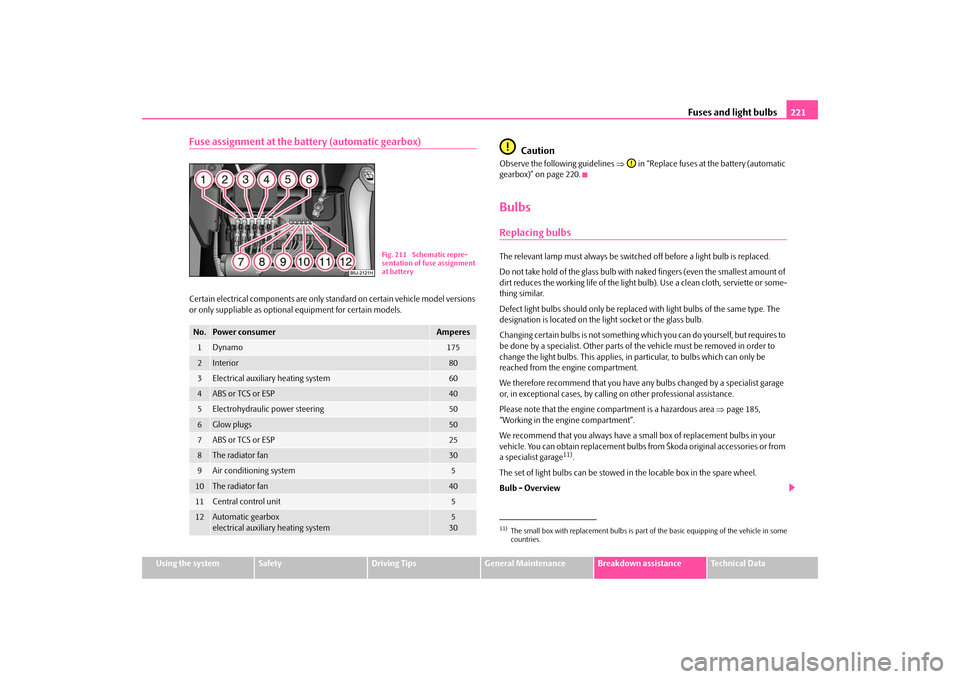
Fuse assignment at the battery (automatic gearbox)Certain electrical components are only standard on certain vehicle model versions
or only suppliable as optional equipment for certain models.
Caution
Observe the following guidelines ⇒ in “Replace fuses at the battery (automatic
gearbox)” on page 220.BulbsReplacing bulbsThe relevant lamp must always be switched off before a light bulb is replaced.
Do not take hold of the glass bulb with naked fingers (even the smallest amount of
dirt reduces the working life of the light bulb). Use a clean cloth, serviette or some-
thing similar.
Defect light bulbs should only be replaced with light bulbs of the same type. The
designation is located on the light socket or the glass bulb.
Changing certain bulbs is not something which you can do yourself, but requires to
be done by a specialist. Other parts of the vehicle must be removed in order to
change the light bulbs. This applies, in particular, to bulbs which can only be
reached from the engine compartment.
We therefore recommend that you have any bulbs changed by a specialist garage
or, in exceptional cases, by calling on other professional assistance.
Please note that the engine compartment is a hazardous area ⇒page 185,
“Working in the engine compartment”.
We recommend that you always have a small box of replacement bulbs in your
vehicle. You can obtain replacement bulbs from Škoda original accessories or from
a specialist garage
11).
The set of light bulbs can be stowed in the locable box in the spare wheel.
Bulb - Overview
No.
Power consumer
Amperes
1
Dynamo
175
2
Interior
80
3
Electrical auxiliary heating system
60
4
ABS or TCS or ESP
40
5
Electrohydraulic power steering
50
6
Glow plugs
50
7
ABS or TCS or ESP
25
8
The radiator fan
30
9
Air conditioning system
5
10
The radiator fan
40
11
Central control unit
5
12
Automatic gearbox
electrical auxiliary heating system
5
30
Fig. 211 Schematic repre-
sentation of fuse assignment
at battery
11)The small box with replacement bulbs is part of the basic equipping of the vehicle in some
countries.
s3f4.1.book Page 221 Thursday, June 18, 2009 11:07 AM
Page 229 of 259

Technical Data 228Partial description of the vehicle
7GG, 7MB, 7MG - vehicles with DPF ⇒page 162
Vehicle identification number (VIN)
The vehicle identification number - VIN (vehicle body number) is stamped into the
engine compartment on the right hand shock absorber dome. This number is also
located on a sign on the lower left hand edge below the windscreen (together with
a VIN bar code).
Engine number
The engine number is stamped into the engine block.
Type plate (production plate)
The type plate is located in the engine compartment at the front on the left hand
shock absorber dome.
Homologation sign
The homologation sign is located on the lock carrier. Vehicles for certain countries
do not have an homologation sign.
Sticker on inside of fuel filler flap
The sticker is affixed to the inside of the fuel filler flap. They contain the following
data:
•
the prescribed type of fuel;
•
tyre size;
•
Tyre pressure.
Fuel consumption according to the regulations (99/100/EU)Depending on the range of the special equipment, style of driving, traffic situation,
weather influences and vehicle condition, the consumption values which in prac-
tice result when using the vehicle can deviate from the indicated values.Urban traffic
The consumption measurement in urban traffic begins with starting of the cold
engine. Afterwards the normal urban traffic is simulated.
Non-urban traffic
For the consumption measurement in non-urban traffic the vehicle, as in daily
motoring, is accelerated and braked several times in all gears. The vehicle speed
changes within the range from 0 to 120 km/h.
Combined traffic
The consumption value in the combined traffic consists of 37% from the value for
the urban traffic and of 63% from the value for the non-urban traffic.
Note
•
Please note that the information stated in the official vehicle registration
documents always takes priority.
A4A5s3f4.1.book Page 228 Thursday, June 18, 2009 11:07 AM