2009 Seat Ibiza ST technical data
[x] Cancel search: technical dataPage 20 of 250
Seat belts19
Safety First
Operating instructions
Practical tips
Technical Data
travelling just before the impact. This example applies not only to frontal acci-
dents, but to all accidents and collisions.
The danger of not using the seat belt
The general belief that the passengers can protect them-
selves with their hands in a minor collision is false.
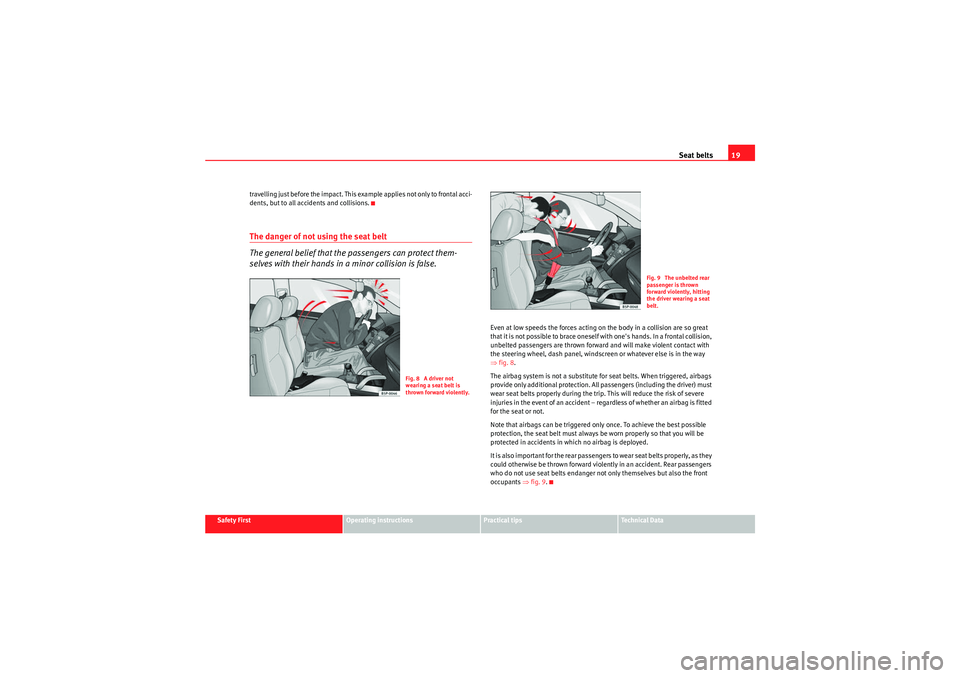
Even at low speeds the forces acting on the body in a collision are so great
that it is not possible to brace oneself with one's hands. In a frontal collision,
unbelted passengers are thrown forward and will make violent contact with
the steering wheel, dash panel, windscreen or whatever else is in the way
⇒
fig. 8 .
The airbag system is not a substitute for seat belts. When triggered, airbags
provide only additional protection. All passengers (including the driver) must
wear seat belts properly during the trip. This will reduce the risk of severe
injuries in the event of an accident – regardless of whether an airbag is fitted
for the seat or not.
Note that airbags can be triggered only once. To achieve the best possible
protection, the seat belt must always be worn properly so that you will be
protected in accidents in which no airbag is deployed.
It is also important for the rear passengers to wear seat belts properly, as they
could otherwise be thrown forward violently in an accident. Rear passengers
who do not use seat belts endanger not only themselves but also the front
occupants ⇒fig. 9 .
Fig. 8 A driver not
wearing a seat belt is
thrown forward violently.
Fig. 9 The unbelted rear
passenger is thrown
forward violently, hitting
the driver wearing a seat
belt.
Ibiza ST_EN.book Seite 19 Dienstag, 12. Januar 2010 4:03 16
Page 22 of 250
Seat belts21
Safety First
Operating instructions
Practical tips
Technical Data
•Fasten your seat belt before every trip - even when driving in town. The
other passengers must also wear seat belts, otherwise they may be in
danger of injury!•The seat belt cannot offer its full protection if the seat belt is not posi-
tioned correctly.•Never allow two passengers (even children) to share the same seat belt.•Keep both feet in the footwell in front of your seat as long as the vehicle
is in motion.•Never unbuckle a seat belt while the vehicle is in motion. Risk of fatal
injury.•The seat belt must never be twisted while it is being worn.•The seat belt should never lie on hard or fragile objects (such as glasses
or pens, etc.) because this can cause injuries.•Do not allow the seat belt to be damaged or jammed, or to rub on any
sharp edges.•Never wear the seat belt under the arm or in any other incorrect posi-
tion.•Loose, bulky clothing (such as an overcoat over a jacket) impairs the
proper fit and function of the belts, reducing their capacity to protect.•The slot in the seat belt buckle must not be blocked with paper or other
objects, as this can prevent the latch plate from engaging securely.•Never use seat belt clips, retaining rings or similar instruments to alter
the position of the belt webbing.•Frayed or torn seat belts or damage to the connections, belt retractors
or parts of the buckle could cause severe injuries in the event of an acci-
dent. Therefore, you must check the co ndition of all seat belts at regular
intervals.•Seat belts which have been worn in an accident and stretched must be
replaced by a qualified workshop. Renewal may be necessary even if there
is no apparent damage. The belt anchorage should also be checked.
•Do not attempt to repair a damaged seat belt yourself. The seat belts
must not be removed or modified in any way.•The belts must be kept clean, otherwise the retractors may not work
properly.
Seat beltsSeat belt adjustment
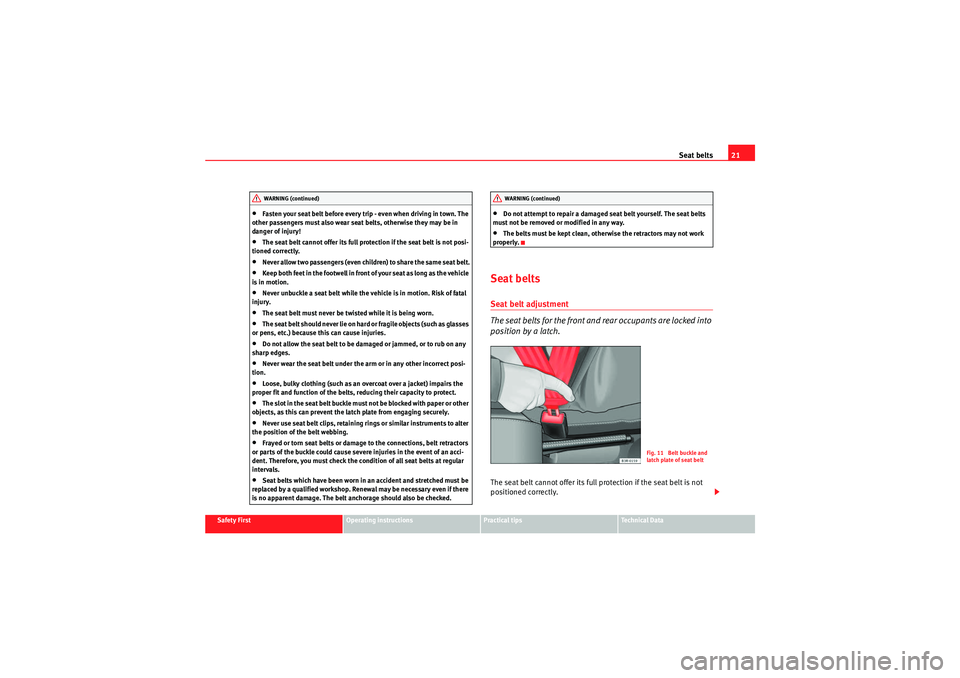
The seat belts for the front and rear occupants are locked into
position by a latch.The seat belt cannot offer its full protection if the seat belt is not
positioned correctly.
WARNING (continued)
WARNING (continued)
Fig. 11 Belt buckle and
latch plate of seat belt
Ibiza ST_EN.book Seite 21 Dienstag, 12. Januar 2010 4:03 16
Page 24 of 250

Seat belts23
Safety First
Operating instructions
Practical tips
Technical Data
WARNING
•An incorrectly worn seat seat belt can cause severe injuries in the event
of an accident.•The shoulder belt must be positioned around the middle of the
shoulder. The seat belt must lie flat and snugly on the torso ⇒page 22,
fig. 12 .•The lap part of the seat belt must lie across the pelvis, never across the
stomach. The seat belt must lie flat and snugly on the pelvis ⇒page 22,
fig. 13 . Pull the belt tight if necessary to take up any slack.•Read and observe the warnings ⇒page 20.
Pregnant women must also fasten their seat belts properly
The best protection for the unbo rn child is for the mother to
wear the seat belt properly at all times during the pregnancy.
The seat belt provides maximum protection only when the seat belt
is properly positioned ⇒page 22.
– Adjust the front seat and head restraint correctly.
– Holding the latch plate, pull the belt evenly across your chest and as low as possible over the pelvis ⇒fig. 14 .
– Insert the latch plate into the buckle for the corresponding seat and push it down until it is securely locked with an audible click
⇒ .
– Pull the belt to ensure that the latch plate is securely engaged in the buckle.
WARNING
•An incorrectly worn seat seat belt can cause severe injuries in the event
of an accident.•For pregnant women, the lap part of the seat belt must lie as low as
possible over the pelvis, never across the stomach, and always lie flat so
that no pressure is exerted on the abdomen.•Read and observe the warnings ⇒page 20.
Fig. 14 Positioning seat
belts during pregnancy
Ibiza ST_EN.book Seite 23 Dienstag, 12. Januar 2010 4:03 16
Page 26 of 250

Seat belts25
Safety First
Operating instructions
Practical tips
Technical Data
Belt tensioners*Function of the belt tension device
During a frontal collision, the seat belts on the front seats are
retracted automatically.The seat belts for the front occupants are equipped with belt tensioners.
Sensors will trigger the belt tensioners during severe head-on, lateral and
rear collisions only if the seat belt is being worn. This retracts and tightens the
seat belts, reducing the forward motion of the occupants.
The belt tension device can be triggered only once.
The belt tensioners will not be triggered in the event of light frontal and side
collisions, if the vehicle overturns, or in situations where no large forces act
on the front, side or rear of the vehicle.
Note
•If the belt tensioners are triggered, a fine dust is produced. This is normal
and it is not an indication of fire in the vehicle.•The relevant safety requirements must be observed when the vehicle or
components of the system are scrapped. A qualified workshop is familiar with
these regulations and will be pleased to pass on the information to you.Service and disposal of belt tensionersThe belt tensioners are components of the seat belts that are installed in the
seats of your vehicle. If you work on the belt tensioners or remove and install
parts of the system when performing other repair work, the seat belt may be
damaged. The consequence may be that, in the event of an accident, the belt
tensioners function incorrectly or not at all. So that the effectiveness of the belt tension device is not reduced and that
removed parts do not cause any injuries or environmental pollution, regula-
tions, which are known to the qualified workshops, must be observed.
WARNING
•If repairs are not carried out by a professional, or if the belt tensioners
are used incorrectly, the risk of severe or fatal injuries increases. The belt
tensioners may fail to trigger or may trigger in the wrong circumstances.•Never attempt to repair, adjust, remove or install parts of the belt
tensioners or seat belts.•The belt tension device and seat belt including its automatic retractor
cannot be repaired.•Any work on the belt tensioners and seat belts, including the removal
and refitting of system parts in conjunction with other repair work, must be
performed by a qualified workshop only.•The belt tensioners will only provide protection for one accident and
must be changed it they have been activated.
Ibiza ST_EN.book Seite 25 Dienstag, 12. Januar 2010 4:03 16
Page 28 of 250

Airbag system27
Safety First
Operating instructions
Practical tips
Technical Data
•Always properly adjust the front seats.
The danger of fitting a child seat on the front passenger seat
Rear-facing child seats must never be used on the front
passenger seat when the front passenger airbag is enabled.An enabled front airbag on the front passenger side is potentially a major
danger to a child. The front passenger seat is life threatening to a child if
he/she is transported in a rear-facing child seat. You should always transport
all children up to 12 years of age on the rear seat.
If a rear-facing child seat is secured to the front passenger seat, an inflating
airbag can strike it with such great force that critical or fatal injuries may
result.
Therefore we strongly recommend you to transport children on the rear seats.
That is the safest place for children in the vehicle. Alternatively, the front
passenger airbag can be disabled with a key-operated switch ⇒page 36.
When transporting children, use a child seat appropriate to the age and size
of each child.
For those vehicles that do not include a key lock switch to turn the airbag off,
an Authorised Service Centre must be consulted.
WARNING
•If a child seat is secured to the front passenger seat, the risk to the child
of sustaining critical or fatal injuries in the event of an accident increases.•Never secure a rear-facing child seat to the front passenger seat if the
front passenger airbag is enabled. The child can suffer critical or fatal inju-
ries when the front passenger airbag is triggered.
•An inflating front passenger airbag can strike the rear-facing child seat
and hurl it with great force against the door, the roof or the backrest.•If, under special circumstances, it is necessary to transport a child in a
rear-facing child seat on the front passenger seat, it is absolutely essential
that you observe the following safety measures:
−Disable the front passenger airbag ⇒page 36, “Deactivating
airbags*”.
− The child seat must be approved by the child seat manufacturer for
use on a front passenger seat with front or side airbag.
− Follow the installation instructions of the child seat manufacturer
and absolutely observe all warnings
− Before properly installing the child seat, push the front passenger
seat completely backwards so that the greatest possible distance to
the front passenger airbag is ensured.
− Ensure that no objects prevent the front passenger seat from being
pushed completely back.
− The backrest of the front passenger seat must be in an upright
position.
Warning lamp for airbag and belt tension device system
This warning lamp monitors the airbag and belt tensioner
system.The warning lamp monitors all airbags and belt tensioners in the vehicle,
including control units and wiring connections.
WARNING (continued)
WARNING (continued)
Ibiza ST_EN.book Seite 27 Dienstag, 12. Januar 2010 4:03 16
Page 30 of 250
Airbag system29
Safety First
Operating instructions
Practical tips
Technical Data
Front airbagsDescription of front airbags
The airbag system is not a substitute for the seat belts.
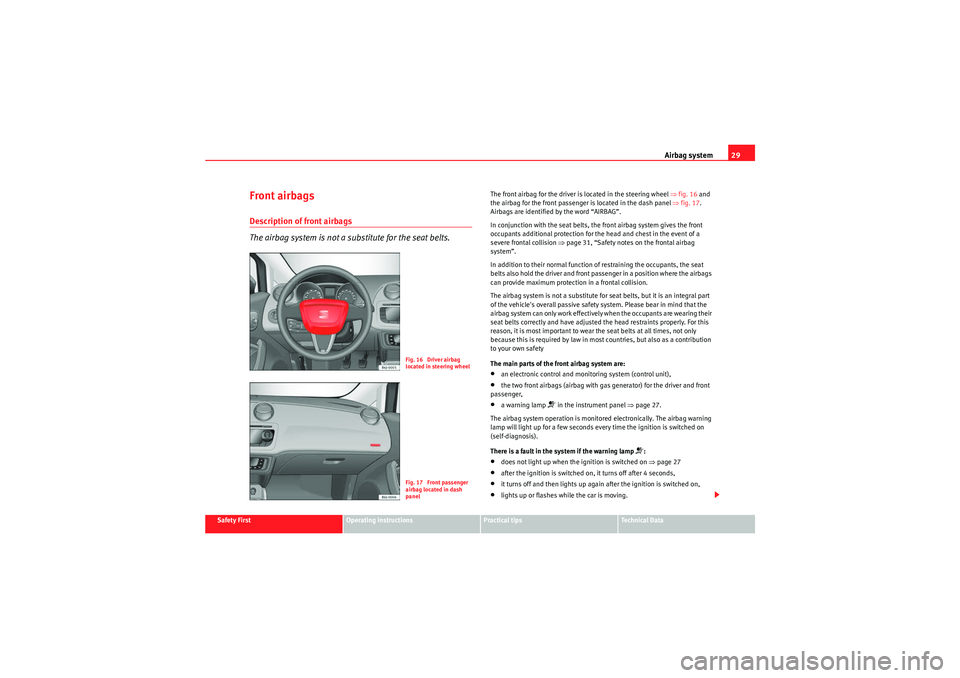
The front airbag for the driver is located in the steering wheel ⇒fig. 16 and
the airbag for the front passenger is located in the dash panel ⇒fig. 17 .
Airbags are identified by the word “AIRBAG”.
In conjunction with the seat belts, the front airbag system gives the front
occupants additional protection for the head and chest in the event of a
severe frontal collision ⇒page 31, “Safety notes on the frontal airbag
system”.
In addition to their normal function of restraining the occupants, the seat
belts also hold the driver and front passenger in a position where the airbags
can provide maximum protection in a frontal collision.
The airbag system is not a substitute for seat belts, but it is an integral part
of the vehicle's overall passive safety system. Please bear in mind that the
airbag system can only work effectively when the occupants are wearing their
seat belts correctly and have adjusted the head restraints properly. For this
reason, it is most important to wear the seat belts at all times, not only
because this is required by law in most countries, but also as a contribution
to your own safety
The main parts of the front airbag system are:•an electronic control and monitoring system (control unit),•the two front airbags (airbag with gas generator) for the driver and front
passenger,•a warning lamp
in the instrument panel ⇒page 27.
The airbag system operation is monitored electronically. The airbag warning
lamp will light up for a few seconds every time the ignition is switched on
(self-diagnosis).
There is a fault in the system if the warning lamp
:
•does not light up when the ignition is switched on ⇒ page 27•after the ignition is switched on, it turns off after 4 seconds,•it turns off and then lights up again after the ignition is switched on,•lights up or flashes while the car is moving.
Fig. 16 Driver airbag
located in steering wheelFig. 17 Front passenger
airbag located in dash
panel
Ibiza ST_EN.book Seite 29 Dienstag, 12. Januar 2010 4:03 16
Page 32 of 250
Airbag system31
Safety First
Operating instructions
Practical tips
Technical Data
may develop when the airbag deploys. This is normal and it is not an indica-
tion of fire in the vehicle.
Safety notes on the frontal airbag system
If you use airbags correctly, they can considerably reduce the
risk of injury in many kinds of accident.
WARNING
•It is important for the driver and front passenger to keep a distance of
at least 25 cm from the steering wh eel or dash panel. If the minimum
distance is not observed, the airbags do not correctly protect the vehicle
occupants; risk of fatal injuries! In addition, the front seats and head
restraints must always be positioned correctly for the height of the occu-
pant.•If you are not wearing a seat belt, if you lean forward or to the side while
travelling or assume an incorrect sitting position, there is a substantially
increased risk of injury. This increased risk of injury will be further
increased if you are struck by an inflating airbag.•Never let a child travel on the front seat without an appropriate restraint
system. If the airbag is triggered in an accident, children can sustain
serious or fatal injuries from the airbag as it inflates ⇒page 38, “Child
safety”.•The deployment space between the front passengers and the airbags
must not in any case be occupied by other passenger, pets and objects.•The airbags provide protection for just one accident; replace them once
they have deployed.•It is also important not to attach any objects such as cup holders or
telephone mountings to the surfaces covering the airbag units.•Do not attempt to modify components of the airbag system in any
way.
Ibiza ST_EN.book Seite 31 Dienstag, 12. Januar 2010 4:03 16
Page 34 of 250
Airbag system33
Safety First
Operating instructions
Practical tips
Technical Data
•Any work carried out to the doors should be made in a qualified author-
ised workshop.•The seat belts and airbags can only provide maximum protection if the
occupants are seated correctly ⇒ page 9, “Proper sitting position for occu-
pants”.•If a fault has occurred in the airbag system, have the system checked
immediately by a qualified workshop. Otherwise, during a side collision,
the system may fail to trigger, or not trigger correctly.WARNING (continued)
Ibiza ST_EN.book Seite 33 Dienstag, 12. Januar 2010 4:03 16