2009 Seat Ibiza SC ignition
[x] Cancel search: ignitionPage 79 of 257

Unlocking and locking77
Safety First
Controls and equipment
Practical tips
Technical Data
Anti-theft alarm system*Description of anti-theft alarm system*
The anti-theft alarm triggers if unauthorised movements are
detected around the vehicle.The anti-theft alarm makes it more difficult to break into the vehicle or steal
it. The system will emit acoustic and optical warning signals if someone is
trying to force your vehicle.
The anti-theft alarm system is automatically connected on locking the
vehicle. For this, either rotate the key in the locking position or press button
on the radio-frequency remote control*. The system is immediately
activated and the indicator light located on the driver's door will flash along
with the indicators, indicating that the alarm and the locking security system
(double lock) have been turned on.
If any of the doors or the bonnet are open, they will not be included in the
protection zones of the vehicle when the alarm is connected. If the door or the
bonnet are subsequently closed, they will be automatically included in the
protection areas of the vehicle and the indicators will flash accordingly when
the doors close.•The indicator light will flash twice on opening and deactivating the alarm..•The indicator light will flash once on closing and activating the alarm.
When does the system trigger an alarm?
The system triggers an alarm if the following unauthorised actions are carried
out when the car is locked:•Opening of vehicle with mechanical key without switching ignition on
within the next 15 seconds•Opening a door•Opening the bonnet
•Opening the tailgate•Ignition switched on with a non-validated key.•Movements in the driving compartment (vehicles with a volume sensor)•Towing of the vehicle
7)
•Tilt angle (tow-away protection)
7)
•Undue manipulation of the alarm•Battery handling
The acoustic signals sound and the indicators flash for approx. 30 seconds.
This may be repeated up to 10 times depending on the country.
How to switch the alarm off
To deactivate the anti-theft alarm, turn the key to the opening direction, open
the door and switch the ignition on, or press the unlocking button on the
remote control.
In vehicles equipped with an anti-theft alarm system, you have 15 seconds to
insert the key in the ignition lock and activate the ignition if the vehicle is
opened using the driver's door key.
Otherwise, the alarm will trigger for 30 sec. and the ignition will be blocked.Note
•After 28 days, the indicator light will be switched off to prevent the battery
from exhausting if the vehicle has been left parked for a long period of time.
The alarm system remains activated.•The alarm will trigger again if attempts are made to open another protec-
tion zone.•The alarm system can be activated or deactivated using the remote
control ⇒page 75.
A2
7)With vehicles fitted with a tow-away protection
IbizaSC_EN.book Seite 77 Mittwoch, 16. September 2009 12:11 12
Page 83 of 257

Unlocking and locking81
Safety First
Controls and equipment
Practical tips
Technical Data
WindowsOpening or closing the windows electrically*
All electric windows can be operated using the controls on the
driver door.Opening and closing the windows
– Press the button to open a window.
– Pull button to close a window ⇒ .Always close the windows fully if you park the vehicle or leave it unattended
⇒.
You can use the electric windows for approx. 10 minutes after switching off
the ignition if neither the driver door nor the front passenger door has been
opened and the key has not been removed from the ignition. Buttons on the driver's door
Button for window in front left door
Button for window in front right door
WARNING
•Incorrect use of the electric windows can result in injury.•Never close the tailgate without observing and ensuring it is clear, to do
otherwise could cause serious injury to you and third parties. Make sure
that no one is in the path of a window.•Always take the vehicle key with you when you leave the vehicle.•Never leave children or disabled persons in the vehicle, particularly if
they have access to the keys. The misuse of the keys, for example, by chil-
dren, may result in serious injury and accident.•The engine may accidentally be started and be out of control.•If the ignition is switched on, the electric equipment could be activated
with risk of injury, for example, in the electric windows.•The doors can be locked using the remote control key. This could make
assistance difficult in an emergency.•Always take the key with you when you leave the vehicle.•The electric windows are only deactivated on switching the ignition off
and opening any of the doors.Note
If the window is not able to close because it is stiff or because of an obstruc-
tion, the window will automatically open again ⇒ page 82. If this happens,
check why the window could not be closed before attempting to close it
again.
Fig. 48 Detail of driver
door: controls for the front
windows.
A1A2
IbizaSC_EN.book Seite 81 Mittwoch, 16. September 2009 12:11 12
Page 85 of 257

Unlocking and locking83
Safety First
Controls and equipment
Practical tips
Technical Data
•Always take the key with you when leaving the vehicle, even if you only
intend to be gone for a short time. Please ensure that children are never left
alone inside the vehicle.•The electric windows will work until the ignition has been switched off
and one of the front doors has been opened.•Closing the windows without observing and ensuring it is clear could
cause serious injury to you and third parties. Make sure that no one is in
the path of a window.•Never allow people to remain in the vehicle when you close the vehicle
from the outside. The windows cannot be opened even in an emergency.•The roll-back function does not prevent fingers or other parts of the
body getting pinched against the window frame and cause injury.
Convenience opening and closing* Using the door lock
– Hold the key in the door lock of the driver door in either the locking or the unlocking position until all windows are either
opened or closed.
– Release the key to interrupt this function.
Using the remote control
– Keep the locking/unlocking button pressed for the electrical window risers to open/close; if you stop pressing the button, the
window raising/lowering function is stopped.
– If the automatic raising is stopped and immediately after, the opening button is kept pressed, the window risers will lower. – Once the windows are completely closed, the indicators will
flash.
Panoramic tilting roof*Opening and closing th e sliding/tilting roof
The panoramic/tilting roof is opened and closed by using the
switch when the ignition is switched on.Closing the panoramic/tilting sunroof
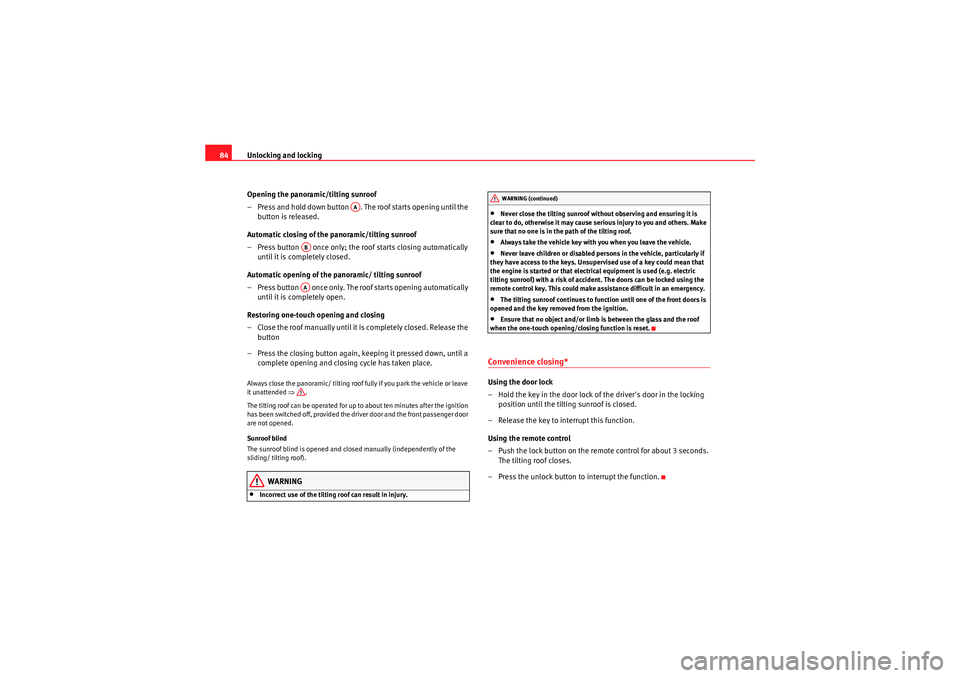
– Press and hold button ⇒fig. 49 ⇒ , the roof starts to
close until the button is released.
WARNING (continued)
Fig. 49 Panoramic/tilting
sunroof
AB
IbizaSC_EN.book Seite 83 Mittwoch, 16. September 2009 12:11 12
Page 86 of 257
Unlocking and locking
84
Opening the panoramic/tilting sunroof
– Press and hold down button . The roof starts opening until the button is released.
Automatic closing of the panoramic/tilting sunroof
– Press button once only; the roof starts closing automatically until it is completely closed.
Automatic opening of the panoramic/ tilting sunroof
– Press button once only. The roof starts opening automatically until it is completely open.
Restoring one-touch opening and closing
– Close the roof manually until it is completely closed. Release the button
– Press the closing button again, keeping it pressed down, until a complete opening and closing cycle has taken place.Always close the panoramic/ tilting roof fully if you park the vehicle or leave
it unattended ⇒ .
The tilting roof can be operated for up to about ten minutes after the ignition
has been switched off, provided the driver door and the front passenger door
are not opened.
Sunroof blind
The sunroof blind is opened and closed manually (independently of the
sliding/ tilting roof).
WARNING
•Incorrect use of the tilting roof can result in injury.
•Never close the tilting sunroof without observing and ensuring it is
clear to do, otherwise it may cause serious injury to you and others. Make
sure that no one is in the path of the tilting roof.•Always take the vehicle key with you when you leave the vehicle.•Never leave children or disabled persons in the vehicle, particularly if
they have access to the keys. Unsupervised use of a key could mean that
the engine is started or that electrical equipment is used (e.g. electric
tilting sunroof) with a risk of accident. The doors can be locked using the
remote control key. This could make assistance difficult in an emergency.•The tilting sunroof continues to function until one of the front doors is
opened and the key removed from the ignition.•Ensure that no object and/or limb is between the glass and the roof
when the one-touch opening/closing function is reset.
Convenience closing*Using the door lock
– Hold the key in the door lock of the driver's door in the locking position until the tilting sunroof is closed.
– Release the key to interrupt this function.
Using the remote control
– Push the lock button on the remote control for about 3 seconds. The tilting roof closes.
– Press the unlock button to interrupt the function.
AA
ABAA
WARNING (continued)
IbizaSC_EN.book Seite 84 Mittwoch, 16. September 2009 12:11 12
Page 88 of 257
Lights and visibility
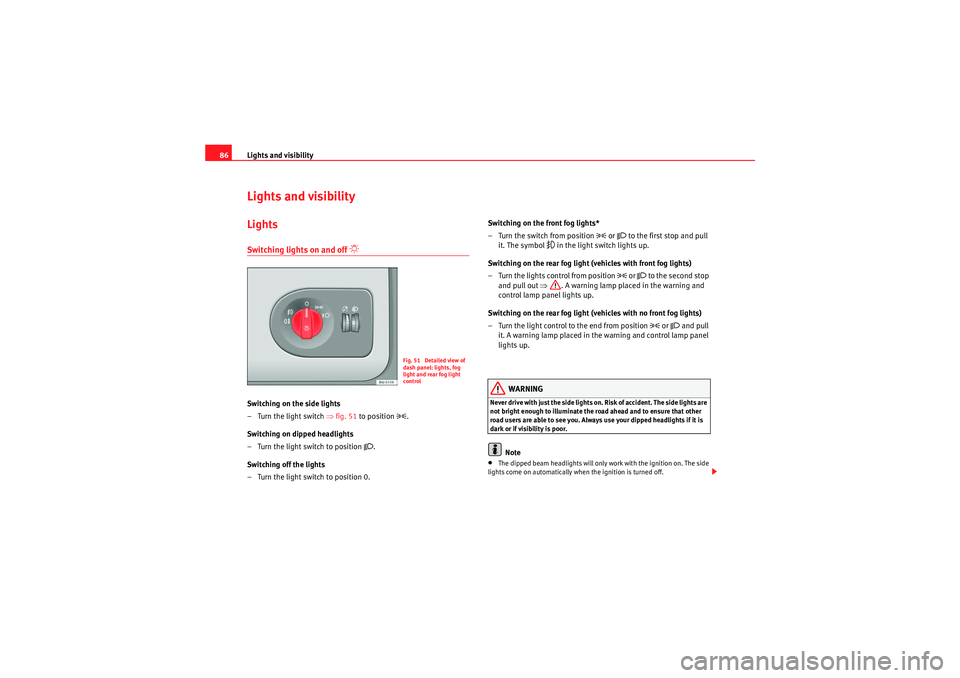
86Lights and visibilityLightsSwitching lights on and off
Switching on the side lights
–Turn the light switch ⇒ fig. 51 to position
.
Switching on dipped headlights
– Turn the light switch to position
.
Switching off the lights
– Turn the light switch to position 0. Switching on the front fog lights*
– Turn the switch from position
or to the first stop and pull
it. The symbol
in the light switch lights up.
Switching on the rear fog light (vehicles with front fog lights)
– Turn the lights control from position
or to the second stop
and pull out ⇒ . A warning lamp placed in the warning and
control lamp panel lights up.
Switching on the rear fog light (vehicles with no front fog lights)
– Turn the light control to the end from position or and pull
it. A warning lamp placed in th e warning and control lamp panel
lights up.
WARNING
Never drive with just the side lights on. Risk of accident. The side lights are
not bright enough to illuminate the road ahead and to ensure that other
road users are able to see you. Always use your dipped headlights if it is
dark or if visibility is poor.
Note
•The dipped beam headlights will only work with the ignition on. The side
lights come on automatically when the ignition is turned off.
Fig. 51 Detailed view of
dash panel: lights, fog
light and rear fog light
control
IbizaSC_EN.book Seite 86 Mittwoch, 16. September 2009 12:11 12
Page 89 of 257

Lights and visibility87
Safety First
Controls and equipment
Practical tips
Technical Data
•If the lights are left on after the key has been taken out of the ignition lock,
a buzzer will sound while the driver door remains open. This is a reminder to
switch the lights off.•The rear fog light is so bright that it can dazzle drivers behind you. You
should use the rear fog light only when visibility is very poor.•The use of the lighting described here is subject to the relevant statutory
requirements.Instrument and switch lighting / Headlight range controlInstrument and switch lighting
When the headlights are switched on, the brightness of the instruments and
switch lighting can be regulated to suit your requirements by turning the
thumb wheel ⇒fig. 52 .
Those vehicles fitted with xenon gas discharge headlights are fitted with an
automatic headlight range system. Headlight range control
By using the electrical headlight range control, you can adjust the head-
light range to the load level that is being carried in the vehicle. This way, it is
possible to avoid dazzling oncoming traffic more than necessary. At the same
time, by using the correct headlight settings, the driver has the best possible
lighting for the road ahead.
The headlights can only be adjusted when the dipped beam is switched on.
To lower the beam, turn the thumb wheel down from the basic setting
0.
Dynamic headlight range control
Vehicles with gas discharge lamps (xenon lamps) are equipped with dynamic
headlight range control . When you switch on the lights, their range regulates
itself according to the vehicle load.
Vehicles with gas discharge lamps do not have headlight range control.
Daytime running lights*
Daylight driving lights light up automatically when the igni-
tion is switched on (only in combination with AFS headlamps)Daylight driving lights switch off automatically when the street lighting
comes on.
Note
See legal requirements for each country.
Fig. 52 Instrument panel:
regulation for instrument
and switch illumination
and headlight range
control
A1
A1
A2
A2A2
IbizaSC_EN.book Seite 87 Mittwoch, 16. September 2009 12:11 12
Page 90 of 257
Lights and visibility
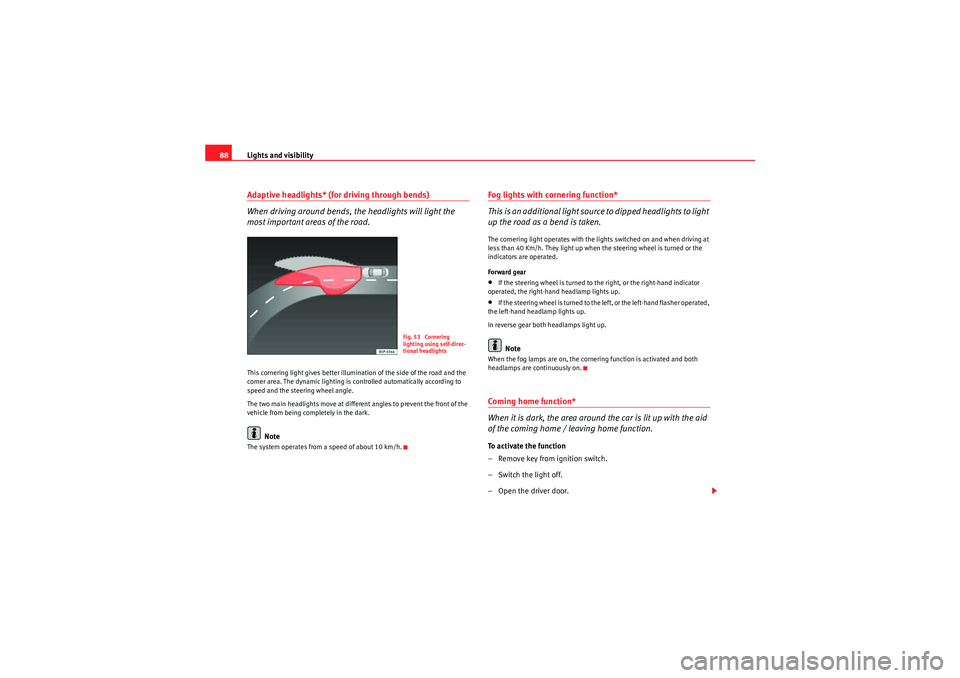
88Adaptive headlights* (for driving through bends)
When driving around bends, the headlights will light the
most important areas of the road.This cornering light gives better illumination of the side of the road and the
corner area. The dynamic lighting is controlled automatically according to
speed and the steering wheel angle.
The two main headlights move at different angles to prevent the front of the
vehicle from being completely in the dark.
Note
The system operates from a speed of about 10 km/h.
Fog lights with cornering function*
This is an additional light source to dipped headlights to light
up the road as a bend is taken.The cornering light operates with the lights switched on and when driving at
less than 40 Km/h. They light up when the steering wheel is turned or the
indicators are operated.
Forward gear•If the steering wheel is turned to the right, or the right-hand indicator
operated, the right-hand headlamp lights up.•If the steering wheel is turned to the left, or the left-hand flasher operated,
the left-hand headlamp lights up.
In reverse gear both headlamps light up.Note
When the fog lamps are on, the cornering function is activated and both
headlamps are continuously on.Coming home function*
When it is dark, the area around the car is lit up with the aid
of the coming home / leaving home function.To activate the function
– Remove key from ignition switch.
– Switch the light off.
– Open the driver door.
Fig. 53 Cornering
lighting using self-direc-
tional headlights
IbizaSC_EN.book Seite 88 Mittwoch, 16. September 2009 12:11 12
Page 92 of 257
Lights and visibility
90Hazard warning lights
The hazard warning lights are used to draw the attention of
other road users to your vehicle in emergencies.
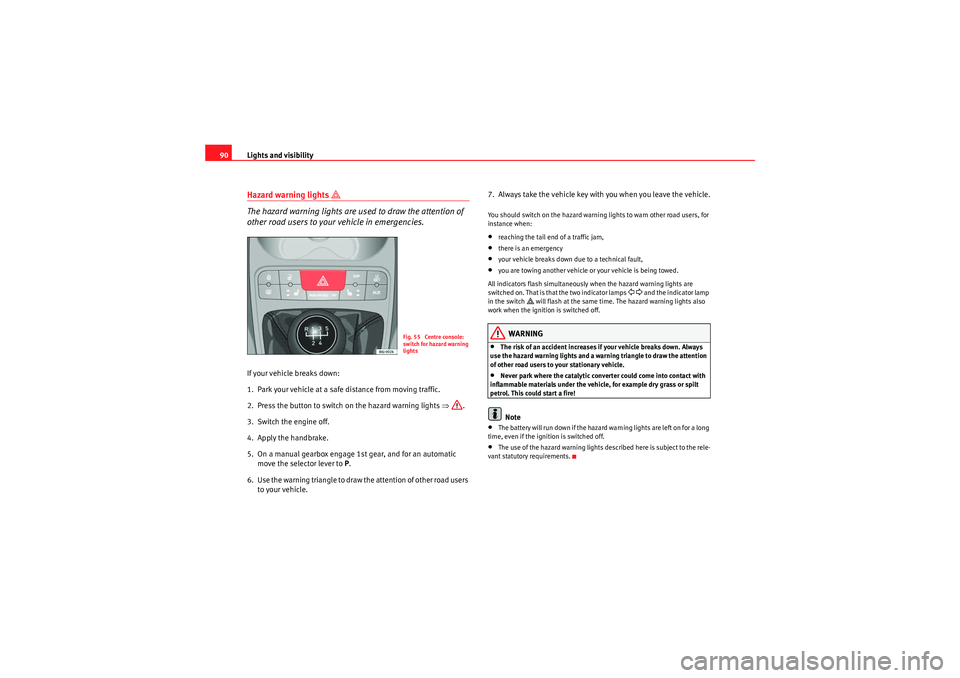
If your vehicle breaks down:
1. Park your vehicle at a safe distance from moving traffic.
2. Press the button to switch on the hazard warning lights ⇒.
3. Switch the engine off.
4. Apply the handbrake.
5. On a manual gearbox engage 1st gear, and for an automatic move the selector lever to P.
6. Use the warning triangle to draw the attention of other road users to your vehicle. 7. Always take the vehicle key with you when you leave the vehicle.
You should switch on the hazard warning lights to warn other road users, for
instance when:•reaching the tail end of a traffic jam,•there is an emergency•your vehicle breaks down due to a technical fault,•you are towing another vehicle or your vehicle is being towed.
All indicators flash simultaneously when the hazard warning lights are
switched on. That is that the two indicator lamps
and the indicator lamp
in the switch
will flash at the same time. The hazard warning lights also
work when the ignition is switched off.
WARNING
•The risk of an accident increases if your vehicle breaks down. Always
use the hazard warning lights and a warning triangle to draw the attention
of other road users to your stationary vehicle.•Never park where the catalytic converter could come into contact with
inflammable materials under the vehicle, for example dry grass or spilt
petrol. This could start a fire!Note
•The batter y will run down if the hazard warn ing lights are left on for a long
time, even if the ignition is switched off.•The use of the hazard warning lights described here is subject to the rele-
vant statutory requirements.
Fig. 55 Centre console:
switch for hazard warning
lights
IbizaSC_EN.book Seite 90 Mittwoch, 16. September 2009 12:11 12