2009 Seat Ibiza 5D ESP
[x] Cancel search: ESPPage 107 of 257

Seats and stowage105
Safety First
Controls and equipment
Practical tips
Technical Data
Heated seats*
The front seat cushions and backrests can be heated electri-
cally.
– Press the corresponding switch ⇒fig. 70 to switch on the seat
heating.
– Press once to connect the heating at maximum power. Two LEDs will light up ⇒fig. 70. After 15 min. of high intensity, the upper
LED goes out, the system is deactivated for 2 min. and is then
reactivated at low intensity (lower LED remains on permanently).
– Press the switch again to set the heating to minimum power. (The lower LED lights up).
– To disconnect the heating, press the switch again. Caution
To avoid damaging the heating elements, please do not kneel on the seat or
apply sharp pressure at a single point to the seat cushion and backrest.
Fig. 70 Front seats
heating switch
Ibiza_EN.book Seite 105 Montag, 14. September 2009 6:19 18
Page 108 of 257
Seats and stowage
106Rear seat benchFolding down rear seats
Folding seat down
– Remove the head restraint ⇒page 103.
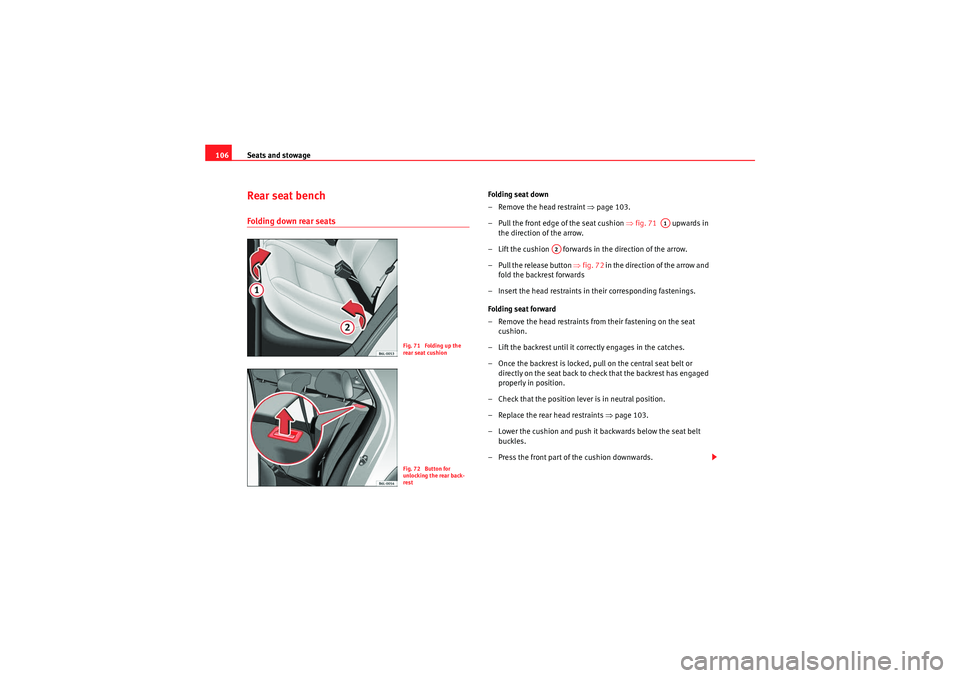
– Pull the front edge of the seat cushion ⇒ fig. 71 upwards in
the direction of the arrow.
– Lift the cushion forwards in the direction of the arrow.
– Pull the release button ⇒fig. 72 in the direction of the arrow and
fold the backrest forwards
– Insert the head restraints in their corresponding fastenings.
Folding seat forward
– Remove the head restraints from their fastening on the seat cushion.
– Lift the backrest until it correctly engages in the catches.
– Once the backrest is locked, pull on the central seat belt or directly on the seat back to check that the backrest has engaged
properly in position.
– Check that the position lever is in neutral position.
–Replace the rear head restraints ⇒page 103.
– Lower the cushion and push it backwards below the seat belt buckles.
– Press the front part of the cushion downwards.
Fig. 71 Folding up the
rear seat cushionFig. 72 Button for
unlocking the rear back-
rest
A1
A2
Ibiza_EN.book Seite 106 Montag, 14. September 2009 6:19 18
Page 109 of 257

Seats and stowage107
Safety First
Controls and equipment
Practical tips
Technical Data
On split rear seats
9) the backrest and cushion can be lowered and raised
respectively in two sections.
WARNING
•Please be careful when folding back the backrest! Injuries can be
caused if the backrest is tilted without due care and attention.•Do no trap or damage seat belts when raising the backrest.•After raising the backrest, check it has engaged properly in position. Do
this by pulling on the central seat belt or directly on the seat back and
check that the position lever is in the neutral position.•The three point automatic seat belt only works correctly when the back-
rest of the central seat is correctly engaged.
Stowage compartmentsStowage compartment on the front passenger sideThe compartment can be opened by pulling the lever ⇒fig. 73.
WARNING
Always keep the stowage compartment cover closed while the vehicle is in
motion in order to reduce the risk of injury caused by a sudden braking or
by an accident.
9)Optional equipment
Fig. 73 Passenger side:
stowage compartment
Ibiza_EN.book Seite 107 Montag, 14. September 2009 6:19 18
Page 117 of 257

Seats and stowage115
Safety First
Controls and equipment
Practical tips
Technical Data
•An overloaded boot could mean that the rear stowage tray is not correctly
seated and it may be bent or damaged.•If the boot is overloaded, remove the tray.Note
•Ensure that, when placing items of clothing on the luggage compartment
cover, rear visibility is not reduced.Roof carrier*Please observe the following points if you intend to carry loads on the roof:•For safety reasons, only luggage racks and accessories approved by SEAT
should be used.•It is imperative to precisely follow the fitting instructions included for the
rack, taking special care when fitting the front bar in the holes designed for
this and the rear bar between the marks on the upper part of the rear door
frame while respecting the correct direction of travel indicated in the installa-
tion manual. Not following these instructions may damage the bodywork.•Pay special attention to the tightening torque of the attachment bolts and
check them following a short journey. If necessary, retighten the bolts and
check them at regular intervals.•Distribute the load evenly. A maximum load of 40 kg only is permitted for
each roof carrier system support bar, the load must be distributed evenly
along the entire length. However, the maximum load permitted for the entire
roof (including the support system) of 75 kg must not be exceeded nor should
the total weight of the vehicle be exceeded. See the chapter on “Technical
Data”.•When transporting heavy or large objects on the roof, any change in the
normal vehicle behaviour due to a change in the centre of gravity or an increased wind resistance must be taken into account. For this reason, a suit-
able speed and driving style must be used.
•For those vehicles fitted with a sunroof*, ensure that it does not interfere
with the load on the roof carrier system when opened.
Ibiza_EN.book Seite 115 Montag, 14. September 2009 6:19 18
Page 125 of 257

Heating, Ventilation and Air conditioning123
Safety First
Controls and equipment
Practical tips
Technical Data
– Turn the temperature selector ⇒page 122, fig. 92 to adjust
the desired temperature.
– The functions will be switched on when its buttons are pressed. When the function is activated, a symbol is displayed on the
screen. Press the button again to switch off the function.
Fan level indicator.
Air recirculation display:
Display AUTO (Automatic operation)
Demisting indicator
AC indicator (Cooling connected)
Interior temperature indicator selected
Air flow direction indicator
Fan speed increase
Fan speed decrease
Interior temperature increase
Interior temperature decrease
Button – Automatic adjustment of temperature, ventilation and air
distribution control
Button – Windscreen demisting function. The air drawn in is directed
at the windscreen. The air recirculation mode will be switched off as soon
as the demisting function is switched on. At temperatures over 3°C, the
cooling system is switched on automatically in order to dry the air.
Button – Air distribution to head
Button – Air distribution to the upper body.
Button – Air distribution to footwell
– Manual air recirculation button - To switch on the air conditioning.
WARNING
For your safety, the windows should never be fogged up or covered with
snow or ice. This is essential to ensure good visibility. Please familiarise
yourself with the correct operation of the heating and ventilation system,
including the demist/defrost functions for the windows.
Note
Please consider the general notes.Automatic mode
In automatic mode air temperature, air flow and distribution
are automatically regulated so that a specified temperature is
attained as quickly as possible, and then maintained.Switching on automatic mode
– Press the button . The indication ⇒page 122, fig. 92
is visible.
– Turn the temperature selector to adjust the desired temperature inside the vehicle. We recommend you adjust the temperature to
22°C (72°F).A comfortable interior climate is quickly reached when a temperature of 22°C
(72°F) is set in automatic mode. Therefore, we recommend you not to change
this adjustment, except as necessary to suit individual preferences or partic-
ular circumstances. The passenger compartment temperature can be set
between +18°C (64°F) and +29°C (86°F). If a lower or higher temperature is
selected, LO or HI are respectively displayed on the screen. These are approx-
A10
A1A2A3A4A5A6A7A8A9A10A11A12
AUTO
A13
A14
A15
A16
A17
A18
AC
AUTO
A7
Ibiza_EN.book Seite 123 Montag, 14. September 2009 6:19 18
Page 130 of 257
Driving
128SafetyElectronic stabilisation programme (ESP)*
ESP helps make driving safer in certain situations.The Electronic Stabilisation Program (ESP) contains the electronic differential
lock (EDL) and the traction control system (TCS). The ESP function works
together with the ABS. Both warning lamps will light up if the ESP or ABS
systems are faulty.
The ESP is started automatically when the engine is started.
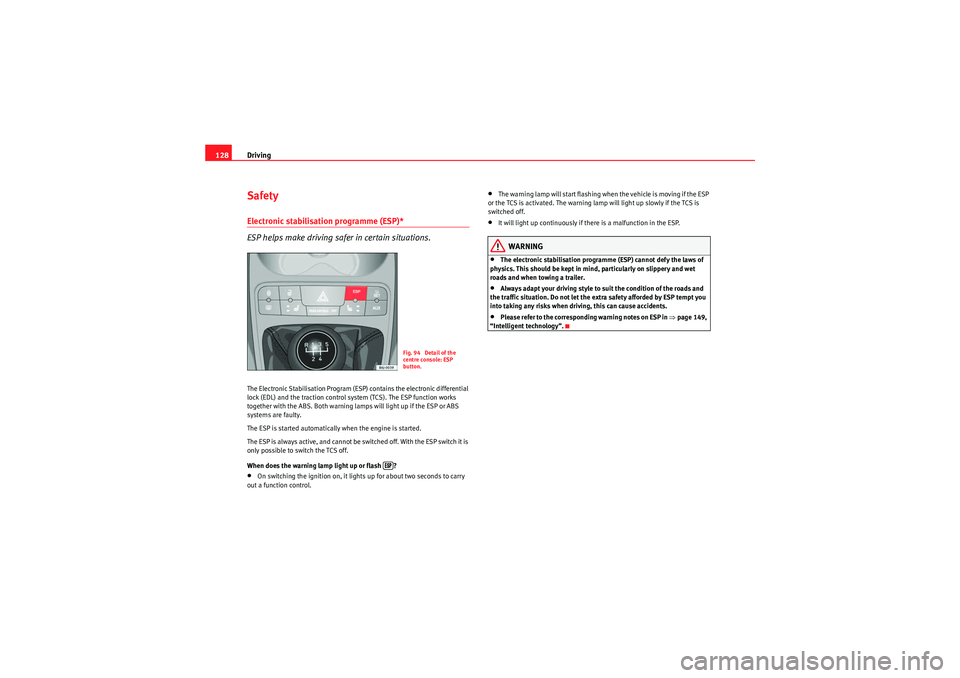
The ESP is always active, and cannot be switched off. With the ESP switch it is
only possible to switch the TCS off.
When does the warning lamp light up or flash ?•On switching the ignition on, it lights up for about two seconds to carry
out a function control.
•The warning lamp will start flashing when the vehicle is moving if the ESP
or the TCS is activated. The warning lamp will light up slowly if the TCS is
switched off.•It will light up continuously if there is a malfunction in the ESP.WARNING
•The electronic stabilisation programme (ESP) cannot defy the laws of
physics. This should be kept in mi nd, particularly on slippery and wet
roads and when towing a trailer.•Always adapt your driving style to suit the condition of the roads and
the traffic situation. Do not let the extra safety afforded by ESP tempt you
into taking any risks when driving, this can cause accidents.•Please refer to the corresponding warning notes on ESP in ⇒page 149,
“Intelligent technology”.
Fig. 94 Detail of the
centre console: ESP
button.
Ibiza_EN.book Seite 128 Montag, 14. September 2009 6:19 18
Page 131 of 257

Driving129
Safety First
Controls and equipment
Practical tips
Technical Data
Ignition lockPosition of the ignition keyIgnition switched off, steering lock
In this position ⇒fig. 95 the ignition and the engine are OFF and the steering
may be locked.
For the Steering lock to operate without the ignition key, turn the steering
wheel until it locks with an audible sound. You should always lock the
steering wheel when you leave your vehicle. This will help prevent vehicle
theft ⇒ .
Switching the ignition or the glow plug system on
Turn the ignition key to this position and release it. If the key cannot be turned
or it is difficult to turn from position to position , move the steering
wheel from one side to the other until it is released. Starting
The engine is started when the key is in this position. Electrical components
with a high power consumption are switched off temporarily.
Every time the vehicle is started again, the ignition key must be turned to
position . The
repetitive start prevention lock of the ignition prevents
possible damage to the starter motor if the engine is already running.
WARNING
•The ignition key must NOT be removed from the lock until the vehicle
comes to a standstill. Otherwise, the steering could be immediately
blocked- Risk of accident!•Always remove the key from the ignition lock when leaving the vehicle,
even for a short period. This is especially important if children or disabled
people are left alone in the vehicle. They could accidentally start the
engine or work electrical equipment such as the electric windows, conse-
quently resulting in an accident.•Unsupervised use of the keys could start the engine or any electrical
system, such as the electric window. This could result in serious injury.Caution
The starter motor will only work when the engine is stopped (ignition key
position ).Electronic immobiliser
The immobiliser prevents unauthorised persons from driving
the vehicle.There is a micro-chip in the key that deactivates the electronic immobiliser
automatically when the key is inserted into the ignition.
Fig. 95 Ignition key posi-
tions
A1
A2
A1
A2
A3A1A3
Ibiza_EN.book Seite 129 Montag, 14. September 2009 6:19 18
Page 144 of 257

Driving
142Hill-start assist*
This function is only included in vehicles with ESP.This device helps when starting uphill.
These are the basic operating conditions: doors closed, brake pedal pressed
down and vehicle in neutral. The system is activated on engaging gear.
After removing your foot from the brake pedal, the braking force is maintained
for a few seconds to prevent the vehicle from moving backward when put into
gear. This short space of time is enough to start the vehicle with ease.
This system also works when reversing uphill.
WARNING
•If you do not start the vehicle immediately after taking your foot off the
brake pedal, the vehicle may start to roll back under certain conditions.
Depress the brake pedal or use the hand brake immediately.•If the engine stalls, depress the brake pedal or use the hand brake
immediately.•When following a line of traffic uphill, if you want to prevent the vehicle
from rolling back accidentally when starting off, hold the brake pedal down
for a few seconds before starting off.Note
The Official Service or a specialist workshop can tell you if your vehicle is
equipped with this system.
Acoustic parking aid system*Rear parking aid
The parking aid system will use an acoustic signal to warn of
the approach of any object towards the rear of the vehicle.Description
The acoustic parking aid system will measure the distance between the rear
of the vehicle and any possible obstacle using four ultrasonic sensors located
on the rear bumper. The measuring range of the sensors starts at approxi-
mately and depending on the nature of the obstacle a distance of:•side of the rear bumper: 0.6 m•middle of the rear bumper: 1.6 m
Activation
The system is activated by engaging reverse gear. A brief acoustic signal
confirms the activation and correct function of the system.
Reverse gear
The distance warning will begin as soon as an obstacle is detected by the
system. The frequency of the bleeps emitted by the system will increase
rapidly as the vehicle approaches the obstacle.
Within a short distance of about 30 cm, a continuous signal sounds (stop
signal). The driver should not reverse any further.
Models with a factory-fitted towing bracket: When the vehicle is less than
0.35 m away from the obstacle, the warning tone is emitted continuously. The
driver should then not reverse any further.
The warning tone decreases by 30% after 3 seconds from the start of the
system.
Ibiza_EN.book Seite 142 Montag, 14. September 2009 6:19 18