Page 192 of 257

Checking and refilling levels
190Brake fluidChecking the brake fluid level
The brake fluid is checked at the intervals given in the service
schedule.– Read off the fluid level at the transparent brake fluid reservoir. It
should always be between the “MIN” and “MAX” marks.The position of the brake fluid reservoir is shown in the corresponding engine
compartment illustration ⇒page 230. The brake fluid reservoir has a black
and yellow cap.
The brake fluid level drops slightly when the vehicle is being used as the
brake pads are automatically adjusted as they wear. However, if the level goes down noticeably in a short time, or drops below the
“MIN” mark, there may be a leak in the brake system. A display on the instru-
ment panel will warn you if the brake fluid level is too low
⇒page 56.
WARNING
Before opening the bonnet to check the brake fluid level, read and observe
the warnings ⇒page 178.Changing the brake fluid
The Maintenance Program indicates the brake fluid change
intervals.We recommend that you have the brake fluid changed by an Authorised
Service Centre.
Before opening the bonnet, please read and follow the warnings ⇒ in
“Safety instructions on working in the engine compartment” on page 178 in
“Working in the engine compartment”.
Brake fluid absorbs moisture. In the course of time, it will absorb water from
the ambient air. If the water content in the brake fluid is too high, the brake
system could corrode. This also considerably reduces the boiling point of the
brake fluid. Heavy use of the brakes may then cause a vapour lock which
could impair the braking effect.
It is important that you use only brake fluid compliant with US standard
FMVSS 116 DOT 4. We recommend the use of Genuine SEAT brake fluid.
WARNING
Brake fluid is poisonous. Old brake fluid impairs the braking effect.
Fig. 122 In the engine
compartment: Brake fluid
reservoir cover
Ibiza_EN.book Seite 190 Montag, 14. September 2009 6:19 18
Page 193 of 257

Checking and refilling levels191
Safety First
Controls and equipment
Practical tips
Technical Data
•Before opening the bonnet to check the brake fluid level, read and
observe the warnings ⇒page 178.•Brake fluid should be stored in the closed original container in a safe
place out of reach of children. There is a toxic risk.•Complete the brake fluid change according to the Maintenance
Program. Heavy use of the brakes may cause a vapour lock if the brake fluid
is left in the system for too long. This would seriously affect the efficiency
of the brakes and the safety of the vehicle. This may cause an accident.Caution
Brake fluid could damage the paintwork. Wipe off any brake fluid from the
paintwork immediately.
For the sake of the environment
Brake fluid must be drained and disposed of in the proper manner observing
environmental regulations.
BatteryWarnings on handling the battery
WARNING
Always be aware of the danger of injury and chemical burns as well as the
risk of accident or fire when working on the battery and the electrical
system:•Wear eye protection. Protect your eyes, skin and clothing from acid and
particles containing lead.•Battery acid is very corrosive and caustic. Wear protective gloves and
eye protection. Do not tilt the batteries. This could spill acid through the
vents. Rinse battery acid from eyes immediately for several minutes with
clear water. Then seek medical care immediately. Neutralize any acid
splashes on the skin or clothing with a soapy solution, and rinse off with
plenty of water. If acid is swallowed by mistake, consult a doctor immedi-
ately.•Fires, sparks, naked lights and smoking are prohibited. When handling
cables and electrical equipment, avoid causing sparks and electrostatic
WARNING (continued)
Wear eye protection
Battery acid is very corrosive and caustic. Wear protective gloves
and eye protection!
Fires, sparks, naked lights and smoking are prohibited!
A highly explosive mixture of gases is released when the battery is
under charge.
Keep children away from acid and batteries!
Ibiza_EN.book Seite 191 Montag, 14. September 2009 6:19 18
Page 194 of 257

Checking and refilling levels
192charge. Never short the battery terminals. High-energy sparks can cause
injury.•A highly explosive mixture of gases is released when the battery is
under charge. The batteries should be charged in a well-ventilated room
only.•Keep children away from acid and batteries.•Before working on the electrical system, you must switch off the
engine, the ignition and all consumers. The negative cable on the battery
must be disconnected. When a light bulb is changed, you need only switch
off the light.•Deactivate the anti-theft alarm by unlocking the vehicle before you
disconnect the battery! The alarm will otherwise be triggered.•When disconnecting the battery from the vehicle electrical system,
disconnect first the negative cable and then the positive cable.•Switch off all electrical consumers before reconnecting the battery.
Reconnect first the positive cable and then the negative cable. Never
reverse the polarity of the connections. This could cause an electrical fire.•Never charge a frozen battery, or one which has thawed. This could
result in explosions and chemical burns. Always replace a battery which
has frozen. A flat battery can even freeze at temperatures around 0°•Ensure that the vent hose is always connected to the battery.•Never use a defective battery. This may be fatally explosive. Replace a
damaged battery immediately.Caution
•Never disconnect the battery if the ignition is switched on or if the engine
is running. This could damage the electrical system or electronic compo-
nents.•Do not expose the battery to direct sunlight over a long period of time, as
the intense ultraviolet radiation can damage the battery housing.
•If the vehicle is left standing in cold conditions for a long period, protect
the battery from frost. If it “freezes” it will be damaged.Checking the electrolyte level
The electrolyte level should be checked regularly in high-
mileage vehicles, in hot countries and in older batteries.– Open the bonnet and lift the cover that protects the front of the battery ⇒ in “Safety instructions on working in the engine
compartment” on page 178 ⇒ in “Warnings on handling the
battery” on page 191.
– Check the colour display in the "magic eye" on the top of the battery.
– If there are air bubbles in the window, tap the window gently until they disperse.The position of the battery is shown in the corresponding engine compart-
ment diagram ⇒page 230.
The “magic eye” indicator, located on the top of the battery changes colour,
depending on the charge state and electrolyte level of the battery.
There are two different colours:•Black: correct charge status.•Transparent/clear yellow: the battery must be replaced. Contact a
specialist workshop.
WARNING (continued)
Ibiza_EN.book Seite 192 Montag, 14. September 2009 6:19 18
Page 214 of 257
If and when
212Double headlamps
Main beam
Side lights
Dipped headlights
Side lights
Indicator light
Turn signal lamps– Raise the bonnet.
– Rotate the bulb holder ⇒fig. 134 to the left and pull.
– Remove the bulb by pressing on the lamp holder and rotating at the same time to the left.
– Installation is in the reverse order.
Fig. 133 Double head-
lamps
AAABACADAE
Fig. 134 Indicator light
AA
Ibiza_EN.book Seite 212 Montag, 14. September 2009 6:19 18
Page 215 of 257
If and when213
Safety First
Controls and equipment
Practical tips
Technical Data
Dipped and side lights– Raise the bonnet. – Remove the loop
⇒fig. 135 in the direction of the arrow and
remove the cover.
– Remove the connector ⇒fig. 136 from the bulb.
– Unclip the retainer spring ⇒fig. 136 , pressing inwards to the
right.
– Extract the bulb and fit the replacement so that the rim of the attachment plate is on the reflector cut-out.
Fig. 135 Dipped head-
lightsFig. 136 Side lights
A1
A2A3
Ibiza_EN.book Seite 213 Montag, 14. September 2009 6:19 18
Page 216 of 257
If and when
214Main beam and side lights– Raise the bonnet. – Move the loop in the direction of the arrow and remove the
cover ⇒fig. 137 .
– Remove the connector by pulling outward.
– Extract the bulb and fit the replacement so that it sits correctly in the cut-out on the reflector.
– Installation is in the reverse order.
Single headlamps
Side lights - Dipped beam/main beam.
Indicator
Fig. 137 Main beam
headlightsFig. 138 Side lights
A2
Fig. 139 Single head-
lamp
AAAB
Ibiza_EN.book Seite 214 Montag, 14. September 2009 6:19 18
Page 217 of 257
If and when215
Safety First
Controls and equipment
Practical tips
Technical Data
Indicator lamps– Raise the bonnet.
– Rotate the bulb holder ⇒fig. 140 to the left and pull.
– Remove the bulb by pressing on the lamp holder and rotating at the same time to the left.
– Installation is in the reverse order.
Dipped/main beam– Raise the bonnet.
Fig. 140 Single indicator
lamp
AA
Fig. 141 Dipped beam /
main beam, single lightFig. 142 Dipped beam /
main beam, single light
Ibiza_EN.book Seite 215 Montag, 14. September 2009 6:19 18
Page 218 of 257
If and when
216
– Remove the loop ⇒page 215, fig. 141 in the direction of the
arrow and remove the cover.
– Remove the connector ⇒page 215, fig. 142 from the bulb.
– Unclip the retainer spring ⇒page 215, fig. 142 , pressing
inwards to the right.
– Extract the bulb and fit the replacement so that the rim of the attachment plate is on the reflector cut-out.Side lights – Raise the bonnet.
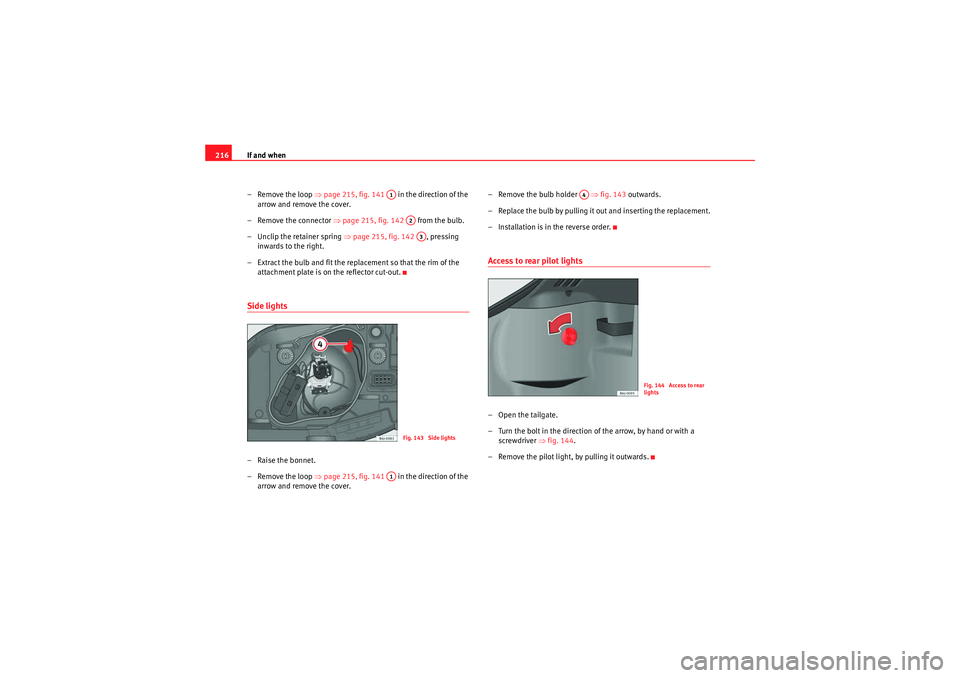
– Remove the loop ⇒page 215, fig. 141 in the direction of the
arrow and remove the cover. – Remove the bulb holder
⇒fig. 143 outwards.
– Replace the bulb by pulling it out and inserting the replacement.
– Installation is in the reverse order.
Access to rear pilot lights–Open the tailgate.
– Turn the bolt in the direction of the arrow, by hand or with a screwdriver ⇒fig. 144 .
– Remove the pilot light, by pulling it outwards.
A1
A2A3
Fig. 143 Side lights
A1
A4
Fig. 144 Access to rear
lights
Ibiza_EN.book Seite 216 Montag, 14. September 2009 6:19 18