2009 Seat Ibiza 5D radio
[x] Cancel search: radioPage 78 of 257
Unlocking and locking
76Radio frequency remote control*Locking and unlocking the vehicle
The remote control key is used to lock and unlock the vehicle
from a distance.
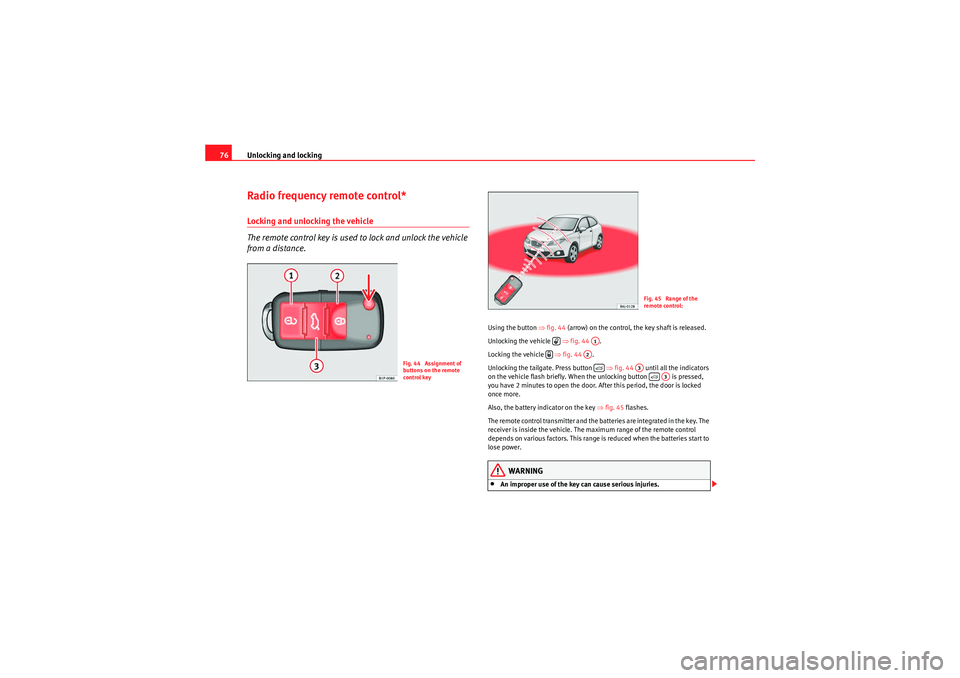
Using the button ⇒fig. 44 (arrow) on the control, the key shaft is released.
Unlocking the vehicle ⇒fig. 44 .
Locking the vehicle ⇒fig. 44 .
Unlocking the tailgate. Press button ⇒fig. 44 until all the indicators
on the vehicle flash briefly. When the unlocking button is pressed,
you have 2 minutes to open the door. After this period, the door is locked
once more.
Also, the battery indicator on the key ⇒fig. 45 flashes.
The remote control transmitter and the batteries are integrated in the key. The
receiver is inside the vehicle. The maximum range of the remote control
depends on various factors. This range is reduced when the batteries start to
lose power.
WARNING
•An improper use of the key can cause serious injuries.
Fig. 44 Assignment of
buttons on the remote
control key
Fig. 45 Range of the
remote control:
A1
A2
A3
A3
Ibiza_EN.book Seite 76 Montag, 14. September 2009 6:19 18
Page 79 of 257

Unlocking and locking77
Safety First
Controls and equipment
Practical tips
Technical Data
•Never leave children or disabled persons in the vehicle. In case of emer-
gency, they may not be able to leave the vehicle and not manage on their
own.•Never leave the keys inside the vehicle. Otherwise, this could result in
serious injuries, accidents or even the theft of your vehicle. Always take the
key with you when you leave the vehicle.•An uncontrolled use of the key could start the engine or activate any
electric equipment (e.g. electric windows), causing risk of accident. The
vehicle can be locked when using the remote control key. This could
complicate the aid in case of emergency.Note
•The remote control key functions only when you are within range
⇒ page 76, fig. 45.•If the vehicle cannot be unlocked or locked by using the radio-frequency
remote control, the remote control key will have to be re-synchronised. In this
case, please refer to your Technical Service.Changing the batteryIf the battery indicator does not flash when the buttons are pushed, the
battery must be replaced.
Caution
The use of inappropriate batteries may damage the radio frequency remote
control. For this reason, always replace the dead battery with another of the
same size and power.
For the sake of the environment
The flat batteries must be thrown away in accordance with regulations
governing the protection of the environment.Synchronising the remote control key
If it is not possible to unlock or lock the door with the remote
control, it should be re-synchronised.While the vehicle is open:
– Press the button ⇒page 76, fig. 44 on the remote control.
– Then close the vehicle using the key bit within one minute.
While the vehicle is closed:
– Press button ⇒page 76, fig. 44 on the remote control.
– Then close the vehicle using the key bit within one minute.It is possible that the vehicle could no longer be opened and closed with the
remote control if the button is repeatedly pressed outside of the effective
range of the radio frequency remote control. The remote control key will have
to be resynchronised.
Spare remote control keys are available in your Authorised Service Centres,
where they must be matched to the locking system.
Up to five remote control keys can be used.
WARNING (continued)
A2
A1
Ibiza_EN.book Seite 77 Montag, 14. September 2009 6:19 18
Page 80 of 257
Unlocking and locking
78Anti-theft alarm system*Description of anti-theft alarm system*
The anti-theft alarm triggers if unauthorised movements are
detected around the vehicle.The anti-theft alarm makes it more difficult to break into the vehicle or steal
it. The system will emit acoustic and optical warning signals if someone is
trying to force your vehicle.
The anti-theft alarm system is automatically connected on locking the
vehicle. For this, either rotate the key in the locking position or press button
on the radio-frequency remote control*. The system is immediately
activated and the indicator light located on the driver's door will flash along
with the indicators, indicating that the alarm and the locking security system
(double lock) have been turned on.
If any of the doors or the bonnet are open, they will not be included in the
protection zones of the vehicle when the alarm is connected. If the door or the
bonnet are subsequently closed, they will automatically be included in the
protection areas of the vehicle and the indicators will flash accordingly when
the doors close.•The indicator light will flash twice on opening and deactivating the alarm.•The indicator light will flash once on closing and activating the alarm.
When does the system trigger an alarm?
The system triggers an alarm if the following unauthorised actions are carried
out when the car is locked:•Opening of vehicle with mechanical key without switching ignition on
within the following 15 seconds•Opening a door•Opening the bonnet
•Opening the tailgate•Ignition switched on with a non-validated key.•Movements in the driving compartment (vehicles with a volume sensor)•Towing of the vehicle
7)
•Tilt angle (tow-away protection)
7)
•Undue manipulation of the alarm•Battery handling
The acoustic signals sound and the indicators flash for approx. 30 seconds.
This may be repeated up to 10 times depending on the country.
How to switch the alarm off
To deactivate the anti-theft alarm, turn the key in the direction, to open, open
the door and switch the ignition on, or press the unlock button on the
remote control.
In ve hicles eq ui ppe d wit h an a nti -t he f t a lar m s yste m , you have 1 5 s e co nds to
insert the key in the ignition lock and activate the ignition if the vehicle is
opened using the driver's door key.
Otherwise, the alarm will trigger for 30 sec. and the ignition will be blocked.Note
•After 28 days, the indicator light will be switched off to prevent the battery
from exhausting if the vehicle has been left parked for a long period of time.
The alarm system remains activated.•The alarm will trigger again if attempts are made to open another protec-
tion zone.•The alarm system can be activated or deactivated using the remote
control ⇒page 76.
A2
7)For vehicles fitted with tow-away protection
Ibiza_EN.book Seite 78 Montag, 14. September 2009 6:19 18
Page 114 of 257
Seats and stowage
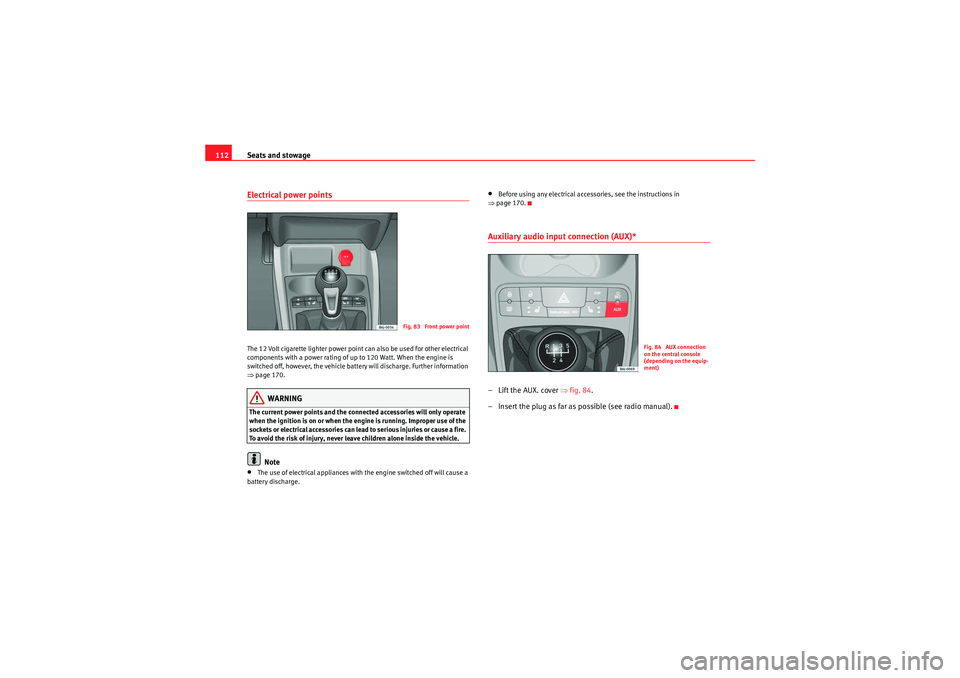
112Electrical power points The 12 Volt cigarette lighter power point can also be used for other electrical
components with a power rating of up to 120 Watt. When the engine is
switched off, however, the vehicle battery will discharge. Further information
⇒ page 170.
WARNING
The current power points and the connected accessories will only operate
when the ignition is on or when the engine is running. Improper use of the
sockets or electrical accessories can lead to serious injuries or cause a fire.
To avoid the risk of injury, never leave children alone inside the vehicle.
Note
•The use of electrical appliances with the engine switched off will cause a
battery discharge.
•Before using any electrical accessories, see the instructions in
⇒ page 170.Auxiliary audio input connection (AUX)*– Lift the AUX. cover ⇒ fig. 84.
– Insert the plug as far as possible (see radio manual).
Fig. 83 Front power point
Fig. 84 AUX connection
on the central console
(depending on the equip-
ment)
Ibiza_EN.book Seite 112 Montag, 14. September 2009 6:19 18
Page 115 of 257

Seats and stowage113
Safety First
Controls and equipment
Practical tips
Technical Data
AUX-USB* Input connection For information concerning the use of this equipment, please see the Radio
handbook.First-aid kit, warning triangle, fire
extinguisher*First-aid kit, warning triangle and fire extinguisherThe use of reflective warning triangles is obligatory in emergencies in some
countries. As are the first aid kit and a set of spare light bulbs.
The first-aid kit and the fire extinguisher are located in the luggage compart-
ment, held in place by Velcro. The warning triangle may be located in the rear of the boot secured by rubber
bands.
Note
•The first aid kit, the warning triangles and the fire extinguisher are not
supplied with the vehicle as standard.•The first aid kit, the warning triangles and the fire extinguisher should
meet legal requirements.•The expiry date of the content of the first aid kit should be checked.•Ensure that the fire extinguisher is fully functional. The fire extinguisher
should, therefore, be checked regularly. The sticker on the fire extinguisher
will inform you of the next date for checking.•Before purchasing accessories and spare parts, see the instructions in
⇒ page 170, “Accessories, replacement of parts and modifications”.BootStowing luggage
All luggage must be securely stowed.Please observe the following points to ensure the vehicle handles
well at all times:
– Distribute the load as evenly as possible.
– Place heavy objects as far forward in the luggage compartment
as possible.
Fig. 85 AUX /USB* input
connection (depending on
the equipment)
Ibiza_EN.book Seite 113 Montag, 14. September 2009 6:19 18
Page 164 of 257
Vehicle maintenance and cleaning
162Care of the vehicle exteriorAutomatic car washing tunnelThe vehicle paintwork is so durable that the car can normally be washed
without problems in an automatic car washing tunnel. However, the paint-
work wear depends to a large extent, on the kind of the car washing tunnel,
the brushes used, its water filtering and the type of cleaning and preservative
products.
Before going through a car wash, be sure to take the usual precautions such
as closing the windows and sunroof. There is nothing to note apart from that.
If the vehicle has special accessories such as spoilers or a roof carrier or two-
way radio aerial, etc., it is advisable to consult the car washing tunnel oper-
ator.
After washing, the brakes could hesitate to respond as the brake discs and
pads could be wet, or even frozen in winter. “Dry” the brakes by braking
several times.
WARNING
Water, ice and salt on the brakes can reduce braking efficiency. Risk of acci-
dent.
Caution
Before putting the vehicle through the car washing tunnel, do not tighten the
aerial if it is folded because it can be damaged.
Washing by handVehicle washing
– First soften the dirt with plenty of water and rinse it off.
– Clean your vehicle from top to bottom with a soft sponge, a glove or a brush. Use very light pressure.
– Rinse the sponge or glove often with clean water.
– Special car shampoo should only be used for very stubborn dirt.
– Clean the wheels, sill panels etc. until last with a different sponge or glove.
– Rinse the vehicle thoroughly with water.
– Dry your vehicle surface gently with a chamois leather.
–When temperature is cold , dry the rubber seals and its surfaces
to prevent them from freezing. Apply silicone spray to the rubber
seals.
After washing
– Directly after washing, avoid sudden and sharp braking. “Dry” the brakes by braking several times.
WARNING
•Wash your car with the ignition switched off.•Protect your hands and arms from cuts on sharp metal edges when
cleaning the underbody, the inside of the wheel housings etc. Risk of
injury.
Ibiza_EN.book Seite 162 Montag, 14. September 2009 6:19 18
Page 170 of 257
Vehicle maintenance and cleaning
168Vehicle interior maintenancePlastic parts and dash panel cleaning– Use a clean, damp cloth to clean plastic parts and the dash
panel.
– If this does not provide satisfactory results, use a special solvent-free plastic cleaning product.
WARNING
Never clean the dash panel and the airbag module surface with cleansers
containing solvents. Solvents cause the surface to become porous. If the
airbag triggered, disintegrating plastic parts could cause substantial inju-
ries.
Caution
Cleaning products which contain solvents will damage the material.Wooden trim cleaning*– Clean the wooden trim with a water-moistened clean cloth.
– If this does not provide satisfactory results, use a gentle soap
solution.
CautionCleaning products which contain solvents will damage the material.
Cloth seat covers and fabric trim cleaningCloth seat covers and fabric trim on the doors, headlining etc. can be cleaned
with a special interior cleanser or with dry foam and a soft brush.Cleaning the radio and climate controlsTo clean the radio and/or climate controls, use a soft damp cloth. For more
resistant dirt, a neutral soap solution may be used.Leather cleaning*Normal cleaning
– Moisten a cotton or woollen cloth with water and wipe over the leather surfaces.
Cleaning stubborn stains
– More stubborn dirt can be removed using a mild soap solution (pure liquid soap; two tablespoons diluted in one litre of water)
and a cloth.
– Do not let the water soak through the leather or soak into the seams.
– Then wipe off with a soft, dry cloth.
Leather maintenance
– The leather should be treated twice a year with a special leather- care product, available in your Authorised Service Centre.
Ibiza_EN.book Seite 168 Montag, 14. September 2009 6:19 18
Page 173 of 257

Accessories, replacement of parts and modifications171
Safety First
Controls and equipment
Practical tips
Technical Data
WARNING
Incorrectly performed modifications or other kind of work on your vehicle
can lead to malfunctions and cause accidents.Roof aerial*The vehicle can be fitted with a collapsible roof aerial* with antitheft system*,
which can be folded backwards, when, for example, going through an auto-
matic carwash.
To f o l d
Unscrew the aerial rod, tilting it backwards into a horizontal position and then
screw in again.
To return to working position
Continue in the reverse order to the previous instruction.
Caution
Before putting the vehicle through the car washing tunnel, do not tighten the
aerial if it is folded because it may be damaged.
Mobile telephones and two-way radiosYou will require an external aerial for mobile phones and two-
way radios. SEAT has approved for your vehicle the use of mobile telephones and two-way
radios under the following conditions:•The correct installation of an external aerial,•transmitting power of a maximum 10 watts.
The optimum range of the equipment is only achieved with an external aerial.
First consult your Authorised Service Centre if you wish to use a mobile tele-
phone or a two-way radio with a transmitting power output in excess of
10 watts. Here you will receive information concerning the technical possibil-
ities for retrofitting this equipment.
Mobile telephones and two-way radios should be only fitted by a qualified
workshop, for example an Authorised Service Centre.WARNING
•Always concentrate primarily on driving. If you are distracted while
driving you could have an accident.•Never attach the telephone mountings to the surfaces covering the
airbag units or within the range of the airbags. There is a high risk of injury
if the airbag is triggered.•If using your mobile telephones or two-way radios in the vehicle
without an external aerial, electromagnetic radiation in the vehicle could
exceed authorised limits. This also may occur to external aerials that have
not been correctly installed.
Ibiza_EN.book Seite 171 Montag, 14. September 2009 6:19 18