2009 Seat Exeo ST seats
[x] Cancel search: seatsPage 140 of 316

Seats and stowage
138
Adjusting the contour of lumbar support
– Press the front part of the adjuster switch ⇒page 137, fig. 110
to increase the contour of the lumbar support.
– Press the rear part of the adjuster switch to decrease the contour of the lumbar support.
Adjusting the height of lumbar support
– Press the top part of the adjuster switch to move the lumbar support upwards.
– Press the bottom part of the adjuster switch to move the lumbar support down.The lumbar support provides effective support for the natural curvature of the
spine to give a more relaxed seating position, especially on long journeys.
Memory for driver's seat*Description
The recall buttons in the driver's door can be used to store
and recall up to four different positions for the driver's seat
and exterior mirrors.Memory buttons
Using the recall buttons 1, 2, 3 and 4 ⇒fig. 111, you can store and recall the
seat and exterior mirror positions for up to four different drivers.
button
The seat memory will be disabled if the button is in the up position
(press and release). The word
will light up next to the button (only
visible when the lights are switched on).
The stored settings will all remain in the memory. However, the seat and the
exterior mirrors can now only be adjusted using the conventional electrical
Fig. 111 Driver's door:
Memory system
STOP
STOP
STOP
ExeoST_EN.book Seite 138 Donnerstag, 3. September 2009 12:24 12
Page 141 of 316

Seats and stowage139
Safety First
Controls and equipment
Practical tips
Technical Data
adjustment. Use of the button is recommended to disable the memory
system when the vehicle is being driven
temporarily by a different driver
whose settings do not need to be stored in the memory.
Note
You can also use the remote control to call up the stored settings
⇒ page 140.Storing settingsThe button must be in its down position (pressed in) before
you can store the desired settings.
– Adjust the driver's seat as required ⇒page 136.
– Adjust both exterior mirrors ⇒page 132.
– Press and hold the button. At the same time, press one of the memory buttons for at least a second.
– Release both buttons. The settin g is now stored on the selected
memory button.Any new setting selected automatically cancels the existing setting stored on
the memory button. It is best to begin with memory button No. 1 for the first
driver and then assign the other memory buttons to each subsequent driver.
The seat and mirror positions are stored when the car is locked with the
remote control and are assigned to the remote control key. The exterior
mirrors adjust automatically to the previous position when you unlock the
car; the driver's seat adjusts automatically when you open the driver's door. However, this does not delete the settings stored in memory buttons 1 to 4.
These settings can be enabled at any time.
Enabling settings
Stored settings can be recalled using either the memory
buttons or the remote control (remote control key).Using the memory buttons
– If the driver's door is open, press the desired memory button
briefly.
– If the driver's door is closed, press and hold down the appro- priate memory button until the seat and exterior mirrors reach
their programmed positions.
Using the remote control
– Unlock the vehicle using the remote control and open the driver's door within the next ten minutes.The seat adjustment will have to be call ed up using the memory buttons if the
driver's door is not opened within 10 minutes after unlocking the vehicle with
the remote control.
WARNING
•For safety reasons, the seat must only be adjusted when the vehicle is
at a standstill. Failure to do so could result in an accident.•In an emergency, the memory function can be stopped at any time by
pressing the STOP button or by briefly pressing any of the memory
buttons.
STOP
STOP
MEMO
ExeoST_EN.book Seite 139 Donnerstag, 3. September 2009 12:24 12
Page 142 of 316

Seats and stowage
140Assigning remote control keys
The key must be assigned to a memory button so that the
positions stored in the memory can also be recalled using the
remote control key.Assigning the remote control key to a memory button
– Using the memory button, recall the settings that are to be
programmed onto the key.
– Keeping the memory button pressed down, press the unlock button on the remote control key within 10 seconds.
– Wait for about 2 seconds before releasing the memory button.
Deleting assignment of the remote control key to the memory
button
– Press and hold the button and press the unlock button on the remote control key within 10 seconds.
– Wait for about 2 seconds before releasing the button.The previous settings are automatically cancelled when the keys are re-
assigned to different memory buttons.
Head restraintsFront head restraints
In combination with properly worn seat belts, the head
restraints offer effective protection, provided they are prop-
erly adjusted to suit the height of the occupant.Raising the head restraint
– Take hold of the sides of the head restraint with both hands.
– Pull up the head restraint.
Lowering the head restraint
– Press button and lower the head restraint.
MEMO
MEMO
Fig. 112 Front seats:
Head restraints
AA
ExeoST_EN.book Seite 140 Donnerstag, 3. September 2009 12:24 12
Page 143 of 316

Seats and stowage141
Safety First
Controls and equipment
Practical tips
Technical Data
Removing the head restraints
– Pull up the head restraint as far as it will go.
– Press button and pull out the head restraint.
Fitting the head restraint
– Insert the head restraint in its gu ides until it clicks into place.
Press button and lower the head restraint.The height of the head restraints is adjustable. They should be set to suit the
height of the occupant. In combination with the seat belts, the head
restraints offer effective protection, provided they are properly adjusted.
For best protection, the top of the head restraint should be at least at eye level
or higher.Head restraints on the side rear seats
Raising the head restraint
– Take hold of the sides of the head restraint with both hands.
– Pull up the head restraint as far as it will go.
Lowering the head restraint
– Press button ⇒fig. 113 and lower the head restraint.
Removing the head restraint
– Pull up the head restraint as far as it will go.
– Press button ⇒fig. 113 and pull out the head restraint.
Fitting the head restraint
– Insert the head restraint in its gu ides until it clicks into place.
Press button and lower the head restraint.When the rear seats are not occupied, the head restraints should be moved
to the lowest position so that they do not obstruct the driver's field of
vision.
AAAA
Fig. 113 Outer rear seats:
Head restraints
AAAAAA
ExeoST_EN.book Seite 141 Donnerstag, 3. September 2009 12:24 12
Page 144 of 316

Seats and stowage
142Central head restraint of the rear seatRaising the head restraint
– Take hold of the sides of the head restraint with both hands.
– Pull up the head restraint as far as it will go.
Lowering the head restraint
–Press button ⇒fig. 114 and lower the head restraint.
Removing the head restraint
– Pull up the head restraint as far as it will go.
–Press button ⇒fig. 114 and pull out the head restraint.
Fitting the head restraint
– Insert the head restraint in its guides until it clicks into place. Press button and lower the head restraint.
When the rear seats are not occupied the head restraints should be moved to
the lowest position so that they do not obstruct the driver's field of vision.ArmrestsThe armrest can be adjusted to several positions and incorpo-
rates a storage compartment.Adjusting the armrest
– To adjust the position of the armrest, fold the armrest all the way down.
– Then lift the armrest gradually until it engages in the desired position.
Opening the storage compartment
– Press the release lever ⇒fig. 115.
Fig. 114 Centre rear seat:
Head restraints
AAAAAA
Fig. 115 Armrest
between the driver's seat
and front passenger's
seat
ExeoST_EN.book Seite 142 Donnerstag, 3. September 2009 12:24 12
Page 145 of 316

Seats and stowage143
Safety First
Controls and equipment
Practical tips
Technical Data
Please note that the armrest can restrict the driver's movements when it is
lowered. The armrest should therefore be raised when driving in city traffic.
Luggage compartmentLoading the luggage compartment
Loads in the luggage compartment should be safely secured.To maintain safe handling on the road, please observe the following
points:
– Distribute the load evenly.
– Position heavy items as far forward as possible
⇒fig. 116 . – Secure the load with a luggage net* or with non-elastic straps
secured to the fastening rings ⇒page 144.
WARNING
•Unsecured objects in the luggage compartment can suddenly shift and
cause changes in the handling of the vehicle.•In an accident or a sudden manoeuvre, loose objects in the passenger
compartment can be flung forward and might injure vehicle occupants.•Always keep all objects in the luggage compartment and use appro-
priate grips to secure them, particularly in the case of heavy objects.•When you transport heavy objects, always bear in mind that a change
of the centre of gravity can also cause changes in vehicle handling.•Please refer to the notes on ⇒page 7.Caution
Make sure that no hard objects chafe against the wires of the heating element
in the rear window and damage them.
Note
The tyre pressure must be adjusted according to the load. If necessary,
consult the tyre pressure label on the door pillar ⇒page 242.
Fig. 116 Position heavy
items as far forward as
possible.
ExeoST_EN.book Seite 143 Donnerstag, 3. September 2009 12:24 12
Page 146 of 316
Seats and stowage
144Fastening rings
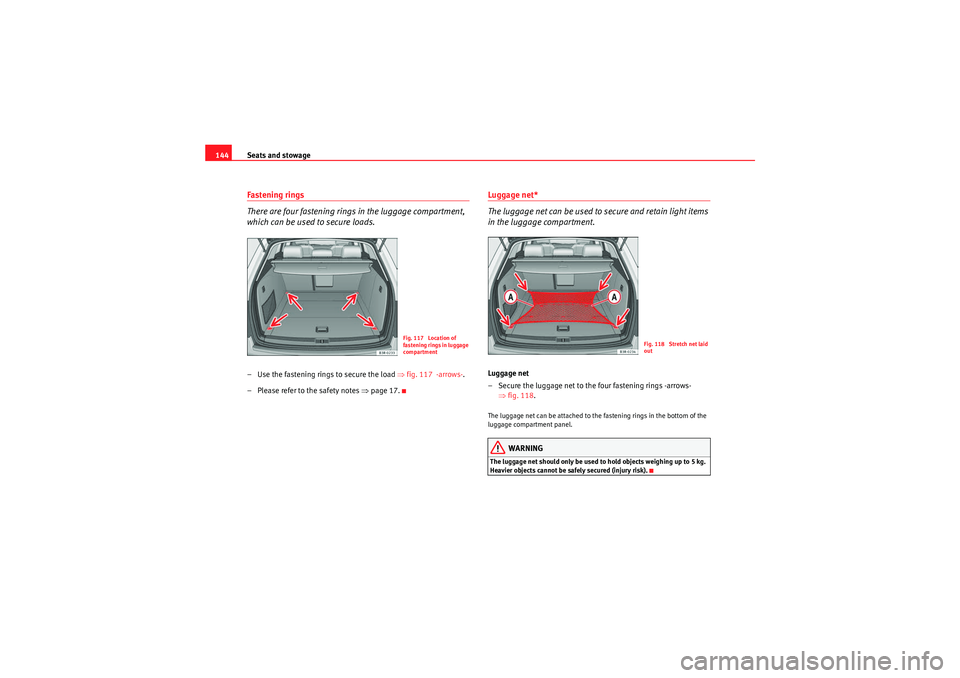
There are four fastening rings in the luggage compartment,
which can be used to secure loads.– Use the fastening ring s to secure the load ⇒fig. 117 -arrows- .
– Please refer to the safety notes ⇒page 17.
Luggage net*
The luggage net can be used to secure and retain light items
in the luggage compartment.Luggage net
– Secure the luggage net to the four fastening rings -arrows-
⇒fig. 118 .The luggage net can be attached to the fastening rings in the bottom of the
luggage compartment panel.
WARNING
The luggage net should only be used to hold objects weighing up to 5 kg.
Heavier objects cannot be safely secured (injury risk).
Fig. 117 Location of
fastening rings in luggage
compartment
Fig. 118 Stretch net laid
out
ExeoST_EN.book Seite 144 Donnerstag, 3. September 2009 12:24 12
Page 147 of 316
Seats and stowage145
Safety First
Controls and equipment
Practical tips
Technical Data
Retaining strap*
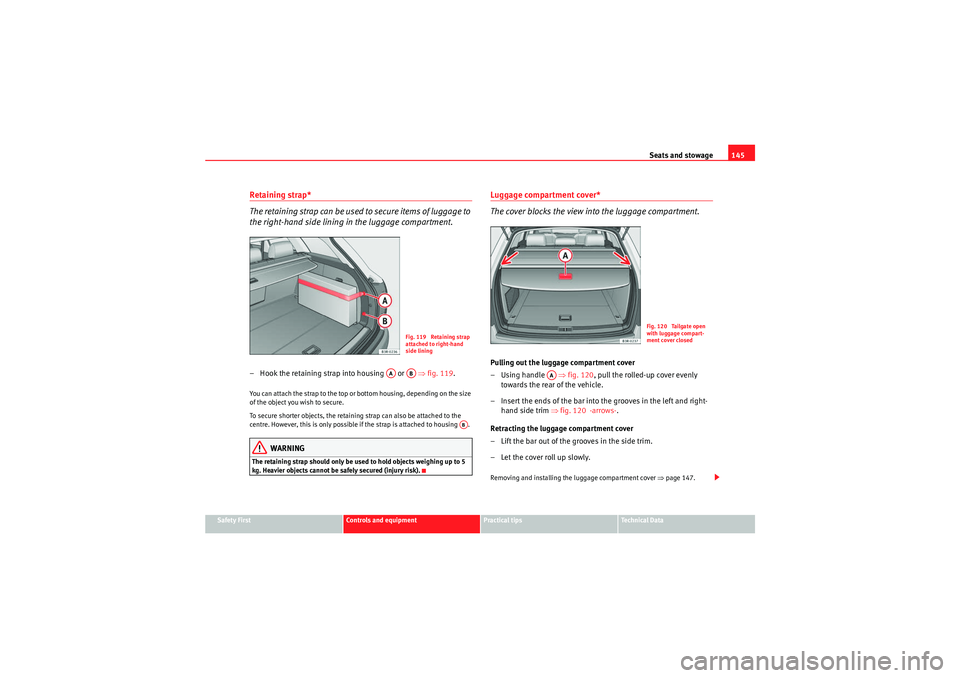
The retaining strap can be used to secure items of luggage to
the right-hand side lining in the luggage compartment.– Hook the retaining strap into housing or ⇒fig. 119 .You can attach the strap to the top or bottom housing, depending on the size
of the object you wish to secure.
To secure shorter objects, the retaining strap can also be attached to the
centre. However, this is only possible if the strap is attached to housing .
WARNING
The retaining strap should only be used to hold objects weighing up to 5
kg. Heavier objects cannot be safely secured (injury risk).
Luggage compartment cover*
The cover blocks the view into the luggage compartment.Pulling out the luggage compartment cover
–Using handle ⇒fig. 120 , pull the rolled-up cover evenly
towards the rear of the vehicle.
– Insert the ends of the bar into the grooves in the left and right- hand side trim ⇒fig. 120 -arrows-.
Retracting the luggage compartment cover
– Lift the bar out of the grooves in the side trim.
– Let the cover roll up slowly.Removing and installing the luggage compartment cover ⇒page 147.
Fig. 119 Retaining strap
attached to right-hand
side lining
AA
AB
AB
Fig. 120 Tailgate open
with luggage compart-
ment cover closed
AA
ExeoST_EN.book Seite 145 Donnerstag, 3. September 2009 12:24 12