2009 Seat Exeo ST ECU
[x] Cancel search: ECUPage 153 of 316

Seats and stowage151
Safety First
Controls and equipment
Practical tips
Technical Data
Loading
–Open the tailgate.
– Press the release catch for the ski bag cover ⇒page 150,
fig. 128 -arrow- and swivel the cover downwards.
– Pull down the centre rear armrest.
– From the passenger compartment, press down the release catch for the ski bag cover and pull out the cover.
– Pull out and unfold the ski bag.
– The long items can now be loaded through the luggage compart- ment into the ski bag ⇒.
Securing
– Insert the fastening belt ⇒page 150, fig. 129 of the ski bag
into the centre seat belt buckle .
– Pull the free end of belt to tighten.
Storing
– Close the cover of the load-through hatch in the luggage compartment.
– Carefully fold away the ski bag.
– Close the inside cover of the load-through hatch from the passenger compartment.
WARNING
The ski bag must be secured in place with the fastening belt after it has
been loaded.
Note
Do not fold away the ski bag after use if it is still damp.Roof carrier / roof rails*Description
Additional luggage can be carried on the roof carrier.Note the following points if you intend to carry loads on the roof:•We recommend using the cross bars from the of SEAT Genuine Accesso-
ries range.•These cross bars form the basic elements of a complete roof carrier
system. For safety reasons, however, the corresponding additional fastenings
must be fitted to carry luggage, bicycles, surfboards, skis and boats. All the
components of this system are available from Authorised Service Centres.Caution
Any damage to the vehicle caused by the use of other types of roof rack or
incorrect installation will not be covered by the factory warranty. The roof
carrier system must therefore be installed exactly according to the instruc-
tions provided.
AA
AB
AC
ExeoST_EN.book Seite 151 Donnerstag, 3. September 2009 12:24 12
Page 154 of 316

Seats and stowage
152Attachment points
The roof carrier must be attached at the marked points only.The cross-bars must be fitted exactly between the points marked on the roof
railings ⇒fig. 130 . The markings are visible on the inside of the railings.
Caution
A roof carrier unit must not be used if the vehicle is not equipped with roof
rails (basic support).Roof load
Loads carried on the roof must be securely attached. The car's
handling is affected whenever you carry loads on the vehicle.The authorised load on the roof of your vehicle is 75 kg. Use the weight of the
roof carrier system and that of the load as a basis to calculate the roof load. If less resistant systems are used, the roof carrier must not be loaded to the
maximum weight permitted. If less resistant systems are used, these must
only be loaded to the maximum weight permitted indicated in the assembly
instructions.
WARNING
•Loads carried on the roof must be securely attached. Failure to do so
could result in an accident.•Do not exceed the maximum roof load for the vehicle, the maximum
axle loads or the maximum gross vehicle weight. Failure to do so could
result in an accident.•When transporting heavy or bulky loads on the roof, bear in mind that
t h e ca r ' s ha n d l i ng is a f fe c te d by t h e e x t ra w e i g h t o n t h e ro o f a n d a p os s ibl e
susceptibility to cross winds. Adjust your speed and driving style accord-
ingly to avoid accidents.Caution
Please take extra care not to let the tailgate strike the roof load when open.
For the sake of the environment
Roof carriers are often left attached for convenience, even when they are not
being used. However, the increased air resistance means that the vehicle
uses more fuel. For this reason you should always take off the roof carrier
when it is not in use.
Fig. 130 Attachment
points for cross bars
ExeoST_EN.book Seite 152 Donnerstag, 3. September 2009 12:24 12
Page 155 of 316

Seats and stowage153
Safety First
Controls and equipment
Practical tips
Technical Data
Drink holdersFront drink holders
– To open the drink holder, press the symbol
on the drink holder
lid ⇒fig. 131
– To close the drink holder, press it in until it engages.
WARNING
•Do not put any hot drinks in the drink holder while the vehicle is
moving. You can be scalded if the hot liquid is spilt.•Do not use hard china cups or glasses. These could cause injury in the
event of an accident.
Drinks holder in the rear armrest*Opening the drink holder
–Press the symbol
⇒fig. 132 .
Adjusting the retainer arm
– To adjust one of the retainer arms , release it by pressing in the direction indicated (arrow) and move it as required.
The retainer arm should be positioned against the drinks holder so that it is
held securely.
One or two drinks holders can be held in the centre armrest.
WARNING
•Do not put any hot drinks in the drink holder while the vehicle is
moving. You can be scalded if the hot liquid is spilt.
Fig. 131 Detailed view of
instrument panel: Drink
holders
Fig. 132 Drink holder in
the rear armrest
AA
AB
ExeoST_EN.book Seite 153 Donnerstag, 3. September 2009 12:24 12
Page 172 of 316
Driving
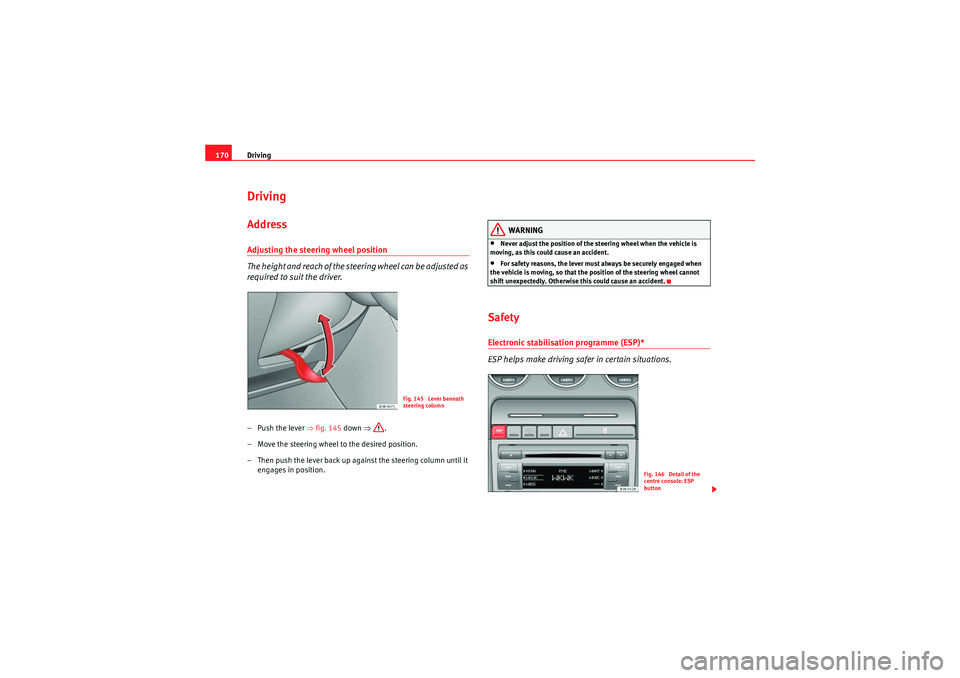
170DrivingAddressAdjusting the steering wheel position
The height and reach of the stee ring wheel can be adjusted as
required to suit the driver.–Push the lever ⇒ fig. 145 down ⇒.
– Move the steering wheel to the desired position.
– Then push the lever back up against the steering column until it engages in position.
WARNING
•Never adjust the position of the steering wheel when the vehicle is
moving, as this could cause an accident.•For safety reasons, the lever must always be securely engaged when
the vehicle is moving, so that the position of the steering wheel cannot
shift unexpectedly. Otherwise this could cause an accident.
SafetyElectronic stabilisation programme (ESP)*
ESP helps make driving safer in certain situations.
Fig. 145 Lever beneath
steering column
Fig. 146 Detail of the
centre console: ESP
button
ExeoST_EN.book Seite 170 Donnerstag, 3. September 2009 12:24 12
Page 202 of 316

Trailer towing
200Trailer towingTrailer towingTechnical requirements
The towing bracket must meet certain technical requirements.Your car is intended mainly for transporting passengers and luggage.
However, if suitably equipped, it can also be used to tow a trailer or caravan.
If your vehicle has been factory -supplied with a towing bracket, all of the
necessary technical and legal aspects for trailing towing have been taking
into account during manufacturing.
Your vehicle is fitted with a 13-pole socket for the electrical connection
between the trailer and the vehicle. If the trailer has a 7-pole connector you
can use an adapter cable. This can be purchased from any SEAT Dealer.
If a towing bracket is to be fitted after the car is purchased, this must be done
according to the instructions of the towing bracket manufacturer
⇒ page 209.
WARNING
If a towing bracket is retrofitted, the installation should be carried out by a
specialist garage.•Particularly in high outdoor temperatures, it is not possible to drive up
long steep gradients without a suitable cooling system. The engine would
heat up.•Incorrect installation can result in a safety risk!
Notes on towing
There are a number of points which need to be checked before
towing a trailer or caravan.– Observe the maximum permitted trailer weights ⇒page 295.Trailer weights
Never exceed the maximum permitted trailer weights.
If you do not load the trailer up to the maximum permitted trailer weight, you
can then climb correspondingly steeper gradients.
The maximum trailer weights listed are only applicable for altitudes up to
1,000 m above sea level. With increa sing altitude the engine power and
therefore the vehicle's climbing ability are impaired because of the reduced
air density. The maximum trailer weight has to be reduced accordingly. The
weight of the car and trailer must be reduced by about 10% for every subse-
quent 1000 m (or part thereof). This figure refers to the combined weight of
the (loaded) vehicle and (loaded) trailer.
The figures for the draw bar weight that appear on the identification plate of
the towing bracket are for certification purposes only. The correct figures for
your specific model, which may be lower than these figures for the towing
bracket, are given in the registration documents and on ⇒page 288. Also
refer to ⇒page 295.
Distributing the load
Distribute loads in the trailer so that heavy objects are as near to the axle as
possible. Loads carried in the trailer must be secured to prevent them
moving.
ExeoST_EN.book Seite 200 Donnerstag, 3. September 2009 12:24 12
Page 205 of 316

Trailer towing203
Safety First
Controls and equipment
Practical tips
Technical Data
Removable towing bracketIntroduction
Special care is required when fitting and removing the towing
bracket.The removable ball joint attachment for the towing bracket is stored under the
floor panel in the luggage compartment.•On vehicles with a spare wheel ⇒fig. 162 .
The ball joint can be fitted and removed by hand.
Equipment / Accessories mounted on the towing bracket
Please note that the ball joint attachment can be damaged by using unsuit-
able equipment that is mounted onto the towing bracket (e.g. bicycle rack).
Due to the material construction, such damage to the towing bracket dramat-
ically increases safety risks and in extreme cases could lead to breakage of
the towing bracket while towing ⇒. Therefore,
before buying such equipment, ensure that it is suitable for
mounting onto the vehicle's towing bracket and that it is approved for this
purpose. To prevent damage to the ball joint from unsuitable equipment, we
recommend that equipment for the towing bracket be purchased through
your SEAT Dealer. Also refer to ⇒page 220.
WARNING
•Only mount equipment on the towing bracket of your vehicle if you are
certain it will not damage the bracket. The use of unsuitable accessory
equipment can result in severe damage to the towing bracket, and it could
then break while pulling a trailer - Risk of accident.•Never use tools of any kind when fitting and removing the ball joint.
This would damage the locking device, no longer guaranteeing the correct
working order of the bracket. This could lead to an accident.Note
•Do not attempt to modify or repair the ball joint or other towing bracket
components.•Should you have any difficulties when using the towing bracket, or
suspect that it is not fitted properly, contact a specialist garage.•Before setting off, always check that the ball joint is secured properly
⇒ page 206.•Never disengage the ball joint with the caravan / trailer still hitched or
with a bicycle rack or similar accessory still attached.•It is advisable to remove the ball joint when you are not towing a trailer.
Make sure that the cover piece is properly fitted on the mounting fixture on
the vehicle.•Remove the ball joint before washing the vehicle with pressurised steam
equipment. Make sure the cover piece is fitted correctly onto the mounting
fixture.
Fig. 162 Luggage
compartment: Spare
wheel with towing bracket
ExeoST_EN.book Seite 203 Donnerstag, 3. September 2009 12:24 12
Page 206 of 316

Trailer towing
204Fitting the ball joint (step 1)– Remove the cover piece ⇒fig. 163 on the mounting fixture
below the bumper as far as it will go. The cover piece is held
automatically in the open position.
– Make sure the mounting fixture is clean. If not, clean it ⇒.Cont ⇒page 204, “Fitting the ball joint (step 2)”.
WARNING
It is important to keep the mounting fixture clean. Otherwise the ball joint
may fail to engage safely and securely. This could lead to an accident.
Fitting the ball joint (step 2)
Fig. 163 Rear bumper:
Open the cover piece
A2
A1
Fig. 164 Removable
towing bracket: Ball jointFig. 165 Removable
towing bracket: Ball joint
ExeoST_EN.book Seite 204 Donnerstag, 3. September 2009 12:24 12
Page 210 of 316

Trailer towing
208
– Take hold of the ball joint and pull out the knob in direction .
– Keep hold of the knob and turn it as far as it will go in direction
.
– Release the knob. The spring mechanism will remain in the ready position ⇒.
– Pull the ball joint down out of the mounting fixture ⇒page 207, fig. 171. The cover piece will cover the mounting
fixture automatically .
– Put away the ball joint attachment under the floor panel in the luggage compartment.
– Move the socket back up to its original position.
WARNING
•To avoid injury, keep your hands away from the locking pin and the
release pin when releasing the locking mechanism.•Make sure that the cover piece is properly engaged on the mounting
fixture on the vehicle. Otherwise the ball joint may fail to engage securely
if dirt accumulates in the mounting fixture.
AA
AB
A1
A2
ExeoST_EN.book Seite 208 Donnerstag, 3. September 2009 12:24 12