2009 Seat Exeo ST belt
[x] Cancel search: beltPage 19 of 316

Safe driving17
Safety First
Controls and equipment
Practical tips
Technical Data
behind them; they will remain trapped without help and there is a mortal
risk.
•Never allow children to play in or around the vehicle. Close and lock
both the tailgate and all the doors when you leave the vehicle. Before you
lock the vehicle, make sure that there are no adults or children in the
vehicle.•Never transport passengers in the luggage compartment. Every
passenger must be properly belted in ⇒page 18.Note
•Air circulation in the vehicle helps reduce fogging of the windows. Used
air escapes through ventilation slits in the side trim of the luggage compart-
ment. Ensure that the ventilation slits are never covered.•Straps for securing the load to the fastening rings are commercially
available.Fastening rings
There can be four fastening rings in the boot for fastening
luggage and other objects.– Always use suitable and undamaged straps to secure luggage and other objects to the fastening rings ⇒ in “Loading the
boot” on page 16.
– Pull up the fastening rings to attach the straps.During a collision or an accident, even small and light objects can build up so
much energy that they can cause very severe injuries. The amount of “kinetic energy” depends on the speed of the vehicle and the weight of the object.
The most significant factor, however, is the speed of the vehicle.
Example: An object weighing 4.5 kg is lying unsecured in the vehicle. During
a frontal collision at a speed of 50 km/h, this object generates a force corre-
sponding to 20 times its weight. That means that the effective weight of the
object increases to about 90 kg. You can imagine the severity of the injuries
which might be sustained if this “projectile” strikes an occupant as it flies
through the passenger compartment. This increased risk of injury will be
further increased if a loose object is struck by an inflating airbag.
WARNING
•If pieces of baggage or other objects are secured to the fastening rings
with inappropriate or damaged retaining cords, injuries could result in the
event of braking manoeuvres or accidents.•To prevent pieces of luggage or other objects from flying forward,
always use appropriate retaining cords which are secured to the fastening
rings.•Never secure a child seat on the fastening rings.
WARNING (continued)
ExeoST_EN.book Seite 17 Donnerstag, 3. September 2009 12:24 12
Page 20 of 316

Seat belts
18Seat beltsBrief introductionBefore driving: remember your seat belt!
Wearing a seat belt properly can save your life!In this chapter you will learn the importance of wearing seat belts,
how they work and how to properly fasten, adjust and wear them.
– Read and consider all the informat ion as well as the warnings in
this chapter.
WARNING
•If seat belts are worn incorrectly or not at all, the risk of severe injuries
increases.•Properly worn seat belts can reduce severe injuries in case of sudden
braking manoeuvres or accidents. For safety reasons, you and your passen-
gers must always wear the seat belts properly while the vehicle is moving.•P r e g n a n t w o m e n o r p e o p l e w i t h p h y s i ca l d i s a b i l i t i e s m u s t a l s o u s e s e a t
belts. Like all other passengers, these people can also sustain severe inju-
ries if they are not wearing their seat belts properly.
Number of seatsYour vehicle has five seats, two in the front and three in the rear. Each seat is
equipped with a three-point seat belt.
WARNING
•More people than available seats must never be transported in your
vehicle.•Every passenger in the vehicle must properly fasten and wear the seat
belt belonging to h is or her s eat . Child ren m ust be protecte d with an appro-
priate child restraint system.
Seat belt warning lamp*
The warning lamp acts as a reminder to the driver to fasten
the seat belt.Before starting the vehicle:
–Fasten your safety belt securely.
– Instruct your passengers to fasten their seat belts properly before driving off.
– Protect children by using a child seat according to the child's height and weight.After switching on the ignition, the warning light
will remain lit until the
driver and front passenger (where applicable) have fastened their seat belts.
When the vehicle has reached a certain speed, you will also hear a warning
signal and the warning light will flash.
ExeoST_EN.book Seite 18 Donnerstag, 3. September 2009 12:24 12
Page 21 of 316

Seat belts19
Safety First
Controls and equipment
Practical tips
Technical Data
Why wear seat belts?Physical principles of frontal collisions
In the event of a frontal collision, a large amount of kinetic
energy must be absorbed.
It is easy to explain how the laws of physics work in the case of a head-on
collision: When a vehicle starts moving ⇒fig. 6 , a certain amount of energy
known as “kinetic energy” is produced in the vehicle and its occupants.
The amount of “kinetic energy” depends on the speed of the vehicle and the
weight of the vehicle and its passengers. The higher the speed and the
greater the weight, the more energy there is to be “released” in an accident.
The most significant factor, however, is the speed of the vehicle. If the speed
doubles from 25 km/h to 50 km/h, for example, the kinetic energy is multi-
plied by four.
Because the passengers in our example are not restrained by seat belts, all
of the passengers' kinetic energy has to be absorbed at the point of impact
⇒ fig. 7 .
Even at speeds of 30 km/h to 50 km/h, the forces acting on bodies in a colli-
sion can easily exceed one tonne (1000 kg). At greater speed these forces are
even higher.
Passengers not wearing seat belts are not “attached” to the vehicle. In a
frontal collision, they will move forward at the same speed their vehicle was
Fig. 6 Vehicle about to hit
a wall: the occupants are
not wearing seat belts
Fig. 7 The vehicle hits
the wall: the occupants
are not wearing seat belts
ExeoST_EN.book Seite 19 Donnerstag, 3. September 2009 12:24 12
Page 22 of 316
Seat belts
20travelling just before the impact. This example applies not only to frontal acci-
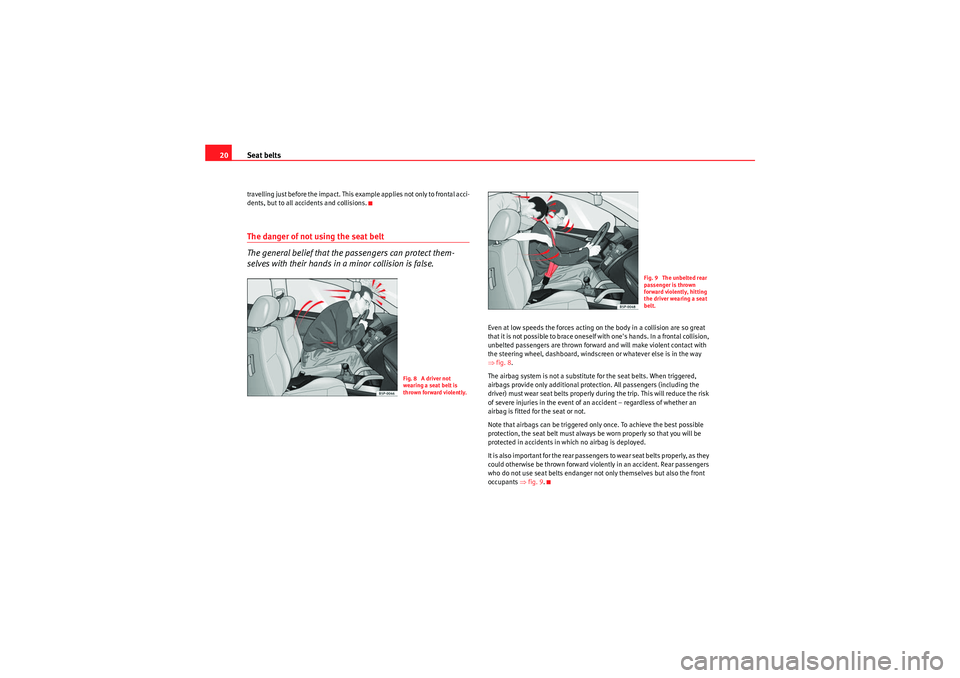
dents, but to all accidents and collisions.The danger of not using the seat belt
The general belief that the passengers can protect them-
selves with their hands in a minor collision is false.
Even at low speeds the forces acting on the body in a collision are so great
that it is not possible to brace oneself with one's hands. In a frontal collision,
unbelted passengers are thrown forward and will make violent contact with
the steering wheel, dashboard, windscreen or whatever else is in the way
⇒ fig. 8.
The airbag system is not a substitute for the seat belts. When triggered,
airbags provide only additional protection. All passengers (including the
driver) must wear seat belts properly during the trip. This will reduce the risk
of severe injuries in the event of an accident – regardless of whether an
airbag is fitted for the seat or not.
Note that airbags can be triggered only once. To achieve the best possible
protection, the seat belt must always be worn properly so that you will be
protected in accidents in which no airbag is deployed.
I t is a ls o i m p o r ta n t f o r t h e r e a r p a ss e ng e r s t o w ea r s ea t b e l t s p r o p e r l y, as t h e y
could otherwise be thrown forward violently in an accident. Rear passengers
who do not use seat belts endanger not only themselves but also the front
occupants ⇒fig. 9 .
Fig. 8 A driver not
wearing a seat belt is
thrown forward violently.
Fig. 9 The unbelted rear
passenger is thrown
forward violently, hitting
the driver wearing a seat
belt.
ExeoST_EN.book Seite 20 Donnerstag, 3. September 2009 12:24 12
Page 23 of 316

Seat belts21
Safety First
Controls and equipment
Practical tips
Technical Data
Seat belt protection
Passengers not wearing seat belts risk severe injuries in the
event of an accident.Properly worn seat belts hold the vehicle occupants in the correct sitting posi-
tions and substantially reduce the kinetic energy in the event of an accident.
Seat belts also help to prevent uncontrolled movements that could lead to
severe injuries. In addition, properly worn seat belts reduce the danger of
being thrown from the car.
Passengers wearing their seat belts correctly benefit greatly from the ability
of the belts to absorb kinetic energy. The front part of your vehicle and other
passive safety features (such as the airbag system) are also designed to
absorb the kinetic energy released in a collision. Taken together, all these
features reduce the releasing kinetic energy and consequently, the risk of
injury.
Our examples describe frontal collisions. Of course, properly worn seat belts
substantially reduce the risk of injury in all other types of accidents. This is why it is so important to fasten seat belts before every trip, even when "just
driving around the corner".
Ensure that your passengers wear their seat belts as well. Accident statistics
have shown that wearing seat belts is an effective means of substantially
reducing the risk of injury and improving the chances of survival in a serious
accident. Furthermore, properly worn seat belts improve the protection
provided by airbags in the event of an accident. For this reason, wearing a
seat belt is required by law in most countries.
Although your vehicle is equipped with airbags, the seat belts must be
fastened and worn. The front airbags, for example, are only triggered in some
frontal accidents. The front airbags will
not be triggered during minor frontal
collisions, minor side collisions, rear collisions, rolls or accidents in which the
airbag trigger threshold value in the control unit is not exceeded.
Therefore, you should always wear your seat belt and ensure that your
passengers have fastened their seat belts properly before you drive off!
Safety instructions on using seat belts
If seat belts are used correctly, they can reduce the risk of
injury in an accident.– Always wear the seat belt as described in this section.
– Ensure that the seat belts can be fastened at all times and are not damaged.
WARNING
•If the seat belts are worn incorrectly or not at all, the risk of severe inju-
ries increases. The optimal protection from seat belts can be achieved only
if you use them properly.
Fig. 10 A driver wearing
the seat belt properly: is
secured by the belt in
sharp braking
ExeoST_EN.book Seite 21 Donnerstag, 3. September 2009 12:24 12
Page 24 of 316

Seat belts
22•Fasten your seat belt before every trip - even when driving in town. The
other passengers must also wear seat belts, otherwise they may be in
danger of injury!•The seat belt cannot offer its full protection if the belt web is not posi-
tioned correctly.•Never allow two passengers (even children) to share the same seat belt.•Keep both feet in the foot-well in front of your seat as long as the
vehicle is in motion.•Never unbuckle a seat belt while the vehicle is in motion. Risk of fatal
injury.•The belt webbing must never be twisted while it is being worn.•The belt webbing should never lie on hard or fragile objects (such as
glasses or pens, etc.) because this can cause injuries.•Do not allow the seat belt to be damaged or jammed, or to rub on any
sharp edges.•Never wear the seat belt under the arm or in any other incorrect posi-
tion.•Loose, bulky clothing (such as an overcoat over a jacket) impairs the
proper fit and function of the belts, reducing their capacity to protect.•The slot in the seat belt buckle must not be blocked with paper or other
objects, as this can prevent the latch plate from engaging securely.•Never use seat belt clips, retaining rings or similar instruments to alter
the position of the belt webbing.•Frayed or torn seat belts or damage to the connections, belt retractors
or parts of the buckle could cause severe injuries in the event of an acci-
dent. Therefore, you must check the condition of all seat belts at regular
intervals.•Seat belts which have been worn in an accident and stretched must be
replaced by a qualified workshop. Renewal may be necessary even if there
is no apparent damage. The belt anchorage should also be checked.
•Do not attempt to repair a damaged seat belt yourself. The seat belts
must not be removed or modified in any way.•The belts must be kept clean, otherwise the retractors may not work
properly ⇒page 219.
Seat beltsSeat belt adjustment
The seat belts for the front and rear occupants are locked into
position by a latch.The seat belt cannot offer its full protection if the belt web is not
positioned correctly.
WARNING (continued)
WARNING (continued)
Fig. 11 Belt buckle and
latch plate of seat belt
ExeoST_EN.book Seite 22 Donnerstag, 3. September 2009 12:24 12
Page 25 of 316

Seat belts23
Safety First
Controls and equipment
Practical tips
Technical Data
– Adjust the seat and head restraint correctly.
– To fasten the belt, take hold of the latch plate and pull it slowly
across your chest and lap.
– Insert the latch plate into the buckle for the appropriate seat and push it down until it is securely locked with a click ⇒ page 22,
fig. 11 .
– Pull the belt to ensure that the latch plate is securely engaged in the buckle.The seat belts are equipped with an automatic retractor on the shoulder
strap. Full freedom of movement is permitted when the shoulder belt is pulled
slowly. However, during sudden braking, during travel in mountains or bends
and during acceleration, the automatic retractor on the shoulder belt is
locked.
The automatic belt retractors on the front seats are fitted with belt tension
devices ⇒page 26.
WARNING
•An incorrectly worn seat belt web can cause severe injuries in the event
of an accident.•The seat belts offer best protection only when the backrests are in an
upright position and the seat belts have been fastened properly.•Never put the latch plate in the buckle of another seat. If you do this, the
seat belt will not protect you properly and the risk of injury is increased.•I f a n o ccu p an t is i n co r re c t l y be l te d i n , t h e b e l t ca n n o t p ro te c t h i m o r h e r
properly. An incorrectly positioned belt web can cause extremely severe
injuries.
Seat belt position
Seat belts offer their maximum protection only when they are
properly positioned.
Fig. 12 Correct belt web
and head restraint posi-
tions, viewed from frontFig. 13 Correct belt web
and head restraint posi-
tions, viewed from side
ExeoST_EN.book Seite 23 Donnerstag, 3. September 2009 12:24 12
Page 26 of 316

Seat belts
24The following features are available to adjust the seat belt in the shoulder
region:•belt height adjustment for the front seats.•front seat height adjustment*.WARNING
•An incorrectly worn seat belt web can cause severe injuries in the event
of an accident.•The shoulder part of the seat belt must lie on the centre of the shoulder,
never across the neck. The seat belt must lie flat and snugly on the torso
⇒ page 23, fig. 12 .•The lap par t of the seat belt must lie across the pelvis, never across the
stomach. The seat belt must lie flat and snugly on the pelvis ⇒page 23,
fig. 13. Pull the belt tight if necessary to take up any slack.•Read and observe the warnings ⇒page 21.
Pregnant women must also fasten their seat belts properly
The best protection for the unborn child is for the mother to
wear the seat belt properly at all times during the pregnancy.The seat belt provides maximum protection only when the belt web
is properly positioned ⇒page 23.
– Adjust the front seat and head restraint correctly ⇒page 10.
– Holding the latch plate, pull the belt evenly across your chest and as low as possible over the pelvis ⇒fig. 14 .
– Insert the latch plate into the buckle for the appropriate seat and push it down until it is securely locked with a click ⇒.
– Pull the belt to ensure that the latch plate is securely engaged in the buckle.
Fig. 14 Positioning seat
belts during pregnancy
ExeoST_EN.book Seite 24 Donnerstag, 3. September 2009 12:24 12