2009 SATURN AURA spare wheel
[x] Cancel search: spare wheelPage 258 of 408

Different Size Tires and Wheels......................5-63
Uniform Tire Quality Grading..........................5-63
Wheel Alignment and Tire Balance..................5-65
Wheel Replacement......................................5-65
Tire Chains..................................................5-66
If a Tire Goes Flat........................................5-67
Changing a Flat Tire.....................................5-68
Removing the Spare Tire and Tools................5-69
Removing the Flat Tire and Installing the
Spare Tire................................................5-71
Storing a Flat or Spare Tire and Tools............5-76
Compact Spare Tire......................................5-80
Appearance Care............................................5-81
Interior Cleaning...........................................5-81
Fabric/Carpet...............................................5-83
Leather.......................................................5-83
Instrument Panel, Vinyl, and Other
Plastic Surfaces........................................5-84
Care of Safety Belts......................................5-84
Weatherstrips...............................................5-84
Washing Your Vehicle...................................5-85
Cleaning Exterior Lamps/Lenses.....................5-85Finish Care..................................................5-86
Windshield and Wiper Blades.........................5-86
Aluminum Wheels.........................................5-87
Tires...........................................................5-87
Sheet Metal Damage.....................................5-88
Finish Damage.............................................5-88
Underbody Maintenance................................5-88
Chemical Paint Spotting.................................5-88
Vehicle Identication......................................5-89
Vehicle Identication Number (VIN).................5-89
Service Parts Identication Label.....................5-89
Electrical System............................................5-90
Add-On Electrical Equipment..........................5-90
Windshield Wiper Fuses................................5-90
Power Windows and Other Power Options.......5-90
Fuses.........................................................5-91
Instrument Panel Fuse Block..........................5-91
Engine Compartment Fuse Block....................5-94
Rear Compartment Fuse Block.......................5-97
Capacities and Specications........................5-100
Section 5 Service and Appearance Care
5-2
ProCarManuals.com
Page 310 of 408

Tire Pressure Monitor System
The Tire Pressure Monitor System (TPMS) uses radio
and sensor technology to check tire pressure levels.
The TPMS sensors monitor the air pressure in
your vehicle’s tires and transmit tire pressure readings
to a receiver located in the vehicle.
Each tire, including the spare (if provided), should be
checked monthly when cold and inated to the ination
pressure recommended by the vehicle manufacturer
on the vehicle placard or tire ination pressure label.
(If your vehicle has tires of a different size than the
size indicated on the vehicle placard or tire ination
pressure label, you should determine the proper
tire ination pressure for those tires.)
As an added safety feature, your vehicle has been
equipped with a tire pressure monitoring system (TPMS)
that illuminates a low tire pressure telltale when one
or more of your tires is signicantly under-inated.
Accordingly, when the low tire pressure telltale
illuminates, you should stop and check your tires as
soon as possible, and inate them to the proper pressure.
Driving on a signicantly under-inated tire causes the
tire to overheat and can lead to tire failure. Under-ination
also reduces fuel efficiency and tire tread life, and may
affect the vehicle’s handling and stopping ability.Please note that the TPMS is not a substitute for proper
tire maintenance, and it is the driver’s responsibility to
maintain correct tire pressure, even if under-ination
has not reached the level to trigger illumination of
the TPMS low tire pressure telltale.
Your vehicle has also been equipped with a TPMS
malfunction indicator to indicate when the system is
not operating properly. The TPMS malfunction indicator
is combined with the low tire pressure telltale. When the
system detects a malfunction, the telltale will ash for
approximately one minute and then remain continuously
illuminated. This sequence will continue upon
subsequent vehicle start-ups as long as the malfunction
exists.
When the malfunction indicator is illuminated, the
system may not be able to detect or signal low tire
pressure as intended. TPMS malfunctions may occur
for a variety of reasons, including the installation of
replacement or alternate tires or wheels on the vehicle
that prevent the TPMS from functioning properly. Always
check the TPMS malfunction telltale after replacing one
or more tires or wheels on your vehicle to ensure that
the replacement or alternate tires and wheels allow the
TPMS to continue to function properly.
SeeTire Pressure Monitor Operation on page 5-55for
additional information.
5-54
ProCarManuals.com
Page 311 of 408

Federal Communications
Commission (FCC) and Industry
and Science Canada
The Tire Pressure Monitor System (TPMS) operates
on a radio frequency and complies with Part 15 of the
FCC Rules. Operation is subject to the following two
conditions:
1. This device may not cause harmful interference.
2. This device must accept any interference received,
including interference that may cause undesired
operation.
Vehicles with TPMS operate on a radio frequency and
comply with RSS-210 of Industry and Science Canada.
Operation is subject to the following two conditions:
1. This device may not cause interference.
2. This device must accept any interference received,
including interference that may cause undesired
operation of the device.
Changes or modications to this system by other than
an authorized service facility could void authorization to
use this equipment.
Tire Pressure Monitor Operation
This vehicle may have a Tire Pressure Monitor
System (TPMS). The TPMS is designed to warn
the driver when a low tire pressure condition exists.
TPMS sensors are mounted onto each tire and wheel
assembly, excluding the spare tire and wheel assembly.
The TPMS sensors monitor the air pressure in the
vehicle’s tires and transmits the tire pressure readings
to a receiver located in the vehicle.
When a low tire pressure
condition is detected, the
TPMS turns on the low
tire pressure warning light
located on the instrument
panel cluster.
At the same time a message to check the pressure in
a specic tire appears on the Driver Information Center
(DIC) display. The low tire pressure warning light and the
DIC warning message come on at each ignition cycle
until the tires are inated to the correct ination pressure.
Using the DIC, tire pressure levels can be viewed by the
driver. For additional information and details about the
DIC operation and displays seeDIC Operation and
Displays on page 3-43andDIC Warnings and Messages
on page 3-45.
5-55
ProCarManuals.com
Page 315 of 408

Tire Inspection and Rotation
We recommend that you regularly inspect your
vehicle’s tires, including the spare tire, for signs
of wear or damage. SeeWhen It Is Time for New
Tires on page 5-60for more information.
Tires should be rotated every 5,000 to 8,000 miles
(8 000 to 13 000 km). SeeScheduled Maintenance
on page 6-4.
The purpose of a regular tire rotation is to
achieve a uniform wear for all tires on the vehicle.
This will ensure that your vehicle continues to
perform most like it did when the tires were new.
Any time you notice unusual wear, rotate the tires
as soon as possible and check wheel alignment.
Also check for damaged tires or wheels. SeeWhen
It Is Time for New Tires on page 5-60andWheel
Replacement on page 5-65.When rotating the vehicle’s tires, always use the
correct rotation pattern shown here.
Do not include the compact spare tire in the tire
rotation.
5-59
ProCarManuals.com
Page 318 of 408

GM recommends replacing tires in sets of four.
This is because uniform tread depth on all tires will
help keep your vehicle performing most like it did
when the tires were new. Replacing less than a
full set of tires can affect the braking and handling
performance of your vehicle. SeeTire Inspection
and Rotation on page 5-59for information on
proper tire rotation.
{CAUTION:
Mixing tires could cause you to lose control
while driving. If you mix tires of different
sizes, brands, or types (radial and bias-belted
tires), the vehicle may not handle properly,
and you could have a crash. Using tires of
different sizes, brands, or types may also
cause damage to your vehicle. Be sure to
use the correct size, brand, and type of
tires on all wheels. It is all right to drive
with your compact spare temporarily, as
it was developed for use on your vehicle.
SeeCompact Spare Tire on page 5-80.
{CAUTION:
If you use bias-ply tires on the vehicle, the
wheel rim anges could develop cracks after
many miles of driving. A tire and/or wheel
could fail suddenly, causing a crash. Use only
radial-ply tires with the wheels on the vehicle.
If you must replace your vehicle’s tires with those
that do not have a TPC Spec number, make sure
they are the same size, load range, speed rating,
and construction type (radial and bias-belted tires)
as your vehicle’s original tires.
Vehicles that have a tire pressure monitoring
system could give an inaccurate low-pressure
warning if non-TPC Spec rated tires are installed
on your vehicle. Non-TPC Spec rated tires may
give a low-pressure warning that is higher or lower
than the proper warning level you would get with
TPC Spec rated tires. SeeTire Pressure Monitor
System on page 5-54.
Your vehicle’s original equipment tires are listed
on the Tire and Loading Information Label.
SeeLoading the Vehicle on page 4-21, for more
information about the Tire and Loading Information
Label and its location on your vehicle.
5-62
ProCarManuals.com
Page 319 of 408

Different Size Tires and Wheels
If you add wheels or tires that are a different size than
your original equipment wheels and tires, this may affect
the way your vehicle performs, including its braking,
ride and handling characteristics, stability, and resistance
to rollover. Additionally, if your vehicle has electronic
systems such as, anti-lock brakes, traction control, and
stability control, the performance of these systems can
be affected.
{CAUTION:
If you add different sized wheels, your vehicle may
not provide an acceptable level of performance and
safety if tires not recommended for those wheels
are selected. You may increase the chance that you
will crash and suffer serious injury. Only use Saturn
specic wheel and tire systems developed for your
vehicle, and have them properly installed by a
Saturn certied technician.
SeeBuying New Tires on page 5-61andAccessories
and Modifications on page 5-3for additional information.
Uniform Tire Quality Grading
Quality grades can be found where applicable
on the tire sidewall between tread shoulder
and maximum section width. For example:
Treadwear 200 Traction AA
Temperature A
The following information relates to the system
developed by the United States National
Highway Traffic Safety Administration (NHTSA),
which grades tires by treadwear, traction, and
temperature performance. This applies only to
vehicles sold in the United States. The grades are
molded on the sidewalls of most passenger car
tires. The Uniform Tire Quality Grading (UTQG)
system does not apply to deep tread, winter-type
snow tires, space-saver, or temporary use
spare tires, tires with nominal rim diameters
of 10 to 12 inches (25 to 30 cm), or to some
limited-production tires.
While the tires available on General Motors
passenger cars and light trucks may vary with
respect to these grades, they must also conform
to federal safety requirements and additional
General Motors Tire Performance Criteria (TPC)
standards.
5-63
ProCarManuals.com
Page 325 of 408

Removing the Spare Tire and Tools
The equipment you will need is located in the trunk.
1. Open the trunk. SeeTrunk on page 2-13.
2. Remove the spare tire cover.
3. Turn the wing nut counterclockwise and remove it.
Then remove the compact spare tire. SeeCompact
Spare Tire on page 5-80.4. Remove the wing nut holding the jack in place.
5. Remove the extension bolt that is clipped to
the jack. You need this later to store the at tire.
6. Remove the jack and wheel wrench from the trunk.
The tools you will be using include the wheel wrench (A)
and jack (B).
5-69
ProCarManuals.com
Page 327 of 408
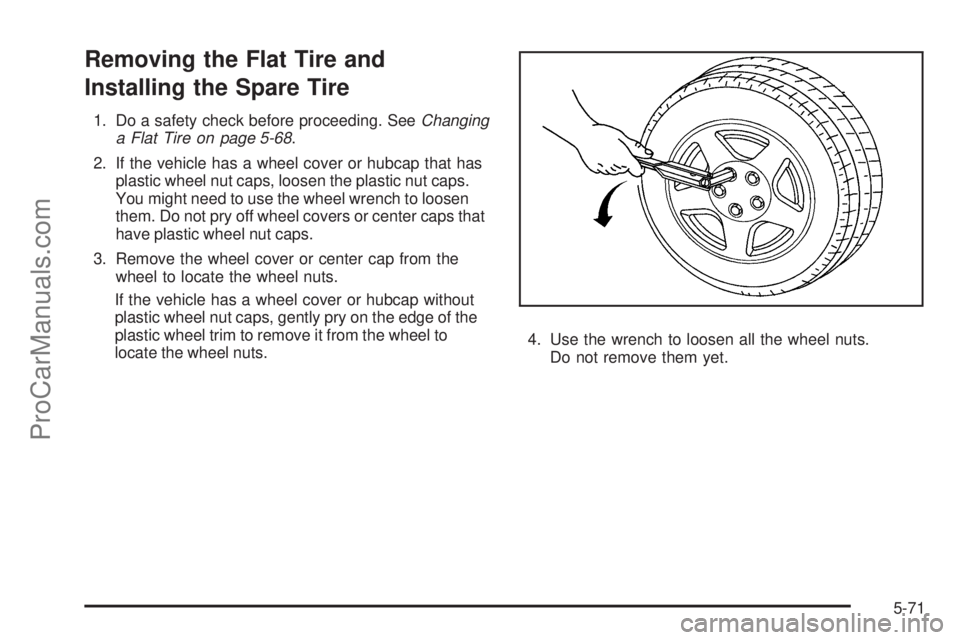
Removing the Flat Tire and
Installing the Spare Tire
1. Do a safety check before proceeding. SeeChanging
a Flat Tire on page 5-68.
2. If the vehicle has a wheel cover or hubcap that has
plastic wheel nut caps, loosen the plastic nut caps.
You might need to use the wheel wrench to loosen
them. Do not pry off wheel covers or center caps that
have plastic wheel nut caps.
3. Remove the wheel cover or center cap from the
wheel to locate the wheel nuts.
If the vehicle has a wheel cover or hubcap without
plastic wheel nut caps, gently pry on the edge of the
plastic wheel trim to remove it from the wheel to
locate the wheel nuts.4. Use the wrench to loosen all the wheel nuts.
Do not remove them yet.
5-71
ProCarManuals.com