2009 SAAB 9-5 trunk
[x] Cancel search: trunkPage 179 of 272

179 Starting and driving
Driving with a roof rack
loadThe maximum permissible roof load is
220 lbs. (100 kg).
Note that the roof load is included in the
car’s maximum permissible load (see
page 258).
Strong, sturdy roof carriers3 designed spe-
cially for the car are available from your
Saab dealer. Always secure the roof load
safely.
Driving with a loadThe driving characteristics of the car are
affected by the way it is loaded.
Place heavy loads as far forward and as
low as possible in the trunk.
Secure the load to the tie downs, see
page 131.
The load should be such that the car´s
total weight or axle weight are not
exceeded, see page 258.
Heavy loads mean that the car’s center of
gravity is further back. As a result, the car
will sway more during evasive steering.
Never exceed the permissible load in the
roof box3, even if there is room for more.
Ensure that the tire pressure is correct –
slight overinflation is preferable to under-
inflation.
The braking distance of a loaded car is
always greater. Keep your distance from
the vehicle in front.
Roof loads can negatively affect tele-
communication.
Tire pressure, see page 263.
Additional information on tires, see page
220.
WARNING
A roof load will affect the car’s center
of gravity and aerodynamics. Be
aware of this when cornering and driv-
ing in crosswinds.
Suit your speed to the prevailing con-
ditions.
Due to higher aerodynamic drag, fuel
economy may suffer when driving with
a roof rack.95_US_MY09.book Page 179 Tuesday, April 15, 2008 11:03 AM
ProCarManuals.com
Page 181 of 272

181 Starting and driving
Driving with a spare
wheel fittedSee page 236.Driving with the trunk
lid/tailgate openAvoid driving with the trunk lid/tailgate partly
or fully open, since exhaust fumes can be
drawn into the cabin.
If you must drive with the trunk lid/tailgate
open, all windows and the moonroof3 must
be closed and the cabin fan on at its highest
speed setting.
Driving in deep water Towing the carNOTICEDo not drive in water deeper than
12 inches (30 cm) and do not drive faster
than 3–4 mph. Water can otherwise be
sucked into the engine. The engine will be
seriously damaged if water enters the
intake system.
WARNING
Remember that the brake servo does
not operate when the engine is off.
Much greater pressure than normal
will therefore be required to operate
the brake pedal.
Nor does the steering servo operate
when the engine is off. The steering
will therefore be much heavier than
usual.
The towing vehicle should always be
heavier than the vehicle on tow.
Never allow passengers to ride in the
car being towed.
Always seek professional help if the
car needs to be towed.
95_US_MY09.book Page 181 Tuesday, April 15, 2008 11:03 AM
ProCarManuals.com
Page 207 of 272
207 Car care and technical information
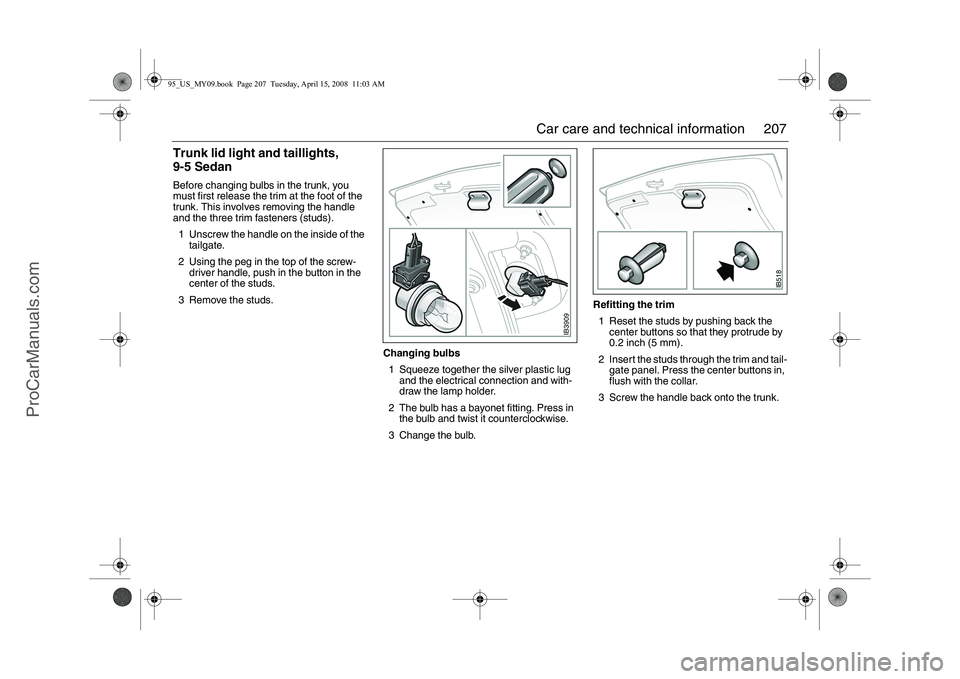
Trunk lid light and taillights,
9-5 SedanBefore changing bulbs in the trunk, you
must first release the trim at the foot of the
trunk. This involves removing the handle
and the three trim fasteners (studs).
1 Unscrew the handle on the inside of the
tailgate.
2 Using the peg in the top of the screw-
driver handle, push in the button in the
center of the studs.
3 Remove the studs.
Changing bulbs
1 Squeeze together the silver plastic lug
and the electrical connection and with-
draw the lamp holder.
2 The bulb has a bayonet fitting. Press in
the bulb and twist it counterclockwise.
3 Change the bulb.Refitting the trim
1 Reset the studs by pushing back the
center buttons so that they protrude by
0.2 inch (5 mm).
2 Insert the studs through the trim and tail-
gate panel. Press the center buttons in,
flush with the collar.
3 Screw the handle back onto the trunk.
IB3909
IB518
95_US_MY09.book Page 207 Tuesday, April 15, 2008 11:03 AM
ProCarManuals.com
Page 216 of 272

216 Car care and technical informationFuse panel in instrument panel
# Amp Function
A 30 Trailer lights
B 10 Automatic transmission
C 7.5 Electric door mirrors; DICE: manual beam length
adjustment3
1 15 Brake lights; Park Brake Shift Lock (cars with auto-
matic transmission)
2 15 Reversing lights
3 10 Parking lights and taillights, left
4 10 Parking lights and taillights, right
5 7.5 DICE / TWICE
6 30 Electric windows, right; trailer charging
6B 7.5 Brake lights, trailer
7 10 Engine injectors
8 15 Trunk lighting; trunk lock; door lighting; parking
assistant3; SID
9 15 Audio System; CD changer3
10 15 Heating, rear seat3; moonroof3, remote control
receiver
11 30 Electrically adjusted passenger seat3
12 7.5 Automatic transmission3
13 20 Audio System, amplifier
14 30 Ignition system, engine
15 20 Fuel pump
16 20 DICE (direction indicators)
16B – OnStar3
17 20 Engine-management system; main instrument;
DICE/TWICE
18 40 Door-mirror heating; rear-window heating
19 10 OnStar3; Telematics3
20 15 ACC; interior lighting; rear fog light; high beam flasher
21 10 Audio System; rear-view mirror; load angle sensor3;
navigation3; Cruise Control3
22 40 Interior fan
23 15 Central locking; navigation3; door mirror memory3
24 20 Main light switch
25 30 Electrically adjustable driver’s seat
IB2439
BC123456 A
14
121110987
13
6B
1516
2324
222120191817
16B25262728293031
3635343332
393837
95_US_MY09.book Page 216 Tuesday, April 15, 2008 11:03 AM
ProCarManuals.com
Page 236 of 272

236 Car care and technical informationDriving considerations with
compact spare wheel/tire fitted
The following should be observed when the
compact spare wheel (T115/70 R16) is
fitted:
The compact spare is light and easy to
handle when changing the wheel.
Do not drive further than necessary with
the compact spare fitted – the maximum
life of the wheel is only just over
2000 miles (3,500 km).
Refit the standard tire as soon as possi-
ble.
Fitting a spare tire/wheel without pressure
sensor will trigger a malfunction
message, see page 234.
Important considerations when driving with
a compact spare tire:
The car’s ground clearance is reduced.
The car must not be driven with more than
one compact tire at a time.
Avoid driving against a curb.
Do not use snow chains.
Do not fit the wheel cover - this would
conceal the warning text.
WARNING
Do not exceed 50 mph (80 km/h) as
the tire can overheat and adversely
affect the handling of the car.
Tire pressure: refer to page 263.
The spare wheel or punctured tire
must be stowed under the trunk floor,
and secured in place with the retaining
nut.
IB3234
Hanging up the cover, 9-5 SportCombi
95_US_MY09.book Page 236 Tuesday, April 15, 2008 11:03 AM
ProCarManuals.com
Page 237 of 272

237 Car care and technical information
Changing a wheel
WARNING
Lifting a vehicle and getting under it to do
maintenance or repairs is dangerous
without the appropriate safety equipment
and training. The jack provided with your
vehicle is designed only for changing a
flat tire. If it is used for anything else, you
or others could be badly injured or killed if
the vehicle slips off the jack. Use the jack
provided with your vehicle only for chang-
ing a flat tire.
Changing a tire can be dangerous. The
vehicle can slip off the jack and roll over
or fall on you or other people. You and
they could be badly injured or even killed.
Find a level place to change your tire. To
help prevent the vehicle from moving:
1 Set the parking brake firmly.
2 If you have an automatic transmis-
sion, put the shift lever in PARK (P).
For a manual transmission, leave the
car in gear (1st or REVERSE (R)).
3 Turn off the engine and do not restart
while the vehicle is raised.
4 Do not allow passengers to remain in
the vehicle.
To be even more certain the vehicle won't
move, you should put blocks at the front
and rear of the tire farthest away from the
one being changed. That would be the
tire, on the other side, at the opposite end
of the vehicle.
The car jack is designed solely for use
in changing a wheel or fitting snow
chains. It must not be used to sup-
port the car during repair work or
servicing.
Never crawl under a car that is
supported only by a jack.
Raising your vehicle too high or with
the jack improperly positioned can
damage the vehicle and even make
the vehicle fall. To help avoid personal
injury and vehicle damage, be sure to
fit the jack lift head into the proper
location before raising the vehicle, and
raise the vehicle only far enough off
the ground so there is enough room
for the spare tire to fit (no more than
25 mm or 1 inch clearance between
the ground and the bottom of the tire).
Switch on the hazard warning lights if
the car is on a road.
The jack should be stored correctly
under the carpeting in the trunk. If it
lies loose in the car, it could thrown for-
ward and cause personal injury in the
event of a crash or if the car rolls over.
Grit, salt and rust can clog the inner
threads of the wheel bolts if the car has
been driven for several years exclu-
sively with alloy wheels.
If steel wheels are being installed, the
bolt hole threads in the brake hubs
should be cleaned before the thinner
steel wheels are fitted. It may other-
wise not be possible to achieve the
correct clamping force, despite tight-
ening the wheel bolts to the correct
torque.
95_US_MY09.book Page 237 Tuesday, April 15, 2008 11:03 AM
ProCarManuals.com
Page 265 of 272

265 Specifications
Adjustable systemsSeveral of the systems in your Saab car can
be adjusted to better fit your individual
needs
Some functions are governed by legal
requirements and cannot therefore be
reprogrammed.
We recommend that you contact an autho-
rized Saab dealer for further information.
Car alarm/central locking system:
The number of blinks when locking/
unlocking.
Automatic locking of the trunk when the
car (SportCombi) is driven, 1 to 8 mph
(2–14 km/h), YES or NO.
Automatic locking of the trunk (Sport-
Combi) when it is closed, YES or NO.
Automatic locking of all doors when the
car is driven above 7.5 mph (12 km/h),
YES or NO.Saab Information Display:
Outdoor temperature display can be
adjusted.
Miscellaneous:
Select the on-time for heated rear seat3.
Additional sweep of the wipers after wind-
shield washer function (ON or OFF).
Courtesy Headlight Feature on-time can
vary from 20 to 50 seconds.
Night panel illumination deactivation
speed for the speedometer can be
adjusted.
Following adjustments can be
done by the driver:Automatic Climate Control (ACC):
You can choose whether front seat and rear
window heating is to be activated manually
or automatically; see "Adaptation of ACC"
on page 85.
Saab 9-5 Audio System (see page 106):
Speed dependent volume.
Daytime Running Lights:
To disable, turn off the ignition and pull out
fuse 35, see page 217.
95_US_MY09.book Page 265 Tuesday, April 15, 2008 11:03 AM
ProCarManuals.com
Page 271 of 272

271 Index
Temperature gauge, engine
________ 66
Temperature zones, ACC
__________ 81
Textile carpeting
________________ 241
Through-load hatch ______________ 131
Tie Downs
_____________________ 131
Tightening torque, wheel studs
_____ 237
Time display
___________________ 106
Tip, driving at night
______________ 179
Tip, to avoid theft
_______________ 166
Tips, ACC
______________________ 86
Tire chains ____________________ 226
Tire date code __________________ 231
Tire direction of rotation
__________ 231
Tire inspection and rotation ________ 221
Tire markings
__________________ 228
Tire pressure ___________________ 180
Tire sidewall labeling
_____________ 227
Tire terminology and definitions
____ 229
Tire, compact spare
_____________ 235
Tires
_____________________ 220
, 261
Tires, winter
___________________ 261
Touching-in the paintwork
_________ 243
Towbar attachment
______________ 174
Towbar load
___________________ 178
Towing the car _________________ 181
Towing, automatics
______________ 181
Traffic programme ________________ 99
Trailer weights
__________________ 259
Treadwear indicators
____________ 222
Trionic
________________________ 190
Trip computer
___________________ 68
Trip meter
______________________ 64Trunk
_________________________ 129
Trunk lid, opening
________________ 47
Tuning
_________________________ 93
Turbo gauge
____________________ 67
Turbo, points to note
_____________ 144
UUnder the hood
_________________ 189
Uniform tire quality grading
________ 224
Upholstery and trim
______________ 241
Upholstery and trim, care of
_______ 241
VVanity mirrors
__________________ 125
Vehicle Data Collection
___________ 255
Ventilated front seats
_____________ 87
Viscosity, engine oil
______________ 260
WWarning labels
___________________ 7
Warning light, AIR BAG
____________ 37
Warning lights
___________________ 58
Washers
______________________ 200
Washers, windshield
_____________ 201
Washing the car
________________ 242
Waxing and polishing
____________ 243
Wear indicators, tires ____________ 222What Will You See After an Airbag
Inflates?
_______________________ 38
Wheel replacement
______________ 225
Wheel, change
_________________ 237
Wheels and tires ________________ 261
Wheels and tires, sizes
___________ 261
When it is time for new tires
_______ 222
Windshield washers
______________ 77
Windshield wipers
________________ 77
Winter tires
________________ 231
, 261
Wiper blades, replacing
___________ 200
Wipers and washers
__________ 77
, 200
XXenon headlight
________________ 202
95_US_MY09.book Page 271 Tuesday, April 15, 2008 11:03 AM
ProCarManuals.com