2009 SAAB 9-5 ECO mode
[x] Cancel search: ECO modePage 124 of 272

124 Interior equipment and trunkEmergency operation of
moonroofIn an emergency (e.g. if there is an electrical
failure) the moonroof can be operated by a
screwdriver. Remove the cover at the front
of the moonroof opening, insert a screw-
driver in the groove, and rotate.
Rotate counterclockwise to close moonroof.
Interior lighting The interior lighting consists of one dome
light in the front and one in the back, a
map-reading light in the front, two reading
lights in the back, floor courtesy lights in the
front (in some model variants) and door
courtesy lights on all doors.
The courtesy lights come on automatically
when the respective door is opened. Each
reading light has its own switch adjacent to
the lamp.The switch for the dome lights is on the front
overhead panel. When the switch is in the
mid-position (door-activated), the interior
lighting will come on:
When the car is unlocked from the
outside.
When any door is opened.
When the ignition key is withdrawn from
the ignition switch.
Lighting goes out 30 seconds after the
doors have been closed or:
when the ignition is switched ON,
provided that the cabin lighting control is
in the center position
when the car is locked with the remote
control.
IB431
Manual operation of moonroof
123
IB357
1 Interior lighting on continuously
2 Lighting comes on when a door is opened
3 Lighting always off
95_US_MY09.book Page 124 Tuesday, April 15, 2008 11:03 AM
ProCarManuals.com
Page 139 of 272
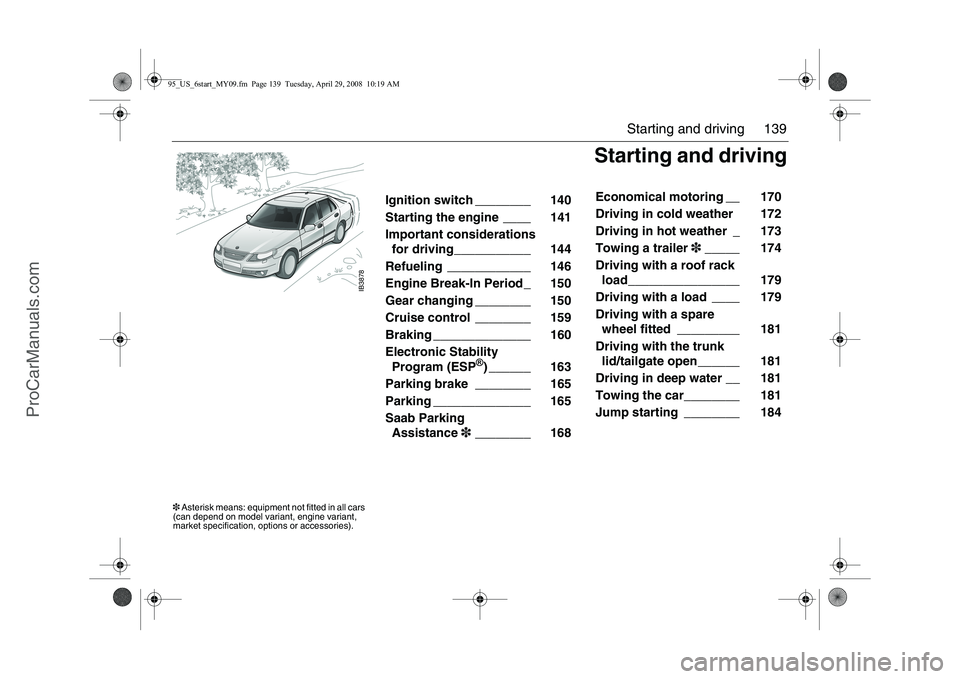
139
Starting and driving
IB3878
Starting and driving
Ignition switch ________ 140
Starting the engine ____ 141
Important considerations
for driving___________ 144
Refueling ____________ 146
Engine Break-In Period_ 150
Gear changing ________ 150
Cruise control ________ 159
Braking ______________ 160
Electronic Stability Program (ESP
®) ______ 163
Parking brake ________ 165
Parking ______________ 165
Saab Parking Assistance 3________ 168 Economical motoring __ 170
Driving in cold weather 172
Driving in hot weather _ 173
Towing a trailer
3_____ 174
Driving with a roof rack load________________ 179
Driving with a load ____ 179
Driving with a spare wheel fitted _________ 181
Driving with the trunk lid/tailgate open______ 181
Driving in deep water __ 181
Towing the car________ 181
Jump starting ________ 184
3 Asterisk means: equipment not fitted in all cars
(can depend on model variant, engine variant,
market specification, options or accessories).95_US_6start_MY09.fm Page 139 Tuesday, April 29, 2008 10:19 AM
ProCarManuals.com
Page 143 of 272

143 Starting and driving
Useful tips on cold climate
startingIf the engine has failed to start after several
attempts in very cold weather, press and
hold the accelerator down to the floor and
run the starter for 5–10 seconds. This will
prevent the engine being flooded (exces-
sively rich fuel-air mixture).
Now start the engine in the normal way – do
not touch the accelerator.
If the engine stalls immediately after starting
(e.g. if the clutch was released too quickly),
do not touch the accelerator when restarting
the engine.
Limp-home modeThe engine management system has a
diagnostic feature that continually checks a
number of internal functions.
If, for example, a fault is detected in the
throttle valve, the engine management
system will go into Limp-home mode.This
limits:
idling control,
disables the cruise-control system and
limits the capacity of the A/C compressor.
If the limp-home mode is in operation (”Ser-
vice Engine Light also known as CHECK
ENGINE” light on, see below) and the out-
side temperature is close to or below freez-
ing, you may need to use some throttle on
starting (some pressure on the accelerator).
If the diagnostic system has detected a fault
in the engine-management system, the
”Service Engine Light also known as
CHECK ENGINE” light on the main
instrument panel will come on (see page
58), indicating that you should have the car
checked as soon as possible by a work-
shop. We recommend that you contact an
authorized Saab dealer.
NOTICEIf the CHECK ENGINE warning light
starts to flash, ease off the accelerator
slightly. If the light does not cease to flash
within 5 seconds, stop the car in a suit-
able place as soon as possible and turn
off the engine. The car must be towed to
a workshop. We recommend that you
contact an authorized Saab dealer.
If the CHECK ENGINE warning light
flashes, it indicates that the engine is mis-
firing which can result in damage to the
catalytic converter.
95_US_MY09.book Page 143 Tuesday, April 15, 2008 11:03 AM
ProCarManuals.com
Page 152 of 272

152 Starting and drivingWhen the car is stationary, the engine must
be at idling speed when the selector lever is
moved.
You must have your foot on the brake
pedal to move the lever out of park.
If the accelerator is depressed while the
lever is moved, this will result in abnormal
wear in the transmission.
The detent button on the selector lever has
to be pressed before the selector can be
moved between certain positions. Three modes for the automatic transmis-
sion can be selected: Normal, Manual and
Sport.
Normal mode
The Normal mode, which provides the best
fuel economy, is the default setting when
the engine is started.
Manual mode (Sentronic): see page 156.
Sport mode
When the Sport mode is selected, the trans-
mission changes up later than in Normal
mode to provide higher performance. In this
mode, the SPORT indicator will appear on
the main instrument panel (see page 158).
Adaptive gear-change pattern
Adaptive gear-change pattern is a transmis-
sion function in the Normal and Sport
modes which matches gear changing to
current driving conditions. The transmission
control module senses the load on the
engine and temperature of the transmis-
sion. A suitable gear change pattern is then
selected automatically to avoid unneces-
sary gear changes and undesired tempera-
ture increases in the transmission.
NOTICEAfter selecting a drive position, pause
briefly to allow the gear to engage (the car
starts to pull a little) before you accel-
erate.
Detent positions for selector movement
IB3853
Selector-lever indicator on main instru-
ment panel 95_US_MY09.book Page 152 Tuesday, April 15, 2008 11:03 AM
ProCarManuals.com
Page 154 of 272

154 Starting and drivingIf ”Automatic transmission3, fault indicator”
light appears on the main instrument panel,
the system has detected a fault in the auto-
matic transmission or its control module
(see page 62).
This also means that the Limp-home mode
has been selected, to guard against further
damage being done to the transmission. In
this mode, the automatic transmission
starts in 5th gear, and gear changes (if nec-
essary) will have to be made manually.
Stop the car in a safe place. Switch off then
restart the engine. If the fault is intermittent,
the transmission will operate as normal
despite the fault indicator being on. Have
the car checked at a workshop. We recom-
mend that you contact an authorized Saab
dealer.
It is not possible to select the SPORT or
Sentronic mode when the Limp-home mode
is active.
Gear changes must be made manually.
The following gears will be engaged in the
respective selector positions when the auto-
matic transmission is in Limp-home mode:
Overheated transmission fluid If the automatic-transmission fluid should
overheat, the following message will appear
on the SID:
”Gearbox too hot.
Make a safe stop.”
In this event, stop the car in a suitable place,
switch off the engine and open the hood.
Wait for several minutes then turn on the
ignition to check that the message has gone
out. When driving subsequent to the trans-
mission fluid overheating, select a gear in
which the engine speed is about 3,000 rpm.
Overheating of the automatic-transmission
fluid can occur when the car is towing a
heavy load, such as a camping trailer in hilly
country. High ambient temperatures can
also increase the temperature of the trans-
mission fluid or the oil cooler may be faulty.
Contact a workshop. We recommend that
you contact an authorized Saab dealer (see
also page 174).
Automatic transmission3,
fault indicator
Position R D M L
Gear Reverse 5th 5th 2nd
NOTICEIf the control module has actuated the
Limp-home function for the automatic
transmission, the car will remain in 5th
gear when D is selected, making it very
sluggish.
Select position L to prevent unnecessary
wear on the transmission. The transmis-
sion then starts in 2nd gear. Once the car
is moving you can select position D.
When the indicator light is on, the car
must not be driven with a caravan or
trailer attached.
95_US_MY09.book Page 154 Tuesday, April 15, 2008 11:03 AM
ProCarManuals.com
Page 158 of 272

158 Starting and drivingIf you move the selector lever from D to L, down shifts will follow a
set pattern to avoid damaging the engine or transmission.
Manual gear-changing is not recommended on slippery roads.
If one of the drive wheels spins excessively, the engine torque will
be reduced to avoid damaging the transmission.Adaptive gear-change patternsAdaptive gear-change patterns are selected automatically depend-
ing on the engine load and the present temperature of the transmis-
sion. The function is available in Normal and Sport modes.
The changes occur at a higher engine speed and the car remains in
the same gear for longer, if the transmission control module senses
that the load has not decreased. These gear-change patterns pre-
vent unnecessary changing up and down, when for example driving
up or down long slopes with a trailer or caravan, and to prevent over-
heating the transmission oil. The adaptive gear-change function is
also selected automatically when the transmission oil becomes too
hot, to protect the transmission itself from damage and to lower the
oil temperature.
The adaptive gear-change pattern function is deselected when:
The engine is switched off.
The load is reduced so much that the function is no longer
required.
”Automatic transmission3, fault indicator” appears on main
instrument panel, see page 154.
SPORT modes
To select Sport mode, press the ”S” button on
the selector lever when the selector lever is in
position N or D.
In this mode, gear changes will take place at
higher engine speeds than in Normal mode, in
other words, the transmission will change up
later and change down earlier for the same throt-
tle (accelerator) position.
The Sport mode will be deselected if:
The SPORT button is pressed.
The selector lever is moved to position P,R, M
or L.
The engine is switched off.
”Automatic transmission3, fault indicator”
appears on main instrument panel, see
page 154.
95_US_MY09.book Page 158 Tuesday, April 15, 2008 11:03 AM
ProCarManuals.com
Page 160 of 272

160 Starting and drivingTo reduce the preset speedThe cruise control system will always disen-
gage automatically the moment that either
the brake pedal or the clutch pedal is
depressed.
It is also possible to reduce the speed by
means of the RESUME/– button.
Sliding the button to RESUME/– once will
reduce the speed by 1 mph (1.6 km/h).
Holding the button in the RESUME/– posi-
tion will effect a gradual reduction in speed
until the button is released.
Disengaging the system The system will be disengaged:
When the brake or clutch pedal is
depressed.
When the switch is moved to CANCEL.
When the switch is moved to OFF.
When the engine is switched off.
When the selector lever is moved to posi-
tion N (cars with automatic transmission).
When the ESP
® system is operative for
more than 1 second.
BrakingTo avoid the brakes becoming overheated,
(e.g. when negotiating long descents with a
drop of several hundred feet), select a low
gear to use the braking effect of the engine.
If the car has automatic transmission, move
the selector lever to position D or L.
When driving fast, you can help to prolong
the life of the brakes by thinking ahead and
braking harder for short periods, rather than
braking more moderately over long
stretches. Brake pad wear indicatorsThe outboard brake pads on the front
wheels incorporate pad-wear indicators.
When the lining is down to 3 mm, the pad
will produce a screeching, squealing or
scraping noise when the brakes are applied.
New pads should be fitted without delay.
Brake pads should only be replaced by a
workshop. We recommend that you con-
tact an authorized Saab dealer.
95_US_MY09.book Page 160 Tuesday, April 15, 2008 11:03 AM
ProCarManuals.com
Page 176 of 272

176 Starting and drivingWhen negotiating long hills, bear the follow-
ing important considerations in mind:
Use Normal mode when driving with a
caravan or trailer on hilly roads. The
adaptive gear change pattern function will
prevent the transmission overheating.
Rises in coolant temperature are indi-
cated by the temperature gauge in the
main instrument panel.Recommendations for cars with
automatic transmission
Rises in coolant temperature are indicated
by the temperature gauge in the main instru-
ment panel.
The following steps are taken in order as the
temperature of the engine increases:
Gear change pattern is altered.
A/C compressor is switched off.
Engine torque is reduced.
The following message will be displayed on
the SID if the transmission fluid becomes
too hot:
“Gearbox too hot.
Make a safe stop.“
If this message appears, stop the car as
soon as it is safe to do so and allow the
engine to idle until the message has gone
out. The selector lever should be in
position P.When continuing your journey, select
manual mode and a gear in which the
engine speed is about 3,000 rpm until the
incline eases (see page 157).
WARNING
Remember to use the braking effect of the
engine (position D or L) when you are
descending long or steep hills to spare
the brakes.
Brake failure can result from overheated
brakes!
95_US_MY09.book Page 176 Tuesday, April 15, 2008 11:03 AM
ProCarManuals.com