2009 SAAB 9-5 fuel pressure
[x] Cancel search: fuel pressurePage 179 of 272

179 Starting and driving
Driving with a roof rack
loadThe maximum permissible roof load is
220 lbs. (100 kg).
Note that the roof load is included in the
car’s maximum permissible load (see
page 258).
Strong, sturdy roof carriers3 designed spe-
cially for the car are available from your
Saab dealer. Always secure the roof load
safely.
Driving with a loadThe driving characteristics of the car are
affected by the way it is loaded.
Place heavy loads as far forward and as
low as possible in the trunk.
Secure the load to the tie downs, see
page 131.
The load should be such that the car´s
total weight or axle weight are not
exceeded, see page 258.
Heavy loads mean that the car’s center of
gravity is further back. As a result, the car
will sway more during evasive steering.
Never exceed the permissible load in the
roof box3, even if there is room for more.
Ensure that the tire pressure is correct –
slight overinflation is preferable to under-
inflation.
The braking distance of a loaded car is
always greater. Keep your distance from
the vehicle in front.
Roof loads can negatively affect tele-
communication.
Tire pressure, see page 263.
Additional information on tires, see page
220.
WARNING
A roof load will affect the car’s center
of gravity and aerodynamics. Be
aware of this when cornering and driv-
ing in crosswinds.
Suit your speed to the prevailing con-
ditions.
Due to higher aerodynamic drag, fuel
economy may suffer when driving with
a roof rack.95_US_MY09.book Page 179 Tuesday, April 15, 2008 11:03 AM
ProCarManuals.com
Page 180 of 272

180 Starting and drivingTires
The tire pressure should match the current
load and speed of the car; for cars sold in
U.S. see page 229; for cars sold in Canada
see page 263.
The tire pressures given apply to cold tires,
that is tires that are the same temperature
as the outside air temperature.
The tire pressure increases as the tires
become warm (e.g. during highway driving)
with approximately 0.3 bar (4 psi). When
the temperature of the tires changes by 50°
(10°C), the tire pressure will change 0.1 bar
(2 psi).Never reduce the pressure of a hot tire. If the
tires are hot when you check them, only
increase the pressure, if necessary.
Underinflated tires wear more quickly than
slightly overinflated tires.
If a valve is leaking, simply unscrew it and fit
a new one.
Important! Remember to adjust the tire
pressures if you change the load in the car
or intend to drive at substantially lower or
higher speeds than normal.
WARNING
Check the tire pressure at least once a
month and before long journeys. Under-
inflation can result in:
Punctures
Separation of the tire and tread
Damage to the sidewalls
Damage to the rims on poor roads
Poor handling characteristics
Premature tire wear
Increased fuel consumption.95_US_MY09.book Page 180 Tuesday, April 15, 2008 11:03 AM
ProCarManuals.com
Page 191 of 272

191 Car care and technical information
Saab Trionic engine
management systemThe Saab Trionic engine management
system is a unique Saab development that
combines sequential multiport fuel injection,
electronic distributorless ignition and turbo-
charger boost pressure control into one sys-
tem.
The Trionic engine control module (ECM)
monitors many different engine parameters
such as:
Intake manifold pressure
Intake air temperature
Crankshaft position
Engine coolant temperature
Throttle position and
The oxygen content of the exhaust gases.
The ECM receives information regarding
engine knocking from a sophisticated feed-
back function in the ignition discharge unit.
By processing all of this information, the Tri-
onic system can control fuel injector open-
ing duration, ignition timing and turbo-
charger boost pressure to provide excellent
engine performance while maintaining low
emissions and fuel consumption.
ORVR (Onboard Refueling Vapor
Recovery)Hydrocarbon vapors formed when refueling
will be recovered by the car and not
released into the atmosphere. The hydro-
carbons are absorbed in a evaporative
emission canister. When the engine is sub-
sequently started, the evaporative emission
canister is gradually purged as air is sucked
into it through a shut-off valve. The hydro-
carbon/air mixture passes through the evap
canister purge valve and into the engine
where it is burned.
When refueling, make sure you screw the
filler cap on and keep turning until it has
clicked at least 3 times. Otherwise, it is pos-
sible for the CHECK ENGINE light to illumi-
nate.
Refueling, see page 146.
NOTICEThe Trionic engine management system
continuously monitors the operation of
these systems and has on-board diag-
nostic capabilities (OBD II).
If the ”Service Engine Light also known as
CHECK ENGINE” lamp in the main
instrument illuminates, this indicates that
the Trionic ECM has detected a problem.
The car will continue to operate, but per-
formance may be diminished. You should
have your car checked by a Saab dealer
as soon as possible.
95_US_MY09.book Page 191 Tuesday, April 15, 2008 11:03 AM
ProCarManuals.com
Page 220 of 272

220 Car care and technical informationTires Your new vehicle comes with high-quality
tires made by a leading tire manufacturer. If
you ever have questions about your tire
warranty and where to obtain service, see
your Saab Warranty and Service Record
Booklet for details.
Inflation - Tire PressureThe Tire-Loading Information label shows
the correct inflation pressures for your tires
when they’re cold. “Cold” means your vehi-
cle has been sitting for at least three hours
or driven no more than 1 mile (1.6 km).
Notice: Don’t let anyone tell you that
underinflation or overinflation is all
right. It’s not. If your tires don’t have
enough air (underinflation), you can get
the following:
Too much flexing
Too much heat
Tire overloading
Bad wear
Bad handling
Bad fuel economy
If your tires have too much air (overinfla-
tion), you can get the following:
Unusual wear
Bad handling
Rough ride
Needless damage from road hazardsAdjust the tire pressure to match the current
load and speed of the car (see page 263).
The stated tire pressures apply to cold tires,
i.e. tires that are the same temperature as
the outside air temperature. Tire pressure
increases as the tires become warm (e.g.
during highway driving) by approximately
0.3 bar (4 psi). When the temperature of the
tires changes by 50°F (10°C), the tire pres-
sure will change 0.1 bar (2 psi).
Never reduce the pressure of a hot tire. If the
tires are hot when you check them, only
increase the pressure, if necessary.
WARNING
Poorly maintained and improperly used
tires are dangerous.
Overloading your tires can cause
overheating as a result of too much
friction. You could have an blow-out
and a serious accident. See “Loading
Your Vehicle” on page 229.
Underinflated tires pose the same
danger as overloaded tires. The
resulting accident could cause serious
injury. Check all tires frequently to
maintain the recommended pressure.
Tire pressure should be checked
when your tires are cold.
Overinflated tires are more likely to be
cut, punctured or broken by a sudden
impact – such as when you hit a pot-
hole. Keep tires at the recommended
pressure.
Worn, old tires can cause accidents. If
your tread is badly worn, or if your tires
have been damaged, replace them.95_US_MY09.book Page 220 Tuesday, April 15, 2008 11:03 AM
ProCarManuals.com
Page 229 of 272

229 Car care and technical information
Loading Your VehicleThis is an example of what your vehicle´s
Tire-Loading Information/Certification label
might look like. It is located on the B-pillar
and shows how much weight your vehicle
may properly carry. The label tells you the
proper size, and recommended inflation
pressures for the tires on your vehicle. It
also gives you important information about
the number of people that can be in your
vehicle and the total weight that you can
carry. This weight is called the Vehicle
Capacity Weight, and includes the weight of
all occupants, cargo and all nonfac-
tory-installed options.
Tire Terminology and DefinitionsAir Pressure: The amount of air inside the
tire pressing outward on each square inch of
the tire. Air pressure is expressed in pounds
per square inch (psi) or kilopascal (kPa).
Accessory Weight: This means the com-
bined weight of optional accessories, for
example, automatic transmission, power
steering, power brakes, power windows,
power seats, radio and air conditioning.
Aspect Ratio: The relationship of a tire´s
height to its width.
Belt: A rubber coated layer of cords that is
located between the plies and the tread.
Cords may be made from steel or other rein-
forcing materials.
Bias Ply Tire: A pneumatic tire in which the
ply cords that extend to the beads are laid at
alternate angles substantially less than 90
degrees to the centerline of the tread.
Cold Inflation Pressure: The amount of air
pressure in a tire, measured in pounds per
square inch (psi) or kilopascal (kPa), before
a tire have built up heat from driving. See
“Inflation - Tire Pressure” on page 220.
Curb weight: This means the weight of a
motor vehicle with standard and optional
equipment including the maximum capacity
of fuel, oil and coolant, without passengers
and cargo.DOT Markings: A code molded into the
sidewall of a tire signifying that the tire is in
compliance with the U.S. Department of
Transportation motor vehicle safety stan-
dards. The DOT code includes the Tire
Identification Number (TIN), an alphanu-
meric designator which can also identify the
tire manufacturer, production plant, brand
and date of production.
GVWR: Gross Vehicle Weight Rating see
page 258.
GAWR FRT: Gross Axle Weight Rating for
the front axle, see page 258.
GAWR RR: Gross Axle Weight Rating for
the rear axle, see page 258.
Intended Outboard Sidewall: The side of
an asymmetrical tire that must always face
outward when mounted on a vehicle.
Kilopascal (kPa): The metric unit for air
pressure. There are 6.9 kPa to one psi.
Light Truck (LT-Metric) Tire: A tire used
on light duty trucks and some multipurpose
passenger vehicles.
Load Index: An assigned number ranging
from 1 to 279 that corresponds to the load
carrying capacity of a tire. This label can only be found on vehicles
sold in the U.S.
Vehicles sold in Canada have the tire
information label in the glovebox, see
page 264.
95_US_MY09.book Page 229 Tuesday, April 15, 2008 11:03 AM
ProCarManuals.com
Page 269 of 272
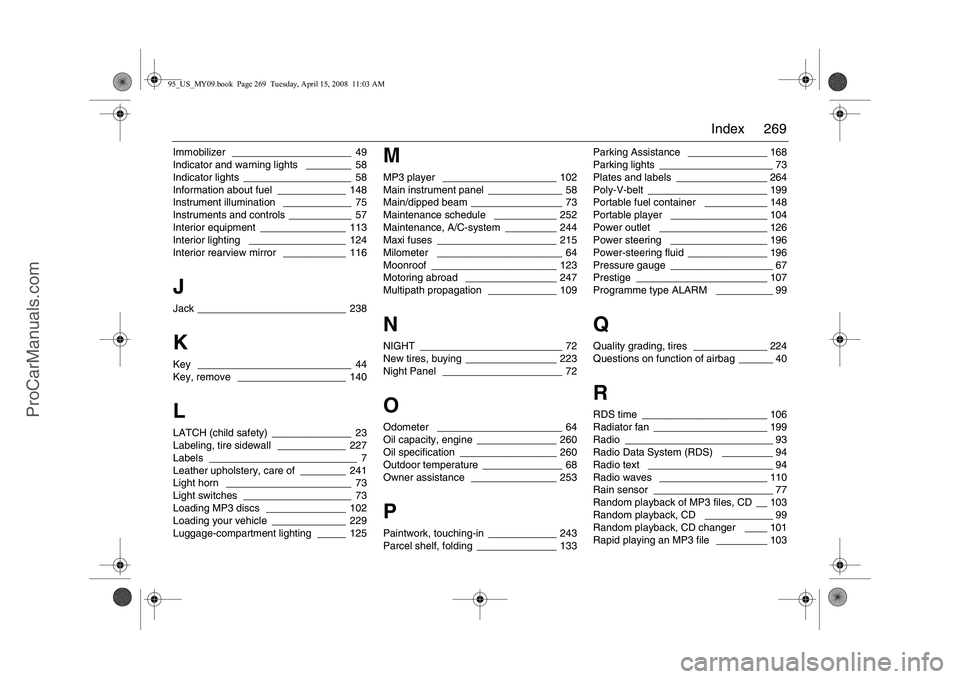
269 Index
Immobilizer
_____________________ 49
Indicator and warning lights
________ 58
Indicator lights
___________________ 58
Information about fuel
____________ 148
Instrument illumination ____________ 75
Instruments and controls ___________ 57
Interior equipment
_______________ 113
Interior lighting
_________________ 124
Interior rearview mirror
___________ 116
JJack
__________________________ 238
KKey
___________________________ 44
Key, remove
___________________ 140
LLATCH (child safety)
______________ 23
Labeling, tire sidewall ____________ 227
Labels
__________________________ 7
Leather upholstery, care of
________ 241
Light horn
______________________ 73
Light switches ___________________ 73
Loading MP3 discs
______________ 102
Loading your vehicle _____________ 229
Luggage-compartment lighting
_____ 125
MMP3 player
____________________ 102
Main instrument panel
_____________ 58
Main/dipped beam
________________ 73
Maintenance schedule
___________ 252
Maintenance, A/C-system _________ 244
Maxi fuses
_____________________ 215
Milometer ______________________ 64
Moonroof ______________________ 123
Motoring abroad
________________ 247
Multipath propagation
____________ 109
NNIGHT
_________________________ 72
New tires, buying
________________ 223
Night Panel
_____________________ 72
OOdometer
______________________ 64
Oil capacity, engine
______________ 260
Oil specification
_________________ 260
Outdoor temperature
______________ 68
Owner assistance
_______________ 253
PPaintwork, touching-in
____________ 243
Parcel shelf, folding
______________ 133Parking Assistance
______________ 168
Parking lights
____________________ 73
Plates and labels
________________ 264
Poly-V-belt
_____________________ 199
Portable fuel container
___________ 148
Portable player
_________________ 104
Power outlet
___________________ 126
Power steering _________________ 196
Power-steering fluid
______________ 196
Pressure gauge
__________________ 67
Prestige
_______________________ 107
Programme type ALARM
__________ 99
QQuality grading, tires
_____________ 224
Questions on function of airbag
______ 40
RRDS time
______________________ 106
Radiator fan ____________________ 199
Radio
__________________________ 93
Radio Data System (RDS)
_________ 94
Radio text
______________________ 94
Radio waves ___________________ 110
Rain sensor _____________________ 77
Random playback of MP3 files, CD
__ 103
Random playback, CD
____________ 99
Random playback, CD changer
____ 101
Rapid playing an MP3 file
_________ 103
95_US_MY09.book Page 269 Tuesday, April 15, 2008 11:03 AM
ProCarManuals.com