2009 SAAB 9-5 fuel
[x] Cancel search: fuelPage 68 of 272

68 Instruments and controlsSaab Information
Display (SID) The Saab Information Display (SID) shows
CHECK messages and incorporates eight
trip-computer functions.
Use the i/SET button to browse the func-
tions.
Outdoor temperature(Frost warning)
Regardless of which function has been
selected, except Night Panel Mode, SID will
automatically display the outdoor tempera-
ture when it is between 26° and 38°F (–3°
and +3°C). This also applies if the
temperature has moved outside the range
of 21° to 43°F (–6° to +6°C) but is again
between 26° and 38°F (–3° and +3°C).
WARNING
It is strongly recommended that the SID
settings be changed only when the car is
stationary. The driver’s attention can oth-
erwise easily be distracted from the road.
SID provides the following function:
Te m p .Outside temperature
D.T.E.Estimated range (distance to
empty fuel tank)
Fuel ØAverage fuel consumption
since function last reset
Dist.Distance to destination/Trip
meter
Speed ØAverage speed since function
last reset
AlarmAlarm function
Speed W.Speed warning
WARNING
Remember that roads can be icy even at
temperatures of above 38°F (+3°C),
especially on bridges and stretches of
road that are sheltered from the sun.
IB3928
SID, buttons and display
95_US_MY09.book Page 68 Tuesday, April 15, 2008 11:03 AM
ProCarManuals.com
Page 70 of 272

70 Instruments and controlsUsing Dist. as a trip meter
If no value is programmed in Dist., it func-
tions as a trip meter. This is indicated by an
arrow to the right in the display.
Reset the trip meter by briefly pressing the
CLR button.
Calculating the arrival time if a specified
average speed is maintained:
1Select Dist.
2 Set the distance.
3Select Speed Ø.
4 Set the average speed you intend to
drive at.
5 SID switches to Dist. automatically. The
calculated arrival time is now displayed
to the right.
The Speed Ø function will show actual
values once you start driving.Average fuel consumption, Fuel Ø
The average fuel consumption is calculated
using the values for fuel consumed and dis-
tance driven since last reset. This value is
stored in the car’s trip computer even when
the engine is switched off.
To reset the value, hold CLR depressed
until a chime sounds. The text Cleared is
displayed.
Resetting valuesTo reset the value, hold CLR depressed
until a chime sounds. The text Cleared is
displayed.
The following functions will be reset simulta-
neously:
D.T.E. (the value is reset to the distance
that can be reached with the amount of
remaining fuel)
FuelØ
Speed Ø (average speed)
Values programmed in Dist., Alarm and
Speed W. are not reset. See respective
function
95_US_MY09.book Page 70 Tuesday, April 15, 2008 11:03 AM
ProCarManuals.com
Page 72 of 272
72 Instruments and controlsNIGHT PANELTo improve night-driving conditions inside
the car, the Night Panel mode can be
selected. In this mode, the amount of infor-
mation displayed is reduced, and only the
most important instruments and displays
will be illuminated.
When the NIGHT PANEL button is pressed,
only the speedometer will be illuminated, all
the other instruments illumination being
extinguished and their needles moved to
zero. The SID display will be extinguished
and the backlighting for switches and other
controls will be dimmed. Note: All indicator
and warning lights, together with the display
of CHECK messages, will operate as nor-
mal, except ”Outdoor temperature”, see
page 68.The following conditions will wake up the
respective displays in the Night-Panel
mode:
Setting of the Audio system or, SID
(display comes on for ten seconds).
CHECK message generated in the SID.
High engine revs cause the rev counter to
be illuminated until the engine speed has
fallen again.
If the quantity of fuel remaining falls below
4 gallons (15 liters), the fuel gauge will be
illuminated.
If the engine temperature rises above
normal, the temperature gauge will be illu-
minated.
In cars with automatic transmission, if the
selector lever is moved from D to position
M or L, the selector indication on the main
instrument panel will be illuminated.
To restore the displays and lighting to the
normal mode, press the NIGHT PANEL but-
ton.
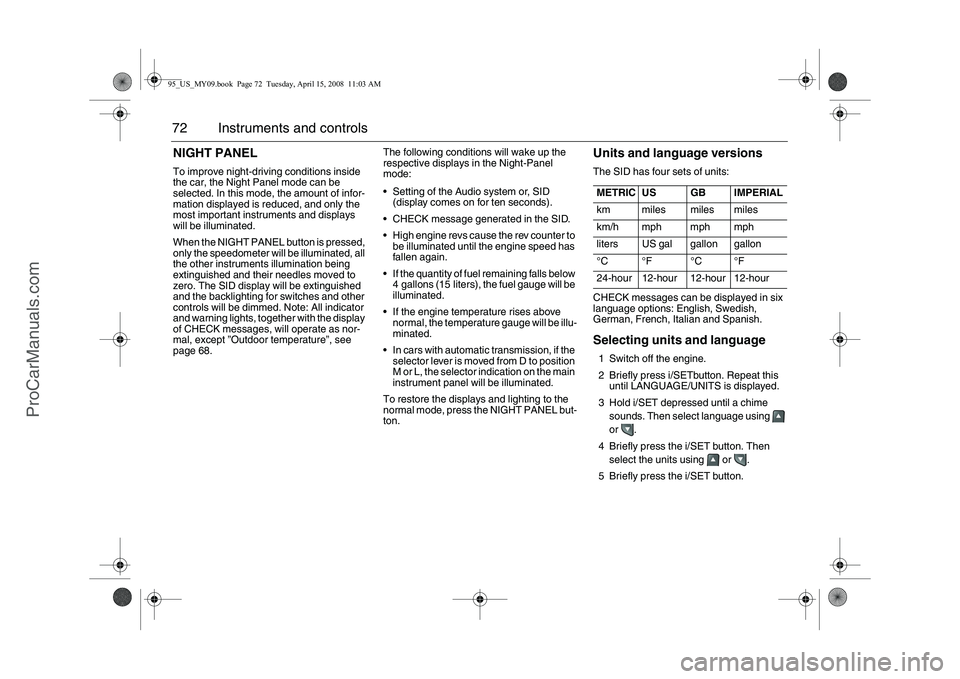
Units and language versionsThe SID has four sets of units: CHECK messages can be displayed in six
language options: English, Swedish,
German, French, Italian and Spanish. Selecting units and language 1 Switch off the engine.
2 Briefly press i/SETbutton. Repeat this
until LANGUAGE/UNITS is displayed.
3 Hold i/SET depressed until a chime
sounds. Then select language using
or .
4 Briefly press the i/SET button. Then
select the units using or .
5 Briefly press the i/SET button. METRIC US GB IMPERIAL
km miles miles miles
km/h mph mph mph
liters US gal gallon gallon
°C °F °C °F
24-hour 12-hour 12-hour 12-hour
95_US_MY09.book Page 72 Tuesday, April 15, 2008 11:03 AM
ProCarManuals.com
Page 85 of 272

85 Instruments and controls
Adaptation of ACCIt is also possible to customize the ACC system, e.g. to adapt to
driving and weather conditions.
Adaptation and restoration of factory settings is done by holding
the respective button depressed approx. 2 seconds until a chime
sounds.
Make sure the ignition is ON.
Example: If you want the ACC system to handle activation and deac-
tivation of rear window/door mirror heating, hold the button
depressed approx. 2 seconds until a chime sounds.
The display shows:
ACC:AUTO
RDEFR CTRL
When “Adaptation of ACC“ is done, it will apply until factory settings
are restored. Function Operation in AUTO mode
after adaptationFactory setting
The rear window heating will
come on after the engine has
started if the outside temper-
ature is below +5 °C.
– This function helps to pre-
vent ice or mist forming on
the rear window in cold,
damp weather. Fuel con-
sumption may increase
slightly.Heating is selected
manually.
Seat heating comes on if the
system determines that heat-
ing is necessary based on
the temperature in the seat
and the outside temperature. There are two settings
for heating. Repeat-
edly pressing the but-
ton switches between
low output, high output
and off. Function Display text in SID
during adaptationDisplay text in SID when
factory settings are
restored
ACC:AUTO
RDEFR CTRLACC:MANUAL
RDEFR CTRL
ACC:AUTO
S E AT H E AT I N GACC:MANUAL
SEAT HEATING
95_US_MY09.book Page 85 Tuesday, April 15, 2008 11:03 AM
ProCarManuals.com
Page 139 of 272
139
Starting and driving
IB3878
Starting and driving
Ignition switch ________ 140
Starting the engine ____ 141
Important considerations
for driving___________ 144
Refueling ____________ 146
Engine Break-In Period_ 150
Gear changing ________ 150
Cruise control ________ 159
Braking ______________ 160
Electronic Stability Program (ESP
®) ______ 163
Parking brake ________ 165
Parking ______________ 165
Saab Parking Assistance 3________ 168 Economical motoring __ 170
Driving in cold weather 172
Driving in hot weather _ 173
Towing a trailer
3_____ 174
Driving with a roof rack load________________ 179
Driving with a load ____ 179
Driving with a spare wheel fitted _________ 181
Driving with the trunk lid/tailgate open______ 181
Driving in deep water __ 181
Towing the car________ 181
Jump starting ________ 184
3 Asterisk means: equipment not fitted in all cars
(can depend on model variant, engine variant,
market specification, options or accessories).95_US_6start_MY09.fm Page 139 Tuesday, April 29, 2008 10:19 AM
ProCarManuals.com
Page 143 of 272

143 Starting and driving
Useful tips on cold climate
startingIf the engine has failed to start after several
attempts in very cold weather, press and
hold the accelerator down to the floor and
run the starter for 5–10 seconds. This will
prevent the engine being flooded (exces-
sively rich fuel-air mixture).
Now start the engine in the normal way – do
not touch the accelerator.
If the engine stalls immediately after starting
(e.g. if the clutch was released too quickly),
do not touch the accelerator when restarting
the engine.
Limp-home modeThe engine management system has a
diagnostic feature that continually checks a
number of internal functions.
If, for example, a fault is detected in the
throttle valve, the engine management
system will go into Limp-home mode.This
limits:
idling control,
disables the cruise-control system and
limits the capacity of the A/C compressor.
If the limp-home mode is in operation (”Ser-
vice Engine Light also known as CHECK
ENGINE” light on, see below) and the out-
side temperature is close to or below freez-
ing, you may need to use some throttle on
starting (some pressure on the accelerator).
If the diagnostic system has detected a fault
in the engine-management system, the
”Service Engine Light also known as
CHECK ENGINE” light on the main
instrument panel will come on (see page
58), indicating that you should have the car
checked as soon as possible by a work-
shop. We recommend that you contact an
authorized Saab dealer.
NOTICEIf the CHECK ENGINE warning light
starts to flash, ease off the accelerator
slightly. If the light does not cease to flash
within 5 seconds, stop the car in a suit-
able place as soon as possible and turn
off the engine. The car must be towed to
a workshop. We recommend that you
contact an authorized Saab dealer.
If the CHECK ENGINE warning light
flashes, it indicates that the engine is mis-
firing which can result in damage to the
catalytic converter.
95_US_MY09.book Page 143 Tuesday, April 15, 2008 11:03 AM
ProCarManuals.com
Page 144 of 272

144 Starting and drivingImportant
considerations for
drivingThe engine-management system in the
Saab 9-5 is called Saab Trionic T7. The
system manages the ignition, fuel injection
and turbo boost pressure.
The Trionic T7 system developed by Saab
is an intelligent engine-management
system designed to achieve optimum driv-
ability under differing driving conditions.
The system makes adjustments automati-
cally, for instance, if the car is being driven
at altitude (oxygen-deficient air), for differ-
ent grades of fuel (AON 87–93) and for dif-
ferent load conditions.
1 Starting and driving
Refrain from using full throttle before
the engine has warmed up (before
needle in mid-range on temperature
gauge).
A safety function prevents the engine
from revving faster than 6,000 rpm by
limiting the induction air.
2 Stopping the engine
Do not rev the engine immediately
before switching it off – stop the engine
when it is idling.
3 Regulating the boost pressure One of the advantages of boost pres-
sure regulation is that the engine can
also be run safely on gasoline with a
lower octane rating, although not lower
than AON 87. However, engine perfor-
mance will fall slightly and heavy load-
ing and laboring should be avoided. For
optimum performance, use the recom-
mended grade of fuel.
The maximum boost pressure is
adjusted automatically to the knocking
or pinging tendency of the engine.
Occasional, short-lived knocking when
the engine is under a heavy load is
perfectly normal; the extent will depend
on the grade of fuel in the tank.
Isolated instances of knocking are
more likely to occur with low-octane
fuel. This controlled form of knocking,
followed by a reduction in the boost
pressure, is a sign that the wastegate is
functioning and is perfectly safe for the
engine.
NOTICE If the engine sounds strange there is a
fault in the system. Have the car
checked without delay by a workshop.
We recommend that you contact an
authorized Saab dealer.
The use of fuel with too low an octane
rating can cause serious engine
damage.
WARNING
If the engine is being run with the car on a
rolling road or dynamometer, longer than
for a standard state emission inspection,
to ensure adequate cooling, air must be
blown into the engine compartment and
under the car at a rate equivalent to the
ram-air effect that would be obtained at
the corresponding road speed.
95_US_MY09.book Page 144 Tuesday, April 15, 2008 11:03 AM
ProCarManuals.com
Page 145 of 272

145 Starting and driving
Important considerations with
catalytic convertersThe catalytic converter is an emission-con-
trol device incorporated in the car’s exhaust
system. It consists of a metal canister with a
honeycomb insert, the cells of which have
walls coated in a catalytic layer (mixture of
precious metals).
To ensure that the catalytic converter con-
tinues to function properly, and also to avoid
damage to the converter and its associated
components, the following points must be
observed:
Have the car serviced regularly in accor-
dance with the service program. The fuel
and ignition systems are particularly
important in this context.
Always be alert to any misfiring of the
engine (not running on all cylinders) and
any loss of power or performance. At the
first sign of a malfunction, reduce speed
and take the car to a workshop as soon as
possible. We recommend that you
contact an authorized Saab dealer. If the engine fails to start (in very cold
weather or if the battery is flat), the car can
be push started (manual gearbox only) or
started using jumper cables to a donor
battery. However, as soon as you have
started the engine, it is important that it
runs on all cylinders. If it is misfiring, allow
it to idle for up to five minutes to give it time
to settle and run smoothly. If, after this
time, the engine still fails to run properly,
turn off the engine and get in touch with a
workshop for advice. We recommend that
you contact an authorized Saab dealer. Never park the car on dry grass or other
combustible material. The catalytic
converter gets very hot and could there-
fore start a fire.
Never drive off if the engine is misfiring.
If you jump start the car when the engine
is already up to normal temperature, the
engine must start to run on all cylinders.
Stop jump-starting if the engine fails to
start immediately.
Failure to follow these directions could
result in the catalytic converter and associ-
ated components being damaged, and
could represent a breach of the warranty
conditions.
NOTICEUse only unleaded gasoline. Leaded gas-
oline is detrimental to the catalyst and
oxygen sensor and will seriously impair
the function of the catalytic converter.
NOTICEIf the car runs out of fuel, it is possible for
air to get into the fuel system. If this
happens, the catalytic converter may
overheat and be damaged.
IB3879
12
2
3
3
Oxygen-sensor-controlled
injection system1 Engine control module
2 Oxygen sensor (lambda probe)
3 Catalytic converters
95_US_MY09.book Page 145 Tuesday, April 15, 2008 11:03 AM
ProCarManuals.com