2009 SAAB 9-3 wheel
[x] Cancel search: wheelPage 186 of 304

186 Starting and drivingRemember that tires age: it may therefore
be necessary to change winter tires before
they reach the legal wear limit, as they grad-
ually lose their friction properties with age.
If you get into a front wheel skid and the car
has a manual transmission, the best
response is to freewheel, which means
declutching so that the wheels neither drive
nor brake, and to cautiously steer in the
desired direction.
If the car has automatic transmission, ease
off the accelerator slightly and steer cau-
tiously in the desired direction.
If you get into a rear wheel skid, steer in the
same direction as the movement of the rear
of the car.
Driving with tire chains3Snow chains must only be fitted to the wheel
and tire dimensions that Saab recommends
in "Technical data" on page 283.
We recommend that you contact a Saab
dealer regarding approved tire chains. See
also page 247.
WARNING
Do not drive at speeds above 30 mph
(50 km/h) when tire chains are fitted.
Tire chains can reduce directional sta-
bility.
Do not fit tire chains to the car’s rear
wheels.
NOTICE Check the links frequently for wear.
Check that the chains do not foul the
wheel arch liner at full lock.
Refer to the "Technical data" section
on page 283, for information on wheel
and tire dimensions approved for the
fitting of tire chains.
93_US_MY09.book Page 186 Tuesday, April 15, 2008 10:30 AM
ProCarManuals.com
Page 188 of 304
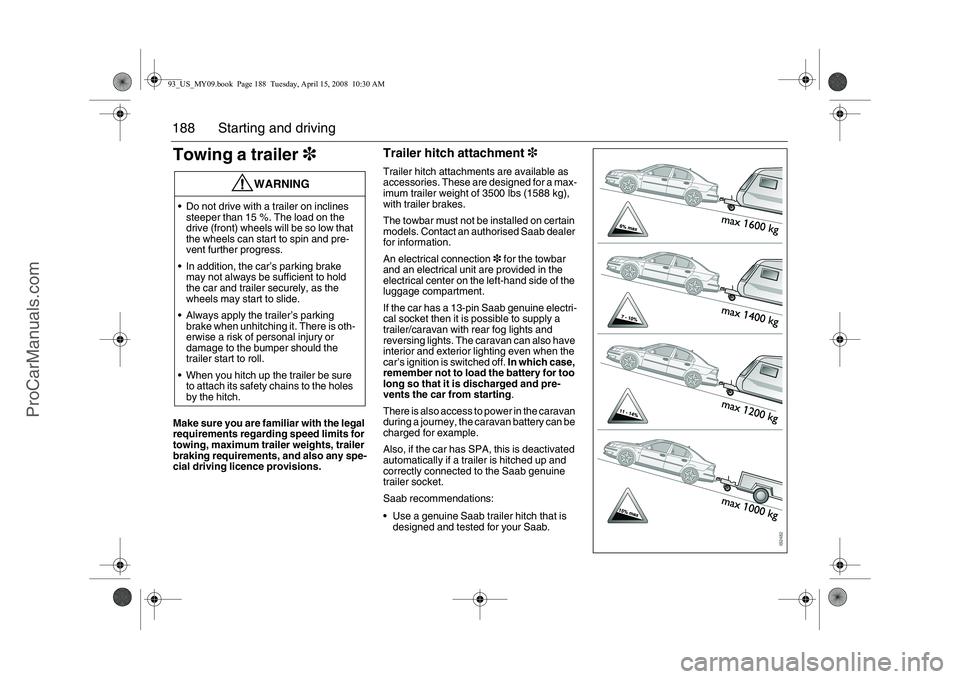
188 Starting and drivingTowing a trailer3Make sure you are familiar with the legal
requirements regarding speed limits for
towing, maximum trailer weights, trailer
braking requirements, and also any spe-
cial driving licence provisions.
Trailer hitch attachment3Trailer hitch attachments are available as
accessories. These are designed for a max-
imum trailer weight of 3500 lbs (1588 kg),
with trailer brakes.
The towbar must not be installed on certain
models. Contact an authorised Saab dealer
for information.
An electrical connection3 for the towbar
and an electrical unit are provided in the
electrical center on the left-hand side of the
luggage compartment.
If the car has a 13-pin Saab genuine electri-
cal socket then it is possible to supply a
trailer/caravan with rear fog lights and
reversing lights. The caravan can also have
interior and exterior lighting even when the
car’s ignition is switched off. In which case,
remember not to load the battery for too
long so that it is discharged and pre-
vents the car from starting.
There is also access to power in the caravan
during a journey, the caravan battery can be
charged for example.
Also, if the car has SPA, this is deactivated
automatically if a trailer is hitched up and
correctly connected to the Saab genuine
trailer socket.
Saab recommendations:
Use a genuine Saab trailer hitch that is
designed and tested for your Saab.
WARNING
Do not drive with a trailer on inclines
steeper than 15 %. The load on the
drive (front) wheels will be so low that
the wheels can start to spin and pre-
vent further progress.
In addition, the car’s parking brake
may not always be sufficient to hold
the car and trailer securely, as the
wheels may start to slide.
Always apply the trailer’s parking
brake when unhitching it. There is oth-
erwise a risk of personal injury or
damage to the bumper should the
trailer start to roll.
When you hitch up the trailer be sure
to attach its safety chains to the holes
by the hitch.93_US_MY09.book Page 188 Tuesday, April 15, 2008 10:30 AM
ProCarManuals.com
Page 189 of 304

189 Starting and driving
Contact your Saab dealer for advice on
which trailer hitch is designed for your car.
Recommendations for cars with
automatic transmissionThe following driving time limits are based
on the capacity of the cooling system in hot
weather, i.e. approximately 86°F (+30°C).
The following driving time limits are based
on the capacity of the cooling system in hot
weather, i.e. approximately 104°F (+40°C).When negotiating long hills, bear the follow-
ing important considerations in mind.
Rises in coolant temperature are indicated
by the temperature gauge in the main instru-
ment panel.
The following steps are taken in order as the
temperature of the transmission increases:
Gear change pattern is altered
A/C compressor is switched off
Max. engine torque is reduced.
The following message will be displayed on
the SID if the transmission fluid becomes
too hot:
If this message appears, stop the car as
soon as it is safe to do so and allow the
engine to idle until the message has gone
out. The selector lever should be in
position P.
NOTICE Only use a towbar that has been
approved for your car. We recom-
mend that you entrust towbar installa-
tion to an authorized Saab dealer,
which can also provide important
information such as trailer weight.
Your authorized Saab dealer has
information on how the towbar is to be
installed and whether other measures
must be undertaken that could affect
the cooling system or other equipment
We recommend that you contact a
Saab dealer for guidance on how to
connect a trailer hitch.
Exercise care when driving on uneven
roads or against the curb if the car is
heavily laden. This particularly applies
to cars with 17" and 18" wheels.
Gradient of
hill, %Max. trailer
weight, lbs.
(kg)Time limit,
minutes
6-8 3330 (1500) unlimited
9-11 3080 (1400) max 15
12-14 2645 (1200) max 15
max 15 2200 (1000) max 15
Gradient of
hill, %Max. trailer
weight, lbs.
(kg)Time limit,
minutes
6-8 2200 (1000) unlimited
9-11 1760 (800) max 15
12-14 1100 (500) max 15
max 15 880 (400) max 15
Gearbox too hot. Make a
safe stop. Open hood.
93_US_MY09.book Page 189 Tuesday, April 15, 2008 10:30 AM
ProCarManuals.com
Page 190 of 304

190 Starting and drivingWhen continuing your journey, manually
select a low gear in which the engine speed
is about 3,500 rpm until the incline eases
(see page 168).
Recommendations for cars with
manual transmissionRises in coolant temperature are indicated
by the temperature gauge in the main instru-
ment panel.
When the needle is just outside the red
zone, the A/C compressor will be switched
off and, on certain engine variants, the max-
imum engine torque will be limited.
When continuing your journey, select a low
gear in which the engine speed is about
3,500 rpm until the incline eases.
Trailer hitch loadThe weight distribution on the trailer makes
a lot of difference to the handling properties
of the car and trailer combination. With a
two-wheel trailer, concentrate the load over
the wheels and keep it as low as possible.
The trailer should be loaded so that the load
on the towball is 110–165 lbs. (50–75 kg).
Note that this load must be included in the
total load for the car. If this now exceeds the
specified load capacity, the load in the trunk
may have to be reduced by the correspond-
ing amount.
WARNING
Remember to use engine-braking (selec-
tor position M1, M2, or M3) to spare the
brakes when you are driving on a long or
steep downhill slope.
Overheating can cause the brakes to
fade!
WARNING
Remember to use engine-braking (selec-
tor position 1, 2, or 3) to spare the brakes
when you are driving on a long or steep
downhill slope.
Overheating can cause the brakes to
fade!
Distribution of load in trailer
aLight
b Moderate
c Heavy
93_US_MY09.book Page 190 Tuesday, April 15, 2008 10:30 AM
ProCarManuals.com
Page 191 of 304

191 Starting and driving
Checks before drivingMake sure that the car and trailer are in
good working order. This is essential since
towing a trailer increases the strain on the
car.
Check and if necessary adjust the tire
pressure of the car and trailer.
Make sure all wheel bolts are properly
tightened.
Make sure that the equipment joining the
car and trailer is properly secured and
adjusted.
Make sure the trailer’s electrical cable is
properly connected and is not so long that
it drags along the ground. Also, make sure
the cable is not too short and risks break-
ing when turning a corner.
Check all bulbs.
Check the car and trailer brakes.
Make sure that all items on or in the
camper or trailer are properly secured.
Make sure that the trailer’s jockey wheel is
raised and locked.
Check the distribution of the load so that
the car and trailer are well balanced.
Check that the rear view mirrors provide
the best possible rearward vision.
Make sure the trailer’s safety cable is
correctly attached.
Driving considerationsAlways take extra care when towing a
trailer, as the car’s handling will be different
and its braking performance reduced. The
trailer’s braking system and suspension
also have a considerable effect on these
characteristics. See also "Driving with a
load" on page 192.
Drive carefully:
Descending hills
On uneven roads
Over railway crossings
When meeting large vehicles.
If the car has automatic transmission, select
gear M1 when ascending or descending
steep hills.
ReversingGet someone to help you keep an eye out
behind the trailer as the door mirrors do not
always provide sufficient rearward vision
when reversing.
93_US_MY09.book Page 191 Tuesday, April 15, 2008 10:30 AM
ProCarManuals.com
Page 193 of 304

193 Starting and driving
Driving with the trunk lid
openIf you must drive with the trunk lid open,
close all windows and the moonroof (if
equipped) and set the cabin fan to its high-
est speed setting.Driving in deep waterTowing the car
WARNING
Avoid driving with the trunk lid partly or
fully open, since exhaust fumes can be
drawn into the cabin.NOTICEDo not drive in puddles or water deeper
than 7 in. (20 cm) and do not drive faster
than 3–4 mph. Water can otherwise be
sucked into the engine. The engine will be
seriously damaged if water enters the
intake system.
WARNING
Remember that the brake servo does
not operate when the engine is off.
Much greater pressure than normal
will therefore be required to operate
the brake pedal.
Nor does the steering servo operate
when the engine is off. The steering
will therefore be much heavier than
usual.
The towing vehicle should always be
heavier than the vehicle on tow.
Never allow passengers to ride in the
car when it is on tow.
Always seek professional help if the
car needs to be recovered.
The ignition switch must be in the ON
position if the car is moved with the
engine not running.
The steering wheel lock must be dis-
engaged before towing the car.
The steering wheel lock disengages
when the remote control is inserted
into the ignition switch, if the battery
has sufficient charge.
93_US_MY09.book Page 193 Tuesday, April 15, 2008 10:30 AM
ProCarManuals.com
Page 194 of 304

194 Starting and drivingFront towing eyeThe front towing eye is stowed by the spare
wheel. On the left-hand side of the bumper
is a cover concealing the attachment point
(tapped hole) for the towing eye.1 Open the cover first at the lower edge
with a screwdriver for example. Watch
out for the paintwork.
2 Screw in the towing eye. The towing
eye has a left-hand thread!
3 Insert the wheel wrench into the eye to
tighten it properly.
To refit the cover: Start by inserting the top
edge of the cover. Then click in the lower
edge.
Rear towing eyeThe car has a permanent towing eye at the
rear under the bumper.
If the car is equipped with a towbar, this can
be used instead of the towing eye.
WARNING
Make sure that the towing eye is
screwed in tightly. It has a left-hand
thread!
The towing eye is only designed for
towing the car on roads. It must not
be used to pull the car out of a ditch,
for example.
Make sure that all bystanders keep a
suitable distance, in case the towing
eye or tow rope should snap. The
towing eye or tow rope could catapult
off and cause seriously injury.
Never drive with the towing eye fitted
to the front bumper. Return it to its des-
ignated storage space.
Rear towing eye
Front towing eye fitted.
The towing eye has a left-hand thread!
93_US_MY09.book Page 194 Tuesday, April 15, 2008 10:30 AM
ProCarManuals.com
Page 195 of 304

195 Starting and driving
Towing the carCars with manual transmission
Engage neutral. Turn on the parking lights.
Drive carefully and do not exceed the
speed limit for vehicles on tow.
Always try to keep the towrope taut by
gently applying the brake of the car on tow,
as necessary. This will avoid the towrope
being jerked violently.Cars with automatic transmission
Move the selector lever to N. Turn on the
parking lights.
Drive carefully and do not exceed the
speed limit for vehicles on tow.
Always try to keep the towrope taut by
gently applying the brake of the car on tow,
as necessary. This will avoid the towrope
being jerked violently.NOTICENever use the towing eyes to pull the
car unstuck.
If the car is to be towed with the front
wheels off the ground, make sure the
parking brake is off, as this acts on the
rear wheels.
Saab 9-3 XWD with manual transmission:
If the car is towed with all four wheels on
the ground then there are no technical
limitations for speed and distance.
If both front wheels or both rear wheels
have been raised, and if the law permits,
the maximum towing speed is 30 mph
(50 km/h). There are no limitations as to
the distance over which the car can be
towed.
NOTICENever use the towing eyes to pull the
car unstuck.
The car must be towed front first.
If the car is to be towed with the front
wheels off the ground, make sure the
parking brake is off, as this acts on the
rear wheels.
Saab 9-3 XWD with automatic transmis-
sion:
If the car is towed with all four wheels on
the ground then it may be towed at a max-
imum speed of 30 mph (50 km/h) and for
a maximum of 30 miles (50 km).
If both front wheels have been raised, and
if the law permits, the car may be towed at
a maximum speed of 30 mph (50 km/h).
There are no technical limitations as to
the distance over which the car can be
towed.
Never use the towing eyes to pull the car
unstuck.93_US_MY09.book Page 195 Tuesday, April 15, 2008 10:30 AM
ProCarManuals.com