2009 PORSCHE PANAMERA ignition
[x] Cancel search: ignitionPage 37 of 343

Opening and Locking
35
Malfunctions When Opening and
ClosingEmergency operation of tailgateIf the tailgate cannot be opened with the radio
remote control (e.g. if th e battery of the remote
control is dead), the emergency operation must
be performed:
1. Unlock and open the driver’s door with the car key.
2. Switch on the ignition within 10 seconds to prevent the alarm system from
triggering.
3. Press the central locking button on the front or rear center console.
The tailgate is now unlocked and can be
opened with the unlocking handle.
Only one door is unlockedOn the multi-function di splay in the instrument
panel, you can set different variants for locking
and unlocking the doors and tailgate. You can
open all doors irrespective of the setting made.
f Press button on the key twice within
2seconds.The vehicle cannot be unlockedThe remote control of the key may
– not function correctly due to radio waves (also
radio contact between remote control and
vehicle in the case of Porsche Entry & Drive),
– fail due to a fault,
– fail due to a flat key battery.
f Unlock the vehicle using the emergency key
in the door lock.
If the vehicle was unlocked using the
emergency key in the door lock, only the
driver’s door can be opened.
In order to prevent the alarm system from
being triggered, switch the ignition on
within 10 seconds of opening the door .
The vehicle cannot be lockedThis is recognizable by the fact that the
emergency flasher does not flash and there is no
locking noise.
The remote control of the key may
– not function correctly due to radio waves (also radio contact between remote control
and vehicle in the case of Porsche Entry &
Drive),
– fail due to a fault,
– fail due to a flat key battery.
f Lock the vehicle usin g the emergency key
in the door lock.
If the central locking system is defective,
operating the lock cylinder in the driver’s door will
lock all functioning lockin g elements of the central
locking system.
For information on lockin g the doors by means of
the emergency operation:
f Please see the chapter “NOT ALL VEHICLE
DOORS ARE LOCKED” on page 36.
f Have faults in the central locking system
repaired.
Please contact a qualified specialist workshop.
We recommend that you have an authorized
Porsche dealer to do this work as they have
trained workshop personnel and the necessary
parts and tools.
Page 43 of 343

Seats, Mirrors and Steering Wheel
41
Preventing automatic storage of settings
on car keyDeactivating automatic storage
fPress the button before leaving the
vehicle.
The indicator light on the button lights up.
The current settings are stored on the
vehicle key.
All settings that are modified when the
function is active are not stored on the
vehicle key.
Activating automatic storage
f Press button briefly.
or
Press and hold the button until the
settings last stored on the car key are
retrieved.
The indicator light on the button goes out.
Automatic storage is activated.
Storing settings on person buttons 1
and 2Storing seat, steering wheel and mirror settings
while driving is not possible.
Storing settings
1. Make the required adjustments to the mirror,
steering wheel (person buttons on the driver’s
side only) and seat settings.
2. Press memory button . The indicator light on the button lights up.
3. Press one of the person buttons or within
10 seconds.
The indicator light on the memory button
goes out and an acknowledgement signal
sounds.
The settings are now stored on the desired
person button.Retrieving settings using the car key or on
vehicles with Porsche Entry & Drivef Open the driver’s door.
The seat positions that were last set are
restored automatically.
Cancelling settings
Automatic settings can be cancelled by
pressing the button or the button
on the car key.
Retrieving settings with person buttons 1
and 2Driver’s side
1. Open the door.
2. Press person button or . or
once the door is closed or the ignition key
is inserted and the ignition is switched on
(on vehicles with Porsche Entry & Drive),
press and hold the person button or until
the stored positions have been reached.
Passenger's side
f Press and hold the person button or on the
passenger’s side until the stored positions
have been reached.
Cancelling settings
Automatic settings can be cancelled by pressing
the button .
Page 44 of 343
42
Seats, Mirrors and Steering Wheel
Easy Entry FunctionThe Easy Entry function makes it easier for you to
get in and out of the vehicle.
Warning!
Risk of crushing if persons are behind the
driver’s seat when settings are retrieved.
Risk of damage if the rear seat bench is
folded forward when settings are retrieved.
f Switch off the Easy Entry function if there are
persons behind the driver’s seat or if the rear seat bench is folded forward.
Prerequisite
– Function must be activated on the multi- function display.
For information on swit ching the Easy Entry
function on and off:
f Please see the chapter “SWITCHING
COMFORT ENTRY ON AND OFF” on page 145. Entering the vehicle
When the driver’s door is opened, the steering
wheel and passenger seat
move upwards or to the
rear depending on the position of the seat and
steering wheel when the driver left the vehicle.
Once the driver’s door is closed and the ignition
key is inserted or, in the case of vehicles with
Porsche Entry & Drive, the ignition is switched on,
the seat and steering wheel move to the stored
position.
Exiting the vehicle
The steering wheel moves upwards:
– After the ignition key is removed or
– After the ignition is switched off and the
driver’s door is opened on vehicles with
Porsche Entry & Drive.
The driver’s seat moves to the rear:
– After the driver’s door is opened.
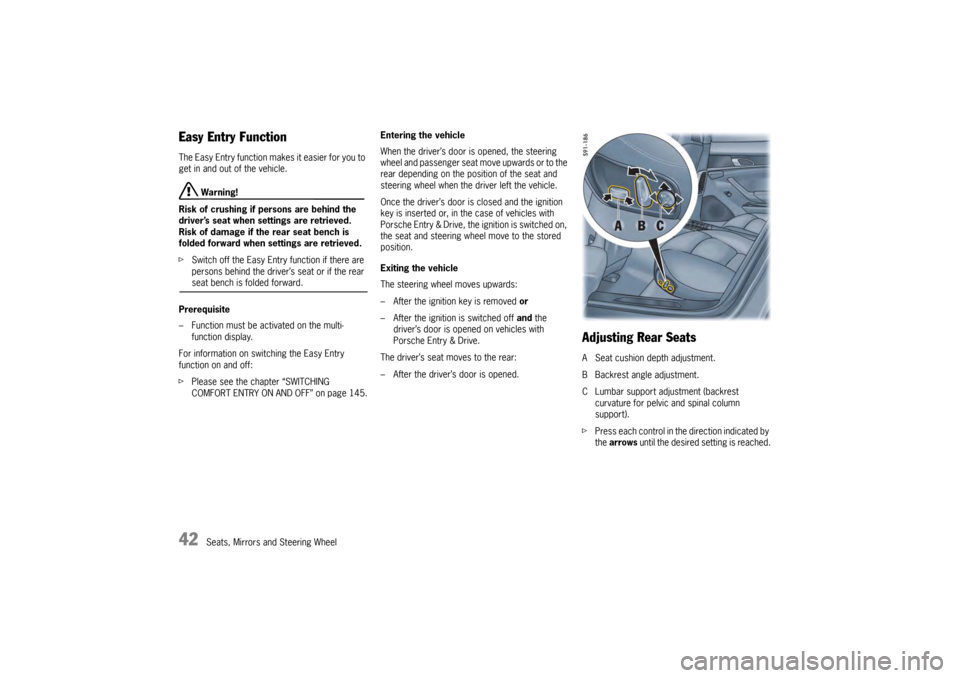
Adjusting Rear SeatsA Seat cushion depth adjustment.
B Backrest angle adjustment.
C Lumbar support adjustment (backrest curvature for pelvic and spinal column
support).
f Press each control in the direction indicated by
the arrows until the desired setting is reached.
Page 45 of 343

Seats, Mirrors and Steering Wheel
43
Adjusting Passenger Seat From
RearD Adjusting backrest angle forward
E Adjusting backrest angle to the rear
F Adjusting seat forward and upwards
G Adjusting seat to the rear and downwards
f Press the button until the desired setting is
reached.
Adjustment of the passenger seat from the rear
control panel can be interrupted at any time by
pressing one of the ad justment buttons on the
passenger seat.
Caution!
Risk of damage. When using a child restraint
system on the passenger’s seat, the seat or
the seat belt may be damaged if the
passenger’s seat is adjusted.
f If a child restraint syst em is installed on the passenger’s seat, do not adjust the seat.
For information on child restraint systems:
f Please see the chapter “CHILD RESTRAINT
SYSTEMS” on page 52.
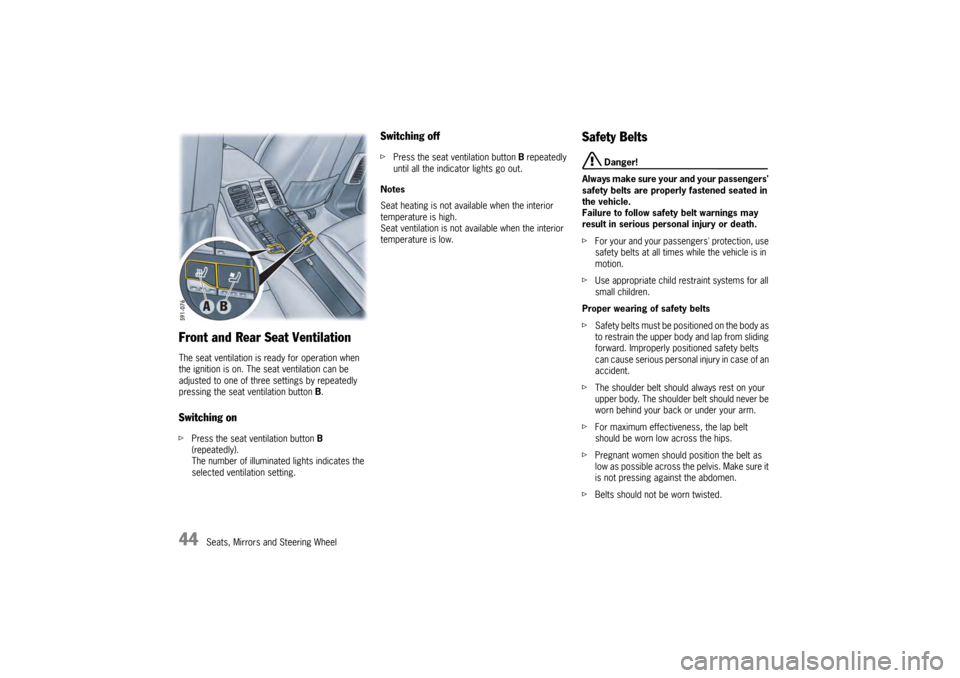
Front and Rear Heated SeatsThe heated seats are ready for operation when the
ignition is on. The heatin g power can be adjusted
to one of three settings by repeatedly pressing the
heated seat button A.Switching onf Press the heated seat button A (repeatedly).
The number of illuminated lights indicates the
selected heat setting.Switching offf Press the heated seat button A repeatedly until
all the indicator lights go out.
Page 46 of 343
44
Seats, Mirrors and Steering Wheel
Front and Rear Seat VentilationThe seat ventilation is ready for operation when
the ignition is on. The seat ventilation can be
adjusted to one of three settings by repeatedly
pressing the seat ventilation button B.Switching onfPress the seat ventilation button B
(repeatedly).
The number of illuminated lights indicates the
selected ventilation setting.
Switching offf Press the seat ventilation button B repeatedly
until all the indicator lights go out.
Notes
Seat heating is not available when the interior
temperature is high.
Seat ventilation is not available when the interior
temperature is low.
Safety Belts
Danger!
Always make sure your and your passengers'
safety belts are properly fastened seated in
the vehicle.
Failure to follow safety belt warnings may
result in serious personal injury or death.
f For your and your passe ngers' protection, use
safety belts at all times while the vehicle is in
motion.
f Use appropriate child restraint systems for all
small children.
Proper wearing of safety belts
f S a f e t y b e l t s m u s t b e p o s i t i o n e d o n t h e b o d y a s
to restrain the upper bo dy and lap from sliding
forward. Improperly positioned safety belts
can cause serious personal injury in case of an
accident.
f The shoulder belt should always rest on your
upper body. The shoulder belt should never be
worn behind your back or under your arm.
f For maximum effectiveness, the lap belt
should be worn low across the hips.
f Pregnant women should position the belt as
low as possible across the pelvis. Make sure it
is not pressing against the abdomen.
f Belts should not be worn twisted.
Page 47 of 343

Seats, Mirrors and Steering Wheel
45
fDo not wear belts over rigid or breakable
objects in or on your clothing, such as eye
glasses, pens, keys, etc. as these may cause
injury.
f Several layers of heavy clothing may interfere
with proper positioning of belts.
f Belts must not rub against sharp objects or
damage may occur to the belt.
f Two occupants should never share the same
belt at the same time.
Care and maintenance
f Keep belt buckles free of any obstruction that
may prevent a secure locking.
f Belts that have been subjected to excessive
stretch forces in an accident must be
inspected or replaced to ensure their
continued effectiveness in restraining you.
The same applies to belt tensioner systems
which have been triggered. In addition, the
anchor points of the belts should be checked.
f If safety belts do not work properly, see your
authorized Porsche dealer immediately.
f If the belts show damage to webbing, bindings,
buckles or retractors, they should be replaced
to ensure safe operation.
f Do not modify or disassemble the safety belts
in your vehicle. f
The belts must be kept clean or the retractors
may not work properly.
Please see the chapter “CAR CARE
INSTRUCTIONS” on page 269.
f Never bleach or dye safety belts.
f Do not allow safety belts to retract until they
are completely dry after cleaning or this may
cause damage to the belt.
Belt tensionerDepending on the force of a collision, fastened
seat belts are automatically tightened in an
accident.
The belt tensioners are triggered in:
– Front and rear impacts of sufficient severity
– Side impacts
– In cases of vehicle rollover
Maintenance notes
The belt tensioner system can be triggered only
once; the system must be replaced afterwards.
If there is a fault in the belt tensioner system, the
air bag warning light lights up.
Work may be performed on the belt tensioner
system only by an authorized Porsche dealer.
Smoke is released when the belt tensioners are
triggered.
This does not indicate a fire in the vehicle. An audio-visual warning
system is
interconnected with the driver’s safety belt.
Every time the ignition is turned on, the gong will
sound for about 6 seconds to remind driver and
passenger to buckle up.
In addition, the gong will sound for approximately
90 seconds if vehicle speed exceeds 15 mph
(24 km/h).
The safety belt warning lights in the instrument
panel and multi-function display will go off as soon
as the driver has buckled up.
Safety Belt Warning System
Page 51 of 343

Seats, Mirrors and Steering Wheel
49
Function of the air bag systemAir bags are a supplemental safety system. Your
primary protection comes from your safety belts.
The front air bags are triggered during a frontal
collision of sufficient force and direction.
In the event of a side impact of corresponding
force, the side air bag on the impact side is
triggered.
The inflation process generates the amount of gas
required to fill the air bags at the necessary
pressure in fractions of a second.
Air bags help to protect the head and body, while
simultaneously damping the motion of the driver
and passenger in the impact direction in the event
of a frontal impact or side impact.
In order to help provide protection in severe
collisions which can cause death and serious
injury, air bags must inflate extremely rapidly.
Such high speed inflation has a negative but
unavoidable side effect, which is that it can and
does cause injuries, including facial and arm
abrasions, bruising and broken bones. You can
help minimize such injuries by always wearing your
safety belts.
There are many types of accidents in which air
bags are not expected to deploy. These include
accidents where the air bags would provide no
benefit, such as a rear impact against your
vehicle. Other accidents where the air bags are
designed not to deploy are those where the risk of
injury from the air bag deployment could exceed any protective benefits, such as in low speed
accidents or higher speed accidents where the
vehicle decelerates over a longer time. Since air
bag deployment does not occur in all accidents,
this further emphasizes the need for you and your
passengers to always wear safety belts.
Your vehicle is equipped with a crash sensing and
diagnostic module. This module will record the
use of the seat belt restraint system by the driver
and front passenger when the air bags and/or belt
tentioner are triggered.
Precondition for activating the restraint systems:
f
Ignition is switched on.
Advanced air bagYour vehicle is equipped with occupant sensing for
the passenger's seat in accordance with
U.S. Federal Motor Vehicle Safety Standard 208.
Depending on the weight, body positioning and
shape acting on the passenger's seat, the
passenger's air bag will automatically be switched
on and off.
Depending on the angle and force of impact, the
passenger's air bag which is switched-on will be
triggered during a collision.
Precondition for switching the passenger's air bag
on and off, depending on weight, body positioning
and shape:
fIgnition is switched on.
Danger!
Risk of serious personal injury or death due
to the passenger air bag not triggering.
Improper handling of occupant sensing can
unintentionally impair switching the
passenger's air bag off and on.
If the weight on the passenger's seat is
reduced significantly, e.g., by supporting
weight on the armrest, the passenger's air
bag can be switched off.
f Select an upright seat position, and do not
support weight on the armrests or lean out of
the window.
Always keep feet in the footwell while driving.
Do not put feet on the dashboard or the seat
area. Do not lean against the inside of the door
or outside the window while the vehicle is
moving.
f If a child restraint system is installed on the passenger’s seat, do not adjust the seat.
Page 53 of 343

Seats, Mirrors and Steering Wheel
51
Note
fAfter switching on the ignition, the
PASSENGER AIR BAG OFF warning light lights
up for a few seconds as a check.
PASSENGER AIR BAG OFF indicator lamp
lights up
The passenger’s air bags are switched off.
PASSENGER AIR BAG OFF indicator lamp
does not light up
The passenger’s air bags are active and ready for
operation.
Danger!
Risk of serious personal injury or death due
to the passenger air bag triggering
unintentionally.
When the ignition is on and the up to one-
year old child is seated in the child restraint
system on the passenger seat the indicator
lamp “PASSENGER AIR BAG OFF“ must be
on.
If the “PASSENGER AIR BAG OFF” indicator
lamp does not light up, it could indicate a
fault in the system, and the air bag could
inflate in a collision, placing the child at risk
of death or severe injury from the inflating air
bag.
In this case:
f Fasten the child restraint system on one of the
rear seats immediately.
f Have the fault remedied at your nearest authorized Porsche dealer. Faults are indicated by a warning light in the
instrument panel.
The air bag warning light illuminates when the
electronic monitoring of the air bag system
detects a malfunction of the
sensors, safety belt
system, occupant detection system, PASSENGER
AIR BAG OFF indicator lamp, related wiring, air bag
modules and control units.
f In the following cases you should
immediately consult an authorized
Porsche dealer in order to assure the air
bag system is functioning properly:
– If the warning light does not light up when the ignition is switched on or
– If the warning light does not go out once the engine is running or
– If the warning light appears while driving.
Warning light