2009 PORSCHE CAYMAN power
[x] Cancel search: powerPage 203 of 284

Maintenance, Car Care
201
Power Steering
Warning!
Risk of accident resulti ng in serious personal
injury or death.
When the engine is stopped (e.g. when being
towed) or the hydraulic system fails, there is
no assistance for steering.
Therefore, substantially more force will have
to be exerted in order to steer.
f Exercise great care when being towed.
f Have the fault remedied at your nearest autho-rized Porsche dealer.
Note
The flow noise heard at full steering lock is system
related and does not indi cate a defect in the
steering system.
Checking hydraulic fluid f Please see the chapter “EXERCISE EXTREME
CAUTION WHEN WORKING ON YOUR VEHICLE”
on Page 186.
The hydraulic fluid reservoir is located in the engi-
ne compartment.
Regular checking of hydraulic fluid is part of
servicing.
Air Filter A dirty air filter not only reduces engine perform-
ance, but can lead to premature engine wear.
Regular filter replacement is part of the routine
maintenance service.
f In dusty conditions, check the filter element
more frequently and replace if necessary.Combination Filter The fresh air passing through the combination fil-
ter into the passenger co mpartment is virtually
free of dust, pollen, and unpleasant odors.
f If the outside air is polluted by exhaust fumes,
press the circulating-air button.
A dirty filter can be the cause of reduced air flow:
f Have filter replaced by your authorized
Porsche dealer.
Regular filter replacement is part of the routine
maintenance service.
Fluids/Oils for Manual
Transmission and Porsche
Doppelkupplung (PDK)The transmission fluids/oils have to be checked
and changed at the intervals listed in your Mainte-
nance Schedule.
f Please see the chapter “CAPACITIES” on
Page 271.
Do not tow the car or run the engine without fluid/
oil in the transmission. The transmission may be
damaged by even a tiny speck of dirt, only a clean
funnel or spout must be used when adding fluid/
oil.
We recommend that you have the fluids/oils
changed at your Porsche dealer, who has the re-
quired lubricants and the necessary filling equip-
ment.
f If you suspect an oil leak in the transmission,
have your authorized Porsche dealer check it
out immediately.
Page 237 of 284

Practical Tips, Emergency Service
235
Electrical System In order to avoid damage and faults in electrical or
electronic systems, electrical accessories should
be installed at your authorized Porsche dealer.
fOnly use accessories authorized by Porsche.
Warning!
Risk of short circuit and fire, resulting in
serious personal injury or death.
Replacing fuses or relays with the engine
running or the ignition on could cause elec-
trical shock.
f Disconnect the negative terminal on the
battery during all work on the electrical
system.
Please see the chapter “BATTERY” on Page 239.
RelaysDefective relays should be changed only by an
authorized workshop.
In storage tray between the front seats
(not on vehicles with iPod, USB, AUX interfaces)SocketsElectrical accessories should preferably be
connected to the 12 V sockets.
f Please observe the maximum power
consumption.
Note on operation
The tire filling compressor must be connected to
the cigarette lighter.
In the passenger’s footwellNote on operation
The sockets and thus the connected electrical
accessories function even if the ignition is
switched off or the igni tion key is withdrawn.
If the engine is not running and the accessories
are switched on, the vehicle battery will be dis-
charged.
Do not operate additional accessories for more
than 5 minutes when engine is off. Continuing to
do so may drain the batte ry such that it may go
completely dead.
Maximum power consumpti on for both sock-
ets together: 70 W.
Page 241 of 284

Practical Tips, Emergency Service
239
Battery The battery is located in the front luggage
compartment under a black plastic cover.
f Please see the chapter “EMERGENCY OPERA-
TION – PULLING OUT THE IGNITION KEY” on
Page 74.
f Please see the chapter “EMERGENCY UNLO-
CKING OF THE FRONT LUGGAGE COMPART-
MENT LID” on Page 238.
Warning!
Risk of short circuit, fire and damage to al-
ternator and electronic control units, result-
ing in serious personal injury or death.
f Observe all warning notes on the battery.
f Disconnect the negative terminal on the bat-
tery during all work on the electrical system.
f Do not lay tools or other metal objects on the
battery as they could cause a short circuit
across the battery terminal.
Hydrogen gas generated by the battery
could cause an explosion, resulting in
serious personal injury or death.
f Do not expose the battery to an open flame,
electrical spark or a lit cigarette.
f Do not wipe battery with a dry cloth.
Risk of serious personal injury or death and
damage to the fabric, metal or paint. f
Wear eye protection.
f Do not allow battery acid to come in contact
with your skin, eyes, fabric or painted
surfaces.
f If you get electrolyte, which is an acid, in your
eyes or on your skin, immediately rinse with
cold water for several minutes and call a doc-
tor.
f Spilled electrolyte must be rinsed off at once
with a solution of baki ng soda and water to
neutralize the acid.
Battery posts, terminals and related acces-
sories contain lead and lead compounds,
chemicals known to the State of California to
cause cancer and reproductive harm.
f Always protect your skin by washing thorough-
ly with soap and water.
Risk of explosion as a result of static charge,
resulting in serious personal injury or death.
f Do not wipe the battery with a dry cloth.
f Eliminate potential electrostatic charge by
touching the vehicle before touching the bat-
tery.
Charge state A well-charged battery prevents starting problems
and has a longer service life.
Traffic density, requirements regarding noise, ex-
haust gas and fuel consumption reduce the engine
speed and, hence, the alternator output.
However, the large number of electrical loads has
markedly increased the demand for electrical
power.
In order to avoid discharging the battery
unintentionally:
f Switch off unnecessary electrical loads in city
traffic, on short trips or in a line or traffic.
f Always remove the ignition key from the igni-
tion switch when leaving the car.
f Avoid frequent operation of the Porsche Com-
munication Management system and audio
system when the engine is not running.
f In the cold season in particular or if the vehicle
is used primarily for short journeys, it may be
necessary to recharge the battery from time to
time.
Page 243 of 284

Practical Tips, Emergency Service
241
Winter operation The capacity and ability of the battery to store
power decreases at low outside temperatures.
Moreover, the battery is more heavily loaded in
winter months, e.g. by the heated rear window,
more frequent use of additional lights, the fans
and the windshield wipers, etc.
f Have the battery checked before the start
of winter.
Maintenance note
Keep the battery well charged to prevent it
from freezing.
A discharged battery can freeze at 23 °F (--5 °C),
but a fully charged battery only freezes at -- 40 °F
(--40 °C).
A frozen battery must always be thawed before
connecting jump leads.
Replacing battery The service life of the batt ery is subject to normal
wear; it depends greatly on care, climatic condi-
tions, and driving conditions (distances, loads).
f Only use an original Porsche battery, with the
correct part number, as a replacement.
f Please observe the disposal instructions for
batteries.
Putting vehicle into operationAfter the battery is co nnected or after an exhaus-
tively discharged battery is charged, the multi-
functional PSM light lights up on the instrument
panel and a message appears on the on-board
computer to indicate a fault.
This fault can be remedied with a few simple
steps:
1. Start the engine.
2. With the vehicle stationary, perform a few steering movements to the left and right and
then drive a short distance in a straight line
until the multifunctinal PSM light goes out and
the message on the on-board computer
disappears.
3. If the warnings do not disappear, then:
Drive carefully to the nearest authorized
Porsche dealer.
Have the fault remedied.
4. After the warnings disappear: Stop the vehicle in a suitable place.
f Perform adaptation of the power windows:
Please see the chapter “STORING END
POSITION OF THE WINDOWS” on Page 28.
Page 268 of 284

266
Technical Data
Technical DataEngine data
CaymanCayman S
Type MA120C MA121C
Horizontally opposed engine, liquid cooled Horizontally opposed engine, liquid cooled
Number of cylinders 6 6
Bore 3.5 in./89 mm 3.8 in./97 mm
Stroke 3.1 in./77.5 mm 3.1 in./77.5 mm
Cubic capacity 176.5 cu. in./2893 cm
3 209.7 cu. in./3436 cm
3
Net-horsepower 265 hp/195 kW 320 hp/235 kW
at crankshaft speed 7200 rpm 7200 rpm
Net torque 221 ft. lb./300 Nm 273 ft. lb./370 Nm
at crankshaft speed 4400 - 6000 rpm 4750 rpm
Engine oil consumption up to 1.6 quarts/622 miles (1.5 liters/1000 km) up to 1.6 quarts/622 m iles (1.5 liters/1000 km)
Page 273 of 284

Technical Data
271
Capacities Use only fluids and fuels authorized by Porsche. Your authorized Porsche dealer will gladly advise you.
Your Porsche has been designed so that it is not necessary to mix any additives with oils or fuels.
Engine Oil change quantity with oil filter approx. 1.98 U.S.gallons/7.5 liters
Please see the chapter “ENGINE OIL RECOMMENDATION” on Page 190.
Coolant Cayman: approx. 6.05 - 6.18 U.S. gallons/22.9 - 23.4 liters
Cayman S: approx. 6.13 - 6.61 U.S. gallons/23.3 - 25 liters
Manual transmission and differential Cayman: approx. 0.79 U.S. gallons/3 liters
Cayman S: approx. 0.85 U.S. gallons/3.2 liters
Porsche Doppelkupplung
Gear set approx. 0.78 U.S. gallons/2.95 liters
Porsche Doppelkupplung
Clutch/Hydraulic fluid approx. 1.37 U.S. gallons/5.2 liters
Power steering approx. 1.1 quarts/1 liter hydraulic fluid Pentosin CHF 11 S
® or CHF 202 S
®
Brake fluidapprox. 0.4 quarts/0.39 liters; use
only Original Porsche brake fluid
Windshield washer approx. 0.66 U.S. gallons/2.5 liters without headlight washer
approx. 1.58 U.S. gallons/6 liters with headlight washer
Fuel tank Refill volume approx. 16.9 U.S. gallons/64 liters, including approx. 2.6 U.S.gallons/10 liters reserve.
Fuel quality Your engine is designed to provide optimum performance and fuel economy using unleaded premium fuel with
an octane rating of 98 RON (93 CLC or AKI).
Porsche therefore recommends the use of these fuels in your vehicle.
Porsche also recognizes that these fuels may not always be available. Be assured tha t your vehicle will operate
properly on unleaded premium fuels with octane numbers of at least 95 RON (90 CLC or AKI), since the engine’s
”Electronic Octane™ knock control“ will adapt the ignition timing, if necessary.
Page 275 of 284
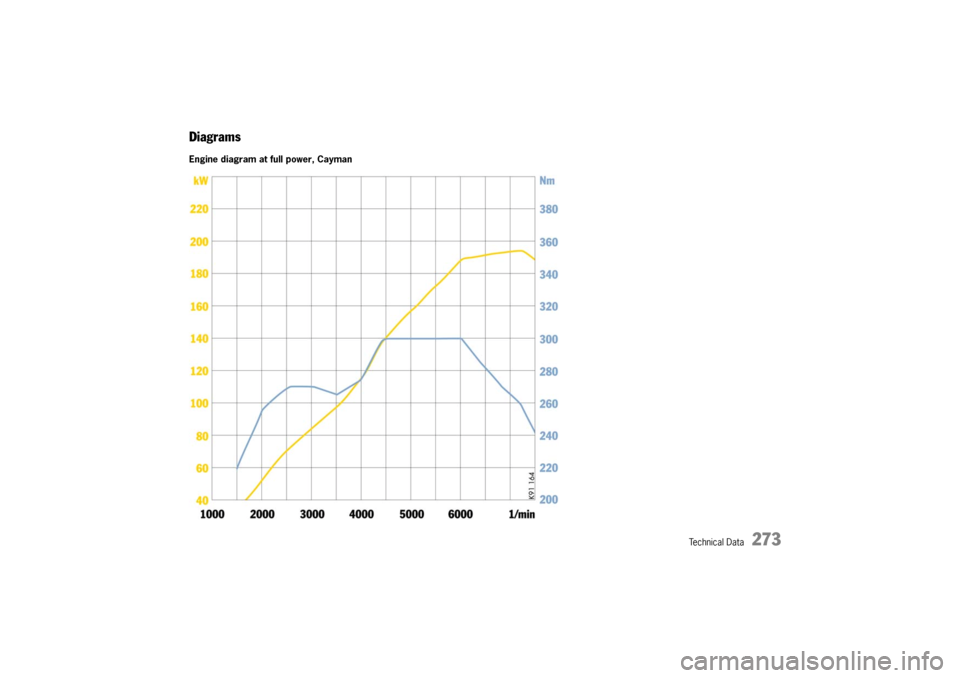
Technical Data
273
DiagramsEngine diagram at full power, Cayman
Page 276 of 284

274
Technical Data
Engine diagram at full power, Cayman S