2009 PORSCHE CAYMAN power
[x] Cancel search: powerPage 65 of 284

Operation, Safety
63
Porsche Stability Management
(PSM)PSM is an active control system for stabilization of
the vehicle approaching the performance limits of
driving maneuvers.
Warning!
Risk of an accident, resulting in serious per-
sonal injury or death.
The increased control that is provided should
not induce you to take greater risks with your
safety. The limits dictated by the laws of
physics cannot be overcome, even with PSM.
The risk of accidents due to inappropriate
speed cannot be reduced, even by PSM.
The driver bears the responsibility for all
driving maneuvers.
f Adapt your driving style to the prevailing road
and weather conditions.
fObey all traffic laws.
Sensors at the wheels, brakes, steering system
and engine continuously measure:
–Speed
– Direction of travel (steering angle)
– Lateral acceleration
– Rate of turn about the vertical axis
– Longitudinal acceleration PSM uses these values to determine the direction
of travel indicated by the driver.
PSM intervenes and helps to correct the course if
the actual direction of motion deviates from the
chosen course (steering-wheel position):
It brakes individual wheels as needed. In addition,
the engine power may be manipulated in order to
stabilize the vehicle.
The events below inform the driver of PSM control
operations and warn him/her to adapt his/her
driving style to the road conditions:
– The multifunctional in
formation light on the
instrument panel flashes.
– Hydraulic noises can be heard.
– The vehicle decelerate s and steering-wheel
forces are altered as the PSM controls the
brakes.
– Reduced engine power.
– The brake pedal pulsates and its position is changed during braking.
In order to achieve full vehicle deceleration,
foot pressure must be increased after the
brake pedal has begun vibrating.
Examples of PSM control operations– If the front wheels of the vehicle drift on a
bend, the rear wheel on the inside of the bend
is braked and the engine power is reduced if
necessary.
– If the rear of the vehicle swings out on a bend, the front wheel on the outside of the bend is
braked.Additional braking functions– Pre-filling the brake system:The brake system is prepared for possible
subsequent emergency braking if the acceler-
ator pedal is released suddenly and quickly.
The brake system is prefilled and the brake
pads are already applied gently to the brake
discs.
– Brake booster: In the event of an emergency braking operation
where the pedal force is insufficient, a brake
booster provides the braking pressure neces-
sary for maximum deceleration at all 4 wheels.Advantages of PSM– Best possible traction and lane-holding ability in all driving situations – even on road surfaces
with varying friction.
Page 92 of 284
90
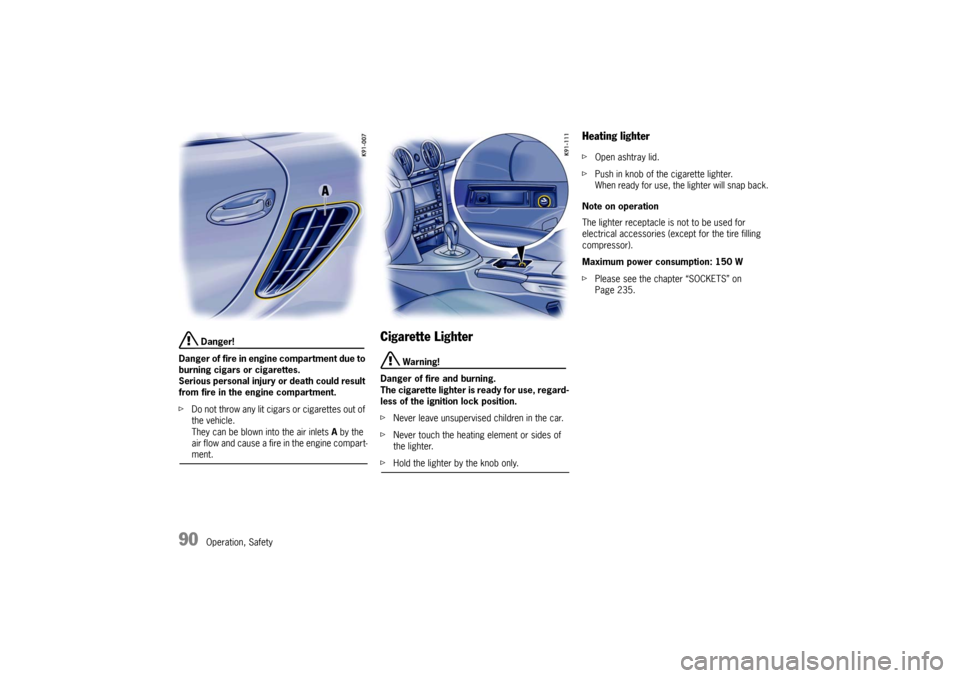
Operation, Safety Danger!
Danger of fire in engine compartment due to
burning cigars or cigarettes.
Serious personal injury or death could result
from fire in the engine compartment.
f Do not throw any lit cigars or cigarettes out of
the vehicle.
They can be blown into the air inlets A by the
air flow and cause a fire in the engine compart-ment.
Cigarette Lighter
Warning!
Danger of fire and burning.
The cigarette lighter is ready for use, regard-
less of the ignition lock position.
f Never leave unsupervised children in the car.
f Never touch the heating element or sides of
the lighter.
fHold the lighter by the knob only.
Heating lighter fOpen ashtray lid.
f Push in knob of the cigarette lighter.
When ready for use, the lighter will snap back.
Note on operation
The lighter receptacle is not to be used for
electrical accessories (except for the tire filling
compressor).
Maximum power consumption: 150 W
f Please see the chapter “SOCKETS” on
Page 235.
Page 95 of 284

Operation, Safety
93
A - Opening front luggage compartment lid
B - Opening rear luggage compartment lid Front Luggage Compartment LidUnlocking the lidf Operate pull-button A next to the driver’s seat
or corresponding button of the remote control.
When the lid is open, the luggage compart-
ment is lit.
f Please see the chapter “LOAD SWITCH-OFF AF-
TER 2 HOURS OR 7 DAYS” on Page 236.
f Please see the chapter “KEYS” on Page 15. Important Note
If the vehicle battery is discharged, the front lug-
gage compartment lid can be opened only by con-
necting an external electrical power source.
f
Please see the chapter “EMERGENCY UNLO-
CKING OF THE FRONT LUGGAGE COMPART-
MENT LID” on Page 238.
or the description inside the fuse box lid.
A warning message in the on-board computer
comes on if the lids are not completely closed.
f Fully close the lid.
Opening front luggage compartment lid
Caution!
Risk of damage to lu ggage compartment lid
or windshield wipers.
f Make sure that the windshield wipers are not folded out forwards when opening the lid.
f Raise lid slightly and unlatch the safety catch
with the red lever ( arrow).
Warning message
Page 104 of 284

102
Operation, Safety
Fading and drifting
FM range is limited to
about 25 miles (40 km),
except for some high power stations.
If a vehicle is moving aw ay from the desired sta-
tion’s transmitter, the signal will tend to fade and/
or drift. This condition is more prevalent with FM
than AM, and is often ac companied by distortion.
Fading and drifting can be minimized to a certain
degree by careful attention to fine tuning or selec-
tion of a stronger signal.
Static and fluttering
When the line-of-sight link between a transmitter
and vehicle is blocked by large buildings or moun-
tains, the radio sound may be accompanied with
static or fluttering because of the characteristic of
FM.
In a similar effect, a fluttering noise is sometimes
heard when driving along a tree-lined road.
This static and fluttering can be reduced by adjust-
ing the tone control for greater bass response un-
til the disturbance has passed.
Multipath
Because of the reflecting characteristics of FM,
direct and reflected signals may reach the antenna
at the same time (multipath) and cancel each other
out.
As a vehicle moves through these electronic dead
spots, the listener may hear a momentary flutter
or loss of reception. Station swapping
When two FM stations are close to each other, and
an electronic dead spot, such as static or multi-
path area, interrupts the original signal, some-
times the stronger second signal will be selected
automatically until the original one returns.
This swapping can also occur as you drive away
from the selected station and approach another
station of a stronger signal.
Compact disc player
Caution!
To avoid damage to compact disc player and
discs.
f Use only compact discs labeled as shown, hav-
ing no dirt, damage or warpage.
f Never attempt to disassemble or oil any part
of the player unit.
Do not insert any object other than a disc into
the slot.
Remember there are no user-serviceable parts
inside the compact disc player.
f Do not allow the disc to sustain any finger-
prints, scrapes or stickers on the surfaces.
This may cause poor sound quality.
Hold the disc only on the edge or center hole. f
When not in use, take th e disc out of the player,
put the disc back into its case and store it
away from dust, heat, damp and direct
sunlight.
Leaving the disc on the dashboard in the sun
can damage the disc.
f If the disc gets dirty, clean the disc by wiping
the surfaces from the center to the outside in
a radial direction with a soft cloth.
Do not use a conventional record cleaner or
anti-static record preservative.
Disc cleaners are available in audio stores.
Page 105 of 284

Operation, Safety
103
Car Telephone and
Aftermarket Alarms Important legal and safety information
regarding the use of cellular telephones
Some states may prohibit the use of cellular tele-
phones while driving a vehicle. Check the laws and
regulations on the use of cellular telephones in the
areas where you drive.
Danger!
Risk of an accident.
Severe personal injury or death can result in
the event of an accident.
Looking away from the road or turning your
attention away from your driving can cause
an accident and seri ous or fatal injury.
When using your cellular telephone, you should al-
ways:
f Give full attention to your driving - pull off the
road and park before making or answering a
call if traffic conditions so require; and
f Keep both hands on the steering wheel - use
hands-free operation (if available) - pull off the
road and park before using a hand-held tele-phone. It is essential to observe the telephone
manufacturer's instructions before operating
the telephone.
Any portable telephone or radio transmitter which
is used in a Porsche must
be properly installed in
accordance with the technical requirements of
Porsche.
The transmission power must not exceed
10 W.
The devices must possess a type approval for
your vehicle and have an “e” symbol.
If you should require equipment with transmission
power values greater than 10 W, please consult
your authorized Porsche dealer for this purpose.
The dealer is familiar with the technical require-
ments for installing devices of this kind.
The antennas for all radios and telephones with a
transmitting antenna must be externally mounted.
The improper installation of radios or telephones
or use of a radio or tele phone with a transmitting
antenna inside the car may cause the warning
lights to come on.
Improper installation of such equipment can cre-
ate a discharged battery or excessive current
draw from added equipment. If aftermarket systems are
installed by non-dealer-
ship technicians or outside the selling dealer,
problems may result. Installation of aftermarket
equipment is not covered under the New Car War-
ranty.
f Consult your authorized Porsche dealer about
the installation of non Porsche approved equip-
ment.
Reception quality
The reception quality of your car telephone will
change constantly when you are driving. Interfer-
ence caused by buildings, landscape and weather
is unavoidable. It may become particularly difficult
to hear when using the hands-free function due to
external noise such as engine and wind noise.
Automatic car-wash
f Unscrew external antennas before using an au-
tomatic car-wash.
Page 131 of 284
Instruments, On-Board Computer, Warnings
129
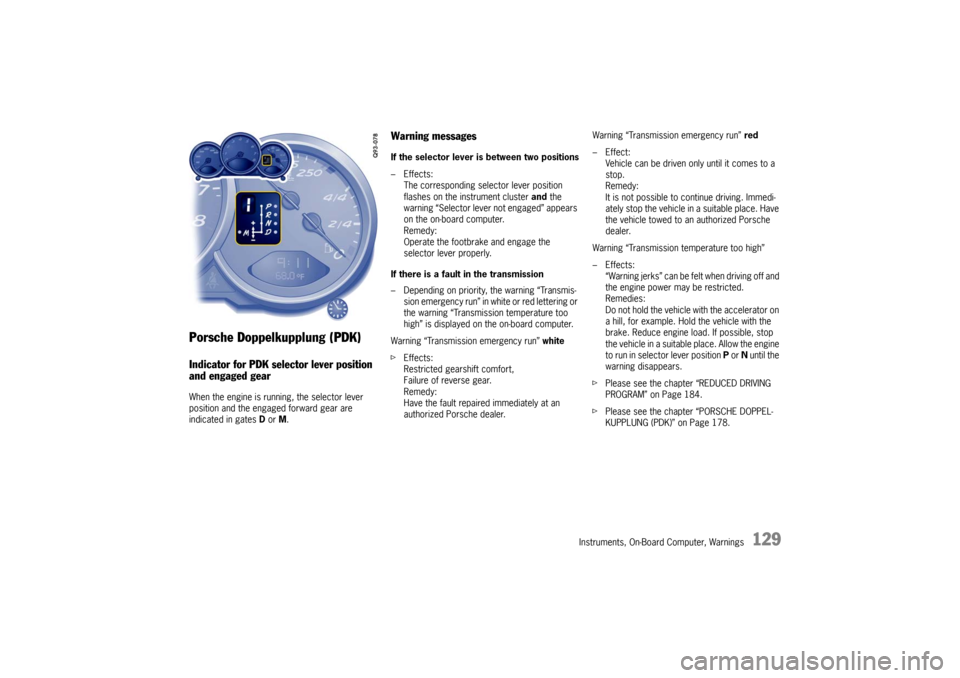
Porsche Doppelkupplung (PDK)Indicator for PDK selector lever position
and engaged gearWhen the engine is running, the selector lever
position and the engaged forward gear are
indicated in gates D or M.
Warning messagesIf the selector lever is between two positions
–Effects:
The corresponding selector lever position
flashes on the instrument cluster and the
warning “Selector lever not engaged” appears
on the on-board computer.
Remedy:
Operate the footbrake and engage the
selector lever properly.
If there is a fault in the transmission
– Depending on priority, the warning “Transmis- sion emergency run” in white or red lettering or
the warning “Transmission temperature too
high” is displayed on the on-board computer.
Warning “Transmission emergency run” white
f Effects:
Restricted gearshift comfort,
Failure of reverse gear.
Remedy:
Have the fault repaired immediately at an
authorized Porsche dealer. Warning “Transmission emergency run”
red
– Effect: Vehicle can be driven only until it comes to a
stop.
Remedy:
It is not possible to co ntinue driving. Immedi-
ately stop the vehicle in a suitable place. Have
the vehicle towed to an authorized Porsche
dealer.
Warning “Transmission temperature too high”
–Effects: “Warning jerks” can be fe lt when driving off and
the engine power may be restricted.
Remedies:
Do not hold the vehicle with the accelerator on
a hill, for example. Hold the vehicle with the
brake. Reduce engine load. If possible, stop
the vehicle in a suitable place. Allow the engine
to run in selector lever position P or N until the
warning disappears.
f Please see the chapter “REDUCED DRIVING
PROGRAM” on Page 184.
f Please see the chapter “PORSCHE DOPPEL-
KUPPLUNG (PDK)” on Page 178.
Page 134 of 284

132
Instruments, On-Board Computer, Warnings
If the battery voltage drops abruptly, a warning
m e s s a g e w i l l b e d i s p l a y e d b y t h e o n - b o a rd c o m p u -
ter.
If the warning is displayed by the on-board
computer while the engine is running or while
driving:
f
Stop the car in a safe place and stop the
engine.
Possible causes
– Defect in the battery charging system.
– Broken drive belt.
Warning!
Risk of engine damage with resultant loss of
control and accident, leading to serious per-
sonal injury or death.
A broken drive belt means there is no power
assistance to the steering (more effort is re-
quired to steer) and coolant pump function
will stop.
f Do not continue driving.
f Have the fault remedied at the nearest author-ized Porsche dealer. The central warning light on the instrument panel
lights up if there are warning messages in the
INFO menu.
The messages can be called in the on-board
computer INFO menu:
f
Please see the chapter “INFO WARNING MES-
SAGES” on Page 140. The warning light on the instrument panel lights
up:
– if the handbrake is on,
– if the brake fluid level is low,
– if the brake pads have
reached the wear limit,
– if the brake circuit division is defective.
Additionally, a warning is displayed by the on-
board computer.
f Please see the chapter “WARNINGS ON THE
INSTRUMENT PANEL AND THE ON-BOARD
COMPUTER” on Page 166.
Battery
Central Warning Light
Brake Warning Light USA
Brake Warning Light Canada
Page 135 of 284

Instruments, On-Board Computer, Warnings
133
Check Engine
(Emission Control)The emission control system detects malfunctions
early that could, for example, cause increased
pollutant emissions or consequential damage.
Faults are indicated by a continuously lit or
flashing instrument panel warning light.
The faults are recorded in the control unit's fault
memory.
The warning light in the instrument panel lights up
when the ignition is switched on as a bulb check
and goes out approx. 4 seconds after the engine
starts. If the warning light does not light up, have
the bulb replaced promptly.
The warning light in the instrument panel flashes to
indicate operating states (e.g. engine misfiring)
which might cause damage to certain parts of the
emission control system.
fIn this case, immediately reduce the engine
load by easing off the accelerator.
f In order to avoid consequential damage to the
engine or emission control system (e.g. cata-
lytic converter), have the fault diagnosed and
rectified immediately at the nearest authorized
Porsche dealer. If the warning light in the
instrument panel lights up
permanently without flashing before and remains
on while driving, it suggests:
– a potential engine control problem and the need for system service or
– an improperly fastened tank cap or
– the vehicle was refueled while the engine was running.
f Stop immediately at a suitable and secure
place and check tank cap for proper fastening.
If tank cap was fastened correctly, see your au-
thorized Porsche dealer for service as soon as
possible.
Caution!
If the check engine warning light in the in-
strument panel is flashing, serious catalytic
converter damage and power loss will soon
occur.
Prolonged driving with the check engine war-
ning light on could cause damage to the
emission control system. It also could affect
fuel economy and driveability.
f Have the fault remedied at the nearest authorized Porsche dealer immediately.
Warning Light