2009 PORSCHE CAYMAN headlights
[x] Cancel search: headlightsPage 83 of 284
Operation, Safety
81
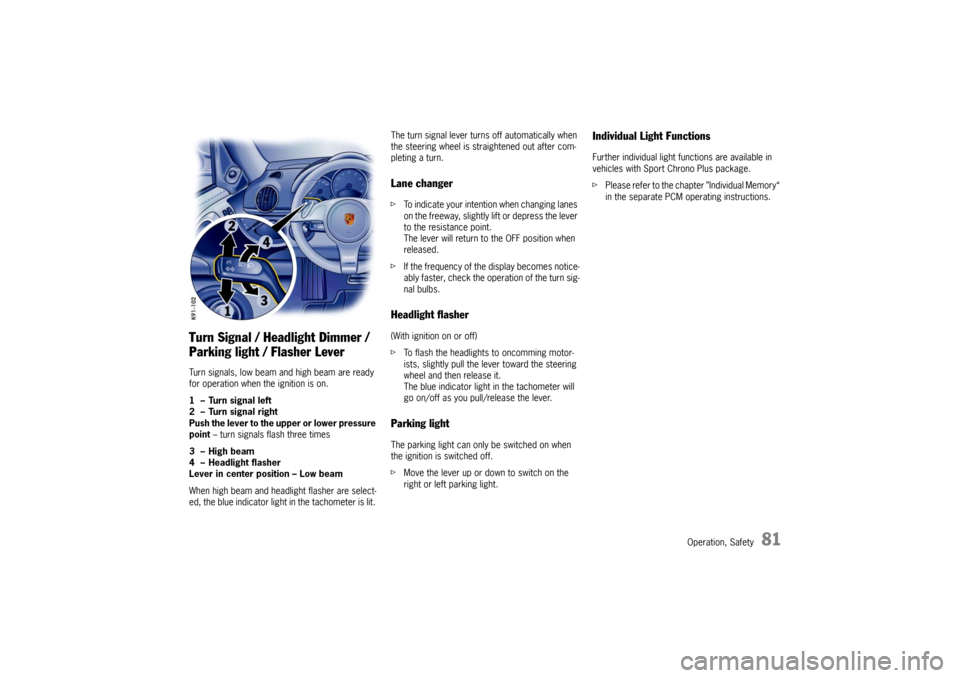
Turn Signal / Headlight Dimmer /
Parking light / Flasher Lever Turn signals, low beam and high beam are ready
for operation when the ignition is on.
1 – Turn signal left
2 – Turn signal right
Push the lever to the upper or lower pressure
point – turn signals flash three times
3 – High beam
4 – Headlight flasher
Lever in center position – Low beam
When high beam and head light flasher are select-
ed, the blue indicator light in the tachometer is lit. The turn signal lever turns off automatically when
the steering wheel is st
raightened out after com-
pleting a turn.
Lane changer f To indicate your intention when changing lanes
on the freeway, slightly lift or depress the lever
to the resistance point.
The lever will return to the OFF position when
released.
f If the frequency of the display becomes notice-
ably faster, check the operation of the turn sig-
nal bulbs. Headlight flasher (With ignition on or off)
fTo flash the headlights to oncomming motor-
ists, slightly pull the lever toward the steering
wheel and then release it.
The blue indicator light in the tachometer will
go on/off as you pull/release the lever. Parking lightThe parking light can only be switched on when
the ignition is switched off.
fMove the lever up or down to switch on the
right or left parking light.
Individual Light FunctionsFurther individual light functions are available in
vehicles with Sport Chrono Plus package.
f Please refer to the chapter ”Individual Memory“
in the separate PCM operating instructions.
Page 84 of 284
82
Operation, Safety
Windshield Wiper/ Washer Lever
Warning!
Danger of injury when the windshield wipers
operate unintentionally, e.g. in intermittent
or rain sensor operation.
Risk of damage to the windshield, wiper sys-
tem and headlight washer.
f Avoid running the wiper blades over a dry
windshield to prevent scratching the glass.
Spray washer fluid on the windshield first.
A scratched windshield will reduce visibility.
f Always loosen wiper blades from frozen glass
before operating wipers to prevent damage to
the wiper motor or blades.
f Always switch off windshield wipers in car
wash to prevent them wiping unintentionally
(intermittent or sensor operation).
f Always switch off windshield wipers before
cleaning the windshield to avoid unintentional
operation (intermittent or sensor operation).
f Do not operate the headlight washer in car
washes.
f Do not operate headlight washer when it is frozen.
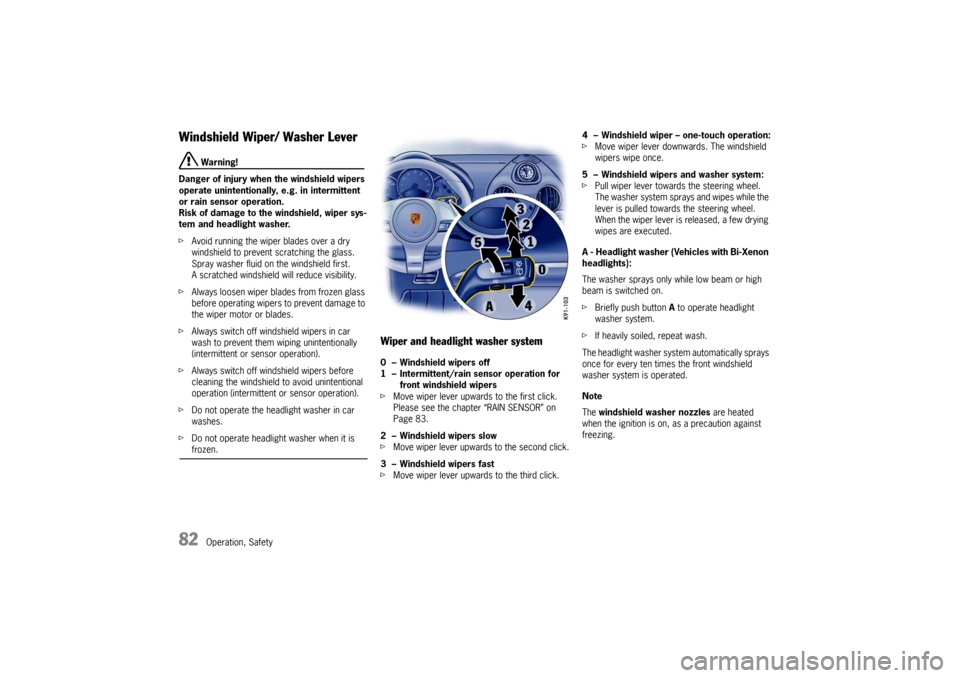
Wiper and headlight washer system0 – Windshield wipers off
1 – Intermittent/rain sensor operation for
front windshield wipers
f Move wiper lever upwards to the first click.
Please see the chapter “RAIN SENSOR” on
Page 83.
2 – Windshield wipers slow
f Move wiper lever upwards to the second click.
3 – Windshield wipers fast
f Move wiper lever upwards to the third click. 4 – Windshield wiper – one-touch operation:
f
Move wiper lever downwards. The windshield
wipers wipe once.
5 – Windshield wipers and washer system:
f Pull wiper lever towards the steering wheel.
The washer system sprays and wipes while the
lever is pulled towards the steering wheel.
When the wiper lever is released, a few drying
wipes are executed.
A - Headlight washer (Vehicles with Bi-Xenon
headlights):
The washer sprays only while low beam or high
beam is switched on.
f Briefly push button A to operate headlight
washer system.
f If heavily soiled, repeat wash.
The headlight washer system automatically sprays
once for every ten times the front windshield
washer system is operated.
Note
The windshield washer nozzles are heated
when the ignition is on, as a precaution against
freezing.
Page 202 of 284
200
Maintenance, Car Care
Washer FluidCapacity – Without headlight cleaning system:approximately 2.6 quarts (2.5 liters).
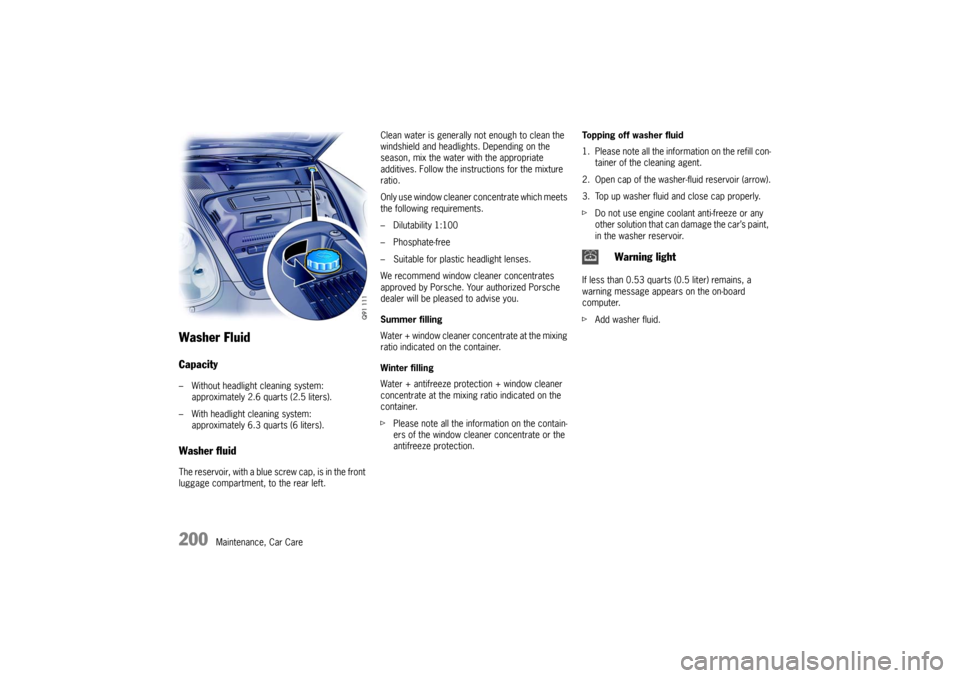
– With headlight cleaning system: approximately 6.3 quarts (6 liters). Washer fluidThe reservoir, with a blue screw cap, is in the front
luggage compartment, to the rear left. Clean water is generally
not enough to clean the
windshield and headlights. Depending on the
season, mix the water with the appropriate
additives. Follow the instructions for the mixture
ratio.
Only use window cleaner concentrate which meets
the following requirements.
– Dilutability 1:100
– Phosphate-free
– Suitable for plastic headlight lenses.
We recommend window cleaner concentrates
approved by Porsche. Your authorized Porsche
dealer will be pleased to advise you.
Summer filling
Water + window cleaner concentrate at the mixing
ratio indicated on the container.
Winter filling
Water + antifreeze protection + window cleaner
concentrate at the mixing ratio indicated on the
container.
f Please note all the info rmation on the contain-
ers of the window cleaner concentrate or the
antifreeze protection. Topping off washer fluid
1. Please note all the info
rmation on the refill con-
tainer of the cleaning agent.
2. Open cap of the washer-fluid reservoir (arrow).
3. Top up washer fluid and close cap properly.
f Do not use engine coolant anti-freeze or any
other solution that can damage the car’s paint,
in the washer reservoir.
If less than 0.53 quarts (0.5 liter) remains, a
warning message appears on the on-board
computer.
f Add washer fluid.
Warning light
Page 210 of 284

208
Maintenance, Car Care
Door, lid and window seals
Caution!
The lubricant coating on the inner door
seals, convertible top and hardtop seals
may be damaged by unsui table cleaning and
care agents.
f Do not use any chemical cleaning agents
or solvents.
fDo not use any preservative agents.
f Wash dirt (e.g. abrasion, dust, road salt and
grit) from all seals regularly using warm
soapy water.
f If there is a risk of frost, protect the outer door
seals and lid seals against freezing into place
with a suitable care product.Headlights, lights, interior and exterior
plastic parts, adhesive filmsUse only clean water and a little dishwashing
detergent to clean light lenses, plastic headlight
lenses, plastic parts, adhesive films and surfaces.
Do not clean when dry.
Use a soft sponge or a soft, lint-free cloth. Gently
wipe the surface without applying too much
pressure.
An interior window cleane r can also be used to
clean plastic surfaces (always read the cleaning
instructions on the container). We recommend
Porsche interior window cleaner. f
Gently wipe the surface without applying too
much pressure.
f Do not clean when dry.
f Never use other chemical cleaners or
solvents.
f Rinse cleaned surfaces with clear water.
Leather Characteristics and special features
The natural surface markings of leather, e.g.
creases, healed scars, insect sting marks, struc-
tural differences and slight variations in shade and
grain add to the attractiveness of the natural leath-
er product.
Observe the following care instructions:
Caution!
The leather will be damaged by the use of
unsuitable cleaning and care agents and by
incorrect treatment.
f Do not use caustic cleaners or hard
cleaning aids.
f Perforated leather must under no circumstances get wet on its reverse side.
f Clean all types of leather regularly to remove
fine dust using a soft, damp, white woollen
cloth or a commercially available
microfibre cloth. f
Remove heavy contamination with a leather
cleaner.
Always read the instructions for use given on
the containers.
We recommend Porsche leather cleaner.
f Treat cleaned leather only with a leather
care product.
We recommend the Porsche leather
care product.
Cleaning airbags covers
Danger!
There is a danger of serious personal injury
or death if the airbag system is impaired by
improper cleaning work.
f Do not make any modifications whatsoever on
individual components such as the padded
covers of the steering wheel, passenger side
instrument panel, the front seats and the door
linings.
f Let your authorized Porsche dealer clean these components.
Page 213 of 284
Practical Tips, Emergency Service
211
Practical Tips, Emergency Service
Exercise Extreme Caution when Working
on your Vehicle .
....................................... 212
Tires/Wheels ............................. .............. 213
Loading Information ................................... 224
Wheel Bolts .......... ................................... 226
Changing a wheel ... ................................... 227
Flat Tire ................. ................................... 229
Lifting the Vehicle with a Lifting Platform
or Garage Lift ........ ................................... 232
Spacers ..................... .............................. 233
Electrical System ..................................... 235
Battery ................. ................................... 239
Replacing the remote-con trol battery ......... 244
Emergency Starting with Jumper Cables ..... 245
Bulb chart .............. ................................... 247
Lights, Replacing Bulb s ............................. 247
Headlights ............. ................................... 248
Number Plate Light . ................................... 256
Changing Light-Emitting Diodes and
Long-Life Bulbs ........................... .............. 256
Adjusting Headlights .................................. 257
Towing ....................... .............................. 259
Page 249 of 284

Practical Tips, Emergency Service
247
Bulb chart
Ty p e , r a t i n g
Halogen low beam H7, 55W
Halogen high beam H9, 65W
Low beam/high beam with Bi-Xen on headlights Philips, D2S 35W
Additional high beam with Bi-Xenon headlights H7, 55 W
Turn signal light, front Philips HY21W
Turn signal light, side WY5W
Fog light H8, 35W
License plate light C5W
Lights, Replacing Bulbs
Warning!
Risk of short circuit.
f Always switch off the relevant consumer when
changing bulbs.
Risk of serious personal injury or death.
The Bi-Xenon headlights are under high
voltage when installed.
f Be careful during all work in the area of the Bi-
Xenon headlights.
Risk of damage. Bulbs of a higher wattage
can damage the lamp housing.
f Only the bulbs shown in the chart may be used.
f New bulbs must be clean and free from oil,
grease and fingerprints. Therefore, never
touch bulbs with your bare hands.
Use a cloth or soft paper while replacing bulbs.
Page 250 of 284
248
Practical Tips, Emergency Service
Headlights
Caution!
Risk of damage to headlights due to exces-
sive temperatures and abrasion.
f To ensure optimum ventilation, do not cover
the gap between headlight and body
(e.g. “stone guards” or films).
f Use soapy water only to clean light lenses and
plastic headlight lenses.
In no case may chemical cleaners or other vol-
atile cleaning fluids be used.
f To prevent scratches, do not rub with a dry or merely moist cloth, tissue or insect sponges.
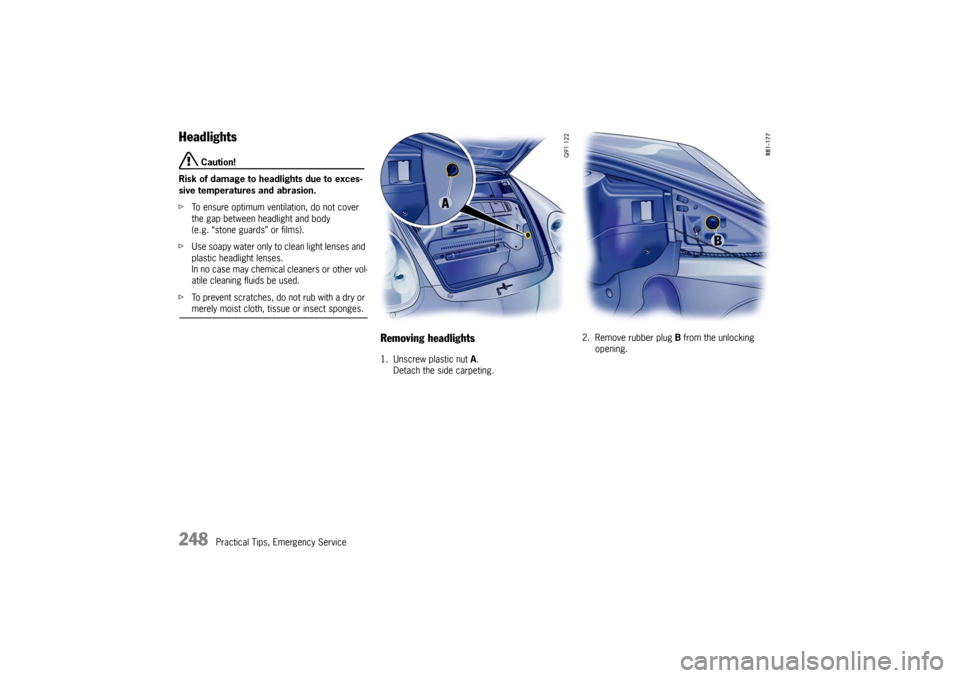
Removing headlights1. Unscrew plastic nut A.
Detach the side carpeting. 2. Remove rubber plug
B from the unlocking
opening.
Page 252 of 284
250
Practical Tips, Emergency Service
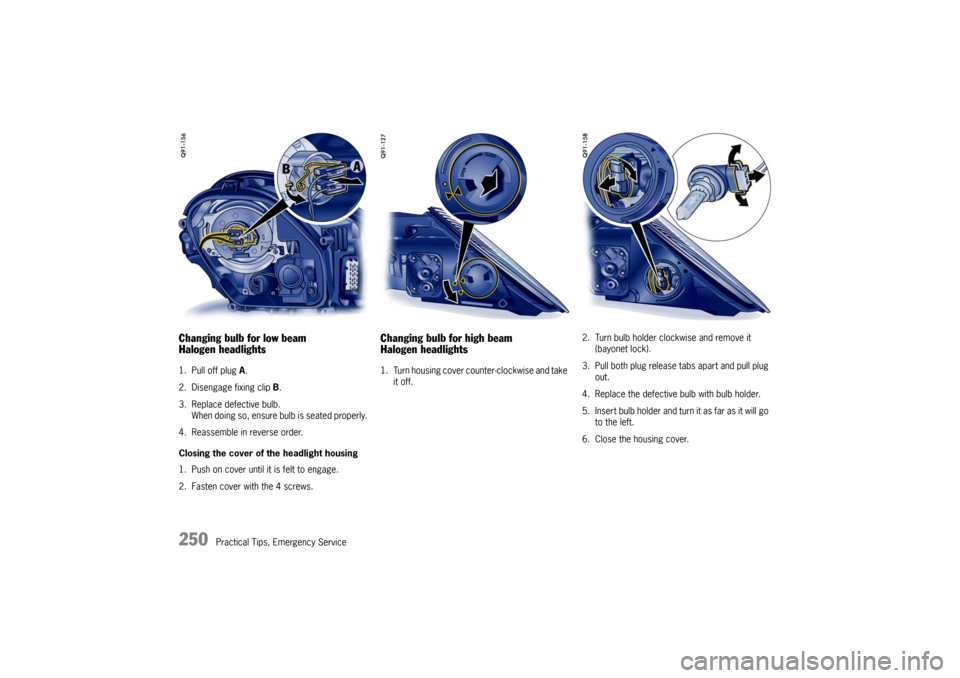
Changing bulb for low beam
Halogen headlights1. Pull off plug A.
2. Disengage fixing clip B.
3. Replace defective bulb. When doing so, ensure bulb is seated properly.
4. Reassemble in reverse order.
Closing the cover of the headlight housing
1. Push on cover until it is felt to engage.
2. Fasten cover with the 4 screws.
Changing bulb for high beam
Halogen headlights1. Turn housing cover counter-clockwise and take it off. 2. Turn bulb holder clockwise and remove it
(bayonet lock).
3. Pull both plug release tabs apart and pull plug out.
4. Replace the defective bulb with bulb holder.
5. Insert bulb holder and turn it as far as it will go to the left.
6. Close the housing cover.