2009 PORSCHE CAYMAN fuel
[x] Cancel search: fuelPage 79 of 284
Operation, Safety
77
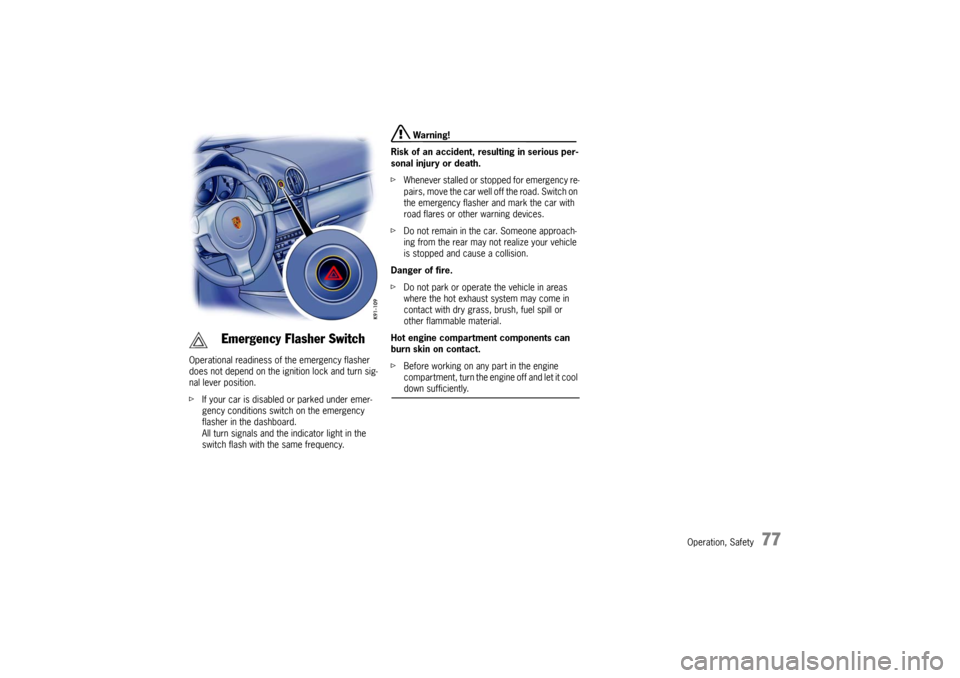
Operational readiness of the emergency flasher
does not depend on the ignition lock and turn sig-
nal lever position.
f If your car is disabled or parked under emer-
gency conditions switch on the emergency
flasher in the dashboard.
All turn signals and the indicator light in the
switch flash with the same frequency.
Warning!
Risk of an accident, re sulting in serious per-
sonal injury or death.
f Whenever stalled or stopped for emergency re-
pairs, move the car well off the road. Switch on
the emergency flasher and mark the car with
road flares or other warning devices.
f Do not remain in the car. Someone approach-
ing from the rear may not realize your vehicle
is stopped and cause a collision.
Danger of fire.
f Do not park or operate the vehicle in areas
where the hot exhaust system may come in
contact with dry grass, brush, fuel spill or
other flammable material.
Hot engine compartment components can
burn skin on contact.
f Before working on any part in the engine
compartment, turn the engine off and let it cool down sufficiently.
Emergency Flasher Switch
Page 107 of 284

Operation, Safety
105
Roof Transport SystemfPlease follow the separate instructions for fit-
ting the Roof Transport System.
f Only use Roof Transport Systems from the
Porsche Tequipment product range or Roof
Transport Systems which have been tested
and approved for your car by Porsche. Fitting
normal commercially available luggage racks
is not possible.
The Porsche Roof Transport System allows you
to carry various sports and hobby equipment.
Your Porsche partner will be pleased to tell you
about the various different uses of the Roof Trans-
port System.
Caution!
f Risk of damage to the paint on the rear lid.
Only open the rear lid if this cannot touch the
load.
f Completely remove the Roof Transport System
b e f o re u s i n g a n a u t o m a t i c c a r w a s h - r i s k o f d a -
mage to the vehicle!
f Do not exceed the maximum permitted pay-
load of 132 lbs. (60 kg), the maximum permit-
ted gross weight and the maximum permitted
axle loads.
f Please see the chapter “WEIGHTS” on
Page 272. f
Distribute load evenly, storing heavy items as
low as possible. Items of luggage must not
project beyond the side of the load area.
f Fix and secure every item to the basic carrier
with a rope or lashing strap (do not use elastic
rubber tensioners).
f Before every trip, and at regular intervals
during long trips, check that Roof Transport
System and load are secu re. Re-tighten if ne-
cessary and secure additionally by locking.
f When the Roof Transport System is loaded, the
maximum speed depends on the nature, size
and weight of the load being carried. But never
drive faster than 90 mph (140 km/h).
f With the basic carrier fitted and no load, do not
exceed a maximum speed of 110 mph
(180 km/h).
f Driving, braking and steering behavior change
due to the higher center of gravity and the gre-
ater wind-resistant area. You should adapt your
driving style appropriately.
f Since fuel consumption and noise are incre-
ased with the Roof Transport System fitted, it
should not remain on the vehicle if not in use.
Page 113 of 284
Automatic air conditioning system, Heated rear window/Door mirror heating
111
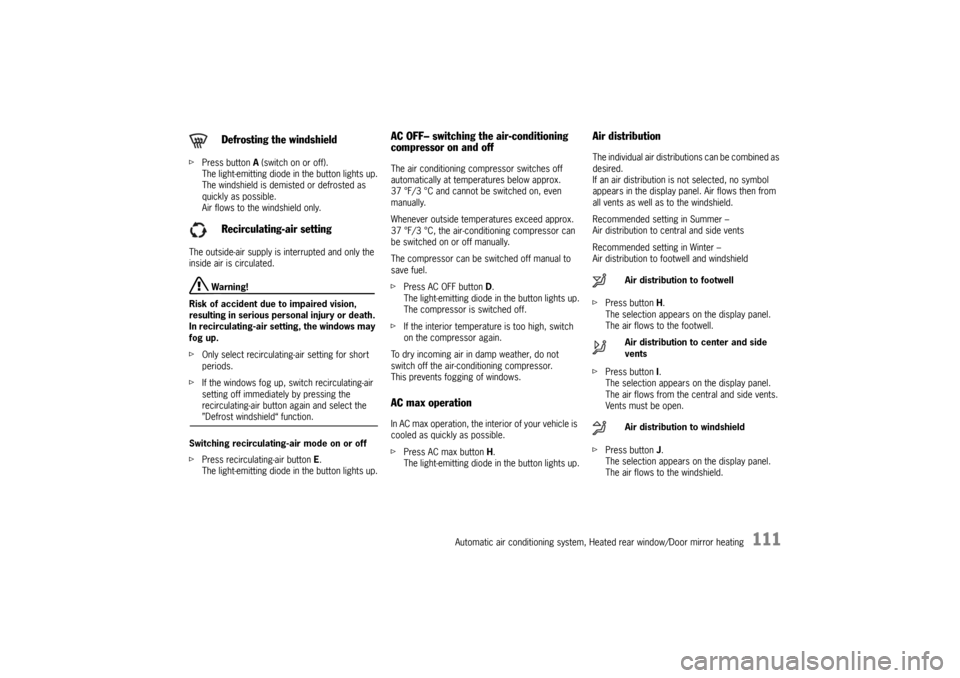
fPress button A (switch on or off).
The light-emitting diode in the button lights up.
The windshield is demisted or defrosted as
quickly as possible.
Air flows to the windshield only.
The outside-air supply is interrupted and only the
inside air is circulated.
Warning!
Risk of accident due to impaired vision,
resulting in serious personal injury or death.
In recirculating-air setting, the windows may
fog up.
f Only select recirculating-air setting for short
periods.
f If the windows fog up, sw itch recirculating-air
setting off immediately by pressing the
recirculating-air button again and select the ”Defrost windshield“ function.
Switching recirculating-air mode on or off
f Press recirculating-air button E.
The light-emitting diode in the button lights up.
AC OFF– switching the air-conditioning
compressor on and offThe air conditioning compressor switches off
automatically at temperatures below approx.
37 °F/3 °C and cannot be switched on, even
manually.
Whenever outside temperatures exceed approx.
37 °F/3 °C, the air-conditioning compressor can
be switched on or off manually.
The compressor can be switched off manual to
save fuel.
f Press AC OFF button D.
The light-emitting diode in the button lights up.
The compressor is switched off.
f If the interior temperature is too high, switch
on the compressor again.
To dry incoming air in damp weather, do not
switch off the air-conditioning compressor.
This prevents fogging of windows.AC max operationIn AC max operation, the interior of your vehicle is
cooled as quickly as possible.
f Press AC max button H.
The light-emitting diode in the button lights up.
Air distributionThe individual air distributions can be combined as
desired.
If an air distribution is not selected, no symbol
appears in the display panel. Air flows then from
all vents as well as to the windshield.
Recommended setting in Summer –
Air distribution to central and side vents
Recommended setting in Winter –
Air distribution to footwell and windshield
f Press button H.
The selection appears on the display panel.
The air flows to the footwell.
f Press button I.
The selection appears on the display panel.
The air flows from the central and side vents.
Vents must be open.
f Press button J.
The selection appears on the display panel.
The air flows to the windshield.
Defrosting the windshield
Recirculating-air setting
Air distribution to footwell
Air distribution to center and side
vents
Air distribution to windshield
Page 116 of 284
114
Automatic air conditioning system, Heated rear window/Door mirror heating
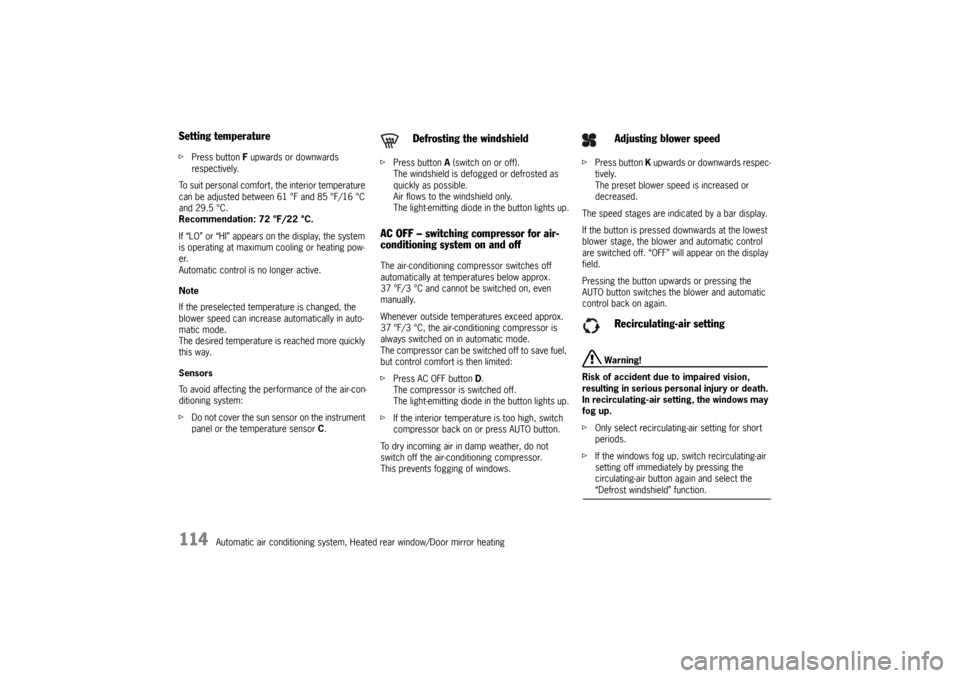
Setting temperaturefPress button F upwards or downwards
respectively.
To suit personal comfort, the interior temperature
can be adjusted between 61 °F and 85 °F/16 °C
and 29.5 °C.
Recommendation: 72 °F/22 °C.
If “LO” or “HI” appears on the display, the system
is operating at maximum cooling or heating pow-
er.
Automatic control is no longer active.
Note
If the preselected temperature is changed, the
blower speed can increase automatically in auto-
matic mode.
The desired temperature is reached more quickly
this way.
Sensors
To avoid affecting the performance of the air-con-
ditioning system:
f Do not cover the sun sensor on the instrument
panel or the temperature sensor C. f
Press button A (switch on or off).
The windshield is defogged or defrosted as
quickly as possible.
Air flows to the windshield only.
The light-emitting diode in the button lights up.
AC OFF – switching compressor for air-
conditioning system on and offThe air-conditioning compressor switches off
automatically at temperatures below approx.
37 °F/3 °C and cannot be switched on, even
manually.
Whenever outside temperatures exceed approx.
37 °F/3 °C, the air-conditioning compressor is
always switched on in automatic mode.
The compressor can be switched off to save fuel,
but control comfort is then limited:
f Press AC OFF button D.
The compressor is switched off.
The light-emitting diode in the button lights up.
f If the interior temperature is too high, switch
compressor back on or press AUTO button.
To dry incoming air in damp weather, do not
switch off the air-conditioning compressor.
This prevents fogging of windows. f
Press button K upwards or downwards respec-
tively.
The preset blower speed is increased or
decreased.
The speed stages are indicated by a bar display.
If the button is pressed downwards at the lowest
blower stage, the blower and automatic control
are switched off. “OFF” will appear on the display
field.
Pressing the button upwards or pressing the
AUTO button switches the blower and automatic
control back on again.
Warning!
Risk of accident due to impaired vision,
resulting in serious personal injury or death.
In recirculating-air setting, the windows may
fog up.
f Only select recirculatin g-air setting for short
periods.
f If the windows fog up, switch recirculating-air
setting off immediately by pressing the
circulating-air button again and select the “Defrost windshield” function.
Defrosting the windshield
Adjusting blower speed
Recirculating-air setting
Page 121 of 284

Instruments, On-Board Computer, Warnings
119
Instruments, On-Board Computer, Warnings
Instrument Panel USA Models ..................... 120
Instrument Panel Canada Models ................ 122
Automatic Speed Control Indicator light ...... 124
Instrument Illumination
............................... 124
Trip Odometer ....... ................................... 125
Speedometer .............. .............................. 126
Changing over between Miles / Kilometers .. 126
Tachometer ................ .............................. 127
Turn Signal Indicator Light ......................... 127
High Beam Indicator Light .......................... 127
Gear Shift Indicator
(in vehicles with manual transmission) ......... 127
Cooling System ...... ................................... 128
Porsche Doppelkupplung (PDK) .................. 129
Fuel ............... ......................... .................. 130
Clock ............ ......................... .................. 131
Outside Temperature ................................. 131
Check Engine (Emission Control) ................ 133
On-Board Computer (BC) ............................ 134
Warnings on the instrument panel and
the on-board computer .............................. 166
Page 122 of 284

120
Instruments, On-Board Computer, Warnings
Instrument Panel USA Models Also refer to the corresponding chapters in
the Owner’s Manual.1. Speedometer with analogue display
2. Automatic speed control indicator light
3. Tire pressure warning light
4. Turn signal indicator light, left/right
5. Tachometer
6. High beam indicator light
7. ABS warning light
8. Cooling system Temperature gage, warning light
9. Fuel Level gage, warning light
10.Adjustment button for instrument illumination and trip counter
11.Odometer and daily trip mileage display
12.Light sensor for instrument illumination
13.Airbag warning light 14.Check Engine warning light
(Emission control warning light)
15.Central warning light
16.On-board computer display
17.Porsche Stability Management PSM Multifunctional light
18.Brake warning light
19.Safety belt warning light
20.Gear display
21.PDK transmission, selector lever position
22.Clock and outside temperature display
23.Adjustment button for clock When the ignition is switched on, the warning
lights light up for a lamp check.
Note
Warnings that have been given are stored in the
appropriate control unit me
mory and can be read
out at an authorized Porsche dealer.
This information can help to warn you about situa-
tions which may be hazardous to you or your car.
Page 124 of 284

122
Instruments, On-Board Computer, Warnings
Instrument Panel Canada Models Also refer to the corresponding chapters in
the Owner’s Manual.1. Speedometer with analogue display
2. Automatic speed control indicator light
3. Tire pressure warning light
4. Turn signal indicator light, left/right
5. Tachometer
6. High beam indicator light
7. ABS warning light
8. Cooling system Temperature gage, warning light
9. Fuel Level gage, warning light
10.Adjustment button for instrument illumination and trip counter
11.Odometer and daily trip mileage display
12.Light sensor for instrument illumination
13.Airbag warning light 14.Check Engine warning light
(Emission control warning light)
15.Central warning light
16.On-board computer display
17.Porsche Stability Management PSM Multifunctional light
18.Brake warning light
19.Safety belt warning light
20.Gear display
21.PDK transmission, selector lever position
22.Clock and outside temperature display
23.Adjustment button for clock When the ignition is switched on, the warning
lights light up for a lamp check.
Note
Warnings that have been given are stored in the
appropriate control unit me
mory and can be read
out at an authorized Porsche dealer.
This information can help to warn you about situa-
tions which may be hazardous to you or your car.
Page 129 of 284

Instruments, On-Board Computer, Warnings
127
Tachometer The tachometer shows the engine speed in revolu-
tions per minute (rpm).
The beginning of the red marks at the right end of
the scale indicates the maximum permissible en-
gine rpm.
A speed limiter prevents the engine from being
overrevved during acceleration. Before reaching
this area, the next higher gear should be select-
ed.
Shift to the next lower gear when the engine rpm
drops below 1,500 rpm.
Caution!
To avoid severe engine damage.
f Always observe the engine rpm before down-
shifting to a lower gear, so you do not exceed the maximum engine rpm.
Flashes in synchronism with the turn signals.
Left arrow – left turn signals
Right arrow – right turn signals
f If the frequency of the display becomes notice-
ably faster, check the operation of the turn sig-
nals.
Lights when high beam or headlight flasher is
switched on.
The indicator light goes out when the high beams
are switched off.
The indicator light flashes in the event of cornering
light failure.
Gear Shift Indicator(in vehicles with manual transmission)The consumption-orientated gear shift indicator A
on the display panel of the on-board computer
assists a fuel-saving driving style. The gear shift
indicator lights up as a recommendation to shift
up to the next-higher gear depending on the
selected gear, engine rpm and accelerator pedal
position.
f When the gear shift indicator A lights up,
change to the next higher gear to decrease
fuel consumption.
Turn Signal Indicator Light
High Beam Indicator Light