2009 PORSCHE 911 ESP
[x] Cancel search: ESPPage 19 of 59

Variable Turbine Geometry
(V TG).
The 911 Turbo and 911 Turbo S
models are straightforward, almost
mat ter-of-fact, when it comes
to handling power. V TG has con -
tributed enormously to this.
The variable turbine geometry of
the t win water-cooled exhaust gas
turbochargers goes a long way
to resolving the conflict of aims of
normal turbochargers. With this
technology, the gas flow from the
engine is channelled onto the
turbines via electronically adjust -
able guide vanes. By changing
the vane angle, the system can
replicate the geometry in all
t ypes of turbo, large or small,
and thus achieve the optimum
gas-flow characteristics. The
guide vanes are controlled by the
engine management system.
The result is a high turbine speed
– and therefore higher boost
pressure – even at low engine
rpm. With more air available, the
combustion is increased, yielding
greater power and torque.
Maximum torque is reached at
lower rpm and is retained across
a wider rev range. Both engine
variants deliver a torque of just
650 Nm from as low as 1,950 rpm.
In the case of the 911 Turbo
models, this torque is available
up to 5,000 rpm. The increased
maximum torque of 700 Nm in
the 911 Turbo S models is avail -
able bet ween 2,100 rpm and
4,250 rpm.
When the boost pressure reaches
its maximum value, the guide
vanes are opened further. By var -
ying the vane angle, it is possible
to achieve the required boost pressure over the entire engine
speed range. As a result, there is
no need for excess-pressure
valves as found on conventional
turbocharged engines.
In the 911 Turbo models, engine
performance can be further
enhanced by selecting the SPORT
but ton on the optional Sport
Chrono Package Turbo. Under
full acceleration, the maximum boost pressure in the lower and
medium speed ranges is tempo
-
rarily increased by approximately
0.2 bar. As a result, engine torque
is temporarily boosted by 50 Nm
to a maximum of 700 Nm. The
911 Turbo S models, by contrast,
are configured to operate with a
higher boost pressure level, which
means that their maximum torque of 700 Nm is available for an
unlimited period.
These values are sure to impress.
Yet, combined with the fuel
economy achieved despite the
high power output, they are
even more impressive. Because
power alone is not enough.
Guide vanes closed
Guide vanes open
Performance | Engine
Variable Turbine Geometry (VTG)
· 36 ·· 37 ·
Page 20 of 59

VarioCam Plus.
VarioCam Plus is a variable valve
timing system on the inlet side
which also features t wo -stage
valve lift. For excellent smooth-
running performance, bet ter fuel
economy and fewer emissions.
And greater power and torque.
The timing of each valve is step-
lessly and electro -hydraulically
controlled by means of a rotary
vane adjuster.
For optimum responsiveness
during the warm-up phase,
VarioCam Plus will select the
higher valve lif t set ting and retard
valve timing. At medium revs
and low engine loads, the lower
valve lif t set ting is selected
and timing advanced in order to
reduce fuel consumption and
emissions. For maximum power
and torque, the higher lif t set ting
is selected and the timing of the
valves is advanced.
Engine management.
The EMS SDI 3.1 engine manage -
ment system ensures optimum
performance at all times.
It is responsible for all engine-
related functions and assemblies,
resulting in improved fuel
economy, emission levels and
performance, regardless of
driving st yle.
Another important task performed
by the engine management
system is cylinder-specific knock
control. Since conditions tend
to vary across the engine, each
cylinder is monitored separately.
If a risk is detected, the individual
ignition timing is adjusted to
protect the cylinders and pistons
at high engine speeds and loads.
The EU-compliant on-board
diagnostics system provides
continuous fault detection as well as early warning for the exhaust
and fuel supply systems. This
actively reduces harmful emissions
while maintaining consistent rates
of fuel consumption.
Ignition system.
The ignition system is a static
high-voltage system. Each indi -
vidual spark plug has a separate
ignition coil, ensuring perfect
combustion every time.
Performance | Engine
VarioCam Plus
· 38 ·· 39 ·
Page 22 of 59

Porsche Doppelkupplung (PDK).
Derived from motorsport, PDK,
which is standard for 911 Turbo S
models and optional for 911 Turbo
models, achieves one thing
above all else: it provides the
perfect balance bet ween uncom -
promisingly dynamic performance
and exceptional levels of comfort.
It ’s purely about point of view.
The driver’s especially.
PDK, with both a manual and an
automatic mode, enables
extremely fast gear changes with
no interruption in the power flow.
For improved acceleration and significantly lower fuel consump
-
tion – without having to dispense
with the advantages of an auto -
matic.
The driver experiences a sportier,
even more dynamic drive with
more agilit y. Depending on driving
st yle, gear changes range from
exceptionally comfortable to
exceptionally sport y.
Manual gear changes are per -
formed using PDK’s ergono-
mically
designed gear lever or
alternatively, on the 911 Turbo
models, using the switches on
the three-spoke sports steering
wheel: nudge forwards to change
up, pull back to change down.
Fit ted as standard on 911 Turbo S
models and available as an option
for 911 Turbo models is the three-
spoke sports steering wheel
with gearshif t paddles, which is
also capable of operating PDK.
With its motorsport-derived gear -
shif t logic, you pull the right-hand
paddle to shift up and pull the
left-hand paddle to shift down.
PDK has been specially tuned
to the characteristics of the
911
Turbo models and the new
911 Turbo S models. It has seven
gears at its disposal. Gears 1 to 6
have a sports ratio, with the top
speed being reached in 6th gear.
The 7th gear has a long ratio and
helps to reduce fuel consumption
even further.
PDK is essentially t wo half-
gearboxes in one and thus
requires t wo clutches –
designed as a double wet
clutch transmission.
The principle is simple: the
transmission ensures that
the extraordinary engine
power isn’t manifested as a
blaze of noise and smoke.
Unless that’s what you really
want.
Calm. Storm. Which way
round is up to you.
Transmission.
Porsche Doppelkupplung (PDK) gear selector Power flow in 1st gear
Power flow in 2nd gear
Performance | Transmission
· 42 ·· 43 ·
Page 25 of 59

Porsche Traction Management
(P TM).
Genuine high per formance calls
for more than just a power ful
engine. It also requires an ef fec-
tive means of delivering that
power to the road. One solution
to this is all -wheel drive. An
even bet ter one is the further-
enhanced Porsche Traction
Management (PTM), consisting
of active all -wheel drive with
electronically controlled multi -
plate clutch and including an
automatic brake differential (ABD)
and anti -slip regulation (ASR).
PTM improves vehicle dynamics
even further whilst ensuring that
none of the customar y traction
and driving safet y is lost. The
result is an even more enjoyable
sport y ride combined with
exceptional stability.
Torque is distributed actively
– and exceptionally quickly –
via an electronically controlled
multi-plate clutch. The advantage is that, through
continuous monitoring of the
driving conditions, a more imme -
diate response to changing
scenarios can be achieved. The
status is monitored with the aid
of on-board sensors. These are
used to measure a range of
values, including the rotational
speed of all four wheels, the
lateral and longitudinal accelera -
tion of the car, and the current
steering angle. The sensor data
is analysed in ‘real time’, enabling
immediate adjustments in front-
end drive torque as and when
required. If, for example, the rear
wheels lose traction under
acceleration, a greater proportion
of drive torque is automatically
transmit ted to the front axle. At
the same time, ASR prevents the
rear wheels from spinning by
adapting the engine power. When
cornering, the system controls
drive to the front wheels in order
to maintain optimum lateral grip.
On variable-grip surfaces, traction
is enhanced using the automatic
brake dif ferential (ABD). If a wheel threatens to spin, PTM brakes it
via ABD and in doing so transfers
more drive torque to the other
wheel on the same axle.
Assisting PTM is Porsche Stabilit y
Management (PSM). Combined,
these systems provide excellent
torque distribution – and there
-
fore outstanding performance –
in all driving conditions.
The benefits of PTM are most
evident in wet and snow y
conditions. In these conditions,
the 911 Turbo models of fer
breathtaking acceleration. In short, PTM provides greater
active safet y and greater
performance, combined with
exemplary balance.
Performance | Transmission
Active all -wheel drive
· 48 ·· 49 ·
Page 26 of 59
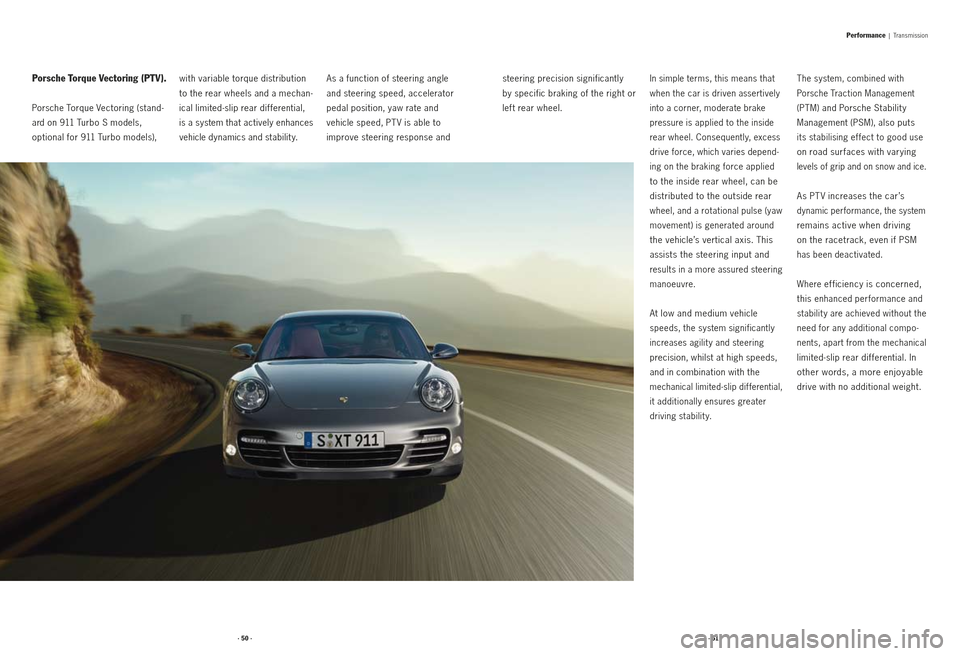
Porsche Torque Vectoring (PTV).
Porsche Torque Vectoring (stand-
ard on 911 Turbo S models,
optional for 911 Turbo models), with variable torque distribution
to the rear wheels and a mechan
-
ical limited-slip rear differential,
is a system that actively enhances
vehicle dynamics and stabilit y. As a function of steering angle
and steering speed, accelerator
pedal position, yaw rate and
vehicle speed, PT V is able to
improve steering response and steering precision significantly
by specific braking of the right or
left rear wheel.
In simple terms, this means that
when the car is driven assertively
into a corner, moderate brake
pressure is applied to the inside
rear wheel. Consequently, excess
drive force, which varies depend -
ing on the braking force applied
to the inside rear wheel, can be
distributed to the outside rear
wheel, and a rotational pulse (yaw
movement) is generated around
the vehicle’s vertical axis. This
assists the steering input and
results in a more assured steering
manoeuvre.
At low and medium vehicle
speeds, the system significantly
increases agilit y and steering
precision, whilst at high speeds,
and in combination with the
mechanical limited-slip differential,
it additionally ensures greater
driving stabilit y. The system, combined with
Porsche Traction Management
(PTM) and Porsche Stabilit y
Management (PSM), also puts
its stabilising ef fect to good use
on road surfaces with varying
levels of grip and on snow and ice.
As PT V increases the car’s
dynamic performance, the system
remains active when driving
on the racetrack, even if PSM
has been deactivated.
Where
efficien cy is concerned,
this
enhanced performance and
stabilit y are achieved without the
need for any additional compo -
nents, apart from the mechanical
limited-slip rear differential. In
other words, a more enjoyable
drive with no additional weight.
Performance | Transmission
· 50 ·· 51 ·
Page 27 of 59

The independent front suspension
combines McPherson-type struts
with longitudinal and transverse
links. Each front wheel is pre-
cisely located, ensuring excellent
handling and directional stabilit y. Proven in motorsport, the rear
axle assembly features multi-link
LSA (Light weight, Stable, Agile)
subframe-based suspension. Its
light weight construction of fers
excellent dynamic properties. The
axle kinematics improves stabilit y
under acceleration by reducing excessive compression. The light
-
weight strut has an aluminium
damper instead of conventional
steel to help improve handling
and agility.
The resulting suspension enables
smooth high -speed manoeuvres
in all road and track scenarios.
Pitch and roll are reduced to a
minimum, as are t yre noise and
vibration. The car offers excep -
tionally high levels of stabilit y.
Porsche Active Suspension
Management (PASM).
Included as standard equipment,
Porsche Active Suspension
Management (PASM) is an elec -
tronic active damping system.
It of fers continuous adjustment of
the damping force on each wheel,
based on current road conditions
and driving st yle.
At the press of a but ton, the
driver can choose bet ween t wo modes. While ‘Normal’ mode
provides a blend of performance
and comfort, the ‘Sport ’ setup
mode has a much firmer range of
set tings. The system responds
to changing road conditions and/
or driving st yle by continuously
varying the individual damping
forces within the parameters
defined for the selected setup
mode (‘Normal’ or ‘Sport ’).
Pitch and roll are reduced, whilst
contact of each wheel with the
road is optimised.
What’s the advantage of being well-balanced?
Not letting the smallest thing bother you.
Chassis.
Perhaps the most efficient
way of overcoming everyday
obstacles is to rely on one’s
own experience. No one
knows that better than our
own chassis engineers.
Front axle (911 Turbo) Rear axle (911 Turbo)
Performance | Chassis
· 52 ·· 53 ·
Page 29 of 59

Porsche Stability Management
(PSM).
PSM, an automatic vehicle sta-
bilit y control system designed to
aid the driver in critical road
scenarios, is fit ted as standard.
Sensors monitor the direction,
speed, yaw velocit y (speed of
rotation around the vertical axis)
and lateral acceleration of the car.
Using this information, it is
possible to calculate the actual
direction of travel at any given
moment. If the car begins to over -
steer or understeer, PSM applies
selective braking on individual
wheels to restore stabilit y and
optimum speed. Whenever PSM is
required to intervene, an indicator
light in the cockpit flashes.
When accelerating on wet or other
low-grip surfaces, PSM combines
with PTM and uses the automatic
brake differential (ABD) and anti-
slip regulation (ASR) functions to
maintain traction and stabilit y.
Included as standard equipment,
PSM assists with high -precision
inputs that enhance the agilit y of
each model. When ‘Sport ’ mode is selected on the Sport Chrono
Package Turbo with dynamic
engine mount system (page 58),
the PSM threshold is raised
higher still to enable greater
driver involvement – particularly
at speeds of up to 70 km/ h
(44 mph).
PSM includes ABS to help mini -
mise braking distances. System
inputs are smooth and precise
for greater driver comfort.
Active safet y is further enhanced
with the aid of t wo additional
brake functions: electronic brake
prefill and brake assist.
The prefill function is automati-
cally enabled whenever the
throt tle pedal is suddenly released.
The pressure in the brake lines
is marginally increased, bringing
each of the pads into light contact
with the corresponding disc. If
the driver then decides to use the
brakes, the system can apply
the maximum force with virtually
no delay.
The brake assist function, by
contrast, is specifically designed
for use in emergency stops.
When the speed of brake pedal
application and the pressure on
the brake pedal exceed a prede -
fined threshold, the hydraulics
automatically apply the necessary
pressure to achieve maximum
deceleration. For a more actively involved
driving experience, PSM can be
manually disabled. PSM remains
present in the background and
will only intervene under heav y
braking where at least one front
wheel requires ABS assistance
(in ‘Sport ’ mode, if both front
wheels require assistance). The
automatic brake differential
(ABD) remains active at all times.
Vehicle yaw
Car steers of f line
Vehicle yaw
Car steers of f line PSM corrects
direction and
stabilises car
PSM corrects
direction and
stabilises carOversteer without PSM
Oversteer with PSM
Understeer with PSM
Understeer without PSM
Performance | Chassis
· 56 ·· 57 ·
Page 30 of 59

Sport Chrono Package Turbo
with dynamic engine mount
system.
The Sport Chrono Package Turbo
with dynamic engine mount
system is standard on 911 Turbo S
models and available as an
option for 911 Turbo models.
This integrated system provides
simultaneous enhancement for
engine, chassis and transmission.
Key features include a digital
and analogue stopwatch on the
dashboard, a performance dis -
play, a personal memor y function
in the Porsche Communication
Management (PCM), the SPORT
but ton and – in combination with
PDK – the SPORT PLUS but ton,
and an additional display on the
steering wheel which informs the
driver if the SPORT but tons and Launch Control have been acti
-
vated. The 911 Turbo models
additionally of fer the ‘overboost ’
function. This is how it works:
When ‘Sport ’ mode is selected,
the engine management system
creates a much more aggressive
response to pedal inputs. To do
this, it implements an alternative
throt tle map which relates the
pedal position in the foot well to
a wider angle of opening in the
throt tle body. In higher gears, it
uses a hard rev- limiter to protect
the engine under power.
In the 911 Turbo models, under
full acceleration, the maximum
boost pressure in the lower and
medium speed ranges is now
temporarily increased by approx -
imately 0.2 bar. As a result,
engine torque is boosted by 50 Nm to a maximum of 700 Nm for a
limited period. (The 911 Turbo S
models are configured to operate
with a higher boost pressure level,
which means that their maximum
torque is always 700 Nm.)
In addition to the engine, ‘Sport ’
mode is enabled in the standard
Porsche Active Suspension
Management (PASM) suspension.
The dampers become firmer,
enabling faster turn - in as well as
bet ter contact with the road.
In automatic mode of PDK,
the basic gearshif t pat tern is
switched to high-performance
mode. The gear change action is
virtually instantaneous, while the
shift points are timed for maxi -
mum acceleration. Lif t of f the
throt tle – even at high revs – and
the system automatically shif ts
down to apply engine braking. In
manual shif t mode, gear chang -
ing is faster and more dynamic.
Porsche Stabilit y Management
(PSM) is also adapted, with the
intervention threshold raised. As
a result, the car has a more natu -
ral response to lateral and longi -
tudinal forces. Cornering agilit y
is greatly enhanced, when both braking to turn in and applying
power on exit – particularly
in low-speed bends. For even
greater driving pleasure.
For maximum manoeuvrabilit y,
PSM can be partially disabled
while the car is still in ‘Sport ’
mode. PSM simply monitors the
forces acting on the car and
will only intervene in the most
critical scenarios, e.g. when ABS
assistance is required on both
front wheels.
In conjunction with PDK (standard
on 911 Turbo S models), the
Sport Chrono Package Turbo with
dynamic engine mount system
has t wo additional functions that can be activated via the SPORT
PLUS but ton, for a sport y drive
that borders on a motorsport
experience.
The first function is ‘Launch
Control’, which, for example
when per forming laps, helps you
achieve optimum acceleration
from a standing start, a racing
start in other words.
The function works like this:
press the SPORT PLUS but ton
when the transmission is in ‘D’
or ‘M’. Then, with your lef t foot,
press the brake pedal and accel -
erate fully with the right foot.
The car recognises ‘Launch’ mode
from the accelerator kickdown action and adjusts the engine
speed to the optimum level,
which is around 5,000 rpm. At
the same time, boost pressure
is increased to approximately
0.5 bar, engine torque is
increased and the clutch is
applied lightly. ‘Launch Control’
now appears in the steering
wheel display. Now release the
brake as quickly as you can –
and feel the acceleration power
unleashed to the road.
Steering wheel display with PDK and Sport Chrono Package Turbo
Performance | Chassis
· 58 ·· 59 ·