2009 PONTIAC G6 DIC
[x] Cancel search: DICPage 128 of 410

4. The hardtop switch is located on the headliner .
To lower the hardtop, press and hold the switch
rearward until the cycle is complete.The windows and trunk lid will open. The hardtop will
automatically lower, and the trunk lid will close and latch.
If the engine is on, a chime will sound when the hardtop
has lowered completely. The Driver Information Center
(DIC) will display TOP MOVE COMPLT. SeeDIC
Warnings and Messages on page 3-46for more
information.
After the hardtop has lowered completely, release the
switch. If you continue to press the switch for about
two seconds after the hardtop has completely lowered,
the windows will automatically close.
2-46
Page 129 of 410

If pressure is released from the switch before the
hardtop cycle is complete, the cycle will stop and the
Driver Information Center (DIC) will display the TOP
NOT SECURE message. Always press and hold the
switch until a chime sounds, if the engine is on, and the
Driver Information Center (DIC) displays the TOP MOVE
COMPLT to signal the procedure is complete. SeeDIC
Warnings and Messages on page 3-46for more
information.
The hardtop will not operate if the vehicle has an
electrical failure. If an electrical failure occurs, see
your dealer/retailer for service.
If your vehicle has an electrical failure while operating
the hardtop, and must be towed to a dealer/retailer for
service, your vehicle should be towed by atbed with the
vehicle facing backwards. Consult your dealer/retailer or
professional towing service if you need to have your
disabled vehicle towed. SeeRoadside Assistance
Program on page 7-7.Raising the Retractable Hardtop
1. Park on a level surface, and shift the transmission
into (P) Park. The vehicle must be in (P) Park,
and the engine must be running, or the ignition
turned to the ON/RUN position, to operate
the retractable hardtop.
2. The trunk cargo cover must be fully closed, and the
trunk must be closed before raising the hardtop.
2-47
Page 131 of 410

As the switch is being pulled, the hardtop will raise from
the trunk and move into place. The hardtop and trunk lid
will close and latch. If the engine is on, a chime will sound
when the hardtop has raised completely.
The Driver Information Center (DIC) will display the
TOP MOVE COMPLT message to signal the procedure
is complete. SeeDIC Warnings and Messages on
page 3-46for more information.After the hardtop has raised completely, release the
switch. If you continue to pull the switch for about
two seconds after the hardtop has raised completely,
the windows will automatically close.
If the switch is released before the hardtop cycle is
complete, the cycle will stop and the Driver Information
Center (DIC) will display the TOP NOT SECURE
message. Always pull and hold the switch until a chime
sounds, if the engine is on, and the Driver Information
Center (DIC) displays the TOP MOVE COMPLT to signal
the procedure is complete. SeeDIC Warnings and
Messages on page 3-46for more information.
The hardtop will not operate if the vehicle has an
electrical failure. If an electrical failure occurs, see
your dealer/retailer for service.
If your vehicle must be towed to a dealer/retailer for
service, your vehicle should be towed by atbed with the
vehicle facing backwards. Consult your dealer/retailer
or professional towing service if you need to have your
disabled vehicle towed. SeeRoadside Assistance
Program on page 7-7.
2-49
Page 133 of 410
Instrument Panel Overview...............................3-4
Hazard Warning Flashers................................3-6
Horn .............................................................3-6
Tilt Wheel.....................................................3-6
Turn Signal/Multifunction Lever.........................3-7
Turn and Lane-Change Signals........................3-7
Headlamp High/Low-Beam Changer..................3-8
Flash-to-Pass.................................................3-8
Windshield Wipers..........................................3-8
Windshield Washer.........................................3-9
Cruise Control..............................................3-10
Headlamps..................................................3-13
Headlamps on Reminder................................3-13
Headlamps Off in Park..................................3-14
Delayed Headlamps......................................3-14
Daytime Running Lamps (DRL).......................3-14
Automatic Headlamp System..........................3-15
Fog Lamps ..................................................3-15
Instrument Panel Brightness...........................3-16
Courtesy Lamps...........................................3-16
Dome Lamps ...............................................3-16
Entry/Exit Lighting.........................................3-16
Parade Dimming...........................................3-17
Reading Lamps............................................3-17
Trunk Lamp.................................................3-17
Electric Power Management...........................3-17
Battery Run-Down Protection..........................3-18Accessory Power Outlet(s).............................3-19
Climate Controls............................................3-20
Climate Control System.................................3-20
Automatic Climate Control System...................3-24
Outlet Adjustment.........................................3-28
Warning Lights, Gages, and Indicators............3-28
Instrument Panel Cluster................................3-29
Speedometer and Odometer..........................
.3-30
Trip Odometer..............................................3-30
Tachometer.................................................3-30
Safety Belt Reminders...................................3-31
Airbag Readiness Light..................................3-32
Passenger Airbag Status Indicator...................3-33
Charging System Light..................................3-34
Brake System Warning Light..........................3-34
Antilock Brake System (ABS) Warning Light.....3-35
Traction Control System (TCS)
Warning Light...........................................3-36
Traction Control System (TCS)
Active Light..............................................3-36
StabiliTrak
®Not Ready Light..........................3-36
StabiliTrak®Indicator Light.............................3-36
Engine Coolant Temperature Gage..................3-37
Tire Pressure Light.......................................3-37
Malfunction Indicator Lamp.............................3-38
Oil Pressure Light.........................................3-40
Section 3 Instrument Panel
3-1
Page 134 of 410

Security Light...............................................3-41
Cruise Control Light......................................3-41
Highbeam On Light.......................................3-41
Fuel Gage...................................................3-42
Low Fuel Warning Light.................................3-42
Driver Information Center (DIC).......................3-42
DIC Operation and Displays...........................3-43
DIC Warnings and Messages.........................3-46
DIC Vehicle Personalization............................3-50Audio System(s).............................................3-52
Setting the Clock..........................................3-53
Radio(s)......................................................3-54
XM Radio Messages.....................................3-66
Theft-Deterrent Feature..................................3-68
Audio Steering Wheel Controls.......................3-68
Radio Reception...........................................3-69
Fixed Mast Antenna......................................3-69
Backglass Antenna.......................................3-70
XM™ Satellite Radio Antenna System.............3-70
Section 3 Instrument Panel
3-2
Page 137 of 410
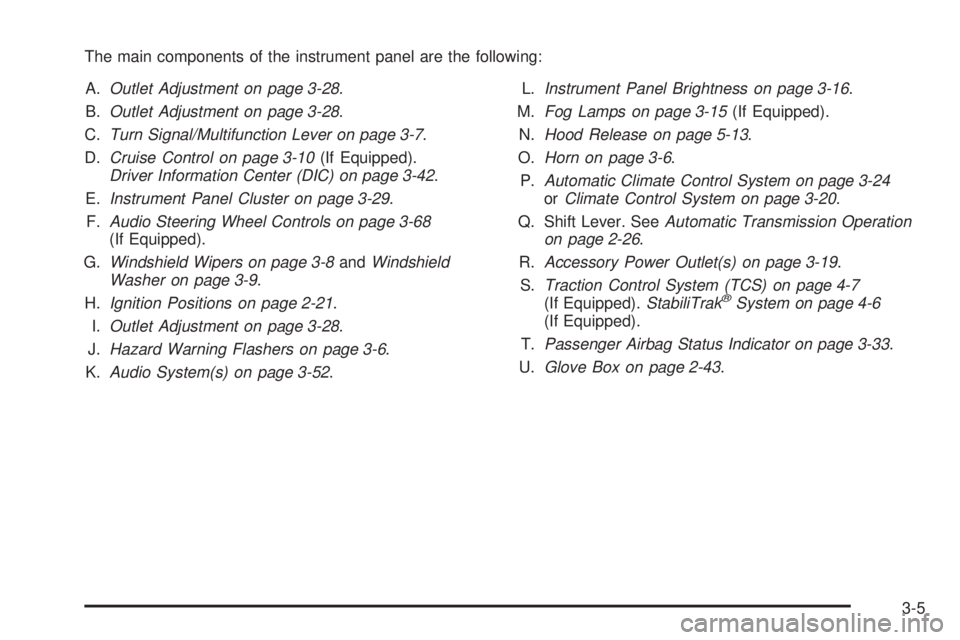
The main components of the instrument panel are the following:
A.Outlet Adjustment on page 3-28.
B.Outlet Adjustment on page 3-28.
C.Turn Signal/Multifunction Lever on page 3-7.
D.Cruise Control on page 3-10(If Equipped).
Driver Information Center (DIC) on page 3-42.
E.Instrument Panel Cluster on page 3-29.
F.Audio Steering Wheel Controls on page 3-68
(If Equipped).
G.Windshield Wipers on page 3-8andWindshield
Washer on page 3-9.
H.Ignition Positions on page 2-21.
I.Outlet Adjustment on page 3-28.
J.Hazard Warning Flashers on page 3-6.
K.Audio System(s) on page 3-52.L.Instrument Panel Brightness on page 3-16.
M.Fog Lamps on page 3-15(If Equipped).
N.Hood Release on page 5-13.
O.Horn on page 3-6.
P.Automatic Climate Control System on page 3-24
orClimate Control System on page 3-20.
Q. Shift Lever. SeeAutomatic Transmission Operation
on page 2-26.
R.Accessory Power Outlet(s) on page 3-19.
S.Traction Control System (TCS) on page 4-7
(If Equipped).StabiliTrak
®System on page 4-6
(If Equipped).
T.Passenger Airbag Status Indicator on page 3-33.
U.Glove Box on page 2-43.
3-5
Page 141 of 410

x(Delay):While the lever is in the intermittent
position, turn the intermittent adjust band with this
symbol on it up or down to select a shorter or longer
delay between wiping cycles. To the left of the adjust
band are bars, increasing in size from bottom to top,
that indicate the frequency of the wipes. Smaller
bars mean the wipers movement is less frequent.
Larger bars mean the movement is more frequent.
6(Low Speed):For steady wiping at low speed.
1(High Speed):For wiping at a high speed.
8(Mist):Move the lever all the way down for a single
wiping cycle. Hold it there until the windshield wipers
start; then release. The wipers stop after one wiping
cycle. Hold the lever down longer, for more wipe cycles.
Clear ice and snow from the wiper blades before
using them.
If the wiper blades are frozen to the windshield, carefully
loosen or thaw them. If they become damaged, install
new blades.
Heavy snow or ice can overload the wiper motor.
A circuit breaker stops the motor until it cools. If the
motor gets stuck, turn the wipers off, clear away
the snow or ice, and then turn the wipers back on.As an added safety feature, if the wipers are on for
more than 15 seconds, the vehicle’s headlamps turn on
automatically. They turn off 15 seconds after the
wipers are turned off.
Windshield Washer
Press the button at the end of the windshield wiper
lever until the washers begin.
{CAUTION:
In freezing weather, do not use your washer until
the windshield is warmed. Otherwise the washer
uid can form ice on the windshield, blocking your
vision.
When the button is released, the washers stop, but the
wipers continue to wipe about three times or resume
the previous speed.
3-9
Page 143 of 410

J(On/Off):Press this button to turn the cruise
control system on and off.
RES+ (Resume):Press this button to resume a set
speed and to accelerate the speed.
SET−(Set):Press this button to set a speed and to
decrease the speed.
[(Cancel):Press this button to cancel cruise control.
To set a speed do the following:
1. Press the on/off symbol to turn cruise control on.
The indicator light on the button comes on.
2. Get to the speed you want.
3. Press the SET−symbol and release it. The cruise
symbol displays in the instrument panel cluster to
show the system is engaged.
4. Take your foot off the accelerator pedal.
When the brakes are applied, the cruise control
shuts off.
If the vehicle is in cruise control and the Traction
Control System (TCS) or Enhanced Traction System
(ETS) begins to limit wheel spin, the cruise control
automatically disengages. SeeTraction Control System
(TCS) on page 4-7. When road conditions allow, the
cruise control can be used again.
Resuming a Set Speed
Suppose the cruise control is set at a desired speed
and the brakes are applied. This disengages the cruise
control. The cruise symbol in the instrument panel
cluster also goes out, indicating cruise is no longer
engaged. To return to the previously set speed,
you do not need to go through the set process again.
Once at a speed of about 25 mph (40 km/h) or
more, press the RES+ symbol briey.
This takes the vehicle back up and maintains the
previously chosen speed.
Increasing Speed While Using Cruise
Control
There are two ways to go to a higher speed.
If the cruise control system is already engaged,
press the RES+ symbol. Hold it there until the
speed desired is reached and then release
the button.
To increase the vehicle speed in very small
amounts, press the RES+ symbol briey and then
release it. Each time this is done, the vehicle
goes about 1 mph (1.6 km/h) faster.
3-11