2009 OPEL ZAFIRA winter tyres
[x] Cancel search: winter tyresPage 174 of 228

174
Vehicle careThe jack and the vehicle tools are in
a pouch, secured to the stowage
compartment in the floor of the load
compartment with a rubber strap.
To close the lid, insert the lugs on its
front rim into the recesses and lock
into place. Wheels and tyres
Tyre condition, wheel condition
Drive over edges slowly and at right
angles if possible. Driving over sharp
edges can cause tyre and wheel
damage.
Do not trap tyres on the kerb
when parking.
Regularly check the wheels for
damage. Seek the assistance of
a workshop in the event of damage or
unusual wear.
Tyres
Tyres of size 225/45 R 17 are only
permitted if the vehicle is equipped
with electronic stability program.
Winter tyres
Winter tyres improve driving safety at
temperatures below 7 °C.
Tyres of size 225/40 R 18, 225/40 ZR
18 and 235/35 R 19 must not be used
as winter tyres. Winter tyres may only be used on the
Zafira OPC on special alloy wheels
approved by Opel.
Run-flat winter tyres may only be
used on factory approved alloy
wheels.
In accordance with country-specific
regulations, affix the speed sticker in
the driver's field of view.
Run-flat tyres
Run-flat tyres have reinforced, self-
supporting sidewalls, which ensure
that the tyres always have a certain
amount of driveability, even when
there is no pressure.
Run-flat tyres are only permitted on
vehicles with electronic stability
program
and tyre pressure monitoring
system or deflation detection system. Caution
Check tyre pressures regularly
even if run-flat tyres are fitted.
Page 176 of 228

176
Vehicle careOn vehicles with tyre pressure
monitoring
system, screw the adapter
to the valve.
Tyre pressure 3 220 and on the label
on the inside of the fuel filler flap.
The tyre pressure data refer to cold
tyres. It applies to summer and winter
tyres.
Always inflate the spare wheel to the
pressure specified for full load.
The ECO tyre pressure serves to
achieve the smallest amount of fuel
consumption possible. It must not be
used with run-flat tyres. Incorrect tyre pressures will impair
safety, vehicle handling, comfort and
fuel economy and will increase tyre
wear.
9
Warning If the pressure is too low, this can
result in considerable tyre warm-
up
and internal damage, leading to
tread separation and even to tyre
blow-out at high speeds. Tyre pressure monitoring
system
The tyre pressure monitoring system
continually checks the pressure of all
four wheels when vehicle speed
exceeds a certain limit.
All wheels must be equipped with
pressure sensors and the tyres must
have the prescribed pressure.
Otherwise, the tyre pressure will be
monitored by the deflation detection
system 3 177.
The current tyre pressures can be
shown in the Info-Display
3 107. Vehicle messages, tyre pressure
3 101.
Control indicator
w 3 90.
If a complete set of wheels without
sensors is mounted (e.g. four winter
tyres), no error message will be
displayed. The tyre pressure
monitoring system is not operational.
Retrofitting of sensors is possible.
The use of commercially available
liquid tyre repair kits can impair the
function of the system. Factory
approved systems can be used.
External high-power radio equipment
could disrupt the tyre pressure
monitoring system.
Page 177 of 228
Vehicle care
177
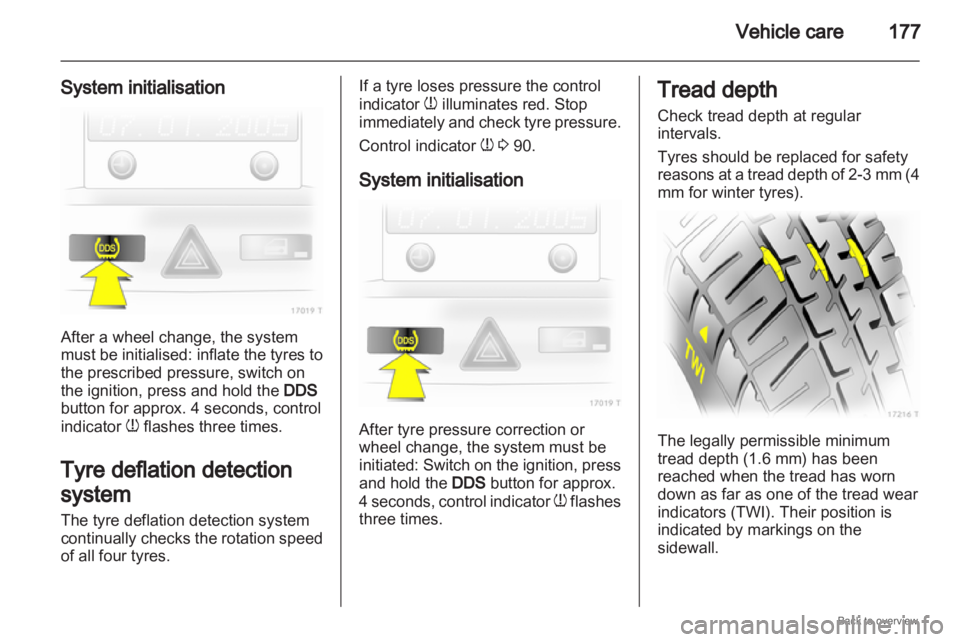
System initialisation After a wheel change, the system
must
be initialised: inflate the tyres to
the prescribed pressure, switch on
the ignition, press and hold the DDS
button for approx. 4 seconds, control
indicator w flashes three times.
Tyre deflation detection
system
The tyre deflation detection system
continually checks the rotation speed
of all four tyres. If a tyre loses pressure the control
indicator
w illuminates red. Stop
immediately
and check tyre pressure.
Control indicator w 3 90.
System initialisation After tyre pressure correction or
wheel change, the system must be
initiated:
Switch on the ignition, press
and hold the DDS button for approx.
4 seconds, control indicator w flashes
three times. Tread depth
Check tread depth at regular
intervals.
Tyres should be replaced for safety
reasons
at a tread depth of 2-3 mm (4
mm for winter tyres). The legally permissible minimum
tread depth (1.6 mm) has been
reached when the tread has worn
down as far as one of the tread wear
indicators (TWI). Their position is
indicated by markings on the
sidewall.
Page 183 of 228

Vehicle care
183
3. Ensure the jack is positioned correctly with the vehicle jacking
points. 4. Set the jack to the necessary
height before positioning it directly
below the jacking point in
a manner that prevents it from
slipping. Attach jack handle and with the
jack correctly aligned rotate
handle until wheel is clear of the
ground.
5.
Unscrew the wheel bolts.
6. Change the wheel.
7. Screw in the wheel bolts.
8. Lower vehicle.
9. Install the wheel wrench ensuring that it locates securely and tighten
each bolt in a crosswise
sequence. Tightening torque is
110 Nm.
10. Align the valve hole in the wheel cover with the tyre valve before
installing. Install wheel bolt caps.
11.
Stow the replaced wheel 3 179
and the vehicle tools 3 173.
12. Check the tyre pressure of the installed tyre and also the wheel
bolt torque as soon as possible.
Have the defective tyre renewed or
repaired.
Spare wheel
The spare wheel can be classified as
a temporary spare wheel depending
on the size compared to the other
mounted wheels and country
regulations.
The spare wheel has a steel rim.
Use of a spare wheel that is smaller
than the other wheels or together with
winter tyres could affect driveability.
Have the defective tyre replaced as
soon as possible.
Page 190 of 228
190
Vehicle care
Clean smearing wiper blades with
a soft cloth and window cleaner.
Moonroof
Never
clean with solvents or abrasive
agents, fuels, aggressive media (e.g.
paint cleaner, acetone-containing
solutions etc.), acidic or highly
alkaline media or abrasive pads. Do
not apply wax or polishing agents to
the middle part of the moonroof.
Wheels and tyres
Do not use high-pressure jet
cleaners.
Clean rims with a pH-neutral wheel
cleaner.
Rims are painted and can be treated
with the same agents as the body.
Paintwork damage
Rectify minor paintwork damage with
a touch-up pen before rust forms.
Have more extensive damage or rust
areas repaired by a workshop. Underbody
Some
areas of the vehicle underbody
have a PVC undercoating while other
critical areas have a durable
protective wax coating.
After the underbody is washed, check
the underbody and have it waxed if
necessary.
Bitumen/rubber materials could
damage the PVC coating. Have
underbody work carried out by
a workshop.
Before and after winter, wash the
underbody and have the protective
wax coating checked.
Engine compartment
Areas of the engine compartment that
are painted in the same colour as the
vehicle must be looked after like any
other painted surface.
It is advisable to wash the engine
compartment before and after winter
and preserve it with wax. Protect the
alternator and brake fluid reservoir
with plastic sheets before washing
the engine. When washing the engine with
a steam-jet cleaner, do not direct the
steam jet towards components of the
antilock brake system, air
conditioning system or the belt drive
and its components.
After
an engine wash, have all engine
room components preserved
thoroughly by a workshop using
protective wax.
Do not use high-pressure jet
cleaners.
Natural gas system
Do not direct the steam jet or high-
pressure jet towards natural gas
system components. It is particularly
important to protect the natural gas
tank and the pressure valves on the
vehicle underbody and the bulkhead
in the engine compartment.
These components must not be
treated using chemical cleaners or
preservatives.
Have components of the natural gas
system cleaned by a workshop
authorised to carry out maintenance
of natural gas vehicles.
Page 221 of 228
![OPEL ZAFIRA 2009 Owners Manual Technical data
221
Comfort with up to 3 people ECO with up to 3 people With full load
Engine Tyres front
rearfrontrearfrontrear
[kPa/bar] [kPa/bar] [kPa/bar] [kPa/bar] [kPa/bar] [kPa/bar]
Z20LER 205/5](/manual-img/37/58241/w960_58241-220.png "OPEL ZAFIRA 2009 Owners Manual Technical data
221
Comfort with up to 3 people ECO with up to 3 people With full load
Engine Tyres front
rearfrontrearfrontrear
[kPa/bar] [kPa/bar] [kPa/bar] [kPa/bar] [kPa/bar] [kPa/bar]
Z20LER 205/5")
Technical data
221
Comfort with up to 3 people ECO with up to 3 people With full load
Engine Tyres front
rearfrontrearfrontrear
[kPa/bar] [kPa/bar] [kPa/bar] [kPa/bar] [kPa/bar] [kPa/bar]
Z20LER 205/55 R 16,
250/2.5 230/2.3 – –260/2.6 310/3.1
225/45 R 17 225/40 R 18 260/2.6 240/2.4 – – 280/2.8 320/3.2
Z20LEH
205/50 R 17
3)
250/2.5 230/2.3 – –270/2.7 320/3.2
225/45 R 17 3)
4)
,
225/40 ZR 18,
235/35 R 19 225/40 R 18
5) 260/2.6 240/2.4 – – 280/2.8 320/3.2
3)
Only permitted as winter tyres.
4) For a correct speed display reprogramme the speedometer.
5) For Russia only.
Page 228 of 228

228
Vehicle messages
.....................100
Vehicle specific data ...................... 3
Vehicle storage ........................... 154
Vehicle unlocking
........................... 6
Vehicle weight ........................... 216
Ventilation ................................... 118
W
Warning chimes .........................100
Warning triangle .......................... 74
Washer and wiper systems .........14
Washer fluid ............................... 158
Washer fluid level ......................102
Wheel changing .........................182
Wheel covers ............................. 178
Wheels and tyres ....................... 174
Windscreen wiper/washer ...........78
Winter mode ................................ 89
Winter tyres ............................... 174
Wiper blade replacement ..........159
X
Xenon headlights .......................163