2009 OPEL ZAFIRA fuel pressure
[x] Cancel search: fuel pressurePage 11 of 228

In brief
11
Instrument panel overview
1 Light switch ........................ 108
Instrument illumination .......113
Rear fog light
....................... 112
Front fog lights ...................111
Headlight range
adjustment ......................... 109
2 Side air vents ...................... 124
3 Turn signals, headlight
flash, low beam and high
beam .................................. 111
Exit lighting .......................... 114
Parking light ........................ 112
Cruise control ....................... 93
4 Remote control on
steering wheel ......................77
5 Horn ...................................... 78
Driver's airbag ....................... 58
6 Instruments .......................... 83
7 Windscreen wipers,
windscreen washer
system, headlight washer
system .................................. 78
8 Centre air vents ................... 124 9
Left heated seat ....................49
Deflation detection system ..177
Tyre pressure monitoring
system
................................. 176
Ultrasonic parking sensors ... 89
Hazard warning flashers .....111
Central locking system ..........32
Sport mode ........................... 89
Right heated seat ..................49
Fuel selector ........................ 84
10 Info-Display ........................... 93
Trip computer ...................... 102
Electronic climate control
system ................................. 121
11 Front passenger airbag .........58
12 Glovebox .............................. 67
13 Infotainment system ............115
14 Climate control system ........ 118
15 Selector lever, manual
transmission ....................... 136
Manual transmission
automated ........................... 136
Automatic transmission .......131
16 Ashtray .................................. 82
17 Start/Stop button ..................29
18 Accelerator pedal ................127 19
Ignition switch with
steering wheel lock .............128
Sensor panel for
emergency operation of
Open&Start system ...............29
20 Brake pedal ......................... 140
21 Clutch pedal ........................ 127
22 Steering wheel adjustment ...77
23 Bonnet release lever ...........155
Page 32 of 228

32
Keys, doors and windowsTo replace the battery, press the
locking mechanism and remove the
cap by applying light pressure. Press
the cap on the other side outward.
Replace the battery (battery type CR
20
32), noting the installation position.
Engage caps.
Radio remote control
synchronisation
The radio remote control
synchronises itself automatically
during every starting procedure. Fault
If the central locking cannot be
operated or the engine cannot be
started, the cause may be one of the
following:
■
Fault in remote control 3 28,
■ electronic key out of reception range.
To rectify the cause of the fault,
change the position of the electronic
key.
Central locking system
Unlocks and locks doors, load
compartment and fuel filler flap.
A pull on an interior door handle
unlocks the entire vehicle and opens
the door.
Note
In the event of an accident of
a certain severity, the vehicle
unlocks automatically. Unlocking
Radio remote control
Press button q.
Page 84 of 228
84
Instruments and controls
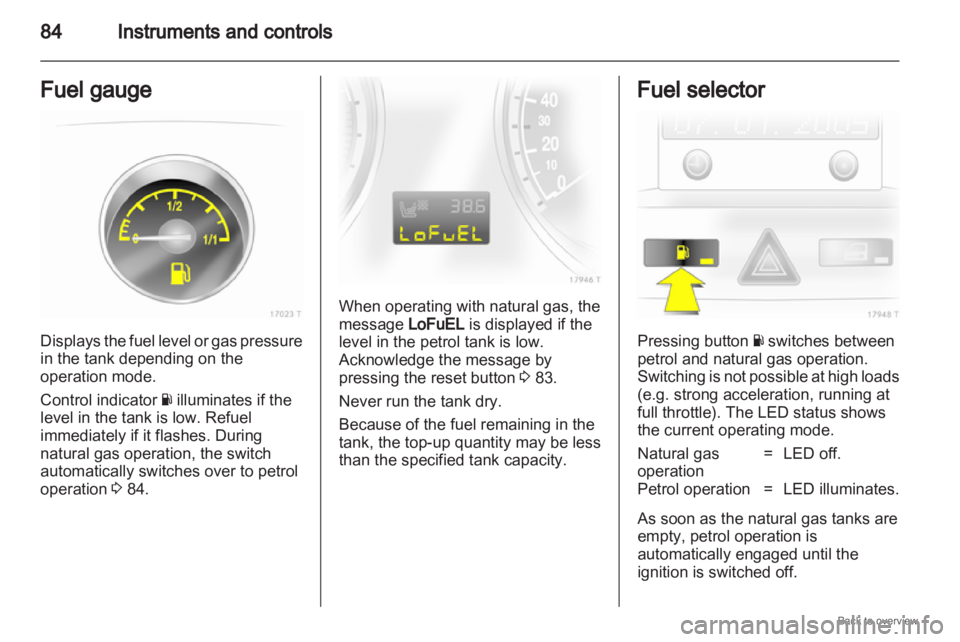
Fuel gauge Displays the fuel level or gas pressure
in the tank depending on the
operation mode.
Control indicator
Y illuminates if the
level in the tank is low. Refuel
immediately if it flashes. During
natural gas operation, the switch
automatically switches over to petrol
operation 3 84. When operating with natural gas, the
message LoFuEL is displayed if the
level in the petrol tank is low.
Acknowledge the message by
pressing the reset button
3 83.
Never run the tank dry.
Because of the fuel remaining in the
tank, the top-up quantity may be less
than the specified tank capacity. Fuel selector
Pressing button
Y switches between
petrol and natural gas operation.
Switching
is not possible at high loads
(e.g. strong acceleration, running at
full throttle). The LED status shows
the current operating mode.
Natural gas
operation = LED off.
Petrol operation = LED illuminates.
As soon as the natural gas tanks are
empty, petrol operation is
automatically engaged until the
ignition is switched off.
Page 91 of 228

Instruments and controls
91
Interactive Driving System,
Continuous Damping
Control, SPORT-mode
IDS+ illuminates yellow.
Illuminates for approximately 10
seconds after the driver's door is
opened. Illumination whilst driving
indicates a fault in the system. The
system
switches to the harder chassis
setting for reasons of safety. Have the
cause of the fault remedied by
a workshop.
IDS Plus
3 143, CDC 3 143, SPORT
mode 3 143.
Engine oil pressure
I illuminates red.
It illuminates when the ignition is
switched on and goes out shortly after
the engine starts. Illuminates when the engine is
running
Caution
Engine lubrication may be
interrupted. This may result in
damage to the engine and/or
locking of the drive wheels.
1. Depress clutch.
2.
Select neutral gear, set selectorlever to N .
3. Move out of the flow of traffic as quickly as possible without
impeding other vehicles.
4. Switch off ignition. 9
Warning When the engine is off,
considerably
more force is needed
to brake and steer.
Do not remove key until vehicle
has come to a standstill, otherwise
the steering column lock could
engage unexpectedly. Seek the assistance of a workshop.
Low engine oil level
S
illuminates yellow.
Engine oil level is checked
automatically.
Illuminates when the engine is
running
Low
engine oil level. Check engine oil
level and top up as necessary
3 156.
Low fuel
Y illuminates or flashes yellow.
Illuminated
Level in fuel tank too low.
Flashes
Fuel used up. Refuel immediately.
Never run the tank dry.
Catalytic converter 3 130.
Bleeding the diesel fuel system
3 159.
Page 101 of 228

Instruments and controls
101
Brake light switch
Brake light does not come on during
braking. Have the cause of the fault
remedied immediately by
a workshop.
Engine cooling level Low fluid level in engine cooling
system. Check coolant immediately
3 157. Drain diesel fuel filter
If
there is water in the diesel fuel filter,
the message InSP4 appears in the
instrument panel. Consult
a workshop.
Lighting
Important exterior lighting lamps,
including cables and fuses, are
monitored. In trailer mode, trailer
lighting is also monitored. Trailers
with LED lighting must have an
adapter that enables lamp monitoring
as with conventional bulbs. The failed lighting will be indicated in
the information display or the
message InSP2 will appear in the
instrument panel display.
Anti-theft alarm system
System fault in anti-theft alarm
system. Have the cause of the fault
remedied by a workshop.
Tyre pressure On vehicles with tyre pressure
monitoring
system, if there is low tyre
pressure, information on which tyre to
check appears on the display.
Page 148 of 228
148
Driving and operating
The fuel filler cap can be retained in
the bracket on the fuel filler flap. Caution
Wipe off any overflowing fuel
immediately.
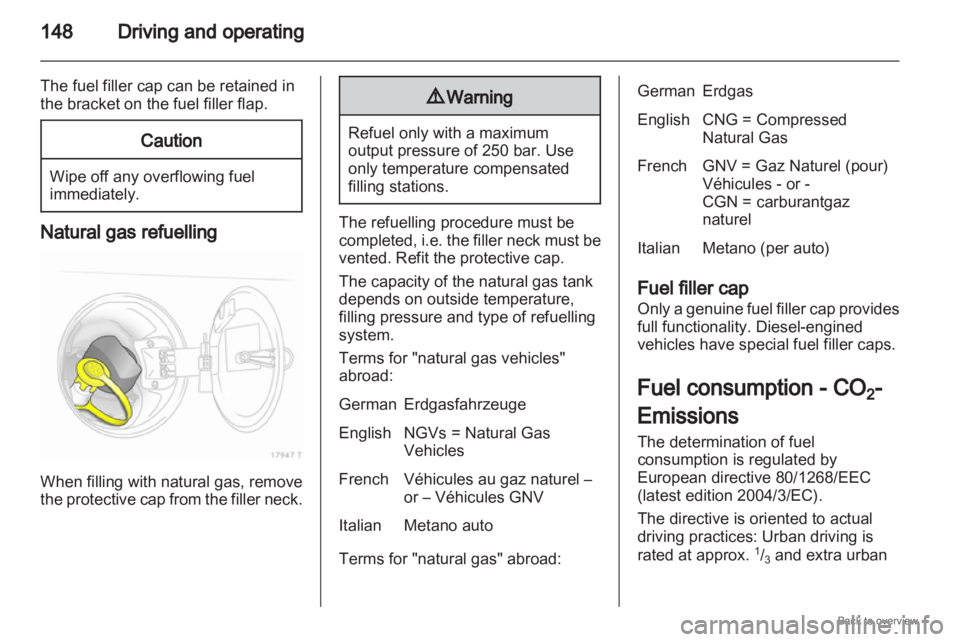
Natural gas refuelling
When filling with natural gas, remove
the
protective cap from the filler neck. 9
Warning Refuel only with a maximum
output pressure of 250 bar. Use
only temperature compensated
filling stations.
The refuelling procedure must be
completed,
i.e. the filler neck must be
vented. Refit the protective cap.
The capacity of the natural gas tank
depends on outside temperature,
filling pressure and type of refuelling
system.
Terms for "natural gas vehicles"
abroad:
German Erdgasfahrzeuge
English NGVs = Natural Gas Vehicles
French Véhicules au gaz naturel – or – Véhicules GNV
Italian Metano auto
Terms for "natural gas" abroad: German Erdgas
English CNG = Compressed
Natural Gas
French GNV = Gaz Naturel (pour) Véhicules - or -
CGN = carburantgaz
naturel
Italian Metano (per auto)
Fuel filler cap
Only
a genuine fuel filler cap provides
full functionality. Diesel-engined
vehicles have special fuel filler caps.
Fuel consumption - CO 2-
Emissions
The determination of fuel
consumption is regulated by
European directive 80/1268/EEC
(latest edition 2004/3/EC).
The directive is oriented to actual
driving practices: Urban driving is
rated at approx. 1
/3 and extra urban
Page 175 of 228
Vehicle care
175
Depending on tyre manufacturer, run-
flat tyres can be identified from
a marking on the tyre wall. E.g. ROF
= RunonFlat for Goodyear or SSR
= Self Supporting Runflat Tyre for
Continental.
Use of run-flat tyres is only permitted
in combination with factory approved
alloy wheels.
Do not use a tyre repair kit.
The ECO tyre pressure must not be
used.
Run-flat tyres must not be combined
with standard tyres.
If converting to standard tyres, note
that the vehicle is not equipped with
a spare wheel or tyre repair kit.
Driving with a damaged tyre
A
loss in tyre pressure is indicated by
the tyre pressure monitoring system
or the deflation detection system.
If a tyre has no pressure, continued
driving is possible
■ at a speed of max. 80 km/h
■ up to a distance of 80 km 9
Warning The vehicle will be more difficult to
steer and handle. Braking
distance will be longer.
Adapt driving style and speed to
the changed conditions.
Tyre designations
E.g. 195/65 R 15 91 H
195
=Tyre width, mm
65 =Cross-section ratio (tyre
height to tyre width), %
R = Belt type: Radial
RF =Type: RunFlat
15 =Wheel diameter, inches
91 =Load index e.g. 91 is
equivalent to 618 kg
H = Speed code letter
Speed code letter:
Q = up to 160 km/h
S = up to 180 km/h
T = up to 190 km/h
H = up to 210 km/h
V = up to 240 km/h
W = up to 270 km/h Tyre pressure
Check the pressure of cold tyres at
least every 14 days and before any
long journey. Do not forget the spare
wheel. This also applies to vehicles
with tyre pressure monitoring.
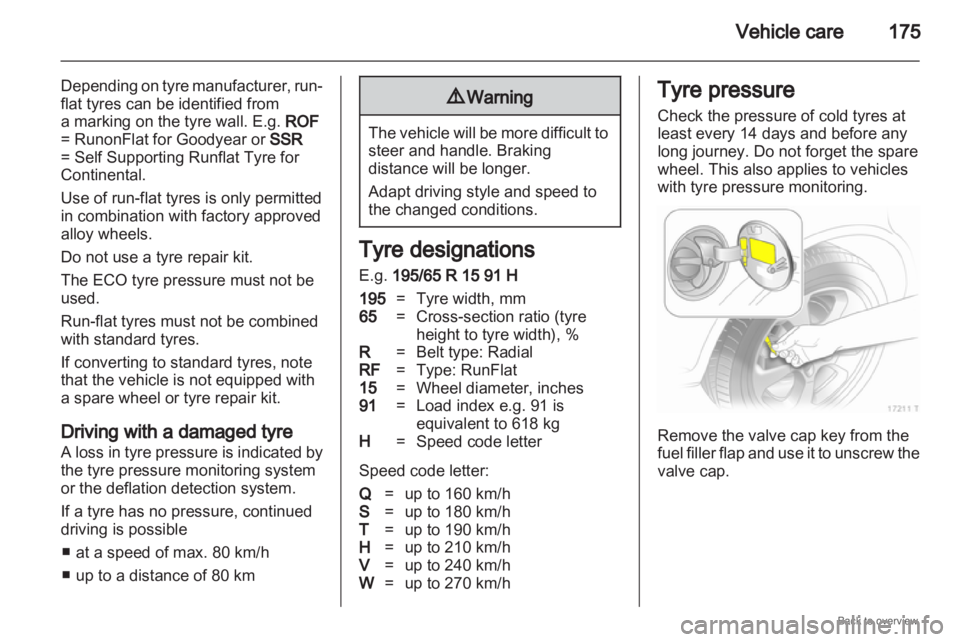
Remove the valve cap key from the
fuel
filler flap and use it to unscrew the
valve cap.
Page 176 of 228

176
Vehicle careOn vehicles with tyre pressure
monitoring
system, screw the adapter
to the valve.
Tyre pressure 3 220 and on the label
on the inside of the fuel filler flap.
The tyre pressure data refer to cold
tyres. It applies to summer and winter
tyres.
Always inflate the spare wheel to the
pressure specified for full load.
The ECO tyre pressure serves to
achieve the smallest amount of fuel
consumption possible. It must not be
used with run-flat tyres. Incorrect tyre pressures will impair
safety, vehicle handling, comfort and
fuel economy and will increase tyre
wear.
9
Warning If the pressure is too low, this can
result in considerable tyre warm-
up
and internal damage, leading to
tread separation and even to tyre
blow-out at high speeds. Tyre pressure monitoring
system
The tyre pressure monitoring system
continually checks the pressure of all
four wheels when vehicle speed
exceeds a certain limit.
All wheels must be equipped with
pressure sensors and the tyres must
have the prescribed pressure.
Otherwise, the tyre pressure will be
monitored by the deflation detection
system 3 177.
The current tyre pressures can be
shown in the Info-Display
3 107. Vehicle messages, tyre pressure
3 101.
Control indicator
w 3 90.
If a complete set of wheels without
sensors is mounted (e.g. four winter
tyres), no error message will be
displayed. The tyre pressure
monitoring system is not operational.
Retrofitting of sensors is possible.
The use of commercially available
liquid tyre repair kits can impair the
function of the system. Factory
approved systems can be used.
External high-power radio equipment
could disrupt the tyre pressure
monitoring system.