2009 OPEL ZAFIRA fuel
[x] Cancel search: fuelPage 11 of 228

In brief
11
Instrument panel overview
1 Light switch ........................ 108
Instrument illumination .......113
Rear fog light
....................... 112
Front fog lights ...................111
Headlight range
adjustment ......................... 109
2 Side air vents ...................... 124
3 Turn signals, headlight
flash, low beam and high
beam .................................. 111
Exit lighting .......................... 114
Parking light ........................ 112
Cruise control ....................... 93
4 Remote control on
steering wheel ......................77
5 Horn ...................................... 78
Driver's airbag ....................... 58
6 Instruments .......................... 83
7 Windscreen wipers,
windscreen washer
system, headlight washer
system .................................. 78
8 Centre air vents ................... 124 9
Left heated seat ....................49
Deflation detection system ..177
Tyre pressure monitoring
system
................................. 176
Ultrasonic parking sensors ... 89
Hazard warning flashers .....111
Central locking system ..........32
Sport mode ........................... 89
Right heated seat ..................49
Fuel selector ........................ 84
10 Info-Display ........................... 93
Trip computer ...................... 102
Electronic climate control
system ................................. 121
11 Front passenger airbag .........58
12 Glovebox .............................. 67
13 Infotainment system ............115
14 Climate control system ........ 118
15 Selector lever, manual
transmission ....................... 136
Manual transmission
automated ........................... 136
Automatic transmission .......131
16 Ashtray .................................. 82
17 Start/Stop button ..................29
18 Accelerator pedal ................127 19
Ignition switch with
steering wheel lock .............128
Sensor panel for
emergency operation of
Open&Start system ...............29
20 Brake pedal ......................... 140
21 Clutch pedal ........................ 127
22 Steering wheel adjustment ...77
23 Bonnet release lever ...........155
Page 26 of 228
26
In brief
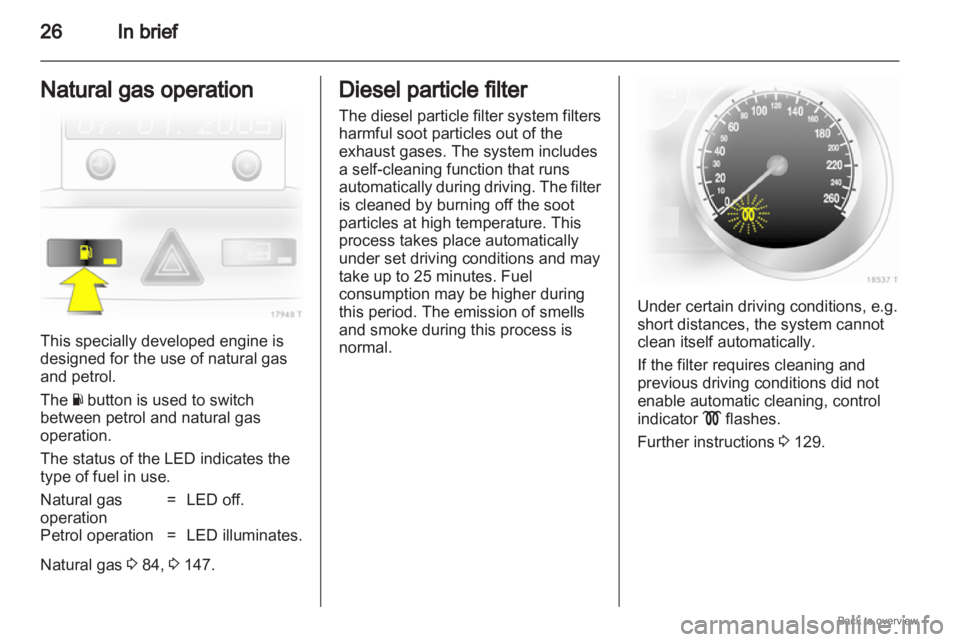
Natural gas operation This specially developed engine is
designed for the use of natural gas
and petrol.
The Y button is used to switch
between petrol and natural gas
operation.
The status of the LED indicates the
type of fuel in use.
Natural gas
operation
= LED off.
Petrol operation = LED illuminates.
Natural gas 3 84, 3 147. Diesel particle filter
The
diesel particle filter system filters
harmful soot particles out of the
exhaust gases. The system includes
a self-cleaning function that runs
automatically during driving. The filter
is cleaned by burning off the soot
particles at high temperature. This
process takes place automatically
under set driving conditions and may
take up to 25 minutes. Fuel
consumption may be higher during
this period. The emission of smells
and smoke during this process is
normal. Under certain driving conditions, e.g.
short distances, the system cannot
clean itself automatically.
If the filter requires cleaning and
previous driving conditions did not
enable automatic cleaning, control
indicator
! flashes.
Further instructions 3 129.
Page 32 of 228

32
Keys, doors and windowsTo replace the battery, press the
locking mechanism and remove the
cap by applying light pressure. Press
the cap on the other side outward.
Replace the battery (battery type CR
20
32), noting the installation position.
Engage caps.
Radio remote control
synchronisation
The radio remote control
synchronises itself automatically
during every starting procedure. Fault
If the central locking cannot be
operated or the engine cannot be
started, the cause may be one of the
following:
■
Fault in remote control 3 28,
■ electronic key out of reception range.
To rectify the cause of the fault,
change the position of the electronic
key.
Central locking system
Unlocks and locks doors, load
compartment and fuel filler flap.
A pull on an interior door handle
unlocks the entire vehicle and opens
the door.
Note
In the event of an accident of
a certain severity, the vehicle
unlocks automatically. Unlocking
Radio remote control
Press button q.
Page 33 of 228

Keys, doors and windows
33
Open&Start system Pull a door handle or press the button
under the tailgate moulding.
The electronic key must be outside
the vehicle, within a range of
approximately one metre.
Locking
Close doors, load compartment and
fuel
filler flap. If the driver's door is not
closed properly, the central locking
system will not work. Radio remote control
Press button p.
Open&Start system Touch the sensor field in the door
handle of one of the front doors.
The electronic key must be outside
the vehicle, within a range of
approximately one metre. The other
electronic key must not be inside the
vehicle.
2 seconds must pass before the
vehicle can be unlocked. Within this
time, it is possible to check that the
vehicle is locked.
Note
The Open&Start system does not
lock the vehicle automatically.
Central locking button
Page 34 of 228
34
Keys, doors and windows
Press the m button: the doors are
locked or unlocked.
The LED in the button m illuminates
for
around 2 minutes after locking with
the remote control.
If the doors are locked from the inside
whilst driving, the LED remains lit.
If the key is in the ignition, locking is
only possible if all doors are closed.
Fault in remote control or
Open&Start system
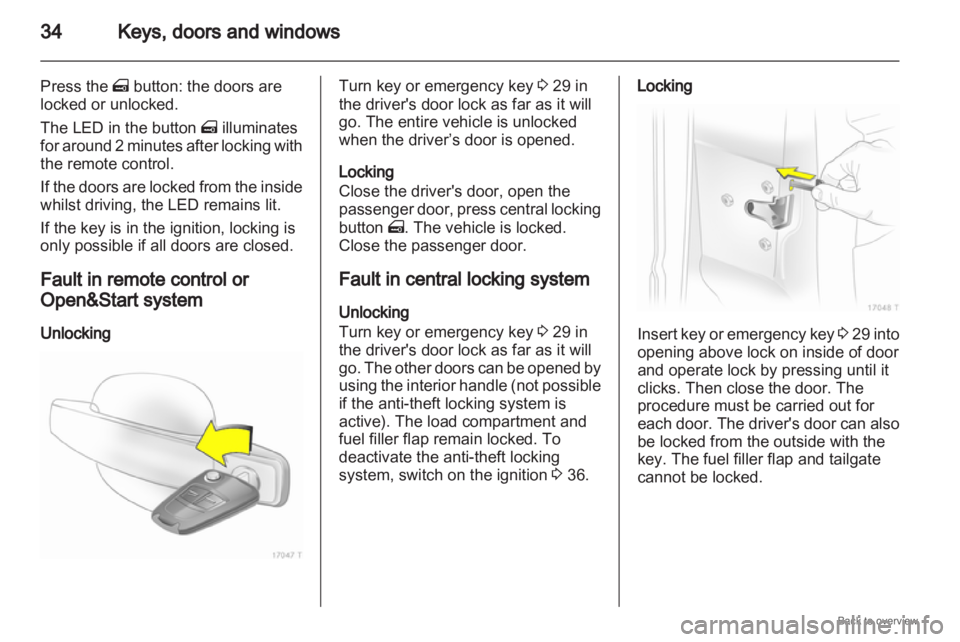
Unlocking Turn key or emergency key
3 29 in
the driver's door lock as far as it will
go. The entire vehicle is unlocked
when the driver’s door is opened.
Locking
Close the driver's door, open the
passenger
door, press central locking
button m. The vehicle is locked.
Close the passenger door.
Fault in central locking system
Unlocking
Turn key or emergency key 3 29 in
the driver's door lock as far as it will
go. The other doors can be opened by
using the interior handle (not possible
if the anti-theft locking system is
active). The load compartment and
fuel filler flap remain locked. To
deactivate the anti-theft locking
system, switch on the ignition 3 36. Locking
Insert key or emergency key
3 29
into
opening above lock on inside of door
and operate lock by pressing until it
clicks. Then close the door. The
procedure must be carried out for
each door. The driver's door can also
be locked from the outside with the
key. The fuel filler flap and tailgate
cannot be locked.
Page 38 of 228

38
Keys, doors and windows
After the first 10 seconds of anti-theft
alarm system activation:
LED flashes
slowly = System active,
LED comes
on for approx.
1 second = Switch off function.
Seek the assistance of a workshop in
the event of faults.
Alarm
When triggered, the alarm gives off
an
acoustic signal (horn) and a visual
signal (hazard warning flashers). The
number and duration of which are
stipulated by legislation.
The alarm can be silenced by
pressing a button of the radio remote
control or by switching on the ignition.
The anti-theft alarm system is
deactivated at the same time. Immobiliser
The system checks whether the
vehicle
is allowed to start with the key
being used. If the transponder in the
key is recognised, the vehicle can be
started.
The electronic immobiliser activates
itself automatically after the key has
been removed from the ignition
switch or when the engine is switched
off by pressing the Start/Stop button.
If the control indicator A flashes
when the ignition is on, there is a fault
in the system; the engine cannot be
started. Switch off the ignition and
then repeat the start attempt.
If the control indicator continues
flashing, attempt to start the engine
using the spare key and seek the
assistance of a workshop.
If control indicator illuminates after
the engine has started, there is a fault
in the engine electronics or
transmission electronics 3 88,
3 135, 3 139, or there is water in the
diesel fuel filter 3 101. Note
The immobiliser does not lock the
doors. You should always lock the
vehicle
after leaving it and switch on
the anti-theft alarm system 3 32,
3 36.
Page 84 of 228
84
Instruments and controls
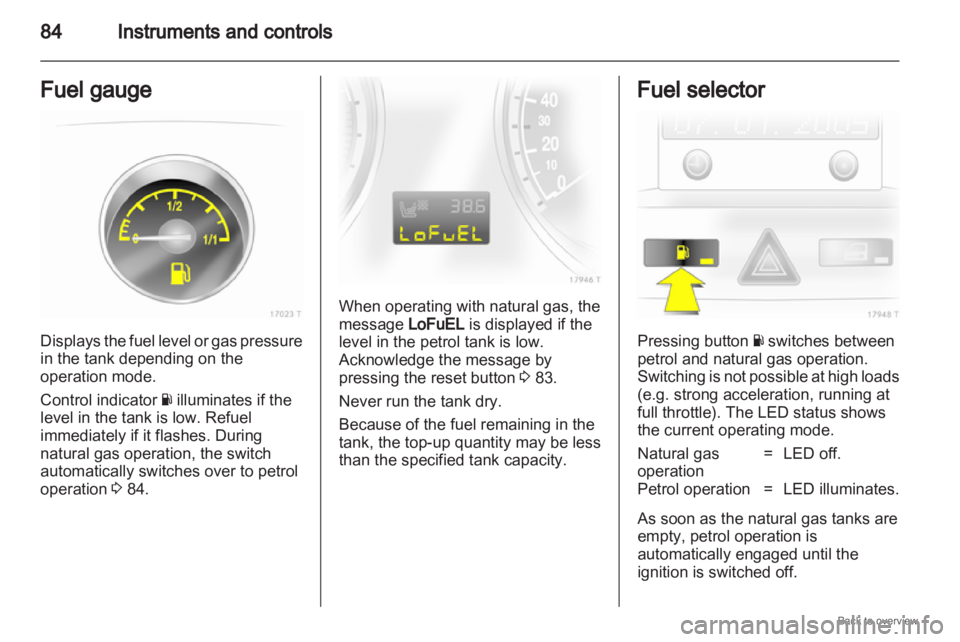
Fuel gauge Displays the fuel level or gas pressure
in the tank depending on the
operation mode.
Control indicator
Y illuminates if the
level in the tank is low. Refuel
immediately if it flashes. During
natural gas operation, the switch
automatically switches over to petrol
operation 3 84. When operating with natural gas, the
message LoFuEL is displayed if the
level in the petrol tank is low.
Acknowledge the message by
pressing the reset button
3 83.
Never run the tank dry.
Because of the fuel remaining in the
tank, the top-up quantity may be less
than the specified tank capacity. Fuel selector
Pressing button
Y switches between
petrol and natural gas operation.
Switching
is not possible at high loads
(e.g. strong acceleration, running at
full throttle). The LED status shows
the current operating mode.
Natural gas
operation = LED off.
Petrol operation = LED illuminates.
As soon as the natural gas tanks are
empty, petrol operation is
automatically engaged until the
ignition is switched off.
Page 85 of 228

Instruments and controls
85
If the natural gas tanks are not
refuelled, the system must be
manually switched to petrol operation
before the engine is started up again.
This will prevent damage to the
catalytic converter (overheating
caused by irregular fuel supply).
If the selector switch is operated
several times within a short time
a switchover block is activated. The
engine remains in the current
operating mode. The block remains
active until the ignition is switched off.
A slight loss of power and torque can
be expected in petrol operation. You
must therefore adapt your driving
style (e.g. during overtaking
manoeuvres) and vehicle loads (e.g.
towing loads) accordingly.
Every six months run the petrol tank
down until control indicator Y
illuminates and refuel. This is
necessary to maintain fuel quality as
well as system function necessary for
petrol operation.
Fill the tank completely at regular
intervals to prevent corrosion in the
tank. Service display
The message InSP appears when it
is time for servicing. Further
information
3 192.
Control indicators
The control indicators described are
not present in all vehicles. The
description applies to all instrument
versions. When the ignition is
switched on, most control indicators
will
illuminate briefly as a functionality
test. The control indicator colours mean:
Red = Danger, important
reminder,
Yellow = Warning, information, fault,
Green = Confirmation of activation,
Blue = Confirmation of activation.