Page 158 of 228
158
Vehicle care
concentration checked and have the
cause of the coolant loss remedied by
a workshop.
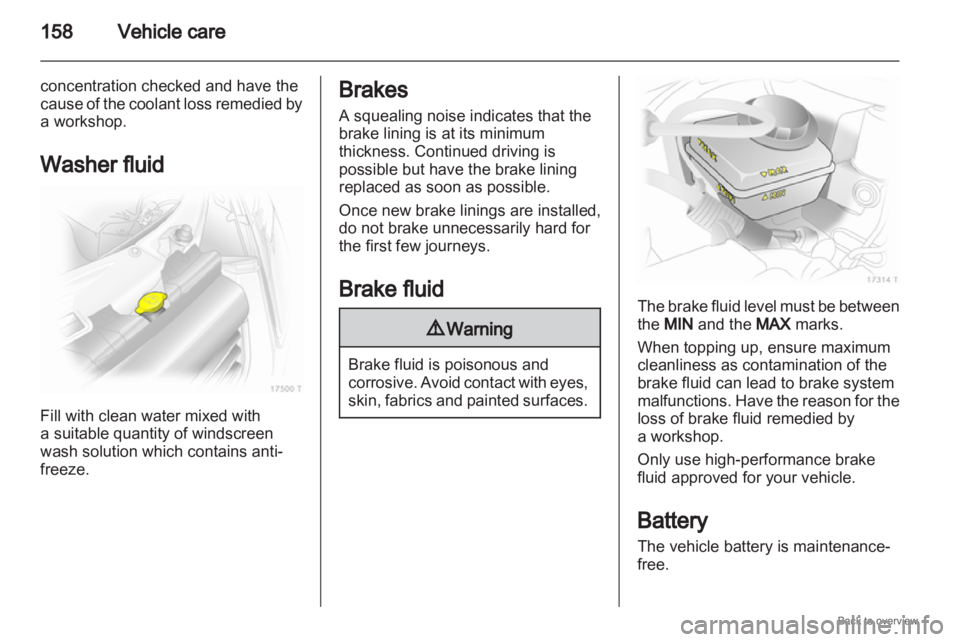
Washer fluid Fill with clean water mixed with
a suitable quantity of windscreen
wash solution which contains anti-
freeze. Brakes
A squealing noise indicates that the
brake lining is at its minimum
thickness. Continued driving is
possible but have the brake lining
replaced as soon as possible.
Once new brake linings are installed,
do not brake unnecessarily hard for
the first few journeys.
Brake fluid
9
Warning Brake fluid is poisonous and
corrosive.
Avoid contact with eyes,
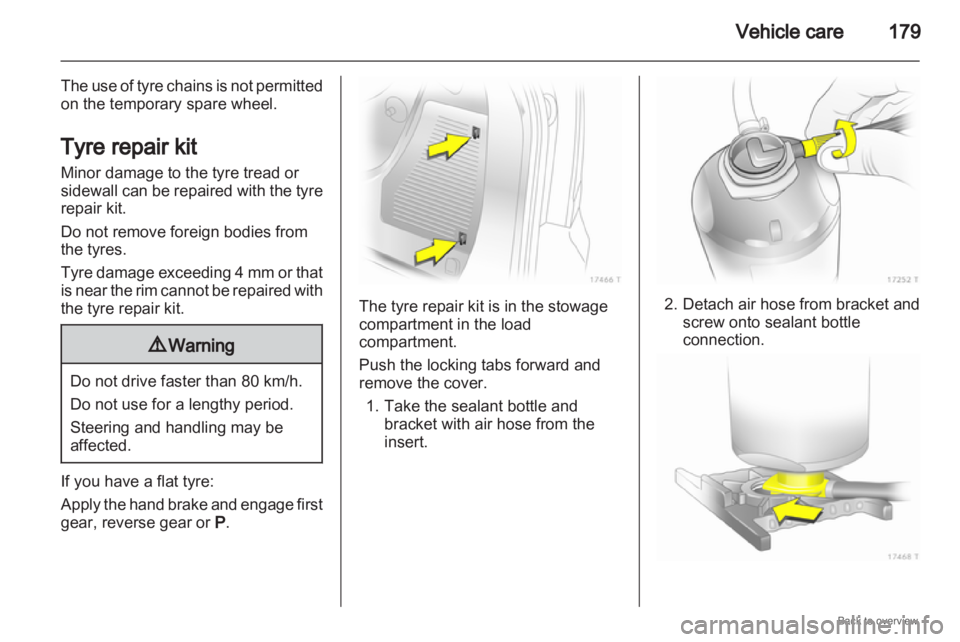
skin, fabrics and painted surfaces. The brake fluid level must be between
the MIN and the MAX marks.
When topping up, ensure maximum
cleanliness as contamination of the
brake fluid can lead to brake system
malfunctions.
Have the reason for the
loss of brake fluid remedied by
a workshop.
Only use high-performance brake
fluid approved for your vehicle.
Battery
The vehicle battery is maintenance-
free.
Page 175 of 228
Vehicle care
175
Depending on tyre manufacturer, run-
flat tyres can be identified from
a marking on the tyre wall. E.g. ROF
= RunonFlat for Goodyear or SSR
= Self Supporting Runflat Tyre for
Continental.
Use of run-flat tyres is only permitted
in combination with factory approved
alloy wheels.
Do not use a tyre repair kit.
The ECO tyre pressure must not be
used.
Run-flat tyres must not be combined
with standard tyres.
If converting to standard tyres, note
that the vehicle is not equipped with
a spare wheel or tyre repair kit.
Driving with a damaged tyre
A
loss in tyre pressure is indicated by
the tyre pressure monitoring system
or the deflation detection system.
If a tyre has no pressure, continued
driving is possible
■ at a speed of max. 80 km/h
■ up to a distance of 80 km 9
Warning The vehicle will be more difficult to
steer and handle. Braking
distance will be longer.
Adapt driving style and speed to
the changed conditions.
Tyre designations
E.g. 195/65 R 15 91 H
195
=Tyre width, mm
65 =Cross-section ratio (tyre
height to tyre width), %
R = Belt type: Radial
RF =Type: RunFlat
15 =Wheel diameter, inches
91 =Load index e.g. 91 is
equivalent to 618 kg
H = Speed code letter
Speed code letter:
Q = up to 160 km/h
S = up to 180 km/h
T = up to 190 km/h
H = up to 210 km/h
V = up to 240 km/h
W = up to 270 km/h Tyre pressure
Check the pressure of cold tyres at
least every 14 days and before any
long journey. Do not forget the spare
wheel. This also applies to vehicles
with tyre pressure monitoring.
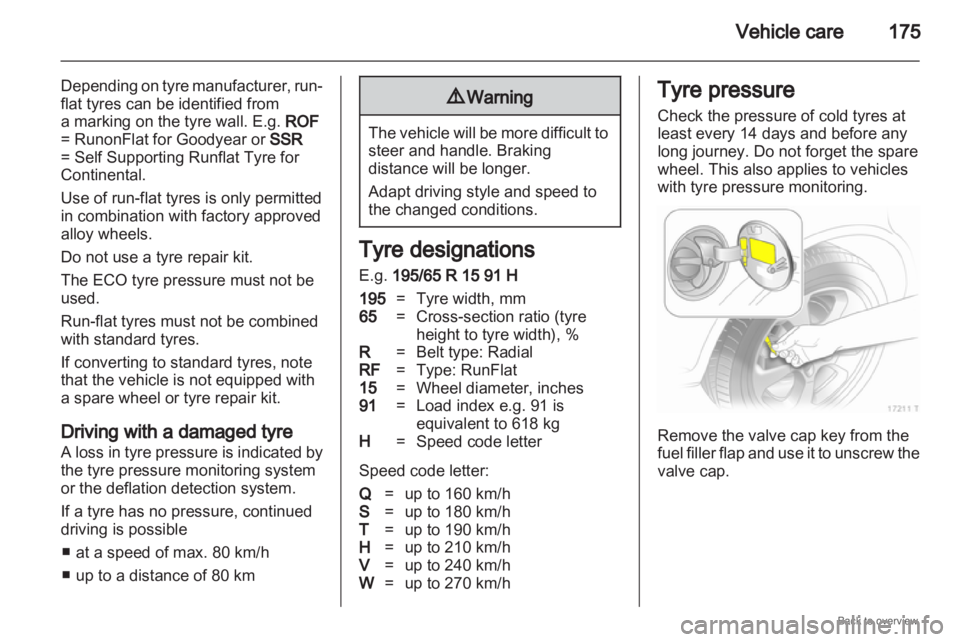
Remove the valve cap key from the
fuel
filler flap and use it to unscrew the
valve cap.
Page 176 of 228

176
Vehicle careOn vehicles with tyre pressure
monitoring
system, screw the adapter
to the valve.
Tyre pressure 3 220 and on the label
on the inside of the fuel filler flap.
The tyre pressure data refer to cold
tyres. It applies to summer and winter
tyres.
Always inflate the spare wheel to the
pressure specified for full load.
The ECO tyre pressure serves to
achieve the smallest amount of fuel
consumption possible. It must not be
used with run-flat tyres. Incorrect tyre pressures will impair
safety, vehicle handling, comfort and
fuel economy and will increase tyre
wear.
9
Warning If the pressure is too low, this can
result in considerable tyre warm-
up
and internal damage, leading to
tread separation and even to tyre
blow-out at high speeds. Tyre pressure monitoring
system
The tyre pressure monitoring system
continually checks the pressure of all
four wheels when vehicle speed
exceeds a certain limit.
All wheels must be equipped with
pressure sensors and the tyres must
have the prescribed pressure.
Otherwise, the tyre pressure will be
monitored by the deflation detection
system 3 177.
The current tyre pressures can be
shown in the Info-Display
3 107. Vehicle messages, tyre pressure
3 101.
Control indicator
w 3 90.
If a complete set of wheels without
sensors is mounted (e.g. four winter
tyres), no error message will be
displayed. The tyre pressure
monitoring system is not operational.
Retrofitting of sensors is possible.
The use of commercially available
liquid tyre repair kits can impair the
function of the system. Factory
approved systems can be used.
External high-power radio equipment
could disrupt the tyre pressure
monitoring system.
Page 178 of 228

178
Vehicle care
If there is more wear at the front than
the rear, swap round front wheels and
rear wheels.
Tyres age, even if they are not used.
We recommend tyre replacement
every 6 years.
Changing tyre and wheel
size
If tyres of a different size than those
fitted at the factory are used, it may be
necessary to reprogram the
speedometer and make other vehicle
modifications.
After converting to a different tyre
size, have the label with tyre
pressures replaced. 9
Warning Use of unsuitable tyres or wheels
may lead to accidents and will
invalidate the vehicle type
approval. Wheel covers
Wheel covers and tyres that are
factory approved for the respective
vehicle and comply with all of the
relevant wheel and tyre combination
requirements must be used.
If
the wheel covers and tyres used are
not factory approved, the tyres must
not have a beaded edge.
Wheel covers must not impair brake
cooling.
Remove the wheel covers if tyre
chains are to be installed. 9
Warning Use of unsuitable tyres or wheel
covers could lead to sudden
pressure loss and thereby
accidents. Tyre chains
Tyre chains are only permitted on the
front wheels.
Always
use fine mesh chains that add
no more than 10 mm to the tyre tread
and the inboard sides (including chain
lock). 9
Warning Damage may lead to tyre blowout.
Tyre chains are not permitted on tyres
of size 225/40 R 18, 225/40 ZR 18
and 235/35 R 19.
Page 179 of 228
Vehicle care
179
The use of tyre chains is not permitted
on the temporary spare wheel.
Tyre repair kit
Minor damage to the tyre tread or
sidewall
can be repaired with the tyre
repair kit.
Do not remove foreign bodies from
the tyres.
Tyre damage exceeding 4 mm or that
is near the rim cannot be repaired with
the tyre repair kit. 9
Warning Do not drive faster than 80 km/h.
Do not use for a lengthy period.
Steering and handling may be
affected.
If you have a flat tyre:
Apply
the hand brake and engage first
gear, reverse gear or P. The tyre repair kit is in the stowage
compartment in the load
compartment.
Push the locking tabs forward and
remove the cover.
1.
Take the sealant bottle andbracket with air hose from the
insert. 2. Detach air hose from bracket and
screw onto sealant bottle
connection.
Page 185 of 228
Vehicle care
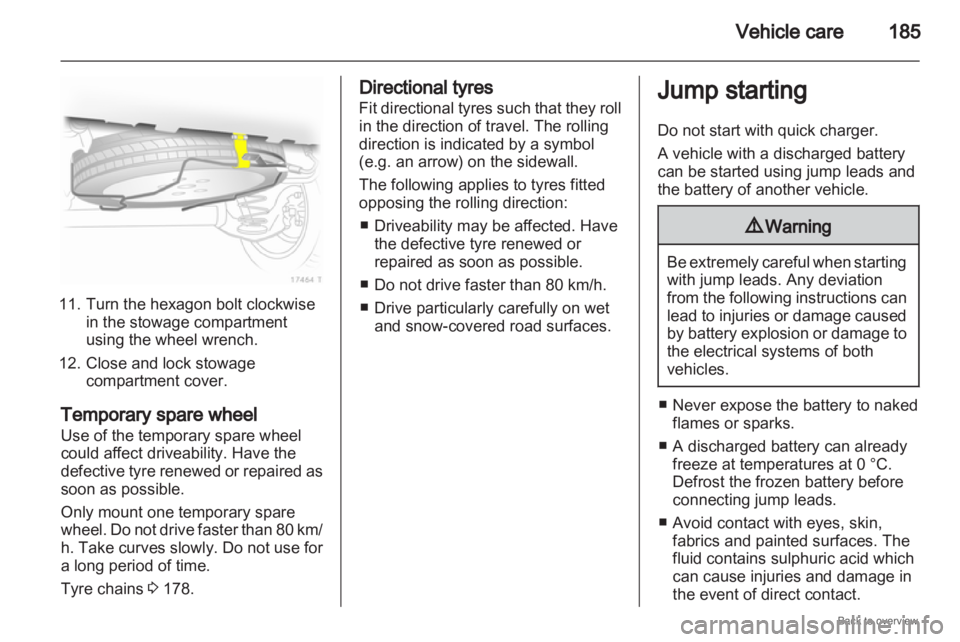
18511. Turn the hexagon bolt clockwise
in the stowage compartment
using the wheel wrench.
12.
Close and lock stowagecompartment cover.
Temporary spare wheel
Use of the temporary spare wheel
could affect driveability. Have the
defective tyre renewed or repaired as
soon as possible.
Only mount one temporary spare
wheel. Do not drive faster than 80 km/
h. Take curves slowly. Do not use for
a long period of time.
Tyre chains 3 178. Directional tyres
Fit
directional tyres such that they roll
in the direction of travel. The rolling
direction is indicated by a symbol
(e.g. an arrow) on the sidewall.
The following applies to tyres fitted
opposing the rolling direction:
■ Driveability may be affected. Have the defective tyre renewed or
repaired as soon as possible.
■ Do not drive faster than 80 km/h.
■ Drive particularly carefully on wet and snow-covered road surfaces. Jump starting
Do not start with quick charger.
A vehicle with a discharged battery
can be started using jump leads and
the battery of another vehicle.
9
Warning Be extremely careful when starting
with jump leads. Any deviation
from
the following instructions can
lead to injuries or damage caused
by battery explosion or damage to
the electrical systems of both
vehicles. ■ Never expose the battery to naked
flames or sparks.
■
A discharged battery can alreadyfreeze at temperatures at 0 °C.
Defrost the frozen battery before
connecting jump leads.
■ Avoid contact with eyes, skin, fabrics and painted surfaces. The
fluid contains sulphuric acid which
can cause injuries and damage in
the event of direct contact.
Page 198 of 228

198
Service and maintenanceService operations by year
1)
km ( x 1000) 1) 1
30 2
60 3
90 4
120 5
150
Undo wheel fastening (take care if tyre pressure monitoring system is present) and
tighten to torque: 110 Nm.
The wheel bolt taper should be greased or oiled lightly during assembly.
Check tyre condition. Check/correct tyre pressure (including spare wheel)
With tyre repair system - check completeness and expiry date of kit. Replace sealant
bottle every 4 years. X X
+
Annual service check if annual mileage exceeds 20 000 km
Visually inspect first-aid kit, (presence in designated stowage compartment,
completeness and expiry date), lashing eyes and warning triangle Every 2 years
Check/correct headlamp adjustment (including auxiliary headlamps) X X
Grease door hinges, door stop, lock cylinder, striker plate, bonnet lock, tailgate hinges,
wipe door stop check strap clean before greasing X X
Test drive, final inspection (check steering and ignition locks, instruments and indicator
lamps,
entire brake system, steering, air conditioning, engine, body and running gear),
reset service interval display with TECH 2) X X X X X
+: Additional operations.
o: Under extreme operating conditions and if required by country-specific conditions, the intervals are reduced.
Page 202 of 228

202
Service and maintenanceService operations by year
3)
km ( x 1000) 1) 1
15 2
30 3
45 4
60 5
75
+o
Visually inspect front and rear wheel brakes
4)
, if a tyre pressure monitoring system is
fitted, do not swap wheels over X X
Annual service check if annual mileage exceeds 20 000 km
Engine, transmission (AT, MT), inspect air-conditioning compressor for leaks
4) X X X X X
Visually inspect folding covers on steering, tie rods and axle drive X X X X X
Tie rod and supporting joint checking X X X X X
+ Change brake and clutch fluid automated manual transmission (MTA) Every 2 years
Undo wheel fastening (take care if tyre pressure monitoring system is present) and
tighten to torque: 110 Nm.
The wheel bolt taper should be greased or oiled lightly during assembly.
Check tyre condition. Check/correct tyre pressure (including spare wheel)
With tyre repair system - check completeness and expiry date of kit. Replace sealant
bottle every 4 years. X X
+
Annual service check if annual mileage exceeds 20 000 km
Visually inspect first-aid kit, (presence in designated stowage compartment,
completeness and expiry date), lashing eyes and warning triangle Every 2 years
Check/correct headlamp adjustment (including auxiliary headlamps) X X
4)
In case of too high consumption / leakage, perform additional work with customer's agreement.