2009 OPEL ANTARA mirror
[x] Cancel search: mirrorPage 34 of 234

Locks, doors, windows34
Sun visors
Use the sun visor to protect from glare by
pulling it up, down or swivelling it to the
side.
Sun visors have vanity mirrors and a ticket
holder 3 on the rear.
When the vanity mirror covers are opened,
the sun visor lamp 3 will illuminate.
Slide/tilt sun roof 3
Operated via switch in roof lining when the
ignition switch is in positions ACC or ON.
With key in LOCK position in the ignition
switch or removed, the slide/tilt sun roof
can be adjusted for up to 10 minutes or
until a door is opened.
For incremental operation, briefly press the
button. For automatic opening or closing,
press and hold the switch. To open
Press switch rearwards; it will open
automatically unless th
e switch is pressed
again in another dire ction, or released.
To close
Press and hold switch forwards. Release
switch when sun roof reaches desired
position.
To tilt
Press and hold switch upwards. Release
switch when sun roof reaches desired
position.
To return sun roof to its original position,
press and hold switch downwards. Release
switch when sun roof reaches desired
position.
Page 100 of 234

Lighting100
Luggage compartment lamps
Come on when a door or the tailgate is
opened. Front door lamps
Come on when a door is opened.
Once all doors are closed, the front door
lamps extinguish after approx. 10 seconds.
If the doors are left open, the lamps will
stay on for approx. 10 minutes.
Front door lamps can
also be turned off
immediately by pressing button
K in the
roof lining.
Ignition switch illumination
Comes on when you open a door.
Ignition switch illumination can also be
turned off immediately by pressing
button
K in the roof lining.
Sun visor lamps 3
Come on when vanity mirror covers are
opened. See page 34.
Ashtray illumination
The portable front ashtray, located in the
front drink holder, illuminates depending
on outside light conditions. See page 68.
Glove compartment illumination
Comes on when the glove compartment is
opened. See page 64.
Battery discharge protection
To prevent battery from becoming
discharged, the extern al lamps turn off
automatically approx. 10 minutes after the
ignition is switched off.
Battery discharge protecti on will not work if
the lamps are turned on 10 minutes after
the ignition has been switched off; the key
cannot be removed from the ignition switch
until the battery is recharged.
Headlamps when driving abroad
The asymmetrical dipped beam increases
the field of vision on the near side of the
lane.
When driving in coun tries which drive on
the opposite side of the road, this causes
glare for oncoming traffic.
For temporary periods, to avoid glare the
headlamp pattern should be adjusted
down to the horizontal position.
Have the headlamps adjusted by a
workshop.
Page 103 of 234

Climate control103
Climate control
Heating and ventilation system,
air conditioning system
Ventilation, heating and cooling are
combined into one unit that is designed to
provide comfort regardless of the season,
weather or outside temperature.
When cooling is activated, the air is cooled
and dehumidified (dried).
The heating unit heats the air as required in
all operating modes, depending on the
position of the temperature rotary knob.
The air supply can be adjusted to suit
personal requirements by means of the
fan.
Air conditioning system - see page 109.
Electronic Climate Control (ECC) 3
Provides the greatest amount of comfort in
the vehicle interior, regardless of the
weather, outside temperature or season.
To ensure a constant and comfortable
climate in the vehicle, the temperature of
inflowing air, the air flow rate, air
distribution mode, air recirculation mode
and air conditioning are automatically
adapted based on the climate conditions
outside the vehicle and the current
temperature of the vehicle interior.
Electronic Climate Control (ECC) 3 -
see page 111.
Heating and ventilation system,
air conditioning system ................... 103
Electronic Climate Control (ECC) 3... 103
Air vents .............................................. 104
Heated rear window, heated exterior mirrors 3................ 105
Heated front seats 3.......................... 105
Glove compartment cooling 3.......... 105
Heating and ventilation system ........ 106
Air recirculation mode ........................ 109
Air conditioning system...................... 109
Electronic Climate Control (ECC) 3... 111
Air intake ............................................. 114
Pollen filter .......................................... 114
Note ..................................................... 114
Maintenance ....................................... 114
Page 104 of 234

Climate control104
Air vents
Pleasant ventilation to the head area with
unheated or slightly warmed air depending
on the position of the temperature rotary
knob.
Centre air vents
To open and close air vents, turn horizontal
knurled wheel to the left or right.
Open air vents when air distribution rotary
knob is set to M or L.
The air supply is increased by switching on
the fan.
The air flow can be directed as desired by
tilting and swivelling the slats up, down
and sideways. Side air vents
To open and close air ve
nts, turn horizontal
knurled wheel to the left or right.
Open air vents when air distribution rotary
knob is set to M or L.
Depending upon the position of the
temperature rotary knob, cold or heated
air will be directed into the vehicle via these
air vents.
The air supply is increased by switching on
the fan.
The air flow can be directed as desired by
tilting and swivelling the slats up, down
and sideways. Door window defroster vents
Air distribution rotary knob set to
l or J ;
cooled or heated air wi ll be directed onto
the windscreen and onto the door windows
(mainly in the area of the exterior mirrors).
Rear air vents
Operational when air distribution rotary
knob is set to L, K or J .
Cooled or heated air is directed into the
footwell area of the rear passenger
compartment.
Keep the area underneath the front seats
clear, to allow air flow to the rear
passenger compartment.
Additional air vents
Below the windscreen (defroster vents) and
in the front footwells.
Page 105 of 234

Climate control105
Heated rear window,
heated exterior mirrors 3
Operational only in ignition switch
positions ACC or ON.
Control indicator in button.
Turn off as soon as vision is clear.
Rear window and exterior mirror heating is
switched off automatically after approx.
15 minutes.
To avoid discharging the battery, do not
operate when you are just starting the
vehicle, or if there is a build up of snow or
ice. Operate only with the engine running.
Do not use sharp instruments or abrasive
cleaners on rear window or exterior mirrors,
and avoid scratching or damaging their
heating elements.
Heated front seats 3
Operational only in ignition switch
positions ACC or ON.
Press switch ß on respective side one or
more times to set the desired heat output.
Control indicator in switch indicates which
of the three heating levels is active.
To switch heating off, set heat output to
the lowest level and press the switch again.
The control indicato r will extinguish.
Prolonged use could cause damage to
delicate and thin clothing and burn seat
occupants.
Avoid subjecting seats to heavy impacts,
as this may cause damage to the heating
element.
If temperature continues to rise, turn seat
heating off and consult a workshop.
Glove compartment cooling 3
Cooled air is fed into the glove
compartment through an air opening,
when the air conditioning is turned on.
Rotate adjustment wheel anti-clockwise to
allow the air conditioning to keep the
contents of the glove compartment cool.
Rotate adjustment wheel clockwise to close
air opening when glove compartment
cooling is not required.
General notes and notes on air intake,
pollen filter and maintenance
see page 114.
Press button
Ü=On
Press button Ü again = Off
Page 143 of 234
Driving and operation143
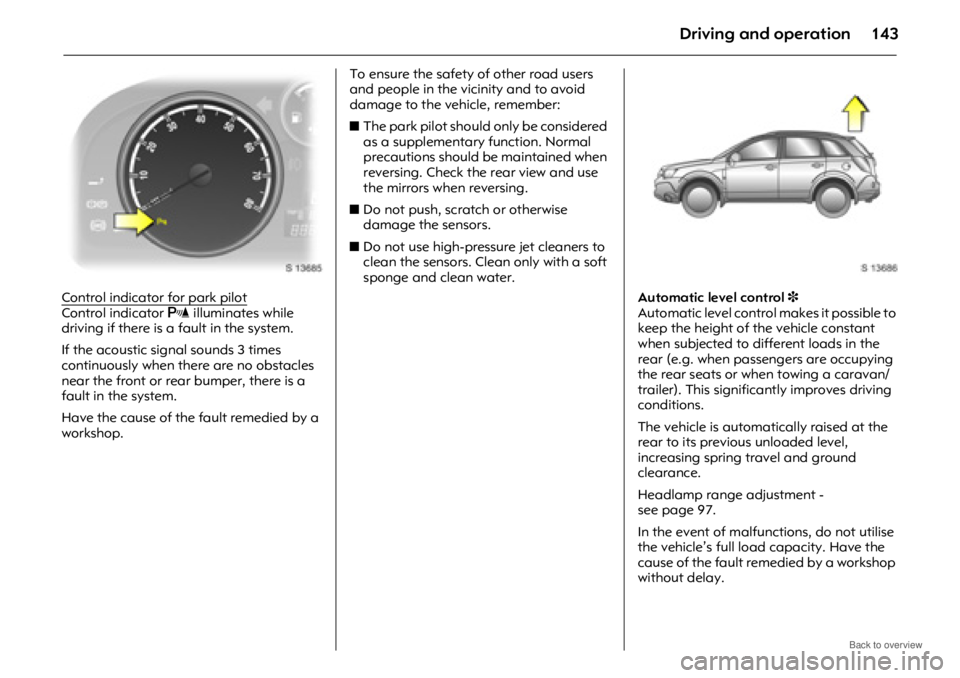
Control indicator for park pilotControl indicator r illuminates while
driving if there is a fault in the system.
If the acoustic signal sounds 3 times
continuously when there are no obstacles
near the front or rear bumper, there is a
fault in the system.
Have the cause of the fault remedied by a
workshop. To ensure the safety of other road users
and people in the vicinity and to avoid
damage to the vehicle, remember:
z
The park pilot should only be considered
as a supplementary function. Normal
precautions should be maintained when
reversing. Check the rear view and use
the mirrors when reversing.
z Do not push, scratch or otherwise
damage the sensors.
z Do not use high-pressure jet cleaners to
clean the sensors. Clean only with a soft
sponge and clean water.
Automatic level control 3
Automatic level control makes it possible to
keep the height of the vehicle constant
when subjected to different loads in the
rear (e.g. when passengers are occupying
the rear seats or when towing a caravan/
trailer). This significantly improves driving
conditions.
The vehicle is automatically raised at the
rear to its previous unloaded level,
increasing spring travel and ground
clearance.
Headlamp range adjustment -
see page 97.
In the event of malfunctions, do not utilise
the vehicle’s full load capacity. Have the
cause of the fault remedied by a workshop
without delay.
Page 169 of 234

Driving and operation169
Driving characteristics, towing tips
In the case of caravans/trailers with
brakes3, attach the breakaway stopping
cable to the eye 3 or loop around coupling
ball bar if no eye is available.
Ensure cable is crossed under the coupling
socket to ensure the caravan/trailer nose
cannot drop to the ground if it becomes
separated from the trailer hitch.
Do not allow the cable to drag along the
ground and always allow enough slack to
permit full turning. Fo llow the instructions
supplied with the towing equipment.
Before coupling the caravan/trailer,
lubricate the ball of the caravan/trailer
towing device. However, do not do so if a
stabilizer which acts on the coupling ball is
being used to damp rolling motions.
Handling is greatly influenced by the
loading of the caravan/trailer. Loads
should therefore be secured so that they
cannot slip and should be placed in the
centre of the caravan/trailer if possible,
i.e. above the axle.
Opel genuine parts an d accessories which
can be subsequently fitted aid trailer
operation, e.g. larg e mirrors for wide
caravans/trailers. In the case of caravans/trailers with low
directional stability, it is advisable to use a
friction-type stabilizer to damp rolling
motions.
Do not drive faster than 80 km/h (50 mph),
even in countries where higher speeds are
permitted.
When driving uphill, do not drive faster
than 30 km/h (20 mph) in 1st gear, or
50 km/h (30 mph) in 2nd gear.
Make sure that you have enough room
when cornering and avoid sudden
manoeuvres.
If the caravan/trailer starts to sway, drive
more slowly, do not attempt to correct the
steering and brake sharply if necessary.
If it is necessary to apply the brakes fully,
depress the brake pedal as hard as
possible.
The cooling fan is electrically operated.
The fan cooling capacity is not, therefore,
dependent on engine speed. It is not
necessary, when drivin
g uphill, to shift
down into a lower gear if the vehicle can
climb in a higher gear. When coupled to a caravan/trailer, the
vehicle requires more
braking effort when
driving down long grad ients, so select the
same gear as you would when driving
uphill and drive at roughly the same speed.
Automatic transmission in automatic mode
will select the drivin g program with the
optimum engine braking effect.
Remember that brak ing distances for
vehicles towing carava ns/trailers with and
without brakes is always greater than for
vehicles not towing a caravan/trailer. For
caravans/trailers with brakes, follow the
instructions carefully. Do not make any
modifications to the brake system.
Always check lamps on caravans/trailers
before towing. Ensure national regulations
are observed.
The fog tail lamp on the vehicle is
deactivated when towing a caravan/
trailer.
When reversing, if possible, have someone
provide assistance.
Drive slowly and shift down into a lower
gear when descending steep gradients
rather than holding the foot brake
depressed, to avoid overheating and
reduced brake efficiency.
Page 183 of 234

Self-help, vehicle care 183
Some circuits may be protected by several
fuses.
No. Circuit Rating
1Accessory socket 20 A
2 Seat heating 20 A
3 Audio 15 A
4 Trailer 10 A
5 Parking lamp (right side) 10 A
6 Air conditioning 10 A
7 Power steering 10 A
8 Body Control Module 10 A
9 Anti-theft alarm 10 A
10 Central door locking 20 A
11 Turn signal (right side) 15 A
12 Turn signal (left side) 15 ANo. Circuit Rating
13 Stop 15 A
14 Headlamp washer 15 A
15 Rear cluster 10 A
16 Air conditioning 15 A
17 Body Control Module 20 A
18 Body Control Module 15 A
19 Ignition switch 2 A
20 Fog tail lamp 10 A
21 Airbag 10 A
22 Front door lock 15 A
23 Accessory socket 20 A
24 Transmission Control
Module 15 A
25 Engine 15 A
26 Body Control Module 10 A
No. Circuit Rating
27 --
28 Windscreen washer 10 A
29 Exterior mirror heating 15 A
30 Instrument cluster 10 A
31 Ignition 10 A
32 Airbag 10 A
33 Steering wheel remote 2 A
34 Folding mirrors 10 A
35 --
36 Cigarette lighter 20 A
37 Passenger’s electric
window 20 A
38 Driver’s electric window 20 A
39 Automatic transmission 10 A