Page 93 of 153
9-6Driving and operating
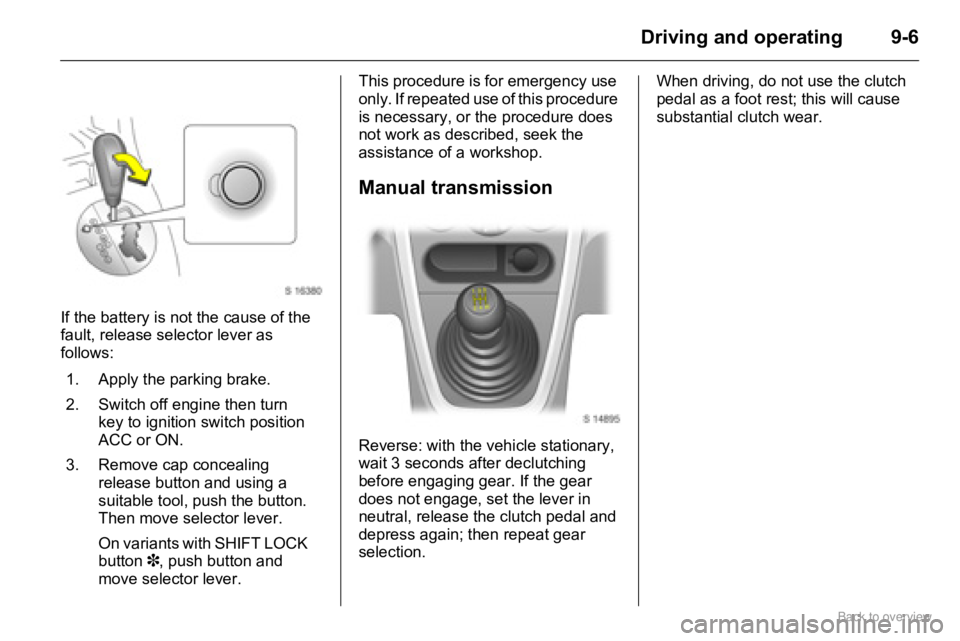
If the battery is not the cause of the
fault, release selector lever as
follows:This procedure is for emergency use
only. If repeated use of this procedure
is necessary, or the procedure does
not work as described, seek the
assistance of a workshop.
Manual transmission
Reverse: with the vehicle stationary,
wait 3 seconds after declutching
before engaging gear. If the gear
does not engage, set the lever in
neutral, release the clutch pedal and
depress again; then repeat gear
selection.When driving, do not use the clutch
pedal as a foot rest; this will cause
substantial clutch wear.
1. Apply the parking brake.
2. Switch off engine then turn
key to ignition switch position
ACC or ON.
3. Remove cap concealing
release button and using a
suitable tool, push the button.
Then move selector lever.
On variants with SHIFT LOCK
button3, push button and
move selector lever.
Page 96 of 153

9-9 Driving and operating
Brakes
Foot brake
The brake system comprises two
separate brake circuits.
If one brake circuit should fail, the
vehicle can still be braked with the
second remaining circuit.
If this happens, the brake pedal must
be fully depressed with greater pedal
pressure. The distance required for
braking will be greater. Seek the
assistance of a workshop.
In order to utilise the full pedal travel,
particularly in the event of a brake
circuit fault, there must be no mats in
the area of the pedals 3 9-1.
With the engine stopped, the brake
servo assistance is discontinued after
the brake pedal has been depressed
once or twice. The braking effect is
not reduced, but increased foot
pressure will be necessary. Take
extra care if the vehicle is being
towed.
Brake system control indicator 3 5-9.
Anti-lock Brake System
(ABS) u
The ABS prevents the wheels from
locking during heavy braking.
It starts to regulate braking pressure
as soon as a wheel shows a tendency
to lock. The vehicle remains
steerable, even during heavy braking,
e.g. on bends or when swerving to
avoid an obstacle. Even in the case of
extreme braking, ABS makes it
possible to drive round obstacles
without releasing the foot brake.
ABS control indicator 3 5-9.
Fault
Have the cause of the fault remedied
by a workshop.
Parking brake
Always apply the parking brake firmly
without actuating the release button.
Apply as fully as possible on uphill or
downhill inclines.
To release the parking brake, press
and hold the button, pull the lever up
slightly and lower lever while holding
the button in.
To reduce the operating forces of the
parking brake, depress the foot brake
at the same time.
Brake system control indicator 3 5-9.
Caution
If there is a fault in the ABS, the
wheels may lock during heavy
braking. This may cause the vehicle
to swerve.
Page 100 of 153

9-13 Driving and operating
The tank flap is opened by pulling up
the release lever located on the
outboard side of the driver’s seat.The fuel filler neck is located on the
left rear side of the vehicle.
To open fuel filler cap: turn it anti-
clockwise.
Fuel consumption,
CO
2emissions
Directive 80/1268/EEC (last changed
by 2004/3/EG) has applied for the
measurement of fuel consumption
since 1996.
The directive is oriented to actual
driving practices: Urban driving is
rated at approx.
1/3 and extra-urban
driving with approx. 2/3 (urban and
extra-urban consumption). Cold
starts and acceleration phases are
also taken into consideration.
The specification of CO
2 emission is
also a constituent of the directive.The figures given must not be taken
as a guarantee for the actual fuel
consumption of a particular vehicle.
All values are based on the EU base
model with standard equipment.
The calculation of fuel consumption
as specified by directive 2004/3/EG
takes account of the vehicle’s kerb
weight, ascertained in accordance
with these regulations. Optional
extras may result in slightly higher
fuel consumption and CO
2emission
levels than those quoted.
Fuel consumption, CO
2emissions
312-4.
Caution
Wipe off any overflowing fuel
immediately.
Page 103 of 153

10-3Vehicle care
To close, lift bonnet slightly, release
the support rod from the hole and
press it back into its retaining clip.
Lower the bonnet gradually, allowing
it to drop from a height of approx.
30 cm.
Check that the bonnet is locked in
position before driving, by pulling at
its front edge. If it is not engaged,
repeat closing procedure.
Engine oil
Information on engine oil is in the
chapter “Service and maintenance”
311-6.
We recommend the engine oil level is
checked before starting a long trip.
The engine oil level must be checked
with the vehicle horizontal and with
the engine (which must be at
operating temperature) switched off.
Wait a few minutes before checking
the level to allow the normal oil
accumulation in the engine to drain
back into the oil pan.
Pull out dipstick from the tube, wipe it
clean and re-insert it as far as it will
go. After pulling the dipstick out again, check the engine oil level,
ensuring it is between the lower and
upper (MIN and MAX) marks.
The illustrations show checking the
engine oil in the K 10 B and K 12 B
petrol engines and the diesel engines
respectively.
Top up if the engine oil level has
dropped to the "add oil" lower mark
(MIN mark).
Page 108 of 153

10-8 Vehicle care
High beam and dipped beam
1. Remove headlamp protective
cover.
2. Detach plug connector from bulb.
3. Push retaining spring wire clip
forward and unhook it.
4. Remove bulb from reflector
housing and pull bulb straight out of
socket.
5. Insert new bulb by pushing in and
install in reflector housing.
6. Engage spring wire clip, and
reattach plug connector to bulb.7. Replace headlamp protective
cover.
Parking lamps
1. Remove headlamp protective
cover.
2. Remove parking lamp socket from
reflector housing.
3. Remove bulb (2) from socket by
pulling straight out.
4. Insert new bulb by pushing in.
5. Install parking lamp socket in
reflector housing.
6. Replace headlamp protective
cover.
Front turn signal lamps
1. Rotate bulb holder anti-clockwise
and remove from reflector housing.
2. Push bulb (1) into socket slightly,
rotate anti-clockwise and remove.
3. Insert new bulb and install bulb
holder in reflector housing by
rotating clockwise.
Front fog lamps 3
Access the rear of the fog lamp from
behind the front bumper.
1. Rotate bulb holder anti-clockwise
and remove from reflector housing.
Page 109 of 153
10-9Vehicle care
2. Remove bulb from socket by
pulling straight out.
3. Insert new bulb by pushing in.
4. Insert bulb holder in reflector
housing, rotate clockwise and
engage in position.
If the bulb is inaccessible, seek the
assistance of a workshop.
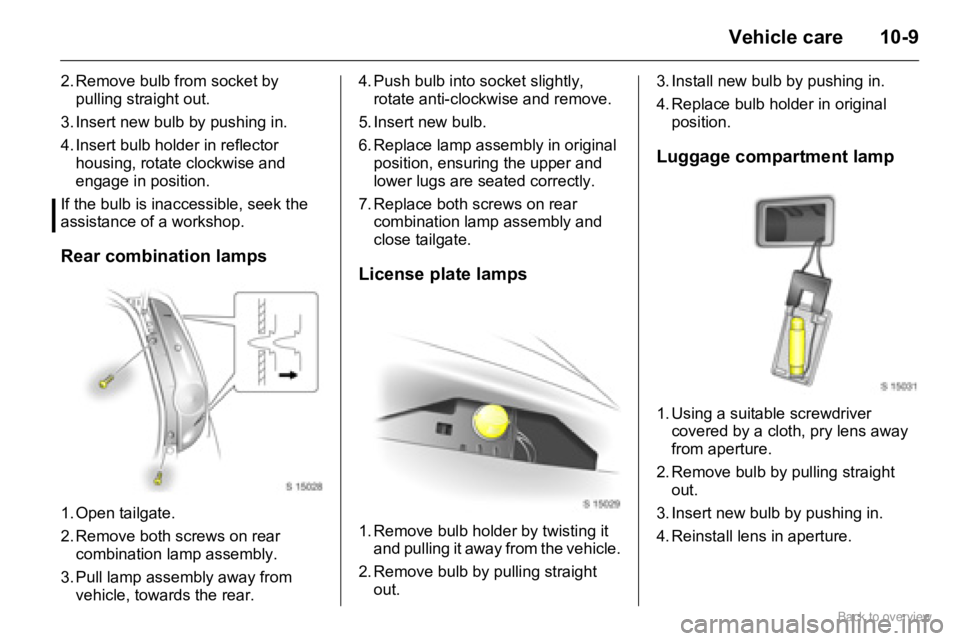
Rear combination lamps
1. Open tailgate.
2. Remove both screws on rear
combination lamp assembly.
3. Pull lamp assembly away from
vehicle, towards the rear.4. Push bulb into socket slightly,
rotate anti-clockwise and remove.
5. Insert new bulb.
6. Replace lamp assembly in original
position, ensuring the upper and
lower lugs are seated correctly.
7. Replace both screws on rear
combination lamp assembly and
close tailgate.
License plate lamps
1. Remove bulb holder by twisting it
and pulling it away from the vehicle.
2. Remove bulb by pulling straight
out.3. Install new bulb by pushing in.
4. Replace bulb holder in original
position.
Luggage compartment lamp
1. Using a suitable screwdriver
covered by a cloth, pry lens away
from aperture.
2. Remove bulb by pulling straight
out.
3. Insert new bulb by pushing in.
4. Reinstall lens in aperture.
Page 113 of 153
10-13Vehicle care
Some circuits may be protected by
several fuses.
Engine compartment fuse
box
Petrol engines
The fuse box is located next to the
battery in the engine compartment.
To open, disengage cover and tilt
upwards. No. Circuit
1-
2Ignition coils
3Reversing lamp
4Instrument cluster
5Accessory socket, cigarette
lighter, power exterior mirror
6Infotainment system
7Power window
8Wipers/washer
9Power steering
10Airbag system
11ABS, ESP
12Tail lamp
13-
14Door lock
15Diesel engine
16Starter motor
17-
18Heater fan
19Rear fog lamp
20Infotainment system
21Heated rear window
22Horn, hazard warning
23Manual transmission
24Power windows No. Circuit
9 Danger
Switch off ignition before opening
the engine compartment fuse
box.
Page 117 of 153

10-17Vehicle care
Tyre condition
Drive over edges slowly and at a right
angle if possible. When parking,
ensure that the tyres are not pressed
against the edge of the kerb.
Check tyres regularly for damage
(foreign bodies, punctures, cuts,
cracks, bulges in sidewalls). Check
wheels for damage. In the event of
damage or abnormal wear, seek the
assistance of a workshop.
Different tyre and wheel
types
If tyres of a different size to those
fitted at the factory are used (this
includes winter tyres), the electronic speedometer may possibly need to
be reprogrammed, to ensure that the
speed displayed is correct.
Wheel covers 3
Wheel covers and tyres that are
approved for the vehicle and comply
with all of the relevant wheel and tyre
combination requirements must be
used.
If the wheel covers and tyres used
are not approved, make sure that the
tyres do not have a beaded edge.
Remove wheel covers before fitting
tyre chains, to avoid damaging the
wheel covers.
Tyre chains 3
Tyre chains are only permitted on the
drive wheels (front axle). They must
be fitted to the tyres symmetrically in
order to achieve a concentric fit.
Use fine mesh chains that add no
more than 10 mm to the tyre tread
and the inboard sides (including
chain lock).
Tyre chains may only be used at
speeds of up to 50 km/h (30 mph) or
up to the tyre chain manufacturer’s
recommended maximum speed,
whichever is lower.
9 Warning
If the pressure is too low, this can
result in considerable tyre warm-
up and internal damage, leading
to tread separation and even to
tyre blow-out at high speeds.
Caution
Use of unsuitable tyres or wheels
may lead to accidents and render
the vehicle unroadworthy.