Page 105 of 153
10-5Vehicle care
If it falls below the LOW mark when
the system is cold, the coolant must
be replenished.
Top up coolant level to the FULL
mark, using a 50/50 mixture of
antifreeze and distilled water. Ensure
that the coolant level does not go
over the FULL mark.
If no antifreeze is available, top up
with distilled water and have the
concentration checked and more
antifreeze added as necessary.
When closing, tighten coolant filler
cap and ensure that the cap is
returned to its original position (with
the arrows on the cap and the tank
aligned correctly).Windscreen/rear window
washer fluid
Fill only with clean water and washer
fluid with antifreeze.
Windscreen/rear window
wipers
Replacing windscreen wipers
Lift wiper arm, press retaining clip
towards wiper arm and detach wiper
blade.
Caution
Too low a coolant level can cause
engine damage.
Page 109 of 153
10-9Vehicle care
2. Remove bulb from socket by
pulling straight out.
3. Insert new bulb by pushing in.
4. Insert bulb holder in reflector
housing, rotate clockwise and
engage in position.
If the bulb is inaccessible, seek the
assistance of a workshop.
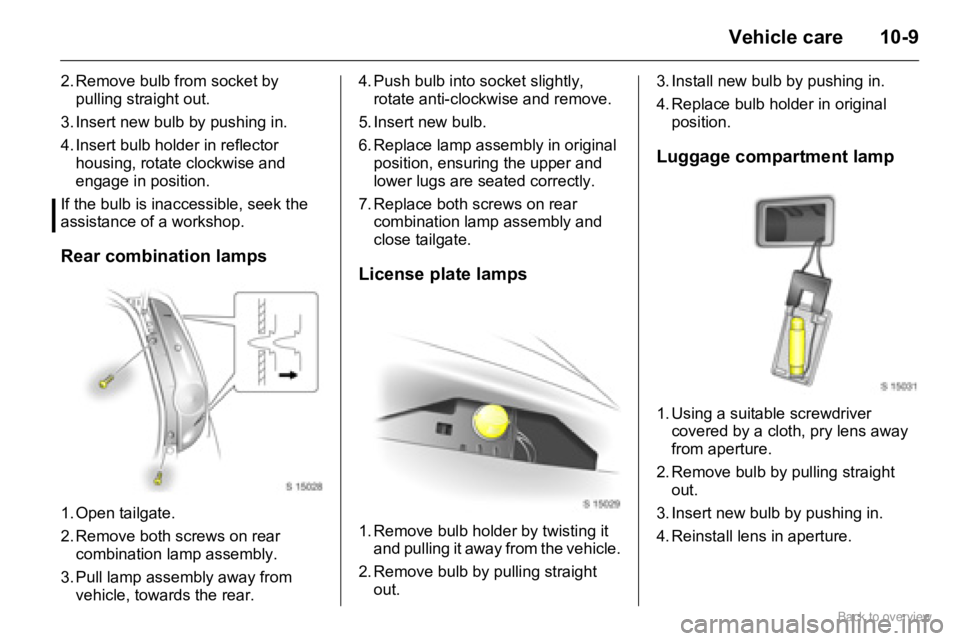
Rear combination lamps
1. Open tailgate.
2. Remove both screws on rear
combination lamp assembly.
3. Pull lamp assembly away from
vehicle, towards the rear.4. Push bulb into socket slightly,
rotate anti-clockwise and remove.
5. Insert new bulb.
6. Replace lamp assembly in original
position, ensuring the upper and
lower lugs are seated correctly.
7. Replace both screws on rear
combination lamp assembly and
close tailgate.
License plate lamps
1. Remove bulb holder by twisting it
and pulling it away from the vehicle.
2. Remove bulb by pulling straight
out.3. Install new bulb by pushing in.
4. Replace bulb holder in original
position.
Luggage compartment lamp
1. Using a suitable screwdriver
covered by a cloth, pry lens away
from aperture.
2. Remove bulb by pulling straight
out.
3. Insert new bulb by pushing in.
4. Reinstall lens in aperture.
Page 110 of 153
10-10 Vehicle care
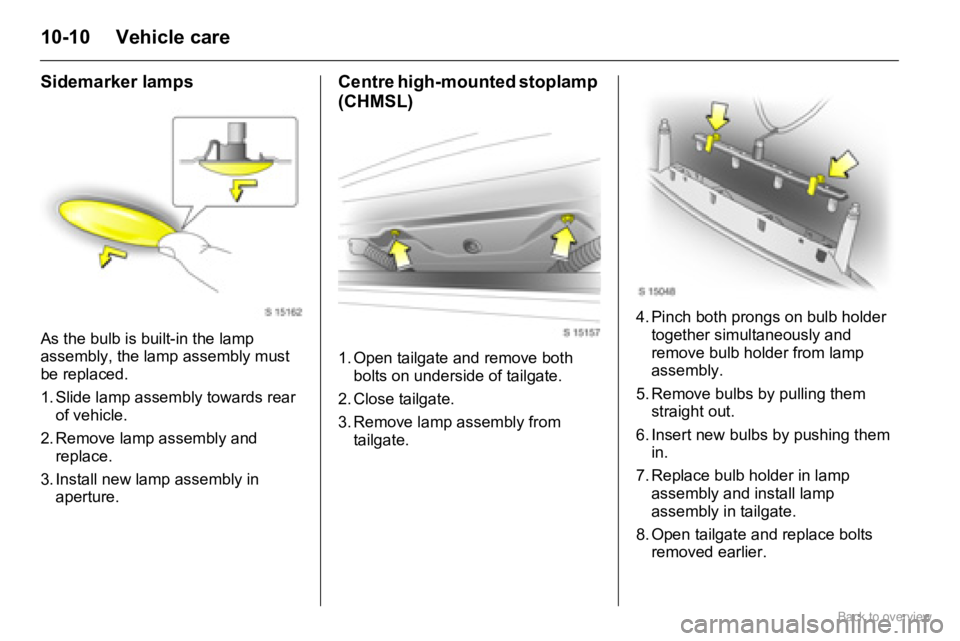
Sidemarker lamps
As the bulb is built-in the lamp
assembly, the lamp assembly must
be replaced.
1. Slide lamp assembly towards rear
of vehicle.
2. Remove lamp assembly and
replace.
3. Install new lamp assembly in
aperture.
Centre high-mounted stoplamp
(CHMSL)
1. Open tailgate and remove both
bolts on underside of tailgate.
2. Close tailgate.
3. Remove lamp assembly from
tailgate.4. Pinch both prongs on bulb holder
together simultaneously and
remove bulb holder from lamp
assembly.
5. Remove bulbs by pulling them
straight out.
6. Insert new bulbs by pushing them
in.
7. Replace bulb holder in lamp
assembly and install lamp
assembly in tailgate.
8. Open tailgate and replace bolts
removed earlier.
Page 118 of 153
10-18 Vehicle care
Tyre chains must not be used on the
temporary spare wheel.
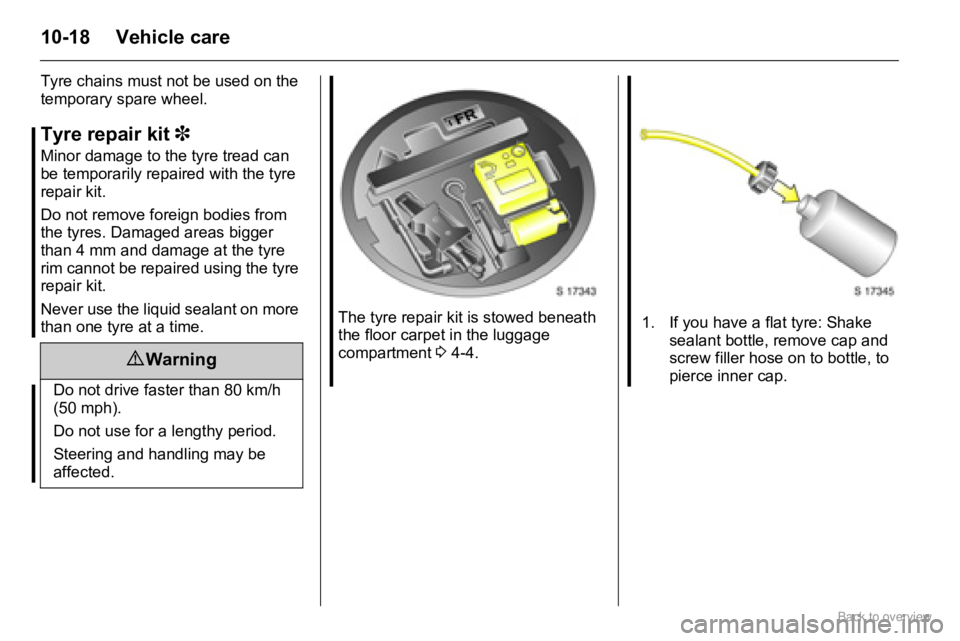
Tyre repair kit 3
Minor damage to the tyre tread can
be temporarily repaired with the tyre
repair kit.
Do not remove foreign bodies from
the tyres. Damaged areas bigger
than 4 mm and damage at the tyre
rim cannot be repaired using the tyre
repair kit.
Never use the liquid sealant on more
than one tyre at a time.The tyre repair kit is stowed beneath
the floor carpet in the luggage
compartment 3 4-4.
9 Warning
Do not drive faster than 80 km/h
(50 mph).
Do not use for a lengthy period.
Steering and handling may be
affected.
1. If you have a flat tyre: Shake
sealant bottle, remove cap and
screw filler hose on to bottle, to
pierce inner cap.
Page 121 of 153

10-21Vehicle care
Note
The driving characteristics of the
repaired tyre is severely affected,
therefore have this tyre replaced.
If unusual noise is heard or the
compressor becomes hot, turn
compressor off for at least
30 minutes.
Pay attention to storage information
and best before date on sealant
bottle. Its sealing capability is not
guaranteed after this time.The sealant bottle can only be used
once. Replace used sealant bottle.
Dispose of used tyre repair kits in
accordance with the applicable laws. 14. Remove any excess sealant
using a cloth.
15. Attach supplied sticker
containing the maximum
permitted speed within the
driver’s field of view.
16. Continue driving immediately
so that sealant is evenly
distributed throughout the tyre.
After driving approx. 5 km
(3 miles) (but no more than
10 minutes), stop and check
tyre pressure, using the
compressor.
17. If the tyre pressure has not
dropped below 130 kPa
(1.3 bar), it may be adjusted to
the prescribed value. Repeat
the procedure until there is no
more loss of pressure.
If the tyre pressure has
dropped below 130 kPa
(1.3 bar), the vehicle must not
be driven. Seek the assistance
of a workshop.
18. Stow tyre repair kit below the
floor carpet in the luggage
compartment.
Page 124 of 153

10-24 Vehicle care
Temporary spare wheel
The temporary spare wheel is
designed for use on your vehicle only.
Do not attempt to use the spare tyre
on a different wheel, or use a different
tyre on the spare wheel, as they will
not fit.
Ensure the temporary spare wheel is
inflated to the correct tyre pressure 3
12-8.The temporary spare wheel is located
in the luggage compartment and is
secured with a screw-in retainer.
To access the spare wheel, open
tailgate and pull up luggage
compartment floor carpet using the
central strap located near the tailgate
latch and hang the string on the hook
provided 3 4-4.
If equipped, remove the under floor
storage compartment 3 from the
luggage compartment by pulling it up
by the handle located near the
tailgate latch, to access the spare
wheel 3 4-4. 8. Remove wheel and install
spare wheel.
9. Screw on wheel bolts and
tighten slightly by hand until
wheel is held against the hub.
10. Apply a light coating of grease
to the cone of each wheel bolt.
Do not grease the threads.
11. Rotate jack handle anti-
clockwise using the attached
wheel bolt wrench to lower
vehicle to the ground.
12. Tighten wheel bolts to the
correct torque (85 Nm) in a
cross wise sequence, putting
the wheel bolt wrench on as far
as possible.
13. Stow replaced wheel in
luggage compartment.
14. Stow the warning triangle 3
and jacking equipment 3 4-5,
10-25.
Page 126 of 153

10-26 Vehicle care
Rotate jack shaft anti-clockwise and
remove jack from storage bracket.
To stow the jack after use, place it in
its storage bracket and turn jack shaft
clockwise until jack is held securely in
place.Jump starting 3
Do not start with quick charger, to
prevent damage to electronic
components.
Never expose the battery to naked
flames or sparks.
„A discharged battery can freeze at
temperatures of 0 °C. Defrost the
battery in a warm room before
connecting the jump leads.
„Do not allow battery fluid to contact
eyes, skin, fabrics or painted
surfaces. The fluid contains
sulphuric acid which can cause
injuries and damage in the event of
direct contact.„Wear eye protection and protective
clothing when handling a battery.
„Use auxiliary battery with same
voltage (12 volts). Its capacity (Ah)
must not be considerably less than
that of the discharged battery.
Voltage and capacity information
can be found on the batteries.
„Use jump leads with insulated
terminals and a width of at least
16 mm
2 (25 mm2 for diesel
engines).
„Do not disconnect the discharged
battery from the vehicle.
„Switch off all unnecessary
electrical consumers. Infotainment
system may be damaged if
switched on while jump starting.
„Do not lean over the battery during
jump starting procedure.
„Do not allow the terminals of one
lead to touch those of the other
lead.
„The vehicles should not touch while
jump starting.
„Apply parking brake.
9 Warning
This must be done with extreme
care. Any deviation from the
following instructions could lead
to personal injury or damage
resulting from battery explosion,
as well as to damage to the
electrical systems in both
vehicles.
Page 128 of 153

10-28 Vehicle care
Towing
Towing the vehicle
Towing from the front is permissible
in emergency situations only.
For fixing of the front towing eye,
remove the towing eye socket cover
by pressing the lower part of the
cover.
The towing eye attachment is stored
below the spare wheel in the luggage
compartment 3 10-25.Screw in towing eye attachment
clockwise until it is firmly in place. If
necessary, use jack handle to tighten.
Attach a tow rope 3 - or better still a
tow rod 3 - to the front towing eye.
The front towing eye must only be
used for towing and not recovering
the vehicle.
Switch on the ignition (3 9-1) to
release the steering column lock and
to permit operation of the brake
lamps and windscreen wipers.
Manual transmission in neutral,
automatic transmission 3 in N.More brake pedal pressure is
necessary when braking since the
brake servo unit is operative only
when the engine is running.
Considerably greater steering force is
necessary since this unit is operative
only when the engine is running.
To prevent entry of exhaust fumes
from towing vehicle, switch on air
recirculation mode (3 8-3) and close
the windows.
Do not tow the vehicle with a tow
rope3 or tow rod 3 for extended
periods, to avoid causing damage to
the vehicle. Only tow in this manner
on hard-surfaced roads.
Vehicles with manual or automatic
transmission3 can be towed from
the front, provided the front axle is
raised off the ground and the parking
brake is released.
Caution
Drive slowly and avoid jerky
movements. Impermissible tractive
forces could damage the vehicles.