2009 OPEL AGILA fuel
[x] Cancel search: fuelPage 84 of 153
8-3 Climate controls
For simultaneous warming of the
footwell, set air distribution rotary
knob to J.
Switch on air conditioning 3 to
improve defrosting efficiency when
position J or V is selected.
Air recirculation mode 3
During ’normal’ operation, the
heating, ventilation and air
conditioning system 3 uses outside
air. To prevent fumes or unpleasant
odours from entering the vehicle
when in stationary traffic and when
rapid heating or cooling of the
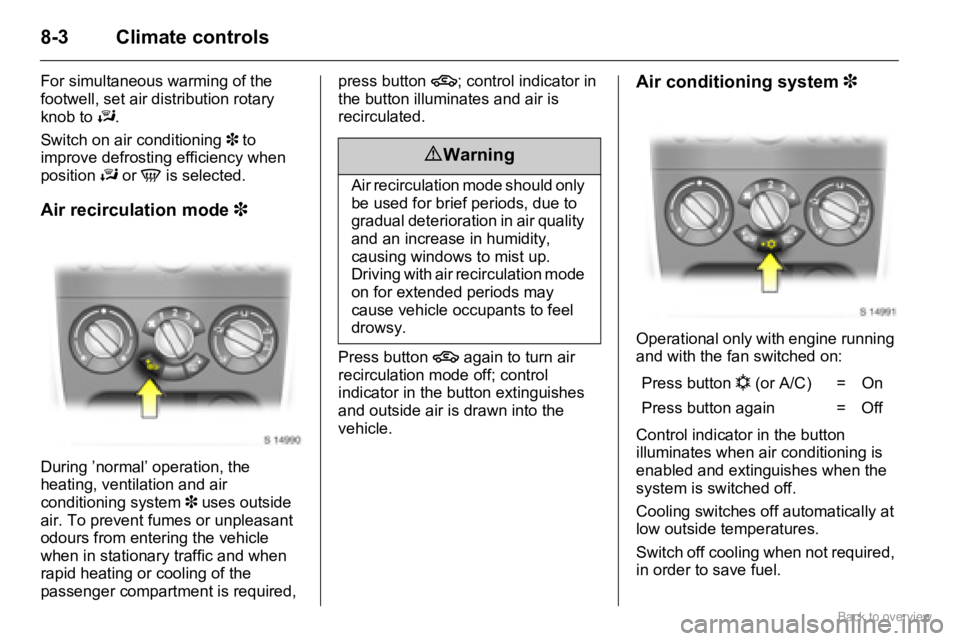
passenger compartment is required, press button 4; control indicator in
the button illuminates and air is
recirculated.
Press button 4 again to turn air
recirculation mode off; control
indicator in the button extinguishes
and outside air is drawn into the
vehicle.
Air conditioning system 3
Operational only with engine running
and with the fan switched on:
Control indicator in the button
illuminates when air conditioning is
enabled and extinguishes when the
system is switched off.
Cooling switches off automatically at
low outside temperatures.
Switch off cooling when not required,
in order to save fuel.
9 Warning
Air recirculation mode should only
be used for brief periods, due to
gradual deterioration in air quality
and an increase in humidity,
causing windows to mist up.
Driving with air recirculation mode
on for extended periods may
cause vehicle occupants to feel
drowsy.
Press button n (or A/C) = On
Press button again = Off
Page 88 of 153
9-1 Driving and operating
Driving and
operatingStarting the vehicle
Driving hints
During the first 1000 km (600 miles),
drive your vehicle at various speeds.
Do not use full throttle. Never allow
the engine to labour at low revs.
Make good use of all gears. Depress
the accelerator pedal a maximum of
around three quarters of the available
pedal travel in all gears and drive
ranges.
Do not brake unnecessarily hard for
the first 200 km (125 miles).
When the vehicle is driven for the first
time, wax and oil on the exhaust
system may evaporate, producing
smoke-like emissions which should
not be inhaled. Allow wax and oil to
evaporate while the vehicle is in the
open air.
Never coast with engine not running
as many units may then not function
(e.g. brake servo unit, power
steering, airbag system). Driving in
this manner is a danger to yourself
and others.Pedals
To ensure the pedal travel is
uninhibited, there must be no mats in
the area of the pedals.
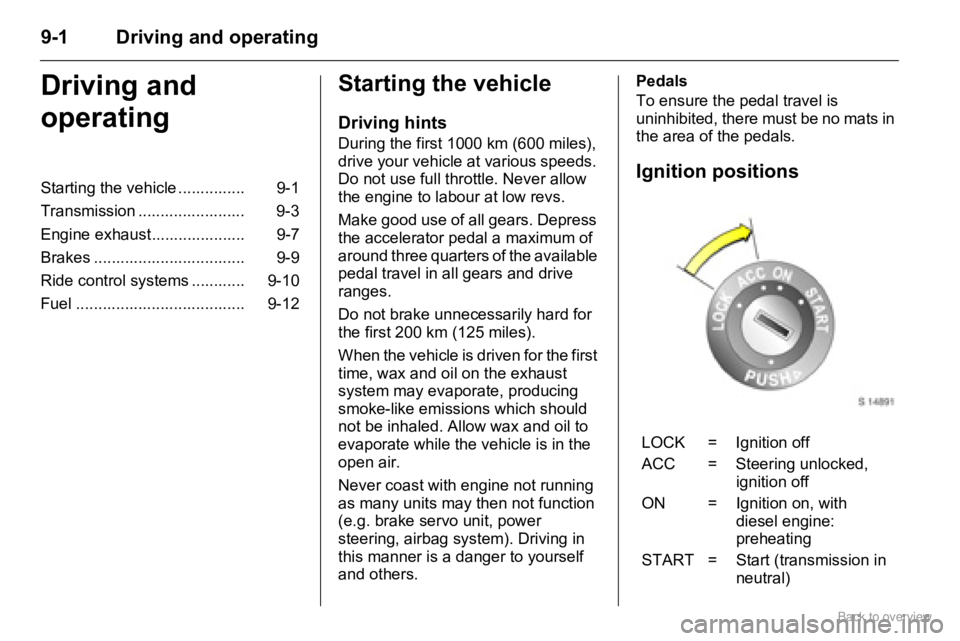
Ignition positionsStarting the vehicle ............... 9-1
Transmission ........................ 9-3
Engine exhaust..................... 9-7
Brakes .................................. 9-9
Ride control systems ............ 9-10
Fuel ...................................... 9-12
LOCK = Ignition off
ACC = Steering unlocked,
ignition off
ON = Ignition on, with
diesel engine:
preheating
START = Start (transmission in
neutral)
Page 94 of 153
9-7 Driving and operating
Engine exhaust
Diesel particle filter (DPF) 3
The diesel particle filter removes
polluting soot particles out of the
exhaust.
The system contains a self-cleaning
function at certain intervals. The filter
is cleaned by burning the soot
particles at high temperature. This
procedure runs automatically under
certain vehicle conditions and can
take up to 30 minutes, during which
time fuel consumption may increase.
The smell and the noise that occur
are normal.
Self-cleaning may begin
automatically during idling; engine
speed increases and cooling fan
operates automatically.The system cannot automatically
clean itself under certain vehicle
conditions, such as driving short
distances.
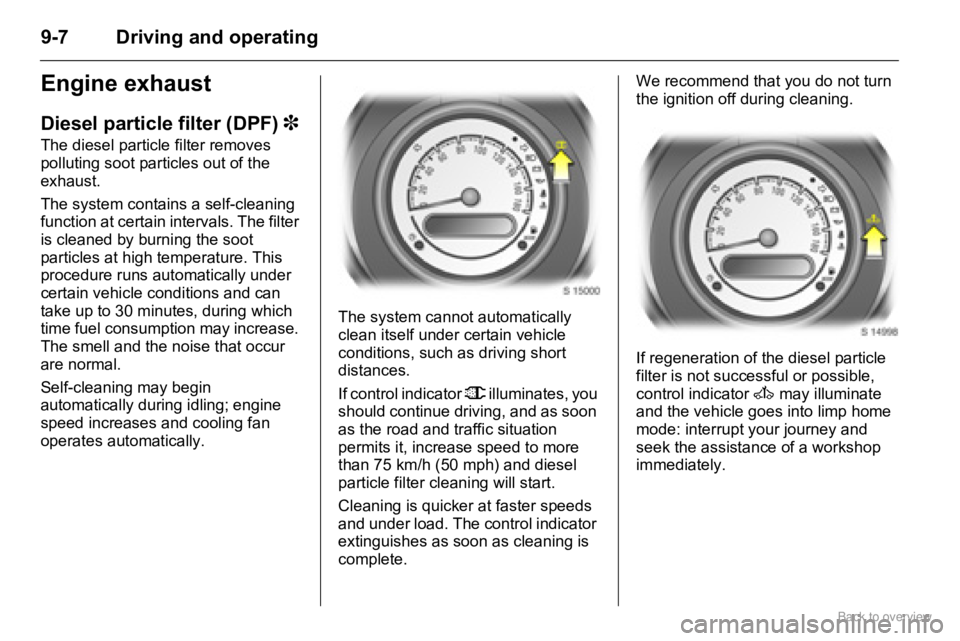
If control indicator 8 illuminates, you
should continue driving, and as soon
as the road and traffic situation
permits it, increase speed to more
than 75 km/h (50 mph) and diesel
particle filter cleaning will start.
Cleaning is quicker at faster speeds
and under load. The control indicator
extinguishes as soon as cleaning is
complete.We recommend that you do not turn
the ignition off during cleaning.
If regeneration of the diesel particle
filter is not successful or possible,
control indicator A may illuminate
and the vehicle goes into limp home
mode: interrupt your journey and
seek the assistance of a workshop
immediately.
Page 95 of 153

9-8Driving and operating
Catalytic converter
Controlling exhaust emission
The catalytic converter reduces to a
minimum the proportion of noxious
materials in the exhaust, such as
carbon monoxide (CO),
hydrocarbons (CH) and nitrogen
oxides (NO
x).
Leaded fuel will damage the catalytic
converter and parts of the electronic
system, thereby rendering them
inoperative.„If the engine misfires or runs
roughly after a cold start, the
engine power has reduced
significantly or other unusual
operating problems occur that
indicate a fault in the ignition
system, seek the assistance of a
workshop as quickly as possible.
Drive at a slower speed and with
less engine revs for a short time, if
necessary.
„If unburned fuel enters the catalytic
converter, this may result in
overheating and irreparable
damage to the catalytic converter.
You should therefore avoid
frequent cold starts, unnecessarily
long use of the starter when setting
off, running the tank dry (an
irregular fuel supply leads to
overheating) and starting the
engine by pushing or towing.„If the control indicator for exhaust
emissions Z illuminates whilst
driving, seek the assistance of a
workshop immediately. Control
indicatorZ for exhaust emissions
35-11.
Exhaust gases
Caution
Damage to the catalytic converter or
the vehicle may result if the following
points are not observed.
9 Danger
Engine exhaust gases contain
poisonous carbon monoxide,
which has no colour or odour and
can be lethal if inhaled.
If exhaust fumes penetrate the
vehicle interior, open the windows
and seek the assistance of a
workshop immediately.
Page 99 of 153

9-12Driving and operating
Fuel
Petrol engine fuel
Use only unleaded fuels meeting the
specifications of DIN EN 228.
Refuel using the correct octane
number 3 12-3.
If the RON 95 label is attached to the
tank flap, unleaded fuel with an
octane rating of 95 or higher must be
used.
Diesel engine fuel
Use only diesel engine fuel meeting
the specifications of DIN EN 590.
Marine diesel fuel, fuel oils, diesel
fuels, which are entirely or partially
plant based such as rape seed oil or
bio-diesel, Aquazole and similar
diesel-water emulsions must not be
used.The flow and filterability of diesel
fuels are temperature-dependent.
Fuel filler cap
If replacing the fuel filler cap, be sure
to use the original fuel filler cap for
your model, to ensure full
functionality.
Refuelling
Caution
A fuel of too low an octane can lead
to engine damage.
9 Warning
Before refuelling, switch off the
engine and any heating systems
with combustion chambers.
Switch off mobile phones.
Fuel is inflammable and
explosive, therefore avoid dealing
with fuel near naked flames and
doing anything that would
generate sparks. No smoking!
This also applies where the smell
of fuel is noticeable. If the smell of
fuel vapour occurs in the vehicle
itself, have the cause remedied
immediately by a workshop.
Observe the operating and safety
instructions of the petrol station
when refuelling.
Page 100 of 153

9-13 Driving and operating
The tank flap is opened by pulling up
the release lever located on the
outboard side of the driver’s seat.The fuel filler neck is located on the
left rear side of the vehicle.
To open fuel filler cap: turn it anti-
clockwise.
Fuel consumption,
CO
2emissions
Directive 80/1268/EEC (last changed
by 2004/3/EG) has applied for the
measurement of fuel consumption
since 1996.
The directive is oriented to actual
driving practices: Urban driving is
rated at approx.
1/3 and extra-urban
driving with approx. 2/3 (urban and
extra-urban consumption). Cold
starts and acceleration phases are
also taken into consideration.
The specification of CO
2 emission is
also a constituent of the directive.The figures given must not be taken
as a guarantee for the actual fuel
consumption of a particular vehicle.
All values are based on the EU base
model with standard equipment.
The calculation of fuel consumption
as specified by directive 2004/3/EG
takes account of the vehicle’s kerb
weight, ascertained in accordance
with these regulations. Optional
extras may result in slightly higher
fuel consumption and CO
2emission
levels than those quoted.
Fuel consumption, CO
2emissions
312-4.
Caution
Wipe off any overflowing fuel
immediately.
Page 101 of 153

10-1Vehicle care
Vehicle care General information
Accessories and vehicle
modifications
We recommend the use of ‘Opel
genuine parts and accessories’
expressly released for your vehicle
type. Do not make any changes to the
vehicle’s electrical systems.
End-of-life vehicle recovery
Information on end-of-life vehicle
recovery centres and the recycling of
end-of-life vehicles is available at
www.opel.com.
Vehicle checks
Bonnet .................................. 10-2
Engine oil .............................. 10-3
Engine coolant ...................... 10-4
Windscreen/rear window
washer fluid ........................ 10-5
Windscreen/rear window
wipers ................................. 10-5
Brakes ................................... 10-6
Battery .................................. 10-6
Diesel fuel system, bleeding . 10-7
Bulb replacement .................. 10-7
Fuses .................................... 10-11
Wheels .................................. 10-15
Tyre repair kit 3 ..................... 10-18
Wheel changing .................... 10-22
Jump starting 3 ..................... 10-26
Towing .................................. 10-28
Interior care........................... 10-29
Exterior care ......................... 10-30
9 Warning
Only carry out engine
compartment checks when the
ignition is switched off.
The cooling fan can start to
operate unexpectedly, even when
the ignition is switched off.
9 Danger
Electronic ignition systems
generate very high voltages. Do
not touch the ignition system; high
voltage can be fatal.
Page 107 of 153

10-7Vehicle care
Diesel fuel system, bleeding
It is possible to restart the engine if
the tank has been run dry.
With vehicle stationary, turn key to
ignition switch position ON for more
than 5 seconds, then turn to START.
If engine does not start, wait
approx.15 seconds before repeating
starting procedure.
If the engine will still not start, seek
the assistance of a workshop.
Bulb replacement
Before replacing a bulb, switch off
ignition and relevant switch.
Only hold new bulbs at base! Do not
touch the bulb glass with bare hands.
Replacement bulb must be in
accordance with data on base of
defective bulb. Do not exceed
wattage given on bulb base.
Headlamps
Battery removal
Diesel engines: for headlamp bulb
replacement on the battery side, it is
necessary to first disconnect and
remove the battery then remove the
coolant expansion tank and fuse box.
1. Switch off ignition and exterior
lamps.
2. Open bonnet and disconnect
battery by detaching negative (-)
terminal followed by positive (+)
terminal.3. Unscrew the retaining bolt using a
suitable tool and remove battery,
coolant expansion tank and fuse
box.
When reinstalling the battery,
reconnect the positive (+) terminal
first and then the negative (-)
terminal.