2009 NISSAN CUBE ECU
[x] Cancel search: ECUPage 263 of 321
Black plate (261,1)
Model "Z12-D" EDITED: 2009/ 1/ 28
.Keep the battery surface clean and dry.
Clean the battery with a solution of baking
soda and water.
.Make certain the terminal connections are
clean and securely tightened.
.If the vehicle is not to be used for 30 days or
longer, disconnect the negative7battery
terminal cable to prevent discharging it.
WARNING
.Do not expose the battery to flames
or electrical sparks. Hydrogen gas
generated by the battery is explo-
sive. Do not allow battery fluid to
contact your skin, eyes, fabrics or
painted surfaces. After touching a
battery or battery cap, do not touch
or rub your eyes. Thoroughly wash
your hands. If the acid contacts your
eyes, skin or clothing, immediately
flush with water for at least 15
minutes and seek medical attention.
.Do not operate the vehicle if the
fluid in the battery is low. Low
battery fluid can cause a higher load
on the battery which can generate
heat, reduce battery life, and in
some cases lead to an explosion..When working on or near a battery,
always wear suitable eye protection
and remove all jewelry.
.Battery posts, terminals and related
accessories contain lead and lead
compounds. Wash hands after
handling.
.Keep the battery out of the reach of
children.
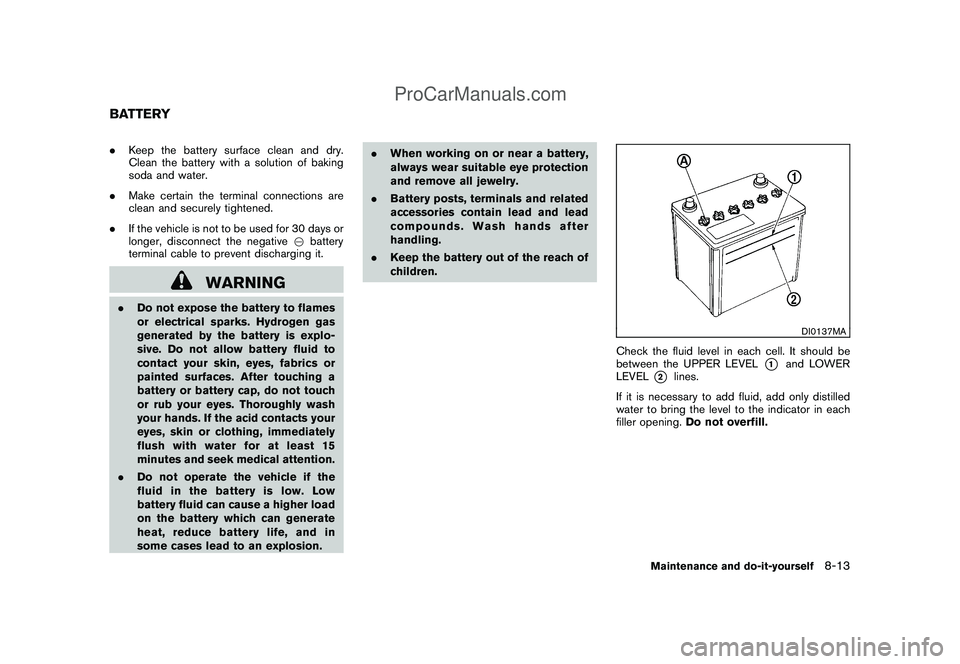
DI0137MA
Check the fluid level in each cell. It should be
between the UPPER LEVEL
*1
and LOWER
LEVEL
*2
lines.
If it is necessary to add fluid, add only distilled
water to bring the level to the indicator in each
filler opening.Do not overfill.
BATTERY
Maintenance and do-it-yourself
8-13
ProCarManuals.com
Page 265 of 321

Black plate (263,1)
Model "Z12-D" EDITED: 2009/ 1/ 28
SDI2422
1. Drive belt auto-tensioner
2. Crankshaft pulley
3. Air conditioner compressor
4. Water pump
5. Alternator
WARNING
Be sure the ignition switch is in the OFF
or LOCK position before servicing drive
belts. The engine could rotate unex-
pectedly.
1. Visually inspect the belt for signs of unusual
wear, cuts, fraying or looseness. If the belt is
in poor condition or loose, have it replacedor adjusted by a NISSAN dealer.
2. Have the belt condition checked regularly.
WARNING
Be sure the engine and ignition switch
are off and that the parking brake is
engaged securely.
CAUTION
Be sure to use the correct socket to
remove the spark plugs. An incorrect
socket can damage the spark plugs.
DRIVE BELT SPARK PLUGS
Maintenance and do-it-yourself
8-15
ProCarManuals.com
Page 272 of 321

Black plate (270,1)
Model "Z12-D" EDITED: 2009/ 1/ 28
CAUTION
Be careful not to allow children to
swallow the battery and removed parts.
SDI2134
KEYFOBReplace the battery in the keyfob as follows:
1. Remove the screw.
2. Insert a small screwdriver into the slit of the
corner and twist it to separate the upper partfrom the lower part. Use a cloth to protect
the casing.
3. Replace the battery with a new one.
Recommended battery:
CR1620 or equivalent
.Do not touch the internal circuit and
electric terminals as doing so could
cause a malfunction.
.Hold the battery by the edges. Holding
the battery across the contact points will
seriously deplete the storage capacity.
.Make sure that the+side faces the
bottom of the case.
4. Close the lid securely and install the screw.
5. Operate the buttons to check its operation.
See a NISSAN dealer if you need any assistance
for replacement.
FCC Notice:
Changes or modifications not expressly
approved by the party responsible for
compliance could void the user’s authority
to operate the equipment.
This device complies with Part 15 of the
FCC Rules and RSS-210 of Industry Cana-
da.
KEY BATTERY REPLACEMENT8-22
Maintenance and do-it-yourself
ProCarManuals.com
Page 274 of 321

Black plate (272,1)
Model "Z12-D" EDITED: 2009/ 1/ 28
SDI1889
4. Align the tips of the upper and lower parts
*1, and then push them together
*2
until it
is securely closed.
5. Operate the buttons to check its operation.
See a NISSAN dealer if you need any assistance
for replacement.
FCC Notice:
This equipment has been tested and found
to comply with the limits for a Class B
digital device pursuant to part 15 of the
FCC Rules. These limits are designed to
provide reasonable protection against
harmful interference in a residential in-
stallation. This equipment generates, usesand can radiate radio frequency energy
and, if not installed and used in accor-
dance with the instructions, may cause
harmful interference to radio communica-
tions. However, there is no guarantee that
interference will not occur in a particular
installation. If this equipment does cause
harmful interference to radio or television
reception, which can be determined by
turning the equipment off and on, the user
is encouraged to try to correct the inter-
ference by one or more of the following
measures:
—Reorient or relocate the receiving an-
tenna.
—Increase the separation between the
equipment and the receiver.
—Connect the equipment into an outlet
on a circuit different from that to which
the receiver is connected.
—Consult the dealer or an experienced
radio/TV technician for help.
8-24
Maintenance and do-it-yourself
ProCarManuals.com
Page 284 of 321

Black plate (282,1)
Model "Z12-D" EDITED: 2009/ 1/ 28
All season tiresNISSAN specifies all season tires on some
models to provide good performance all year,
including snowy and icy road conditions. All
Season tires are identified by ALL SEASON
and/or M&S (Mud and Snow) on the tire
sidewall. Snow tires have better snow traction
than All Season tires and may be more appro-
priate in some areas.Summer tiresNISSAN specifies summer tires on some
models to provide superior performance on dry
roads. Summer tire performance is substantially
reduced in snow and ice. Summer tires do not
have the tire traction rating M&S on the tire
sidewall.
If you plan to operate your vehicle in snowy or
icy conditions, NISSAN recommends the use of
SNOW tires or ALL SEASON tires on all four
wheels.Snow tiresIf snow tires are needed, it is necessary to select
tires equivalent in size and load rating to the
original equipment tires. If you do not, it can
adversely affect the safety and handling of your
vehicle.
Generally, snow tires will have lower speed
ratings than factory equipped tires and may not
match the potential maximum vehicle speed.Never exceed the maximum speed rating of the
tire.
If you install snow tires, they must be the same
size, brand, construction and tread pattern on all
four wheels.
For additional traction on icy roads, studded
tires may be used. However, some U.S. states
and Canadian provinces prohibit their use.
Check local, state and provincial laws before
installing studded tires. Skid and traction cap-
abilities of studded snow tires, on wet or dry
surfaces, may be poorer than that of non-
studded snow tires.
TIRE CHAINSUse of tire chains may be prohibited according
to location. Check the local laws before instal-
ling tire chains. When installing tire chains, make
sure they are the proper size for the tires on your
vehicle and are installed according to the chain
manufacturer’s suggestions.Use only SAE
Class S chains.Class “S” chains are used on
vehicles with restricted tire to vehicle clearance.
Vehicles that can use Class “S” chains are
designed to meet the SAE standard minimum
clearances between the tire and the closest
vehicle suspension or body component required
to accommodate the use of a winter traction
device (tire chains or cables) . The minimum
clearances are determined using the factory
equipped tire size. Other types may damageyour vehicle. Use chain tensioners when re-
commended by the tire chain manufacturer to
ensure a tight fit. Loose end links of the tire
chain must be secured or removed to prevent
the possibility of whipping action damage to the
fenders or underbody. If possible, avoid fully
loading your vehicle when using tire chains. In
addition, drive at a reduced speed. Otherwise,
your vehicle may be damaged and/or vehicle
handling and performance may be adversely
affected.
Tire chains must be installed only on the
front wheels and not on the rear wheels.
Never install tire chains on a TEMPORARY USE
ONLY spare tire.
Do not use tire chains on dry roads. Driving with
tire chains in such conditions can cause damage
to the various mechanisms of the vehicle due to
some overstress.
8-34
Maintenance and do-it-yourself
ProCarManuals.com
Page 289 of 321

Black plate (28,1)
9 Technical and consumer information
Model "Z12-D" EDITED: 2009/ 1/ 28
Capacities and recommended fuel/lubricants............ 9-2
Fuel recommendation...................................... 9-3
Engine oil and oil filter recommendation............... 9-5
Air conditioning system refrigerant and lubricant
recommendations........................................... 9-6
Specifications.................................................... 9-7
Engine......................................................... 9-7
Wheels and tires............................................ 9-7
Dimensions and weights.................................. 9-8
When traveling or registering your vehicle in
another country.................................................. 9-8
Vehicle identification........................................... 9-8
Vehicle Identification Number (VIN) plate............. 9-8
Vehicle identification number (chassis number)...... 9-9
Engine serial number...................................... 9-9
F.M.V.S.S./C.M.V.S.S. certification label............... 9-9
Emission control information label.................... 9-10
Tire and loading information label..................... 9-10
Air conditioner specification label
(if so equipped)........................................... 9-10
Installing front license plate................................ 9-11
Except for Kro¯
m models................................. 9-11For Kro¯
m models......................................... 9-13
Vehicle loading information................................. 9-14
Terms........................................................ 9-14
Vehicle load capacity.................................... 9-15
Securing the load......................................... 9-17
Loading tips................................................ 9-17
Measurement of weights................................ 9-18
Towing a trailer................................................ 9-18
Flat towing..................................................... 9-18
Continuously Variable Transmission (CVT).......... 9-19
Manual Transmission..................................... 9-19
Uniform tire quality grading................................. 9-19
Treadwear.................................................. 9-19
Traction AA, A, B and C................................ 9-19
Temperature A, B and C................................ 9-19
Emission control system warranty......................... 9-20
Reporting safety defects (US only)....................... 9-20
Readiness for Inspection/Maintenance (I/M) test . ..... 9-21
Event Data Recorders (EDR).............................. 9-22
Owner’s Manual/Service Manual order information . . . 9-22
In the event of a collision............................... 9-23
ProCarManuals.com
Page 305 of 321
Black plate (303,1)
Model "Z12-D" EDITED: 2009/ 1/ 28
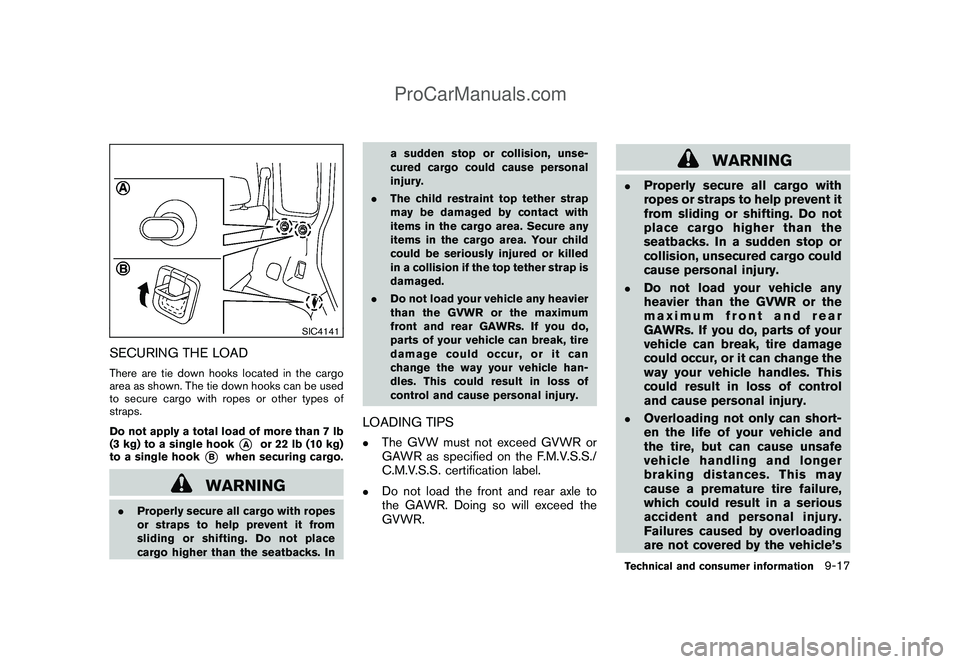
SIC4141
SECURING THE LOADThere are tie down hooks located in the cargo
area as shown. The tie down hooks can be used
to secure cargo with ropes or other types of
straps.
Do not apply a total load of more than 7 lb
(3 kg) to a single hook
*A
or 22 lb (10 kg)
to a single hook
*B
when securing cargo.
WARNING
.Properly secure all cargo with ropes
or straps to help prevent it from
sliding or shifting. Do not place
cargo higher than the seatbacks. Ina sudden stop or collision, unse-
cured cargo could cause personal
injury.
.The child restraint top tether strap
may be damaged by contact with
items in the cargo area. Secure any
items in the cargo area. Your child
could be seriously injured or killed
in a collision if the top tether strap is
damaged.
.Do not load your vehicle any heavier
than the GVWR or the maximum
front and rear GAWRs. If you do,
parts of your vehicle can break, tire
damage could occur, or it can
change the way your vehicle han-
dles. This could result in loss of
control and cause personal injury.
LOADING TIPS.
The GVW must not exceed GVWR or
GAWR as specified on the F.M.V.S.S./
C.M.V.S.S. certification label.
.
Do not load the front and rear axle to
the GAWR. Doing so will exceed the
GVWR.
WARNING
.
Properly secure all cargo with
ropes or straps to help prevent it
from sliding or shifting. Do not
place cargo higher than the
seatbacks. In a sudden stop or
collision, unsecured cargo could
cause personal injury.
.
Do not load your vehicle any
heavier than the GVWR or the
maximum front and rear
GAWRs. If you do, parts of your
vehicle can break, tire damage
could occur, or it can change the
way your vehicle handles. This
could result in loss of control
and cause personal injury.
.
Overloading not only can short-
en the life of your vehicle and
the tire, but can cause unsafe
vehicle handling and longer
braking distances. This may
cause a premature tire failure,
which could result in a serious
accident and personal injury.
Failures caused by overloading
are not covered by the vehicle’s
Technical and consumer information
9-17
ProCarManuals.com
Page 306 of 321

Black plate (304,1)
Model "Z12-D" EDITED: 2009/ 1/ 28
warranty.
MEASUREMENT OF WEIGHTSSecure loose items to prevent weight shifts
that could affect the balance of your
vehicle. When the vehicle is loaded, drive
to a scale and weigh the front and the rear
wheels separately to determine axle loads.
Individual axle loads should not exceed
either of the Gross Axle Weight Ratings
(GAWR) . The total of the axle loads should
not exceed the Gross Vehicle Weight
Rating (GVWR) . These ratings are given
on the vehicle certification label. If weight
ratings are exceeded, move or remove
items to bring all weights below the ratings.
Do not tow a trailer with your vehicle.Towing your vehicle with all four wheels on the
ground is sometimes called flat towing. This
method is sometimes used when towing a
vehicle behind a recreational vehicle, such as a
motor home.
CAUTION
.Failure to follow these guidelines
can result in severe transmission
damage.
.Whenever flat towing your vehicle,
always tow forward, never back-
ward.
.DO NOT tow any Continuously Vari-
able Transmission (CVT) vehicle
with all four wheels on the ground
(flat towing) . Doing so WILL DA-
MAGE internal transmission parts
due to lack of transmission lubrica-
tion.
.For emergency towing procedures
refer to “TOWING YOUR VEHICLE”
in the “6. In case of emergency”
section of this manual.
TOWING A TRAILER FLAT TOWING
9-18
Technical and consumer information
ProCarManuals.com