Page 15 of 313
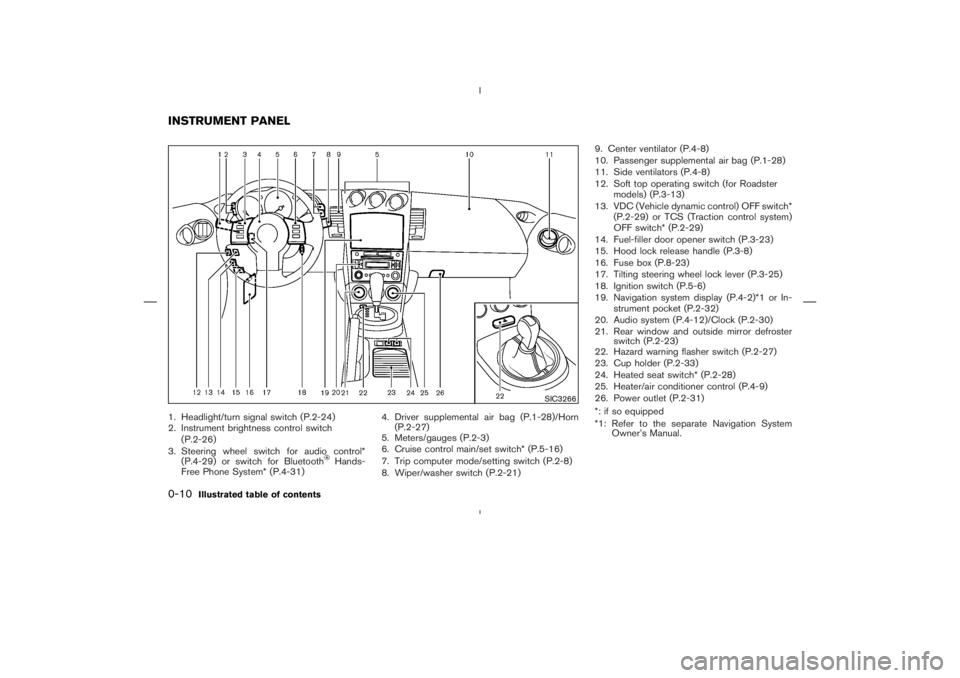
Hands-
Free Phone System* (P.4-31)4. Driver supplemental air bag (P.1-28)/Horn
(P.2-27)
5. Meters/gauges (P.2-3)
6. Cruise control main/set switch* (P.5-16)
7. Trip computer mode/setting switch (P.2-8)
8. Wiper/washer switch (P.2-21)9. Center ventilator (P.4-8)
10. Passenger supplemental air bag (P.1-28)
11. Side ventilators (P.4-8)
12. Soft top operating switch (for Roadster
models) (P.3-13)
13. VDC (Vehicle dynamic control) OFF switch*
(P.2-29) or TCS (Traction control system)
OFF switch* (P.2-29)
14. Fuel-filler door opener switch (P.3-23)
15. Hood lock release handle (P.3-8)
16. Fuse box (P.8-23)
17. Tilting steering wheel lock lever (P.3-25)
18. Ignition switch (P.5-6)
19. Navigation system display (P.4-2)*1 or In-
strument pocket (P.2-32)
20. Audio system (P.4-12)/Clock (P.2-30)
21. Rear window and outside mirror defroster
switch (P.2-23)
22. Hazard warning flasher switch (P.2-27)
23. Cup holder (P.2-33)
24. Heated seat switch* (P.2-28)
25. Heater/air conditioner control (P.4-9)
26. Power outlet (P.2-31)
*: if so equipped
*1: Refer to the separate Navigation System
Owner’s Manual.
SIC3266
INSTRUMENT PANEL0-10
Illustrated table of contents
Page 65 of 313
Hands-
Free Phone System (if so equipped)
4. Driver supplemental air bag/Horn
5. Meters/gauges6. Cruise control main/set switch
(if so equipped)
7. Trip computer mode/setting switch
8. Wiper/washer switch
9. Center ventilator
10. Passenger supplemental air bag11. Side ventilator
12. Soft top operating switch (for Roadster
models)
13. VDC (Vehicle dynamic control) OFF switch
(if so equipped) or TCS (Traction control
system) OFF switch (if so equipped)
14. Fuel-filler door opener switch
15. Hood lock release handle
16. Fuse box
17. Tilting steering wheel lock lever
18. Ignition switch/steering lock
19. Navigation system display* or Instrument
pocket
20. Audio system/Clock
21. Rear window and outside mirror defroster
switch
22. Hazard warning flasher switch
23. Cup holder
24. Heated seat switch (if so equipped)
25. Heater/air conditioner control
26. Power outlet
*: Refer to the separate Navigation System
Owner’s Manual.
SIC3266
INSTRUMENT PANEL2-2
Instruments and controls
Page 69 of 313
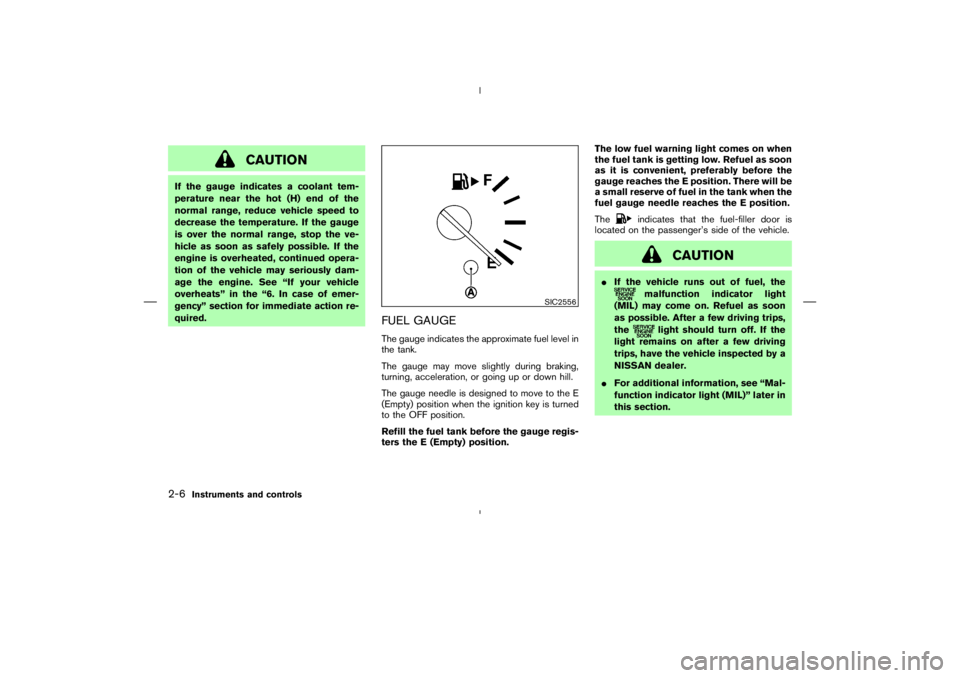
indicates that the fuel-filler door is
located on the passenger’s side of the vehicle.malfunction indicator light
(MIL) may come on. Refuel as soon
as possible. After a few driving trips,
the
light should turn off. If the
light remains on after a few driving
trips, have the vehicle inspected by a
NISSAN dealer.
�For additional information, see “Mal-
function indicator light (MIL)” later in
this section.
Page 78 of 313
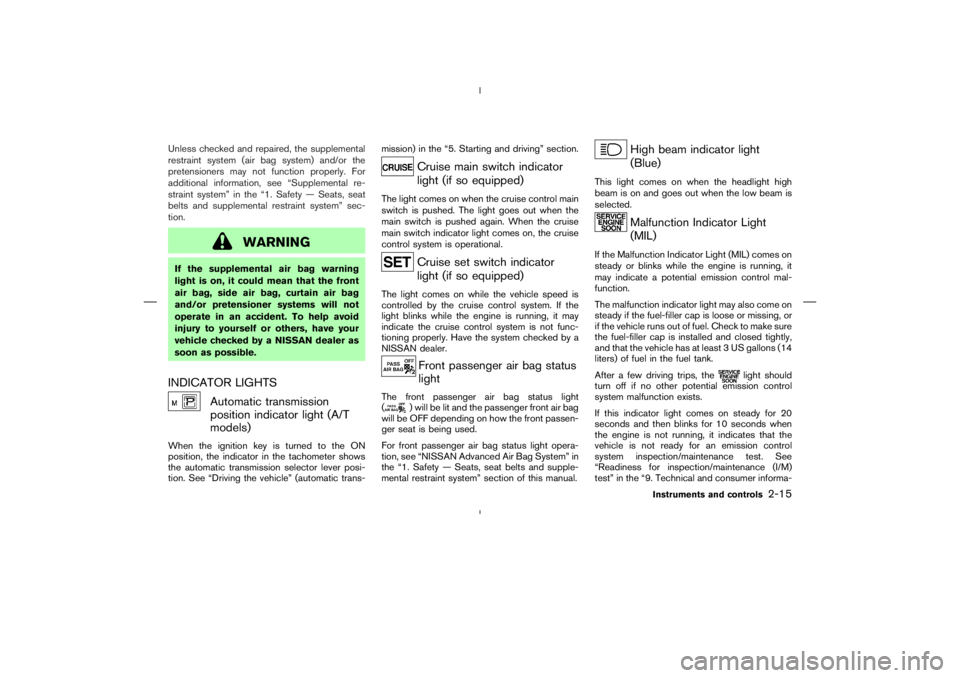
Automatic transmission
position indicator light (A/T
models)
When the ignition key is turned to the ON
position, the indicator in the tachometer shows
the automatic transmission selector lever posi-
tion. See “Driving the vehicle” (automatic trans-mission) in the “5. Starting and driving” section.
Cruise main switch indicator
light (if so equipped)
The light comes on when the cruise control main
switch is pushed. The light goes out when the
main switch is pushed again. When the cruise
main switch indicator light comes on, the cruise
control system is operational.
Cruise set switch indicator
light (if so equipped)
The light comes on while the vehicle speed is
controlled by the cruise control system. If the
light blinks while the engine is running, it may
indicate the cruise control system is not func-
tioning properly. Have the system checked by a
NISSAN dealer.
Front passenger air bag status
light
The front passenger air bag status light
(
) will be lit and the passenger front air bag
will be OFF depending on how the front passen-
ger seat is being used.
For front passenger air bag status light opera-
tion, see “NISSAN Advanced Air Bag System” in
the “1. Safety — Seats, seat belts and supple-
mental restraint system” section of this manual.
High beam indicator light
(Blue)
This light comes on when the headlight high
beam is on and goes out when the low beam is
selected.
Malfunction Indicator Light
(MIL)
If the Malfunction Indicator Light (MIL) comes on
steady or blinks while the engine is running, it
may indicate a potential emission control mal-
function.
The malfunction indicator light may also come on
steady if the fuel-filler cap is loose or missing, or
if the vehicle runs out of fuel. Check to make sure
the fuel-filler cap is installed and closed tightly,
and that the vehicle has at least 3 US gallons (14
liters) of fuel in the fuel tank.
After a few driving trips, the
light should
turn off if no other potential emission control
system malfunction exists.
If this indicator light comes on steady for 20
seconds and then blinks for 10 seconds when
the engine is not running, it indicates that the
vehicle is not ready for an emission control
system inspection/maintenance test. See
“Readiness for inspection/maintenance (I/M)
test” in the “9. Technical and consumer informa-
Instruments and controls
2-15
Page 134 of 313
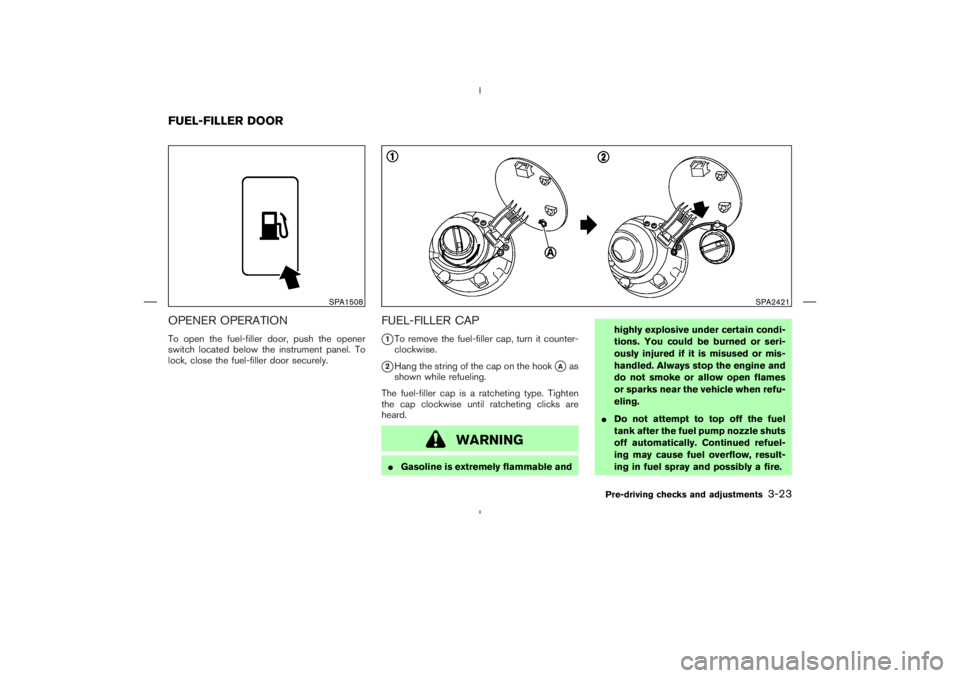
SPA2421
FUEL-FILLER DOOR
Pre-driving checks and adjustments
3-23
Page 135 of 313
CAUTION
�If fuel is spilled on the vehicle body,
flush it away with water to avoid
paint damage.
�Tighten until the fuel-filler cap clicks.
Failure to tighten the fuel-filler cap
properly may cause the
mal-
function indicator light (MIL) to illu-
minate. If the
light illuminates
because the fuel-filler cap is loose or
missing, tighten or install the cap and
continue to drive the vehicle. The
light should turn off after a few
driving trips. If the
light does
not turn off after a few driving trips,
have the vehicle inspected by a
NISSAN dealer.
�For additional information, see the
“Malfunction Indicator Light (MIL)” in
the “2. Instruments and controls”section.
3-24
Pre-driving checks and adjustments
Page 188 of 313
CAUTION
�Do not use leaded gasoline. Deposits
from leaded gasoline will seriously
reduce the three-way catalyst’s abil-
ity to help reduce exhaust pollutants.
�Keep your engine tuned up. Malfunc-
tions in the ignition, fuel injection, or
electrical systems can cause overrich
fuel flow into the three-way catalyst,
causing it to overheat. Do not keep
driving if the engine misfires, or if
noticeable loss of performance or
other unusual operating conditions
are detected. Have the vehicle in-
spected promptly by a NISSAN
dealer.�Avoid driving with an extremely low
fuel level. Running out of fuel could
cause the engine to misfire, damag-
ing the three-way catalyst.
�Do not race the engine while warm-
ing it up.
�Do not push or tow your vehicle to
start the engine.
TIRE PRESSURE MONITORING
SYSTEM (TPMS)Each tire, including the spare (if provided),
should be checked monthly when cold and
inflated to the inflation pressure recommended
by the vehicle manufacturer on the vehicle plac-
ard or tire inflation pressure label. (If your vehicle
has tires of a different size than the size indicated
on the vehicle placard or tire inflation pressure
label, you should determine the proper tire infla-
tion pressure for those tires.)
As an added safety feature, your vehicle has
been equipped with a Tire Pressure Monitoring
System (TPMS) that illuminates a low tire pres-
sure telltale when one or more of your tires is
significantly under-inflated. Accordingly, when
the low tire pressure telltale illuminates, you
should stop and check your tires as soon as
Starting and driving
5-3
Page 278 of 313

CAUTION
�Using a fuel other than that specified
could adversely affect the emission
control system, and may also affect
the warranty coverage.�Under no circumstances should a
leaded gasoline be used, because
this will damage the three-way cata-
lyst.
�Do not use E-85 fuel in your vehicle.
Your vehicle is not designed to run
on E-85 fuel. Using E-85 fuel can
damage the fuel system components
and is not covered by the NISSAN
vehicle limited warranty.
Gasoline specificationsNISSAN recommends using gasoline that meets
the World-Wide Fuel Charter (WWFC) specifi-
cations where it is available. Many of the auto-
mobile manufacturers developed this specifica-
tion to improve emission control system and
vehicle performance. Ask your service station
manager if the gasoline meets the WWFC
specifications.Reformulated gasolineSome fuel suppliers are now producing reformu-
lated gasolines. These gasolines are specially
designed to reduce vehicle emissions. NISSAN
supports efforts towards cleaner air and sug-gests that you use reformulated gasoline when
available.
Gasoline containing oxygenatesSome fuel suppliers sell gasoline containing
oxygenates such as ethanol, MTBE and metha-
nol with or without advertising their presence.
NISSAN does not recommend the use of fuels of
which the oxygenate content and the fuel com-
patibility for your NISSAN cannot be readily
determined. If in doubt, ask your service station
manager.
If you use oxygenate-blend gasoline, please take
the following precautions as the usage of such
fuels may cause vehicle performance problems
and/or fuel system damage.
�The fuel should be unleaded and have
an octane rating no lower than that
recommended for unleaded gasoline.
�If an oxygenate-blend, excepting a
methanol blend, is used, it should con-
tain no more than 10% oxygenate.
(MTBE may, however, be added up to
15%.)
�If a methanol blend is used, it should
contain no more than 5% methanol (me-
thyl alcohol, wood alcohol). It should
also contain a suitable amount of ap-
propriate cosolvents and corrosion in-
Technical and consumer information
9-3