2009 MITSUBISHI COLT instrument
[x] Cancel search: instrumentPage 139 of 273

Downloaded from www.Manualslib.com manuals search engine l“CRUISE” indication lamp is turned OFF.Cargo loads
E00609901240
Cargo loads precautionsCAUTIONl When loading luggage, be careful to the
following. •Stow cargo and luggage in the luggage
compartment whenever possible.
• Distribute cargo or luggage evenly not
to be unbalanced in weight of a load.
• Do not place cargo or luggage on the
instrument panel.
Also, do not stack up cargo or luggage
on the front passenger’s seat or the
rear seats.
Having the driver’s vision blocked,
and your cargo being thrown inside
the cabin if you suddenly have to
brake can cause a serious accident or
injury.Trailer towing E00610000488
In order to tow a trailer with your vehicle, have a
trailer towing device that meets all relevant regula-
tions in your area, mounted consult a
MITSUBISHI MOTORS Authorized Service Point.
The regulations concerning the towing of a trailer
may differ from country to country. You are ad-
vised to obey the regulations in each area.CAUTIONl Danger of Accident!
A towing bar should be fitted according
to MITSUBISHI MOTORS guidelines.
NOTE
l If you are going to tow a trailer, pay careful
attention to the following points.
Maximum towable weight with brake
and maximum trailer-nose weight
Never exceed the maximum towable weight with
brake and the maximum trailer-nose weight as lis-
ted in the specifications.
(Refer to page 9-07.)
If you tow a trailer at an altitude of more than
1,000 m above sea-level, reduce your weight by
10 % of the gross combination weight for every in-
crease of 1,000 m above sea-level, as the engine out-
put is lowered owing to decrease in atmospheric
pressure.
Starting and driving
4-36
4
Page 194 of 273

Downloaded from www.Manualslib.com manuals search engine Remove the “max. 80 km/h” or “max.
50 mph ” label from the bottle, that must be
displayed on the instrument panel within the
driver’s field of view.12. Insert the plug on the compressor’s power
cord (O) into the accessory socket (P), then
turn the ignition switch to the “ACC” or
“ON” position.
13. Turn ON the compressor switch (Q) and in-
flate the tyre to the specified pressure. Check
and adjust the tyre pressure with reference to
the air pressure gauge (R) on the compressor
(I). If you overinflate the tyre, release air by
pressing the pressure release switch (S) on
the compressor or by loosening the hose’s
end fitting. (Refer to “Tyre inflation pres-
sures” on page 8-12.)
CAUTIONl Do not keep the compressor running con-
tinuously for more than 6 minutes. Doing
so could result in a malfunction.
If the tyre pressure does not rise adequately,
remove the compressor from the tyre and care-
fully drive the vehicle 10 metres forwards or
backwards to distribute the tyre sealant
amount in the tyre’s interior, then try inflat-
ing the tyre again.
If there is a gap between the tyre and wheel
because the tyre has moved inward from the
wheel rim, press the periphery of the tyre to-
wards the wheel to close the gap before run-
ning the compressor. (With no gaps, the tyre
pressure will rise.)
CAUTIONl Be careful not to get your fingers trapped
between the tyre and wheel as the tyre in-
flates.
14. Turn OFF the compressor switch, then pull
the power cord plug out of the accessory sock-
et.
NOTE l The supplied compressor is designed only
for inflation of passenger vehicle tyres.
l The compressor is designed to run on a vehi-
cle’s 12 V power supply. Do not connect it
to any other power source.
For emergencies
6-09
6
Page 195 of 273

Downloaded from www.Manualslib.com manuals search engine lThe surface of the compressor will get hot
while the compressor is running. Do not
keep the compressor running continuously
for more than 6 minutes. After using the com-
pressor, wait for the compressor to cool be-
fore using it again.
l If the tyre pressure does not rise to the neces-
sary of at least 1.8 bar level within 5 mi-
nutes, the tyre may be so severely damaged
that the tyre sealant cannot be used to effect
an emergency repair. Please contact a
MITSUBISHI MOTORS Authorized Service
Point or another specialist in this event.
l Simply putting sealant and air into the tyre us-
ing the tyre repair kit does not seal the punc-
ture hole. Air will leak through the puncture
hole until the emergency repair procedure is
completed (through step 17 of these instruc-
tions).
15. When you have inflated the tyre to the speci-
fied pressure, stow the compressor and bottle
in the vehicle and promptly start driving the
vehicle so that the tire sealant can spread even-
ly in the tyre. Drive with great care. Do not
exceed a speed of 80 km/h (50 mph). Ob-
serve local speed limits.
Remove the “max. 80 km/h ” or “max.
50 mph ” label from the bottle, that must be
displayed on the instrument panel within the
driver’s field of view.CAUTIONl If you sense any abnormality while driv-
ing, stop the vehicle and contact a
MITSUBISHI MOTORS Authorized
Service Point or another specialist. Other-
wise the tyre pressure may drop before
the emergency repair procedure is com-
pleted, rendering the vehicle unsafe.
NOTE
l Driving faster than 80 km/h
(50 mph) can
make the vehicle vibrate.
16. After driving for 10 minutes, check the tyre
pressure using the air pressure gauge on the
compressor.
If the tyre pressure is not sufficient, inflate
the tyre to the specified pressure again and
drive the vehicle carefully without exceeding
a speed of 80 km/h (50 mph).
CAUTIONl If the tyre pressure is lower than the min-
imum permitted pressure (1.3 bar
{ 130 kPa}), the tyre cannot successfully
be repaired with the tyre sealant. Do not
drive the vehicle any further. Contact a
MITSUBISHI MOTORS Authorized
Service Point or another specialist.
17. After driving for 10 minutes, check the tyre
pressure using the air pressure gauge on the
compressor. (Refer to “Tyre inflation pres-
sures” on page 8-12.) If the tyre pressure
has apparently not dropped, the emergency re-
pair procedure is complete. You must still
not exceed a speed of 80 km/h (50 mph).
Observe local speed limits.
NOTE l If the tyre pressure has dropped below the
specified level when you check it at the end
of the repair procedure, do not drive the vehi-
cle any further. Contact a MITSUBISHI
MOTORS Authorized Service Point or anoth-
er specialist.
l In cold conditions (when the ambient temper-
ature is 0 °C or lower), the time and driving
distance necessary until completion of the re-
pair can be longer than in warmer conditions,
meaning that the tyre pressure can drop be-
low the specified level even when you have
inflated the tyre a second time and subsequent-
ly driven the vehicle. If this happens, inflate
the tyre to the specified pressure once more,
drive for about 10 minutes or 5 km (3 miles),
then check the tyre pressure again. If the tyre
pressure has again dropped below the speci-
fied level, stop driving the vehicle and con-
tact a MITSUBISHI MOTORS Authorized
Service Point or another specialist.
18. Then immediately drive with great care to a
MITSUBISHI MOTORS Authorized Service
Point or another specialist and have tyre re-
pair/replacement performed.
For emergencies
6-10
6
Page 265 of 273
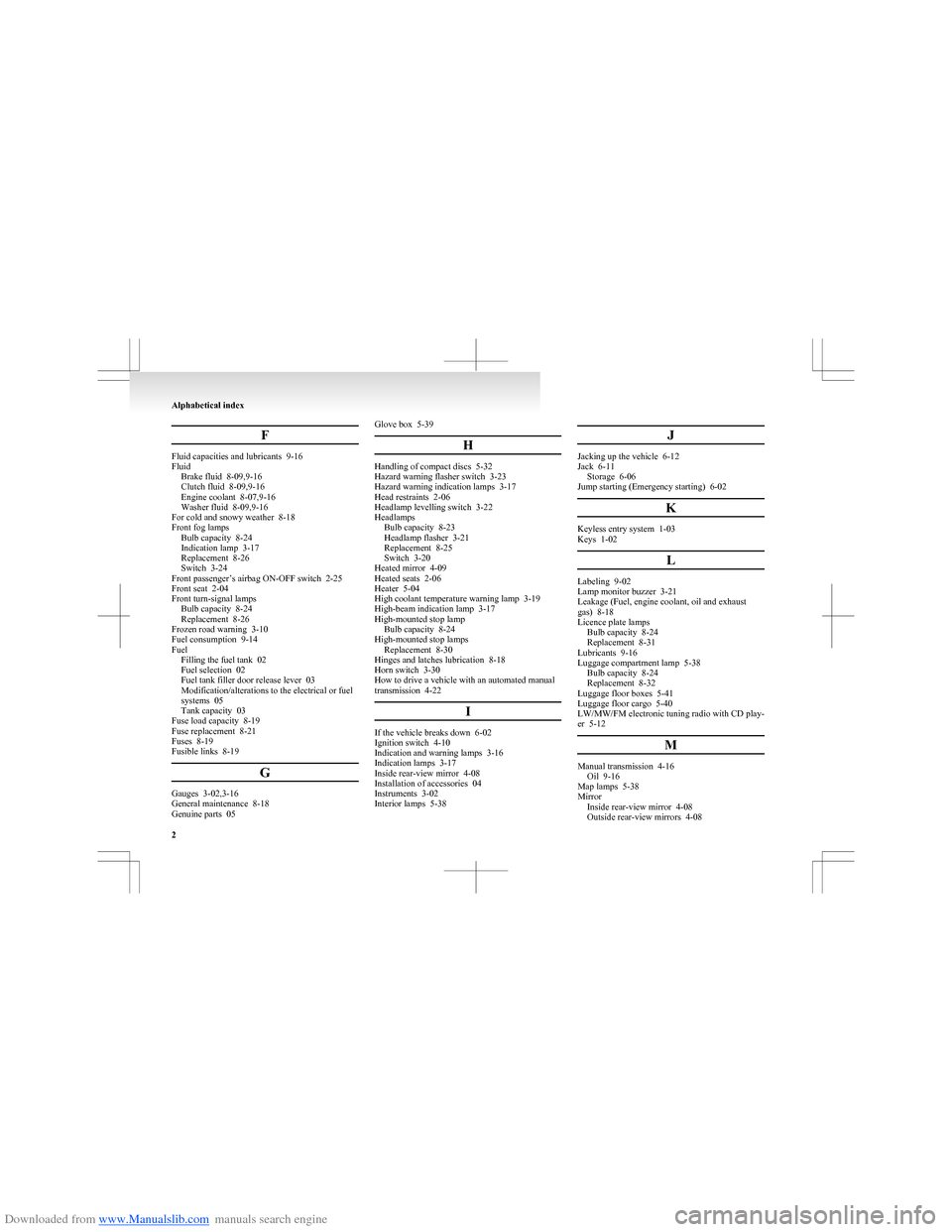
Downloaded from www.Manualslib.com manuals search engine F
Fluid capacities and lubricants 9-16
Fluid Brake fluid 8-09,9-16
Clutch fluid 8-09,9-16
Engine coolant 8-07,9-16
Washer fluid 8-09,9-16
For cold and snowy weather 8-18
Front fog lamps Bulb capacity 8-24
Indication lamp 3-17
Replacement 8-26
Switch 3-24
Front passenger’s airbag ON-OFF switch 2-25
Front seat 2-04
Front turn-signal lamps Bulb capacity 8-24
Replacement 8-26
Frozen road warning 3-10
Fuel consumption 9-14
Fuel Filling the fuel tank 02
Fuel selection 02
Fuel tank filler door release lever 03
Modification/alterations to the electrical or fuel
systems 05
Tank capacity 03
Fuse load capacity 8-19
Fuse replacement 8-21
Fuses 8-19
Fusible links 8-19
G
Gauges 3-02,3-16
General maintenance 8-18
Genuine parts 05
Glove box 5-39
H
Handling of compact discs 5-32
Hazard warning flasher switch 3-23
Hazard warning indication lamps 3-17
Head restraints 2-06
Headlamp levelling switch 3-22
Headlamps Bulb capacity 8-23
Headlamp flasher 3-21
Replacement 8-25
Switch 3-20
Heated mirror 4-09
Heated seats 2-06
Heater 5-04
High coolant temperature warning lamp 3-19
High-beam indication lamp 3-17
High-mounted stop lamp Bulb capacity 8-24
High-mounted stop lamps Replacement 8-30
Hinges and latches lubrication 8-18
Horn switch 3-30
How to drive a vehicle with an automated manual
transmission 4-22
I
If the vehicle breaks down 6-02
Ignition switch 4-10
Indication and warning lamps 3-16
Indication lamps 3-17
Inside rear-view mirror 4-08
Installation of accessories 04
Instruments 3-02
Interior lamps 5-38
J
Jacking up the vehicle 6-12
Jack 6-11 Storage 6-06
Jump starting (Emergency starting) 6-02
K
Keyless entry system 1-03
Keys 1-02
L
Labeling 9-02
Lamp monitor buzzer 3-21
Leakage (Fuel, engine coolant, oil and exhaust
gas) 8-18
Licence plate lamps Bulb capacity 8-24
Replacement 8-31
Lubricants 9-16
Luggage compartment lamp 5-38 Bulb capacity 8-24
Replacement 8-32
Luggage floor boxes 5-41
Luggage floor cargo 5-40
LW/MW/FM electronic tuning radio with CD play-
er 5-12
M
Manual transmission 4-16Oil 9-16
Map lamps 5-38
Mirror Inside rear-view mirror 4-08
Outside rear-view mirrors 4-08
Alphabetical index
2