2009 MITSUBISHI ASX lock
[x] Cancel search: lockPage 55 of 368
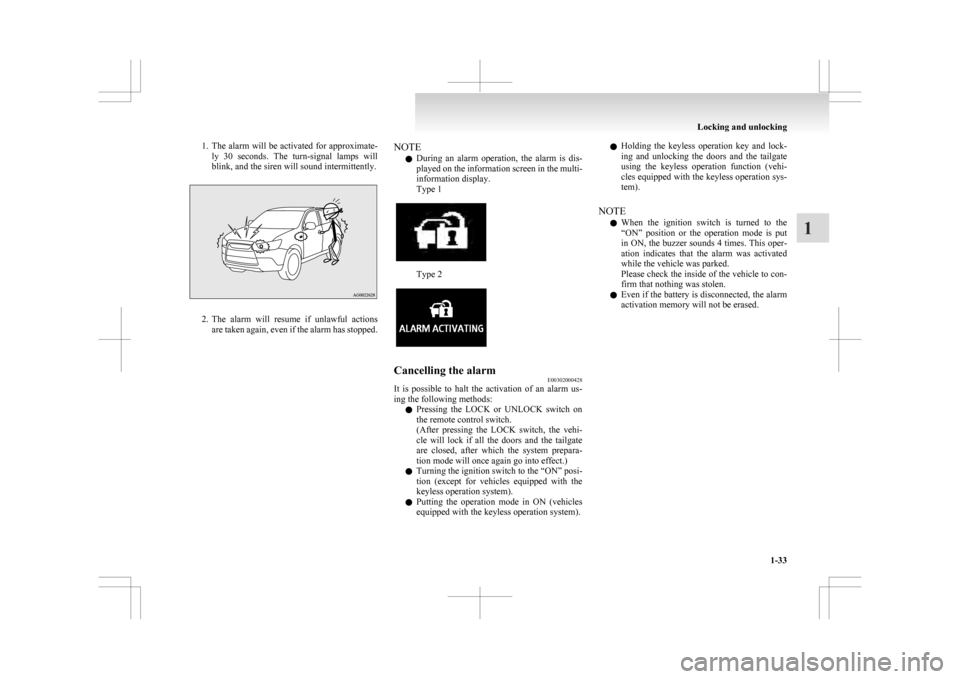
1. The alarm will be activated for approximate-
ly 30 seconds. The turn-signal lamps will
blink, and the siren will sound intermittently. 2. The
alarm will resume if unlawful actions
are taken again, even if the alarm has stopped. NOTE
l During
an alarm operation, the alarm is dis-
played on the information screen in the multi-
information display.
Type 1 Type 2
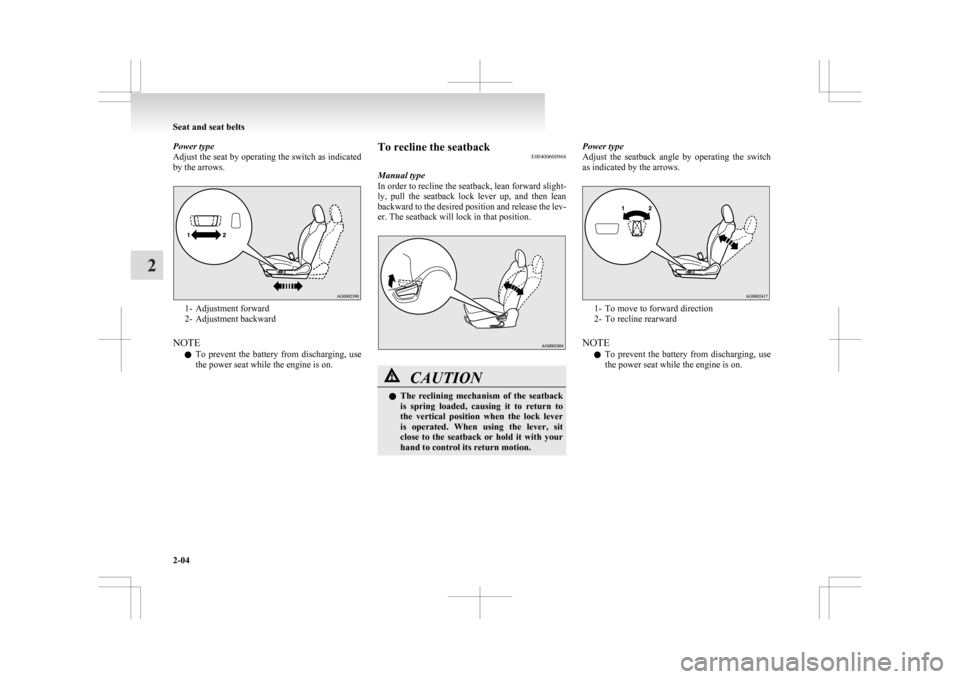
Cancelling the alarm
E00302000428
It is possible to halt the activation of an alarm us-
ing the following methods:
l Pressing
the LOCK or UNLOCK switch on
the remote control switch.
(After pressing the LOCK switch, the vehi-
cle will lock if all the doors and the tailgate
are closed, after which the system prepara-
tion mode will once again go into effect.)
l Turning the ignition switch to the “ON” posi-
tion (except for vehicles equipped with the
keyless operation system).
l Putting the operation mode in ON (vehicles
equipped with the keyless operation system). l
Holding
the keyless operation key and lock-
ing and unlocking the doors and the tailgate
using the keyless operation function (vehi-
cles equipped with the keyless operation sys-
tem).
NOTE l When the ignition switch is turned to the
“ON” position or the operation mode is put
in ON, the buzzer sounds 4 times. This oper-
ation indicates that the alarm was activated
while the vehicle was parked.
Please check the inside of the vehicle to con-
firm that nothing was stolen.
l Even if the battery is disconnected, the alarm
activation memory will not be erased. Locking and unlocking
1-33 1
Page 56 of 368
Electric window control
E00302200521
The electric windows can only be operated with the
ignition
switch in the “ON” position or the opera-
tion mode in ON. WARNING
l Before
operating the electric window con-
trol, make sure that nothing can get trap-
ped (head, hand, finger, etc.).
l Never leave the vehicle without removing
the key.
l Never leave a child (or other person who
might not be capable of safe operation of
the electric window control) in the vehicle
alone.
l The child may tamper with the switch at
the risk of its hands or head being trap-
ped in the window.
Electric window control switch E00302301558
Each door window opens or closes while the corre-
sponding switch is operated.
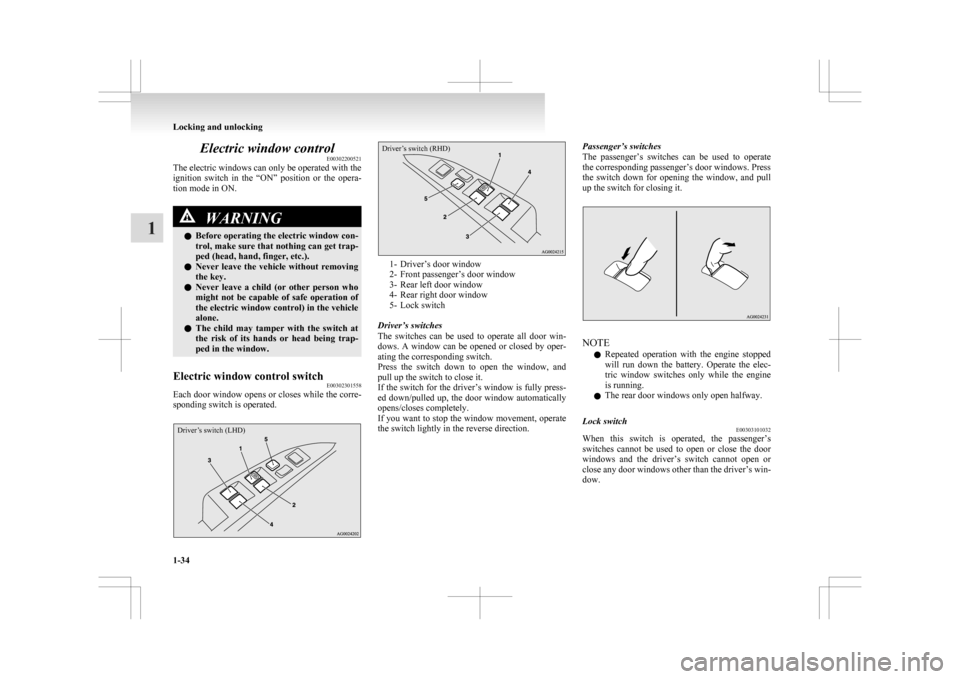
Driver’s switch (LHD)
Driver’s switch (RHD) 1- Driver’s door window
2-
Front passenger’s door window
3- Rear left door window
4- Rear right door window
5- Lock switch
Driver’s switches
The switches can be used to operate all door win-
dows. A window can be opened or closed by oper-
ating the corresponding switch.
Press the switch down to open the window, and
pull up the switch to close it.
If the switch for the driver’s window is fully press-
ed down/pulled up, the door window automatically
opens/closes completely.
If you want to stop the window movement, operate
the switch lightly in the reverse direction. Passenger’s switches
The
passenger’s switches can be used to operate
the corresponding passenger’s door windows. Press
the switch down for opening the window, and pull
up the switch for closing it. NOTE
l Repeated
operation with the engine stopped
will run down the battery. Operate the elec-
tric window switches only while the engine
is running.
l The rear door windows only open halfway.
Lock switch E00303101032
When this switch is operated, the passenger’s
switches
cannot be used to open or close the door
windows and the driver’s switch cannot open or
close any door windows other than the driver’s win-
dow. Locking and unlocking
1-34
1
Page 57 of 368
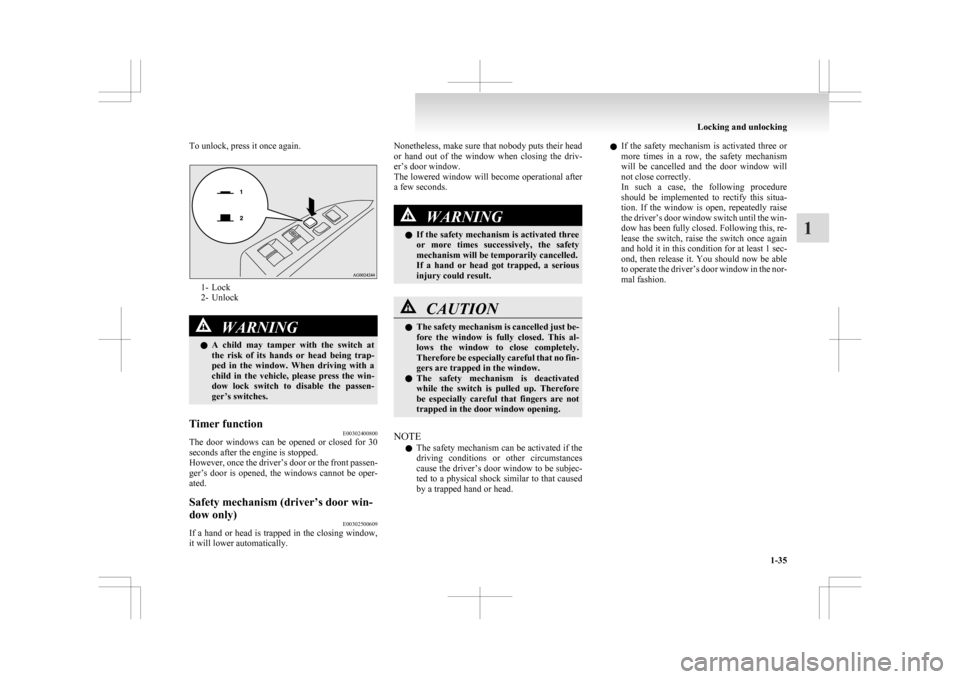
To unlock, press it once again.
1- Lock
2-
Unlock WARNING
l A
child may tamper with the switch at
the risk of its hands or head being trap-
ped in the window. When driving with a
child in the vehicle, please press the win-
dow lock switch to disable the passen-
ger’s switches.
Timer function E00302400800
The door windows can be opened or closed for 30
seconds after the engine is stopped.
However,
once the driver’s door or the front passen-
ger’s door is opened, the windows cannot be oper-
ated.
Safety mechanism (driver’s door win-
dow only) E00302500609
If a hand or head is trapped in the closing window,
it will lower automatically. Nonetheless, make sure that nobody puts their head
or
hand out of the window when closing the driv-
er’s door window.
The lowered window will become operational after
a few seconds. WARNING
l If
the safety mechanism is activated three
or more times successively, the safety
mechanism will be temporarily cancelled.
If a hand or head got trapped, a serious
injury could result. CAUTION
l
The
safety mechanism is cancelled just be-
fore the window is fully closed. This al-
lows the window to close completely.
Therefore be especially careful that no fin-
gers are trapped in the window.
l The safety mechanism is deactivated
while the switch is pulled up. Therefore
be especially careful that fingers are not
trapped in the door window opening.
NOTE l The
safety mechanism can be activated if the
driving conditions or other circumstances
cause the driver’s door window to be subjec-
ted to a physical shock similar to that caused
by a trapped hand or head. l
If
the safety mechanism is activated three or
more times in a row, the safety mechanism
will be cancelled and the door window will
not close correctly.
In such a case, the following procedure
should be implemented to rectify this situa-
tion. If the window is open, repeatedly raise
the driver’s door window switch until the win-
dow has been fully closed. Following this, re-
lease the switch, raise the switch once again
and hold it in this condition for at least 1 sec-
ond, then release it. You should now be able
to operate the driver’s door window in the nor-
mal fashion. Locking and unlocking
1-35 1
Page 58 of 368

Sunshade*
E00302800279WARNING
l Never leave a child (or other person who
might not be capable of safe operation of
the sunshade switch) in the vehicle alone.
l Before operating the sunshade, make
sure that nothing can be trapped (head,
hand, finger, etc.).
l Do not bring your head, hand, finger, etc.
near the opening edge of the sunshade re-
ceptacle while the vehicle is in motion.
It may cause injury to your head, hand,
finger, etc. in the event of sudden braking. CAUTION
l
Do
not place heavy luggage on the panor-
amic glass roof. Doing so could damage
the glass roof.
l Do not hang heavy luggage from, allow a
person to hang onto, or apply any other
strong force to the opening of the sun-
shade receptacle or the parts between the
ceiling and the sunshade opening on ei-
ther side. Doing so could damage the sun-
shade.
NOTE l Release
the switch as soon as the sunshade
reaches the fully open or fully closed position. l
If
the sunshade does not operate when the sun-
shade switch is operated, release the switch
and check whether something is trapped by
the sunshade. If nothing is trapped, we recom-
mend you to have the sunshade checked.
l Operating the sunshade repeatedly with the
engine stationary will run down the battery.
Operate the sunshade while the engine is run-
ning.
l Close the sunshade when parking the vehicle
for a long time. Parking in the hot sun with
the sunshade open will make the vehicle in-
side extremely hot.
The sunshade can only be operated with the igni-
tion switch or the operation mode in ON. 1- Open
2-
Close
3- Stop
To open, press the switch (1).
Press and hold the switch (1), the sunshade automat-
ically opens. Release the switch once the sunshade
starts moving automatically.
To stop the moving sunshade, press the switch (1),
(2) or (3).
To close, press the switch (2).
Press
and hold the switch (2), the sunshade automat-
ically closes. Release the switch once the sunshade
starts moving automatically.
To stop the moving sunshade, press the switch (1),
(2) or (3).
Safety mechanism
If a hand or head is trapped in the closing sun-
shade, it will reopen automatically.
Nonetheless, make sure that nobody brings their
head or hand near the sunshade when opening or
closing.
The opened sunshade will become operational after
a few seconds. CAUTION
l
The
safety mechanism is cancelled just be-
fore the sunshade is fully closed. This al-
lows the sunshade to close completely.
Therefore be especially careful that no fin-
gers are trapped in the sunshade.
NOTE l The
safety mechanism can be activated if the
driving conditions or other circumstances
cause the sunshade to be subjected to a phys-
ical shock similar to that caused by a trapped
hand or head. Locking and unlocking
1-36
1
Page 61 of 368
Seat adjustment
E00400300271
Adjust
the driver’s seat so that you are comfortable
and that you can reach the pedals, steering wheel,
switches etc. while retaining a clear field of vision. WARNING
l Do
not attempt to adjust the seat while
driving. This can cause loss of vehicle con-
trol and result in an accident. After ad-
justments are made, ensure the seating is
locked in position by attempting to move
the seat forward and rearward without us-
ing the adjusting mechanism.
l Do not let children or adults ride in areas
of the vehicle that are not equipped with
seats or seat belts. Also, make sure that
all occupants are sitting in their seats and
wearing their seat belts, and that children
are sitting in child restraints.
l To minimize the risk of personal injury
in the event of a collision or sudden brak-
ing, the seatbacks should always be in the
almost upright position while the vehicle
is in motion. The protection provided by
the seat belts may be reduced significant-
ly when the seatback is reclined. There is
greater risk that the passenger will slide
under the seat belt, resulting in serious in-
jury, when the seatback is reclined. CAUTION
l
Make
sure the seat is adjusted by an
adult or with adult supervision for cor-
rect and safe operation.
l Do not place a cushion or the like be-
tween your back and the seatback while
driving. The effectiveness of the head re-
straints will be reduced in the event of an
accident.
l When sliding the seat rearward, be care-
ful not to catch your hand or foot. Front seat
E00400400142
To adjust forward or backward E00400500462
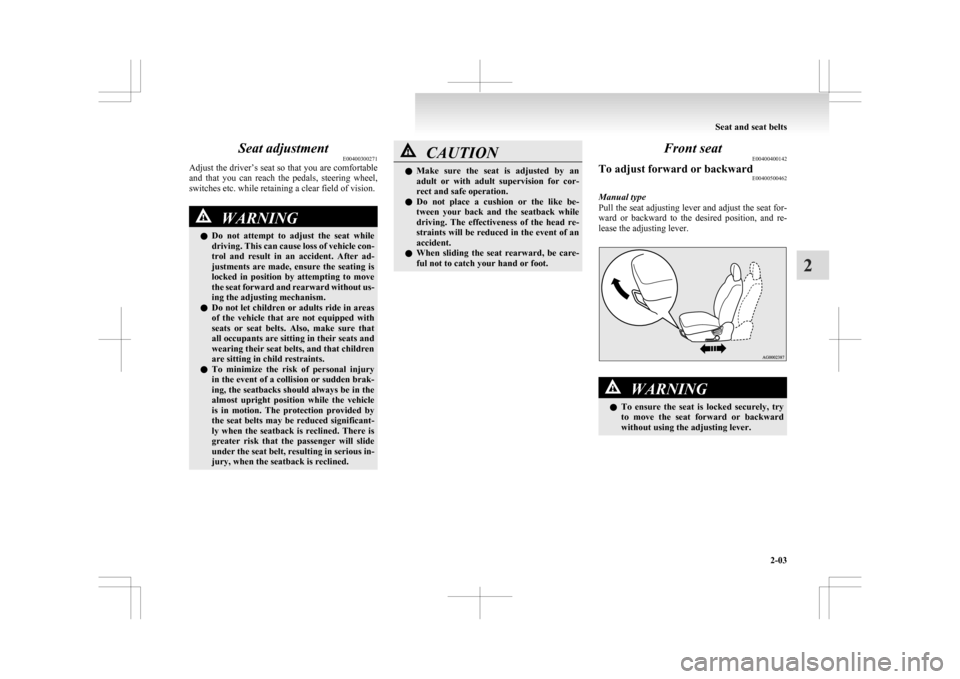
Manual type
Pull
the seat adjusting lever and adjust the seat for-
ward or backward to the desired position, and re-
lease the adjusting lever. WARNING
l To
ensure the seat is locked securely, try
to move the seat forward or backward
without using the adjusting lever. Seat and seat belts
2-03 2
Page 62 of 368
Power type
Adjust
the seat by operating the switch as indicated
by the arrows. 1- Adjustment forward
2-
Adjustment backward
NOTE l To prevent the battery from discharging, use
the power seat while the engine is on. To recline the seatback
E00400600968
Manual type
In
order to recline the seatback, lean forward slight-
ly, pull the seatback lock lever up, and then lean
backward to the desired position and release the lev-
er. The seatback will lock in that position. CAUTION
l
The
reclining mechanism of the seatback
is spring loaded, causing it to return to
the vertical position when the lock lever
is operated. When using the lever, sit
close to the seatback or hold it with your
hand to control its return motion. Power type
Adjust
the seatback angle by operating the switch
as indicated by the arrows. 1- To move to forward direction
2-
To recline rearward
NOTE l To prevent the battery from discharging, use
the power seat while the engine is on. Seat and seat belts
2-04
2
Page 64 of 368

Heated seats*
E00401100960
The
heated seats can be operated with the ignition
switch or the operation mode in ON. The indica-
tion lamp (A) will illuminate while the heater is on. 1 (HI) - Heater high (for quick heating).
2 - Heater off.
3 (LO) - Heater low (to keep the seat warm).
CAUTION
l
Switch off seat heaters when not in use.
l Operate
in the high position for quick heat-
ing. Once the seat is warm, set the heater
to low to keep it warm. Slight variations
in seat temperature may be felt while us-
ing the heated seats. This is caused by the
operation of the heater’s internal thermo-
stat and does not indicate a malfunction.
l If the following types of persons use the
heated seats, they might become too hot CAUTION
or receive minor burns (red skin, heat blis-
ters, etc.):
•
Children, elderly or ill people
• People with sensitive skin
• Excessively tired people
• People under the influence of alcohol or sleep inducing medication (cold
medicine, etc.)
l Do not place heavy objects on the seat or
stick pins, needles, or other pointed ob-
jects into it.
l Do not use a blanket, cushion, or other ma-
terial with high heat insulation properties
on the seat while using the heater; this
might cause the heater element to overheat
l Do not use benzine, kerosene, petrol, alco-
hol or other organic solvents when clean-
ing the seats. Doing so could damage not
only the seat cover, but also the heater el-
ement.
l If water or any other liquid is spilled on
the seat, allow it to dry thoroughly before
attempting to use the heater.
l Turn the heater off immediately if it ap-
pears to be malfunctioning during use. Rear seat
E00401300294 WARNING
l When
a person sits in the rear seat, pull
up the head restraint to a height at which
it locks in position. Be sure to make this
adjustment before starting to drive. Seri-
ous injuries could otherwise be suffered
as the result of an impact. Refer to “Head
restraints” on page 2-07.
Armrest* E00401700650
To use the armrest, fold it down.
To
return to the original position, push it backward
level with the seat. NOTE
l Do
not climb or sit on the armrest. Doing so
could damage the armrest. Seat and seat belts
2-06
2
Page 65 of 368

l
The top surface of the armrest contains a cup
holder for rear seat occupants.
Refer to “Cup holder” on page 5-68.
Armrest through lid* E00414600028
Open the lid to gain access to the luggage compart-
ment
from the cabin. This feature is useful for car-
rying long objects while accommodating 2 passen-
gers in the rear seats.
Fold down the armrest. Then slide the knob (A)
down while pulling it forward to open the lid. Head restraints
E00403301439 WARNING
l Driving without the head restraints in
place can cause you and your passengers
serious injury or death in an accident. To
reduce the risk of injury in an accident, al-
ways make sure the head restraints are in-
stalled and properly positioned when the
seat is occupied.
l Never place a cushion or similar device
on the seatback. This can adversely affect
head restraint performance by increasing
the distance between your head and the
restraint.
To adjust height
Adjust
the head restraint height so that the centre
of the head restraint is as close as possible to eye
level to reduce the chances of injury in the event of
collision. Any person too tall for the head restraint
to reach their seated eye level, should adjust the re-
straint as high as possible. To raise the head restraint, move it upward. To low-
er
the restraint, move it downward while pushing
the height adjusting knob (A) in the direction of the
arrow. After adjustment, push the head restraint
downward and make sure that it is locked. To remove
To
remove the head restraints, lift the head re-
straint with the height adjusting knob (A) pushed in. Seat and seat belts
2-07 2