2009 MITSUBISHI ASX fuel
[x] Cancel search: fuelPage 130 of 368

Screen type 1 Screen type 2 Cause Solution (Reference)
l
The fuel is running low.
lRefuel as soon as possible. Refer
to “Fuel remaining warning dis-
play” on page 3-15. l
An
excessive amount of particu-
late matter (PM) accumulates in-
side the diesel particultate filter
(DPF). Refer to “Diesel particulate filter
(DPF)” on page 4-15. l
It
is suspected that the engine oil
level has increased excessively. Immediately have your vehicle
checked by a MITSUBISHI MOTORS
Authorized Service Point.
Refer to “Engine oil level warning dis-
play” on page 3-44. l
The
outside temperature is 3 °C
(37 °F) or less. l
Be careful of ice on the road.
l The
road can be icy even when
this warning is not displayed, so
drive carefully. Instruments and controls
3-36
3
Page 135 of 368

Warning lamps
E00502400147Brake warning lamp
E00502502357
This
lamp illuminates when the ignition
switch is turned to the “ON” position or
the operation mode is put in ON, and
goes off after a few seconds.
Always make sure that the lamp goes off
before driving.
With the ignition switch or the operation
mode in ON, the brake warning lamp il-
luminates under the following conditions:
l When the parking brake lever has
been engaged.
l When the brake fluid level in the
reservoir falls to a low level.
l When the brake force distribution
function is not operating correctly. CAUTION
l
In
the situations listed below,
brake performance may be com-
promised or the vehicle may be-
come unstable if brakes are ap-
plied suddenly; consequently,
avoid driving at high speeds or
applying the brakes suddenly.
Furthermore, the vehicle
should be brought to a stop in a
safe location and to have it
checked. CAUTION
• The
brake warning lamp
does not illuminate when
the parking brake is applied
or does not turn off when
the parking brake is re-
leased.
• The ABS warning lamp and brake warning lamp illumi-
nate at the same time
For details, refer to “ABS
warning lamp” on page
4-38.
• The brake warning lamp re- mains illuminated during
driving.
l The vehicle should be brought
to a halt in the following man-
ner when brake performance
has deteriorated.
• Depress the brake pedalharder than usual.
Even if the brake pedal
moves down to the very end
of its possible stroke, keep it
pressed down hard.
• Should the brakes fail, use engine braking to reduce
your speed and pull the park-
ing brake lever.
Depress the brake pedal to
operate the stop lamp to
alert the vehicles behind you. Check engine warning lamp
E00502601638
This
lamp is a part of an onboard diag-
nostic system which monitors the emis-
sions, engine control system or CVT con-
trol system.
If a problem is detected in one of these
systems, this lamp illuminates or flashes.
Although your vehicle will usually be
drivable and not need towing, we recom-
mend you to have the system checked as
soon as possible.
This lamp will also illuminate when the
ignition switch is turned “ON” or the op-
eration mode is put in ON, and goes off
after the engine has started. If it does not
go off after the engine has started, we rec-
ommend you to have the vehicle checked. CAUTION
l
Prolonged
driving with this
lamp on may cause further dam-
age to the emission control sys-
tem. It could also affect fuel
economy and drivability.
l If the lamp does not illuminate
when the ignition switch is
turned to the “ON” position or
the operation mode is put in
ON, we recommend you to
have the system checked. Instruments and controls
3-41 3
Page 154 of 368

Economical driving
E00600101076
For
economical driving, there are some technical re-
quirements that have to be met. The prerequisite
for low fuel consumption is a properly adjusted en-
gine. In order to achieve longer life of the vehicle
and the most economical operation, we recommend
you to have the vehicle checked at regular intervals
in accordance with the service standards.
Fuel economy and generation of exhaust gas and
noise are highly influenced by personal driving hab-
its as well as the particular operating conditions.
The following points should be observed in order
to minimize wear of brakes, tyres and engine as
well as to reduce environmental pollution.
Starting the engine
Avoid sudden acceleration and sudden starts, as
they will increase fuel consumption.
Shifting
Shift only at an appropriate speed and engine
speed. Always use the highest shift position possible.
Selecting the 4WD drive mode (4WD
vehicles)
The drive mode-selector should be set to “2WD”
when driving on normal roads and express ways to
obtain best possible fuel economy.
City traffic
Frequent starting and stopping increases the aver-
age fuel consumption. Use roads with smooth traf-
fic flow whenever possible. When driving on con-
gested roads, avoid use of a low shift position at
high engine speeds. Idling
The
vehicle consumes fuel even during idling.
Avoid extended idling whenever possible.
Speed
At higher vehicle speed, more fuel is consumed.
Avoid driving at full speed. Even a slight release of
the accelerator pedal will save a significant amount
of fuel.
Tyre inflation pressure
Check the tyre inflation pressures at regular inter-
vals. Low tyre inflation pressure increases road re-
sistance and fuel consumption. In addition, low
tyre pressures adversely affect tyre wear and driv-
ing stability.
Cargo loads
Do not drive with unnecessary articles in the lug-
gage compartment. Especially during city driving
where frequent starting and stopping is necessary,
the increased weight of the vehicle will greatly af-
fect fuel consumption. Also avoid driving with un-
necessary luggage or carriers, etc., on the roof; the
increased air resistance will increase fuel consump-
tion.
Cold engine starting
Starting of a cold engine consumes more fuel.
Unnecessary fuel consumption is also caused by
keeping a hot engine running. After the engine is
started, commence driving as soon as possible.
Air conditioning
The use of the air conditioning will increase the
fuel consumption. Driving, alcohol and drugs
E00600200070
Driving
after drinking alcohol is one of the most fre-
quent causes of accidents.
Your driving ability can be seriously impaired even
with blood alcohol levels far below the legal mini-
mum. If you have been drinking, don’t drive. Ride
with a designated non-drinking driver, call a cab or
a friend, or use public transportation.
Drinking coffee or taking a cold shower will not
make you sober.
Similarly, prescription and nonprescription drugs af-
fect your alertness, perception and reaction time.
Consult with your doctor or pharmacist before driv-
ing while under the influence of any of these medi-
cations. WARNING
l NEVER DRINK AND DRIVE.
Your
perceptions are less accurate, your
reflexes are slower and your judgment is
impaired. Starting and driving
4-02
4
Page 167 of 368
Fuel injection amount learning proc-
ess (diesel-powered vehicles)
E00627900043
To
keep exhaust emissions and engine noise low,
the engine very occasionally performs a learning
process for the fuel injection amount.
The engine sounds slightly different from usual
while the learning process is taking place. The
change in the engine sound does not indicate a fault. Diesel particulate filter (DPF)*
E00619800199
The
diesel particulate filter (DPF) is a device that
captures most of the particulate matter (PM) in the
exhaust emissions of the diesel engine. The DPF au-
tomatically burns away trapped PM during vehicle
operation. Under certain driving conditions, howev-
er, the DPF is not able to burn away all of the trap-
ped PM and, as a result, an excessive amount of
PM accumulates inside it. WARNING
l The DPF reaches very high temperatures.
Do
not park your vehicle in areas where
combustible materials such as dry grass
or leaves can come in contact with a hot
exhaust system since a fire could occur. CAUTION
l
Do
not use any type of fuel or engine oil
that is not specified for your vehicle. Al-
so, do not use any moisture-removing
agent or other fuel additive. Such substan-
ces could have a detrimental effect on the
DPF.
Refer to “Fuel selection” on page 02 and
“Engine oil” on page 8-04.
NOTE l To
minimize the likelihood of excessive ac-
cumulation of PM, try to avoid driving for
long periods at low speeds and repeatedly
driving short distances. l
The
engine sounds slightly different than usu-
al while the DPF automatically burns away
trapped PM. The change in the engine sound
does not indicate a fault.
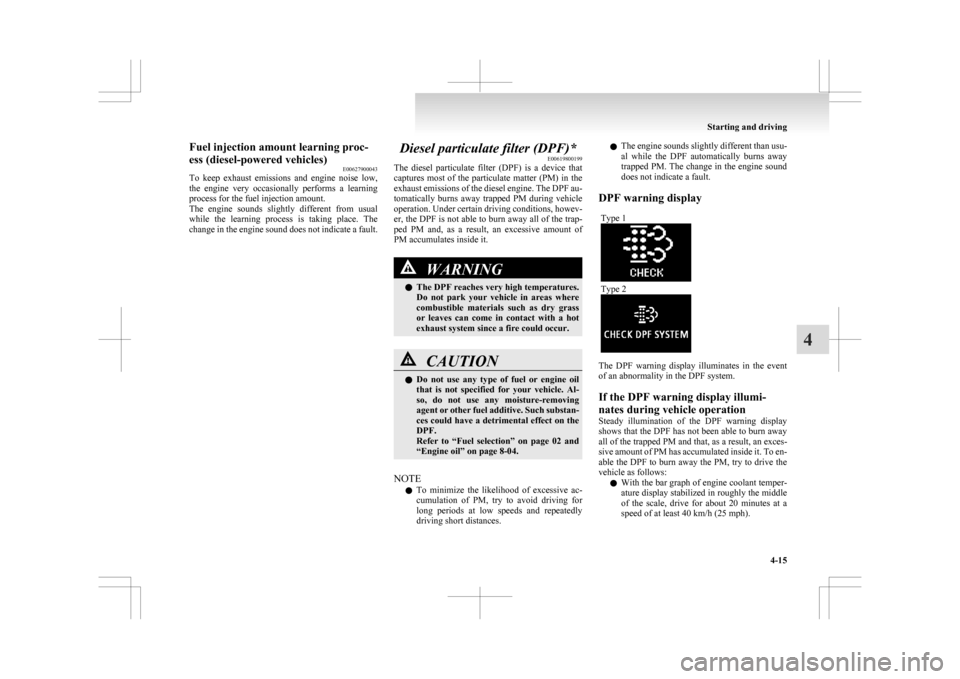
DPF warning display Type 1 Type 2
The DPF warning display illuminates in the event
of an abnormality in the DPF system.
If the DPF warning display illumi-
nates during vehicle operation
Steady
illumination of the DPF warning display
shows that the DPF has not been able to burn away
all of the trapped PM and that, as a result, an exces-
sive amount of PM has accumulated inside it. To en-
able the DPF to burn away the PM, try to drive the
vehicle as follows:
l With the bar graph of engine coolant temper-
ature display stabilized in roughly the middle
of the scale, drive for about 20 minutes at a
speed of at least 40 km/h (25 mph). Starting and driving
4-15 4
Page 169 of 368
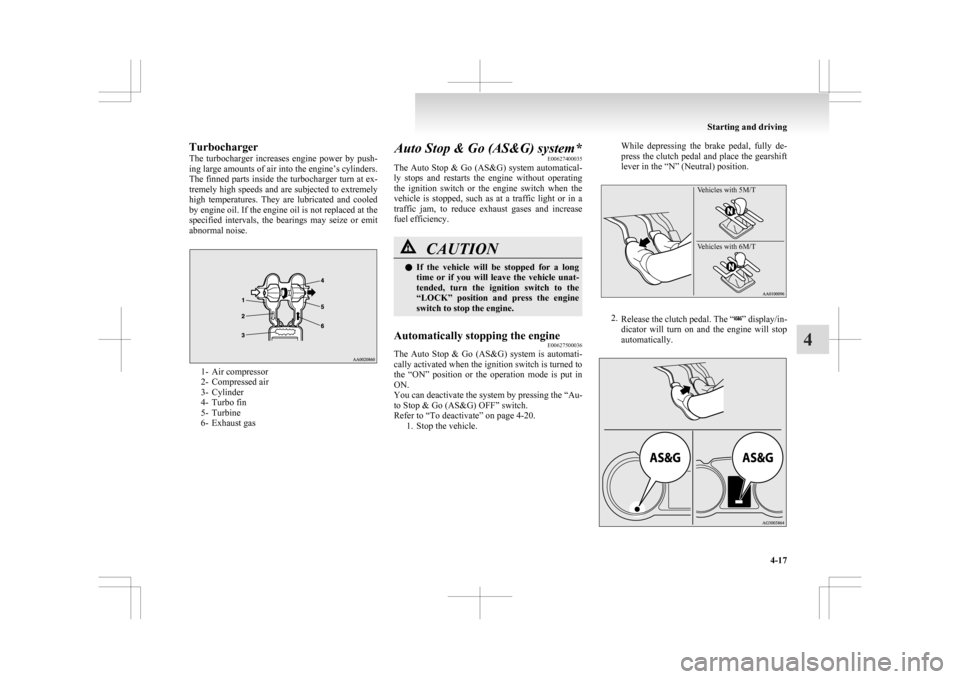
Turbocharger
The
turbocharger increases engine power by push-
ing large amounts of air into the engine’s cylinders.
The finned parts inside the turbocharger turn at ex-
tremely high speeds and are subjected to extremely
high temperatures. They are lubricated and cooled
by engine oil. If the engine oil is not replaced at the
specified intervals, the bearings may seize or emit
abnormal noise. 1- Air compressor
2-
Compressed air
3- Cylinder
4- Turbo fin
5- Turbine
6- Exhaust gas Auto Stop & Go (AS&G) system*
E00627400035
The
Auto Stop & Go (AS&G) system automatical-
ly stops and restarts the engine without operating
the ignition switch or the engine switch when the
vehicle is stopped, such as at a traffic light or in a
traffic jam, to reduce exhaust gases and increase
fuel efficiency. CAUTION
l
If
the vehicle will be stopped for a long
time or if you will leave the vehicle unat-
tended, turn the ignition switch to the
“LOCK” position and press the engine
switch to stop the engine.
Automatically stopping the engine E00627500036
The Auto Stop & Go (AS&G) system is automati-
cally activated when the ignition switch is turned to
the
“ON” position or the operation mode is put in
ON.
You can deactivate the system by pressing the “Au-
to Stop & Go (AS&G) OFF” switch.
Refer to “To deactivate” on page 4-20. 1. Stop the vehicle. While depressing the brake pedal, fully de-
press
the clutch pedal and place the gearshift
lever in the “N” (Neutral) position.
Vehicles with 5M/T
Vehicles with 6M/T 2.
Release
the clutch pedal. The “ ” display/in-
dicator
will turn on and the engine will stop
automatically. Starting and driving
4-17 4
Page 173 of 368
Manual transmission*
E00602000535
The
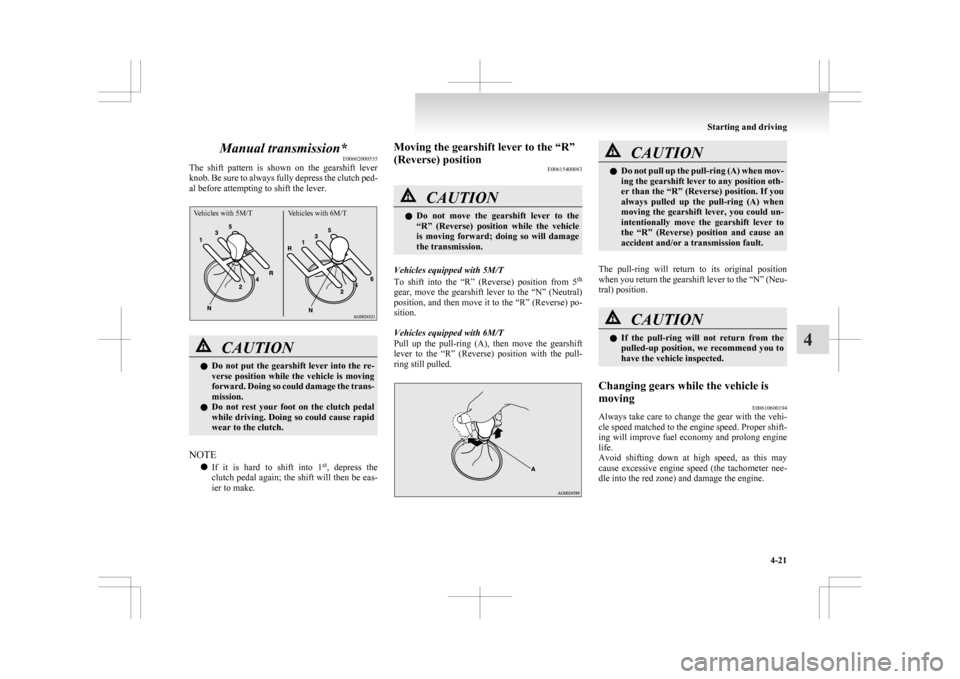
shift pattern is shown on the gearshift lever
knob. Be sure to always fully depress the clutch ped-
al before attempting to shift the lever.
Vehicles with 5M/T Vehicles with 6M/T CAUTION
l
Do
not put the gearshift lever into the re-
verse position while the vehicle is moving
forward. Doing so could damage the trans-
mission.
l Do not rest your foot on the clutch pedal
while driving. Doing so could cause rapid
wear to the clutch.
NOTE l If
it is hard to shift into 1 st
, depress the
clutch pedal again; the shift will then be eas-
ier to make. Moving the gearshift lever to the “R”
(Reverse) position
E00615400083 CAUTION
l
Do
not move the gearshift lever to the
“R” (Reverse) position while the vehicle
is moving forward; doing so will damage
the transmission.
Vehicles equipped with 5M/T
To
shift into the “R” (Reverse) position from 5 th
gear, move the gearshift lever to the “N” (Neutral)
position, and then move it to the “R” (Reverse) po-
sition.
Vehicles equipped with 6M/T
Pull up the pull-ring (A), then move the gearshift
lever to the “R” (Reverse) position with the pull-
ring still pulled. CAUTION
l
Do
not pull up the pull-ring (A) when mov-
ing the gearshift lever to any position oth-
er than the “R” (Reverse) position. If you
always pulled up the pull-ring (A) when
moving the gearshift lever, you could un-
intentionally move the gearshift lever to
the “R” (Reverse) position and cause an
accident and/or a transmission fault.
The pull-ring will return to its original position
when
you return the gearshift lever to the “N” (Neu-
tral) position. CAUTION
l
If
the pull-ring will not return from the
pulled-up position, we recommend you to
have the vehicle inspected.
Changing gears while the vehicle is
moving E00610600194
Always take care to change the gear with the vehi-
cle
speed matched to the engine speed. Proper shift-
ing will improve fuel economy and prolong engine
life.
Avoid shifting down at high speed, as this may
cause excessive engine speed (the tachometer nee-
dle into the red zone) and damage the engine. Starting and driving
4-21 4
Page 174 of 368
NOTE
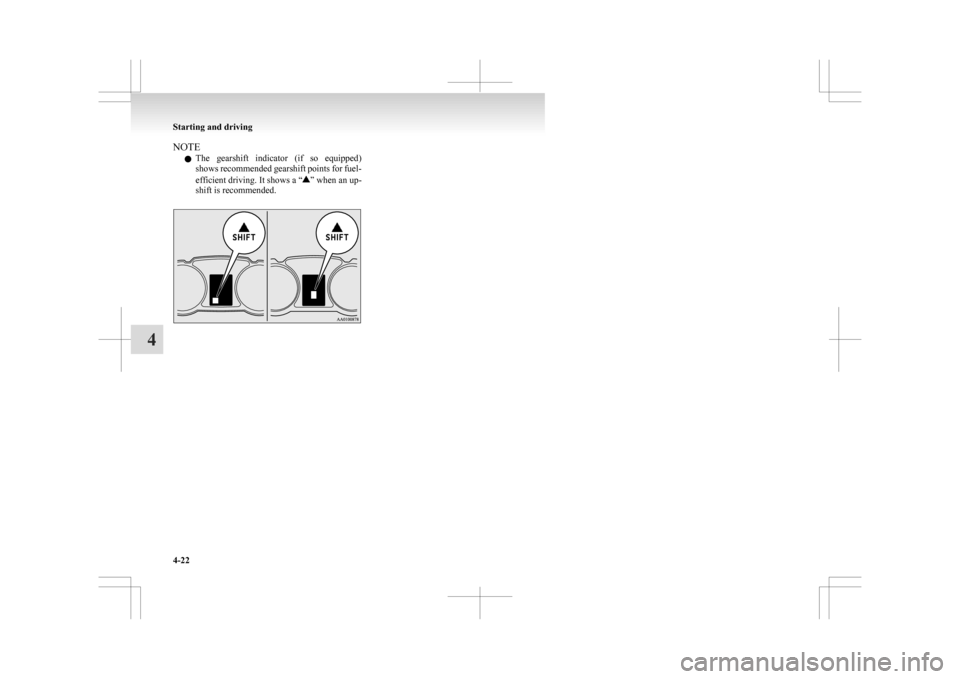
l The
gearshift indicator (if so equipped)
shows recommended gearshift points for fuel-
efficient driving. It shows a “ ” when an up-
shift is recommended. Starting and driving
4-22
4
Page 175 of 368
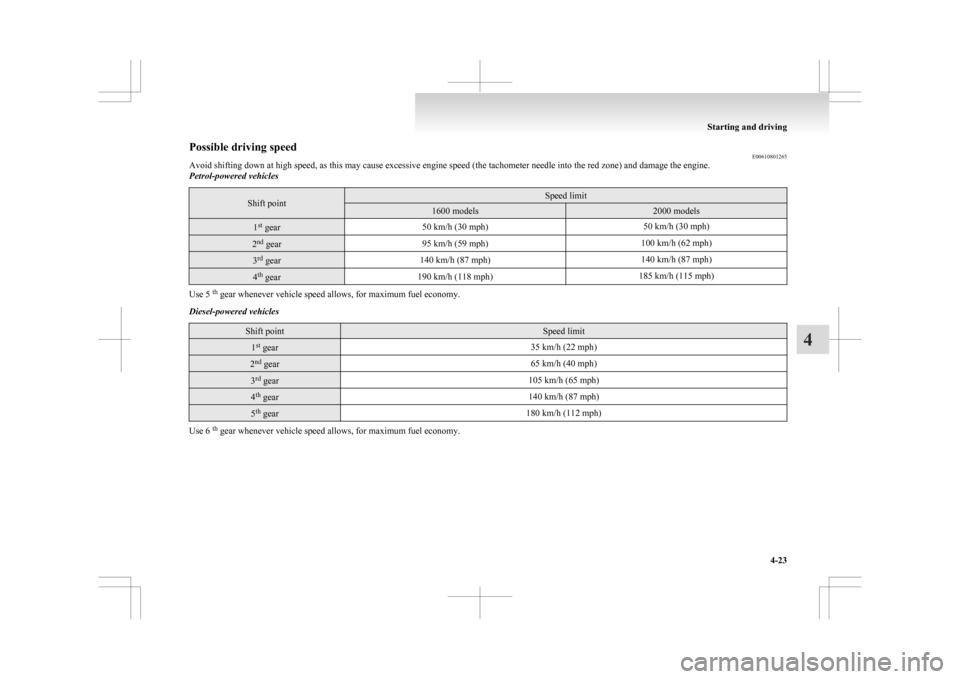
Possible driving speed
E00610801265
Avoid shifting down at high speed, as this may cause excessive engine speed (the tachometer needle into the red zone) and damage the engine.
Petrol-powered vehicles Shift point Speed limit
1600 models 2000 models
1
st
gear 50 km/h (30 mph) 50 km/h (30 mph)2
nd
gear 95 km/h (59 mph) 100 km/h (62 mph)3
rd
gear 140 km/h (87 mph) 140 km/h (87 mph)4
th
gear 190 km/h (118 mph) 185 km/h (115 mph)Use 5
th
gear whenever vehicle speed allows, for maximum fuel economy.
Diesel-powered vehicles Shift point Speed limit
1
st
gear 35 km/h (22 mph)2
nd
gear 65 km/h (40 mph)3
rd
gear 105 km/h (65 mph)4
th
gear 140 km/h (87 mph)5
th
gear 180 km/h (112 mph)Use 6
th
gear whenever vehicle speed allows, for maximum fuel economy. Starting and driving
4-23 4