2009 MERCEDES-BENZ E-CLASS SALOON mirror
[x] Cancel search: mirrorPage 282 of 373
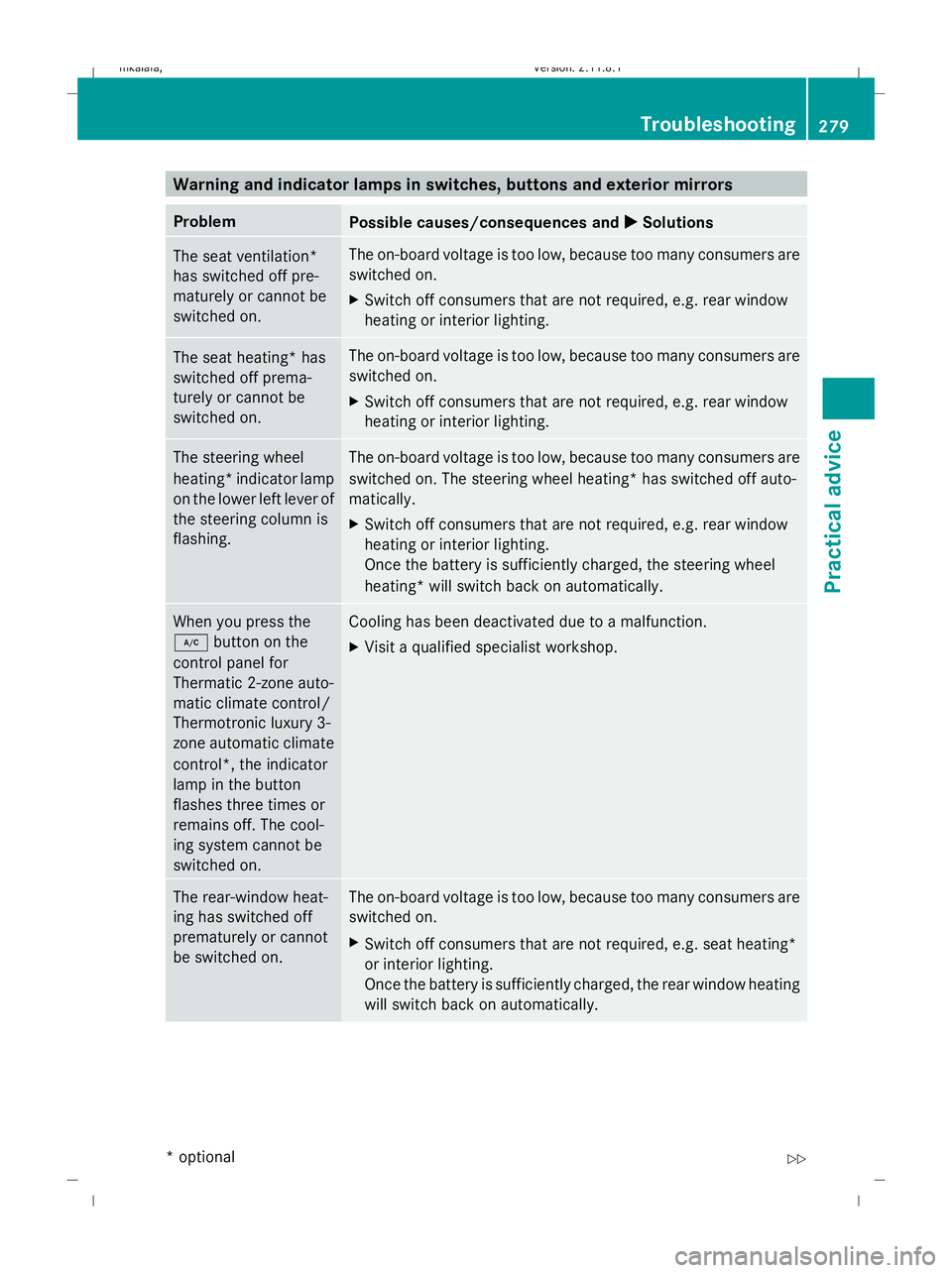
Warning and indicator lamps in switches, buttons and exterior mirrors
Problem
Possible causes/consequences and
X
X Solutions The seat ventilation*
has switched off pre-
maturely or cannot be
switched on. The on-board voltage is too low, because too many consumers are
switched on.
X
Switch off consumers that are not required, e.g. rear window
heating or interior lighting. The seat heating* has
switched off prema-
turely or cannot be
switched on. The on-board voltage is too low, because too many consumers are
switched on.
X
Switch off consumers that are not required, e.g. rear window
heating or interior lighting. The steering wheel
heating* indicator lamp
on the lower left lever of
the steering column is
flashing. The on-board voltage is too low, because too many consumers are
switched on. The steering wheel heating* has switched off auto-
matically.
X
Switch off consumers that are not required, e.g. rear window
heating or interior lighting.
Once the battery is sufficiently charged, the steering wheel
heating* will switch back on automatically. When you press the
¿
button on the
control panel for
Thermatic 2-zone auto-
matic climate control/
Thermotronic luxury 3-
zone automatic climate
control*, the indicator
lamp in the button
flashes three times or
remains off. The cool-
ing system cannot be
switched on. Cooling has been deactivated due to a malfunction.
X Visit a qualified specialist workshop. The rear-window heat-
ing has switched off
prematurely or cannot
be switched on. The on-board voltage is too low, because too many consumers are
switched on.
X
Switch off consumers that are not required, e.g. seat heating*
or interior lighting.
Once the battery is sufficiently charged, the rear window heating
will switch back on automatically. Troubleshooting
279Practical advice
* optional
212_AKB; 2; 4, en-GB
mkalafa,
Version: 2.11.8.1 2009-05-05T14:17:16+02:00 - Seite 279 Z
Dateiname: 6515346702_buchblock.pdf; erzeugt am 07. May 2009 14:17:11; WK
Page 283 of 373
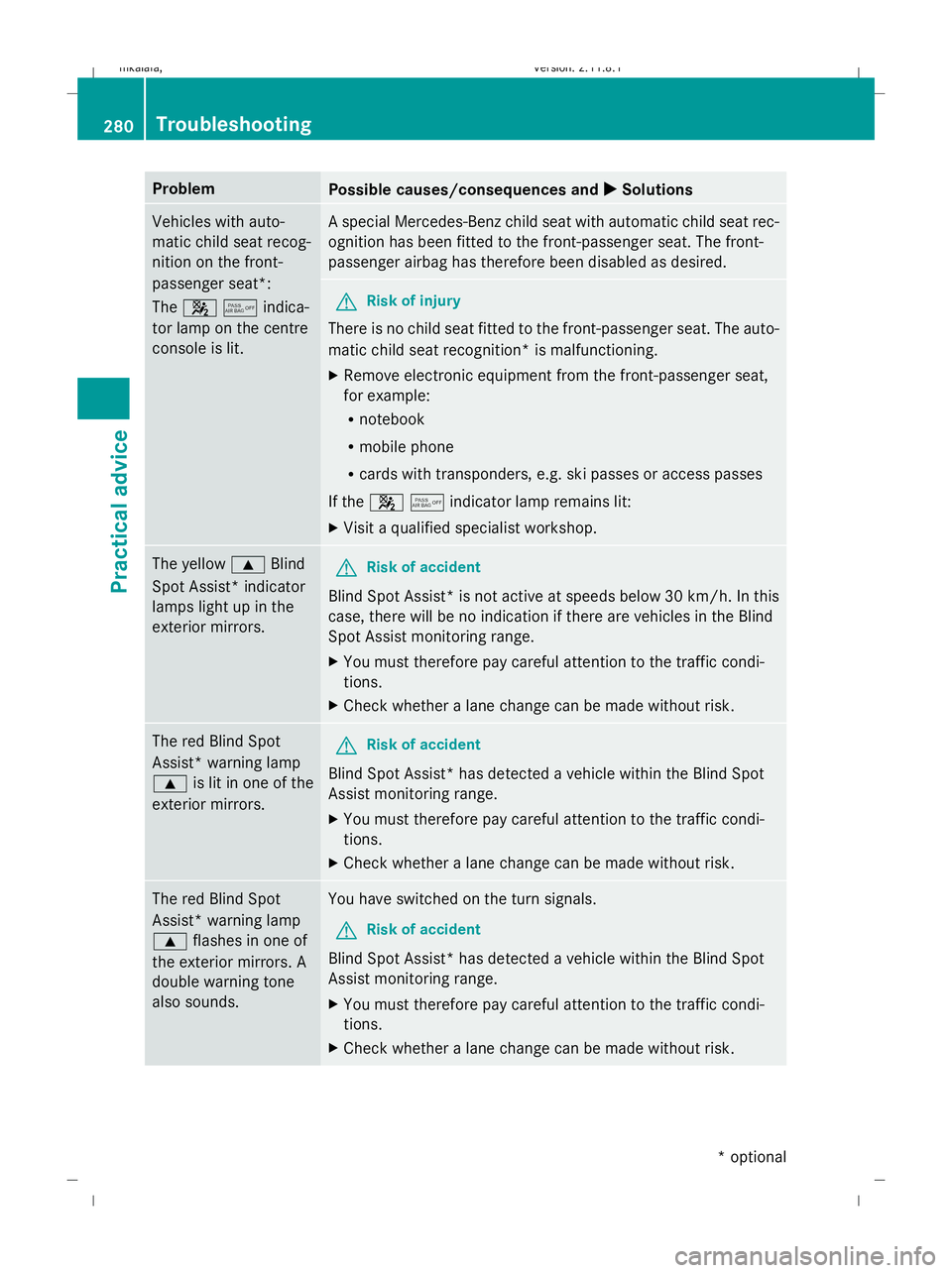
Problem
Possible causes/consequences and
X XSolutions Vehicles with auto-
matic child seat recog-
nition on the front-
passenger seat*:
The
45indica-
tor lamp on the centre
console is lit. A special Mercedes-Benz child seat with automatic child seat rec-
ognition has been fitted to the front-passenger seat. The front-
passenger airbag has therefore been disabled as desired.
G
Risk of injury
There is no child seat fitted to the front-passenger seat. The auto-
matic child seat recognition* is malfunctioning.
X Remove electronic equipment from the front-passenger seat,
for example:
R
notebook
R mobile phone
R cards with transponders, e.g. ski passes or access passes
If the 45indicator lamp remains lit:
X Visit a qualified specialist workshop. The yellow
9Blind
Spot Assist* indicator
lamps light up in the
exterior mirrors. G
Risk of accident
Blind Spot Assist *is not active at speeds below 30 km/h. In this
case, there will be no indication if there are vehicles in the Blind
Spot Assist monitoring range.
X You must therefore pay careful attention to the traffic condi-
tions.
X Check whether a lane change can be made without risk. The red Blind Spot
Assist* warning lamp
9
is lit in one of the
exterior mirrors. G
Risk of accident
Blind Spot Assist* has detected a vehicle within the Blind Spot
Assist monitoring range.
X You must therefore pay careful attention to the traffic condi-
tions.
X Check whether a lane change can be made without risk. The red Blind Spot
Assist* warning lamp
9
flashes in one of
the exterior mirrors. A
double warning tone
also sounds. You have switched on the turn signals.
G Risk of accident
Blind Spot Assist* has detected a vehicle within the Blind Spot
Assist monitoring range.
X You must therefore pay careful attention to the traffic condi-
tions.
X Check whether a lane change can be made without risk. 280
TroubleshootingPractical advice
* optional
212_AKB; 2; 4, en-GB
mkalafa,
Version: 2.11.8.1 2009-05-05T14:17:16+02:00 - Seite 280
Dateiname: 6515346702_buchblock.pdf; erzeugt am 07. May 2009 14:17:11; WK
Page 291 of 373
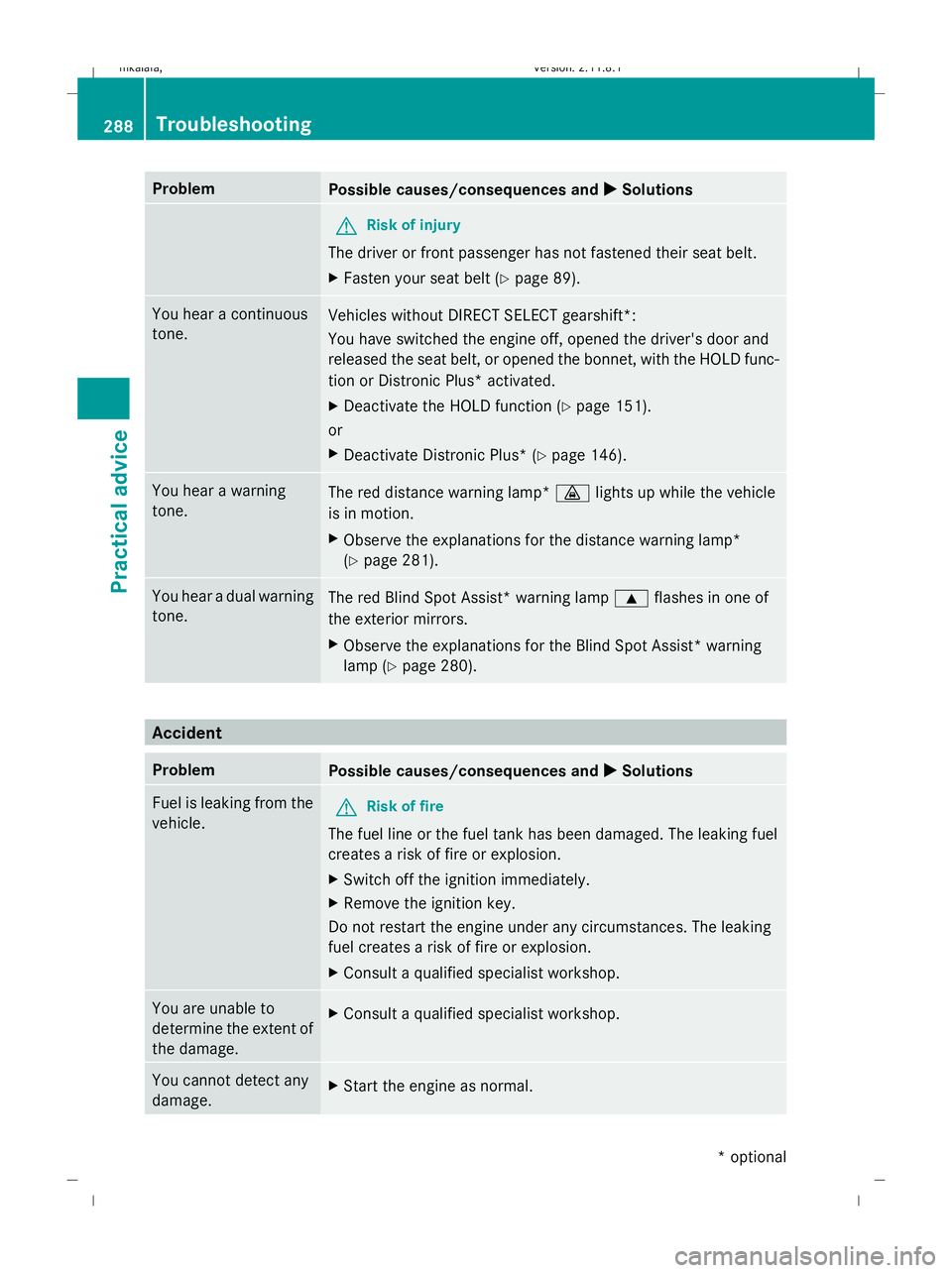
Problem
Possible causes/consequences and
X XSolutions G
Risk of injury
The driver or front passenger has not fastened their seat belt.
X Fasten your seat belt (Y page 89).You hear a continuous
tone.
Vehicles without DIRECT SELECT gearshift*:
You have switched the engine off, opened the driver's door and
released the seat belt, or opened the bonnet, with the HOLD func-
tion or Distronic Plus* activated.
X
Deactivate the HOLD function (Y page 151).
or
X Deactivate Distronic Plus* (Y page 146).You hear a warning
tone.
The red distance warning lamp*
·lights up while the vehicle
is in motion.
X Observe the explanations for the distance warning lamp*
(Y page 281). You hear a dual warning
tone.
The red Blind Spot Assist* warning lamp
9flashes in one of
the exterior mirrors.
X Observe the explanations for the Blind Spot Assist* warning
lamp (Y page 280). Accident
Problem
Possible causes/consequences and
X XSolutions Fuel is leaking from the
vehicle.
G
Risk of fire
The fuel line or the fuel tank has been damaged. The leaking fuel
creates a risk of fire or explosion.
X Switch off the ignition immediately.
X Remove the ignition key.
Do not restart the engine under any circumstances. The leaking
fuel creates a risk of fire or explosion.
X Consult a qualified specialist workshop. You are unable to
determine the extent of
the damage.
X
Consult a qualified specialist workshop. You cannot detect any
damage.
X
Start the engine as normal. 288
TroubleshootingPractical advice
* optional
212_AKB; 2; 4, en-GB
mkalafa,
Version: 2.11.8.1 2009-05-05T14:17:16+02:00 - Seite 288
Dateiname: 6515346702_buchblock.pdf; erzeugt am 07. May 2009 14:17:13; WK
Page 299 of 373

Exterior mirrors
Problem
Possible causes/consequences and
X
X Solutions An exterior mirror has
been pushed out of
position.
Vehicles with exterior mirrors that cannot be folded in/out elec-
trically:
X
Move the exterior mirror into the correct position manually.
Vehicles with electrically folding exterior mirrors*:
X Press the mirror-folding button* (Y page 86) repeatedly until
you hear a distinct click.
The mirror housing is engaged again and you can adjust the
mirror as usual ( Ypage 86). Key
Problem
Possible causes/consequences and
X
X Solutions You cannot lock or
unlock the vehicle
using the key. The key batteries are discharged or nearly discharged.
X
Point the tip of the key at the driver's door handle from close
range and try to unlock or lock the vehicle again.
If this does not work:
X Lock or unlock the vehicle using the emergency key element
(Y page 299). The key is faulty.
X
Lock/unlock the vehicle as described in the "Opening and clos-
ing in an emergency" section (Y page 299).
X Have the key checked at a qualified specialist workshop. You can no longer lock
or unlock the vehicle
using KEYLESS GO*.
KEYLESS GO* is in standby mode because the vehicle has not
been unlocked for an extended period.
X
Pull the door handle and then turn the key to position 2in the
ignition lock. KEYLESS-GO* is malfunctioning.
X
Lock/unlock the vehicle using the remote control function of
the key. Point the tip of the key at the driver's door handle from
close range and press the %/&button.
X Have the key checked at a qualified specialist workshop. There is interference from a powerful source of radio waves.
X
Lock/unlock the vehicle as described in the "Opening and clos-
ing in an emergency" section (Y page 299).296
TroubleshootingPractical advice
* optional
212_AKB; 2; 4, en-GB
mkalafa,
Version: 2.11.8.1 2009-05-05T14:17:16+02:00 - Seite 296
Dateiname: 6515346702_buchblock.pdf; erzeugt am 07. May 2009 14:17:14; WK
Page 326 of 373

the jump-starting procedure
(Y
page 323).
Fitting the battery X
Install the battery. To do this, follow the
steps described in "Removing the battery"
(Y page 322) in reverse order.
X Reconnect the battery (Y page 323).Reconnecting the battery
! Always connect the battery in the order
described below. Never swap the terminal
clamps. Otherwise, you may damage the
vehicle electronics.
X Switch off all electrical consumers (e.g.
radio, blower, etc.).
X Connect the positive terminal clamp and
secure the cover.
X Connect the negative terminal clamp.
X Connect the breather hose.
X On vehicles with the battery in the
engine compartment: put the filter box
back in place, then clip in and close the
retaining clamps.
Close the bonnet.
X Vehicles with the battery in the boot:
close the boot.
i If the battery power supply has been inter-
rupted (e.g. if it has been reconnected), you
must carry out the following tasks:
R set the time ( Ypage 132)
R reset the function for folding the exterior
mirrors in/out automatically* by folding
the mirrors out once ( Ypage 87) Jump-starting
If your vehicle's battery is discharged, the
engine can be jump-started from another
vehicle or from an external battery using jump
leads. Observe the following points:
R
you may only jump-start when the engine
and catalytic converter are cold.
R do not start the engine if the battery is fro-
zen. Let the battery thaw first.
R jump-starting may only be performed from
batteries with a nominal voltage of 12 V.
R only use jump leads which have a sufficient
cross-section and insulated terminal
clamps.
i Jump leads and further information about
jump-starting can be obtained from any
Mercedes-Benz Service Centre.
! Avoid repeated and lengthy starting
attempts.
Do not use a rapid-charging device to start
the engine. G
Risk of injury
There is a risk of acid burns when jump-start-
ing a vehicle due to the gases which escape
from the battery. Do not lean over the battery
while the engine is being jump-started. G
Risk of explosion
Gases escaping from the battery during jump-
starting may cause minor explosions. Avoid
creating sparks. Keep naked flames away
from the battery, and do not smoke.
Comply with safety precautions and take pro-
tective measures when handling batteries.
You will find these under "Battery" in the
index.
X Make sure that the two vehicles do not
touch.
X Depress the parking brake firmly.
X Manual transmission: engage neutral.
X Automatic transmission*: shift the trans-
mission to position P.
X Switch off all electrical consumers (e.g.
radio, blower, etc.).
X Open the bonnet (Y page 219). Jump-starting
323Practical advice
* optional
212_AKB; 2; 4, en-GB
mkalafa
,V ersion: 2.11.8.1
2009-05-05T14:17:16+02:00 - Seite 323 Z
Dateiname: 6515346702_buchblock.pdf; erzeugt am 07. May 2009 14:17:26; WK
Page 342 of 373

driving downhill). This would impair braking
efficiency.
Have the brake fluid renewed every two years
with a brake fluid that has been approved by
Mercedes-Benz and have this confirmed in
the Service Booklet.
i There is usually a notice in the engine
compartment to remind you when the next
brake fluid change is due. Windscreen washer system
The headlamp cleaning system* and wind-
screen washer system are both supplied from
the washer fluid reservoir.
Further information on windscreen washer
fluid and its mixing ratio ( Ypage 222). Vehicle data, E 200 CGI BlueEFFI-
CIENCY
Vehicle dimensions
Vehicle length
(ECE)
4868 mm
Vehicle width
including exterior
mirrors
2071 mm
Vehicle height
51 1464 mm
Wheelbase
2874 mm
Vehicle weights
Unladen weight (in accordance with EC
Directive)
Manual transmis-
sion
1615 kg Vehicle weights
Automatic trans-
mission
1615 kg
The unladen weight includes the driver
(68 kg), luggage (7 kg) and all fluids (fuel
tank 90% full). Items of optional equipment
increase the unladen weight and reduce the
maximum payload.
Maximum roof
load
100 kg
Maximum luggage
compartment load
100 kg
You will find weight information specific to
the vehicle on the vehicle identification
plate (Y
page 332). Vehicle data, E 250 CGI BlueEFFI-
CIENCY
Vehicle dimensions
Vehicle length
(ECE)
4868 mm
Vehicle width
including exterior
mirrors
2071 mm
Vehicle height
52 1464 mm
Wheelbase
2874 mm
51
The value specified may differ from the actual value depending on tyres, load, optional equipment and state
of the suspension system.
52 The value specified may differ from the actual value depending on tyres, load, optional equipment and state
of the suspension system. Vehicle data, E 250 CGI BlueEFFICIENCY
339Technical data
* optional
212_AKB; 2; 4, en-GB
mkalafa,
Version: 2.11.8.1 2009-05-05T14:17:16+02:00 - Seite 339 Z
Dateiname: 6515346702_buchblock.pdf; erzeugt am 07. May 2009 14:17:33; WK
Page 343 of 373

Vehicle weights
Unladen weight
(according to EC
directive)
1650 kg
The unladen weight includes the driver
(68 kg), luggage (7 kg) and all fluids (fuel
tank 90% full). Items of optional equipment
increase the unladen weight and reduce the
maximum payload. Maximum roof
load
100 kg
Maximum luggage
compartment load
100 kg
You will find weight information specific to
the vehicle on the vehicle identification
plate (Y page 332). Vehicle data, E 300
i The E 300 model is only available in cer-
tain countries. Vehicle dimensions
Vehicle length
(ECE)
4868 mm
Vehicle width
including exterior
mirrors
2071 mm
Vehicle height
53 1465 mm
Wheelbase
2874 mm Vehicle weights
Unladen weight
(according to EC
directive)
1735 kg
The unladen weight includes the driver
(68 kg), luggage (7 kg) and all fluids (fuel
tank 90% full). Items of optional equipment
increase the unladen weight and reduce the
maximum payload.
Maximum roof
load
100 kg
Maximum luggage
compartment load
100 kg
You will find weight information specific to
the vehicle on the vehicle identification
plate (Y
page 332). Vehicle data, E 350
i The E 350 model is only available in cer-
tain countries. Vehicle dimensions
Vehicle length
(ECE)
4868 mm
Vehicle width
including exterior
mirrors 2071 mm
Vehicle height
54 1465 mm
Wheelbase
2874 mm
53
The value specified may differ from the actual value depending on tyres, load, optional equipment and state
of the suspension system.
54 The value specified may differ from the actual value depending on tyres, load, optional equipment and state
of the suspension system. 340
Vehicle data, E 350Technical data
212_AKB; 2; 4, en-GB
mkalafa
,V ersion: 2.11.8.1
2009-05-05T14:17:16+02:00 - Seite 340
Dateiname: 6515346702_buchblock.pdf; erzeugt am 07. May 2009 14:17:33; WK
Page 344 of 373

Vehicle weights
Unladen weight
(according to EC
directive) 1735 kg
The unladen weight includes the driver
(68 kg), luggage (7 kg) and all fluids (fuel
tank 90% full). Items of optional equipment
increase the unladen weight and reduce the
maximum payload. Maximum roof
load
100 kg
Maximum luggage
compartment load
100 kg
You will find weight information specific to
the vehicle on the vehicle identification
plate (Y page 332). Vehicle data, E 350 4MATIC
Vehicle dimensions
Vehicle length
(ECE)
4868 mm
Vehicle width
including exterior
mirrors
2071 mm
Vehicle height
55 1467 mm
Wheelbase
2874 mm Vehicle weights
Unladen weight (in
accordance with
EC Directive)
1805 kg
The unladen weight includes the driver
(68 kg), luggage (7 kg) and all fluids (fuel
tank 90% full). Items of optional equipment
increase the unladen weight and reduce the
maximum payload. Maximum roof
load
100 kg
Maximum luggage
compartment load
100 kg
You will find weight information specific to
the vehicle on the vehicle identification
plate (Y
page 332). Vehicle data, E 350 CGI BlueEFFI-
CIENCY
Vehicle dimensions
Vehicle length (ECE)
Saloon
4868 mm
Estate
4895 mm
Vehicle width including exterior mirrors
Saloon
2071 mm
Estate
2071 mm
Vehicle height
56 Saloon
1465 mm
Estate
1512 mm
55
The value specified may differ from the actual value depending on tyres, load, optional equipment and state
of the suspension system.
56 The values specified may differ from the actual values depending on tyres, load, optional equipment and
state of the suspension system. Vehicle data, E 350 CGI BlueEFFICIENCY
341Technical data
212_AKB; 2; 4, en-GB
mkalafa,V ersion: 2.11.8.1
2009-05-05T14:17:16+02:00 - Seite 341 Z
Dateiname: 6515346702_buchblock.pdf; erzeugt am 07. May 2009 14:17:33; WK