2009 MERCEDES-BENZ CL COUPE technical data
[x] Cancel search: technical dataPage 24 of 421

ing stickers unless the sticker clearly states
that you may do so.
If you remove the warning stickers, you or
others could be injured by failing to recognise
certain dangers. Data stored in the vehicle
Fault data
Components critical for vehicle operation are
equipped with fault data memories as stand-
ard. There are also memories dedicated to
storing the technical reactions of vehicle
components to driving situations (e.g. the
triggering of an airbag, ESP ®
intervention).
This data is used exclusively to:
R assist in the rectification of faults and
defects
R help Mercedes-Benz optimise and develop
vehicle functions.
The data cannot be used to trace the vehicle's
movements.
When your vehicle is serviced by Mercedes-
Benz, this technical information can be read
from the fault memories. This is performed by
authorised employees of the Mercedes-Benz
service network using special diagnostic
computers.
After a fault has been rectified, the informa-
tion is deleted from the memory. Other mem-
ory data is constantly overwritten. Other devices that store data
Depending on its equipment, your vehicle
may feature communications and/or enter-
tainment systems (e.g. navigation devices,
telephone systems). These allow you to save
and edit data required for the operation of the
respective device.
Further information on operation (e.g. on
deleting data) can be found in the separate
operating instructions. Introduction
21216_AKB; 2; 3, en-GB
bjanott
,V ersion: 2.11.7.7
2009-02-27T14:54:17+01:00 - Seite 21 ZDateiname: 6515230602_buchblock.pdf; erzeugt am 04. Mar 2009 11:14:36; WK
Page 301 of 421

Tyre tread
G
Risk of accident
Bear in mind that:
R tyre grip decreases rapidly on wet roads
when the tread depth is less than 3 mm.
Thus, you should replace tyres that have
insufficient tread.
R winter tyres should be replaced when the
tread depth is 4 mm or less as they will no
longer provide adequate grip.
R the tread on a tyre may not wear evenly.
Thus, you should regularly check the tread
depth and the condition of the tread across
the entire width of all tyres. If necessary,
turn the steering wheel so that you can see
the tyre tread more easily.
You could otherwise lose control of the vehi-
cle and cause an accident due to the reduced
grip of the tyres on the road. Tyre pressures
i You will find a table of tyre pressures for
various operating conditions on the inside
of your vehicle's fuel filler flap.
The applicable value for the spare
wheel*/"Minispare" emergency spare
wheel* is stated on the spare wheel and in
the technical data section. G
Risk of accident
Tyre pressure that is either too high or too low
has a negative effect on the vehicle’s driving
safety, which could lead you to cause an acci-
dent. Therefore, you should regularly check
the pressure of all the tyres, particularly prior
to long trips, and correct the pressure as nec-
essary.
To test tyre pressure, use a suitable pressure
gauge. The outer appearance of a tyre does
not permit any reliable conclusion about the
tyre pressure. On vehicles fitted with the elec-
tronic tyre pressure monitor*, the tyre pres- sure can be checked in the on-board com-
puter. G
Risk of accident
Do not fit anything else to the tyre valve other
than the standard valve cap. In particular, ret-
rofitted tyre pressure monitors which are
screwed on to the valve may overload it and
cause it to fail. Due to their design, the valve
is kept open continuously, which may lead to
air loss. G
Risk of accident
Should the tyre pressure drop repeatedly:
R check the tyre for foreign bodies.
R check whether the wheel is losing air or the
valve is leaking.
R make sure that only a valve cap approved
by Mercedes-Benz has been fitted on the
tyre valve.
Tyre pressures that are too low have a nega-
tive effect on vehicle safety, which could lead
to your causing an accident.
If possible, you should only correct tyre pres-
sures when the tyres are cold. Depending on
the ambient temperature, the speed you are
driving at and the load on the tyres, the tyre
temperature and thus the tyre pressure may
change by approximately 0.1 bar per 10 †.
Take this into account when checking the
pressure of warm tyres and only correct it if
it is too low for the current operating condi-
tions.
Driving with tyre pressure that is too high or
too low can:
R shorten the service life of the tyres
R increase the likelihood of tyre damage
R have a negative effect on handling charac-
teristics (e.g. by causing aquaplaning)
i The tyre pressure values given for low
loads are minimum values which offer you
good ride comfort characteristics.
However, you can also use the values given
for higher loads. These are permissible and 298
Tyres and wheelsOperation
* optional
216_AKB; 2; 3, en-GB
bjanott,
Version: 2.11.7.7 2009-02-27T14:54:17+01:00 - Seite 298
Dateiname: 6515230602_buchblock.pdf; erzeugt am 04. Mar 2009 11:16:27; WK
Page 396 of 421

Notes on the technical data
.............394
Genuine Mercedes-Benz parts .........394
Vehicle electronics ...........................394
Vehicle identification plates ............396
Service products and capacities .....396
Vehicle data, CL 500 ........................400
Vehicle data, CL 500 4MATIC ..........400
Vehicle data, CL 600 ........................401
Vehicle data, CL 63 AMG ..................401
Vehicle data, CL 65 AMG ..................402
Tailgate opening dimensions ...........402
Tyres and wheels .............................. 402
Frequencies for garage door open-
ers* .................................................... 408
24-GHz radar sensor system*
(country overview) ............................411 393Technical data
216_AKB; 2; 3, en-GB
bjanott,
Version: 2.11.7.7 2009-02-27T14:54:17+01:00 - Seite 393
Dateiname: 6515230602_buchblock.pdf; erzeugt am 04. Mar 2009 11:16:56; WK
Page 397 of 421
Notes on the technical data
i The technical data was determined in
accordance with EU directives. All data
applies to the vehicle's standard equip-
ment. Therefore, the data may differ for
vehicles with optional equipment. You can
obtain further information from a
Mercedes-Benz Service Centre.
You can find technical data on the Internet at:
www.mercedes-benz.com Genuine Mercedes-Benz parts
Mercedes-Benz tests genuine parts and con-
version parts and accessories which have
been specifically approved for your vehicle for
their reliability, safety and suitability. Despite
ongoing market research, Mercedes-Benz is
unable to evaluate other parts. Therefore,
Mercedes-Benz accepts no responsibility for
the use of such parts in Mercedes-Benz vehi-
cles, even if they have been independently or
officially approved.
In Germany and some other countries, certain
parts are only officially approved for installa-
tion or modification if they comply with legal
requirements. All genuine Mercedes-Benz
parts meet this requirement. The use of non-
approved parts may invalidate the vehicle's
general operating permit. This is the case if:
R they cause a change of the vehicle type
from that for which the vehicle's general
operating permit was granted
R other road users could be endangered
R the emission or noise levels are adversely
affected
The use of non-approved parts could affect
your vehicle's operating safety. Therefore,
Mercedes-Benz recommends genuine
Mercedes-Benz parts and conversion parts
and accessories that have been approved for
your vehicle. H
Environmental note
Daimler also supplies reconditioned assem-
blies and parts which are of the same quality
as new parts. For these, the same warranty
applies as for new parts.
Genuine Mercedes-Benz parts and approved
conversion parts and accessories are availa-
ble from Mercedes-Benz Service Centres.
There, you can also receive advice about tech-
nical modifications and have the parts pro-
fessionally fitted.
Always quote the vehicle identification num-
ber and the engine number when ordering
genuine parts. You will find these numbers on
your vehicle's identification plates, for exam-
ple (Y page 396). Vehicle electronics
Tampering with the engine electron-
ics
G
Risk of accident
Only have work on the engine electronics and
related components carried out at a qualified
specialist workshop which has the necessary
specialist knowledge and tools to carry out
the work required. Mercedes-Benz recom-
mends that you use a Mercedes-Benz Service
Centre for this purpose. In particular, work
relevant to safety or on safety-related sys-
tems must be carried out at a qualified spe-
cialist workshop. Otherwise, the vehicle’s
roadworthiness could be affected.
! Only have maintenance work on the
engine electronics and its associated parts,
such as control units, sensors and connec-
tor leads, performed at a qualified special-
ist workshop, e.g. a Mercedes-Benz Service
Centre. Otherwise, vehicle components
may wear more quickly and your vehicle's
warranty and operating permit may be inva-
lidated. 394
Vehicle electronicsTechni
cal data
216_AKB; 2; 3, en-GB
bjanott, Version: 2.11.7.7 2009-02-27T14:54:17+01:00 - Seite 394
Dateiname: 6515230602_buchblock.pdf; erzeugt am 04. Mar 2009 11:16:56; WK
Page 398 of 421
Retrofitting of two-way radios and
mobile phones (RF transmitter)
When retrofitting RF transmitters, the
ISO/TS 21609 technical specifications 40
are
to be used.
If your vehicle has fittings for two-way radio
equipment (e.g. taxis, hire cars or official vehi-
cles), use the power supply or aerial connec-
tions intended for use with the basic wiring.
Be sure to observe the manufacturer's addi-
tional instructions when installing the fittings.
! The Mercedes-Benz warranty does not
cover consequential damage resulting from
improper installation.
To ensure proper installation, Mercedes-
Benz recommends having this work done
at a Mercedes-Benz Service Centre or at a
qualified specialist workshop.
Transmission output Transmission output at the aerial base must
not exceed the maximum values below.
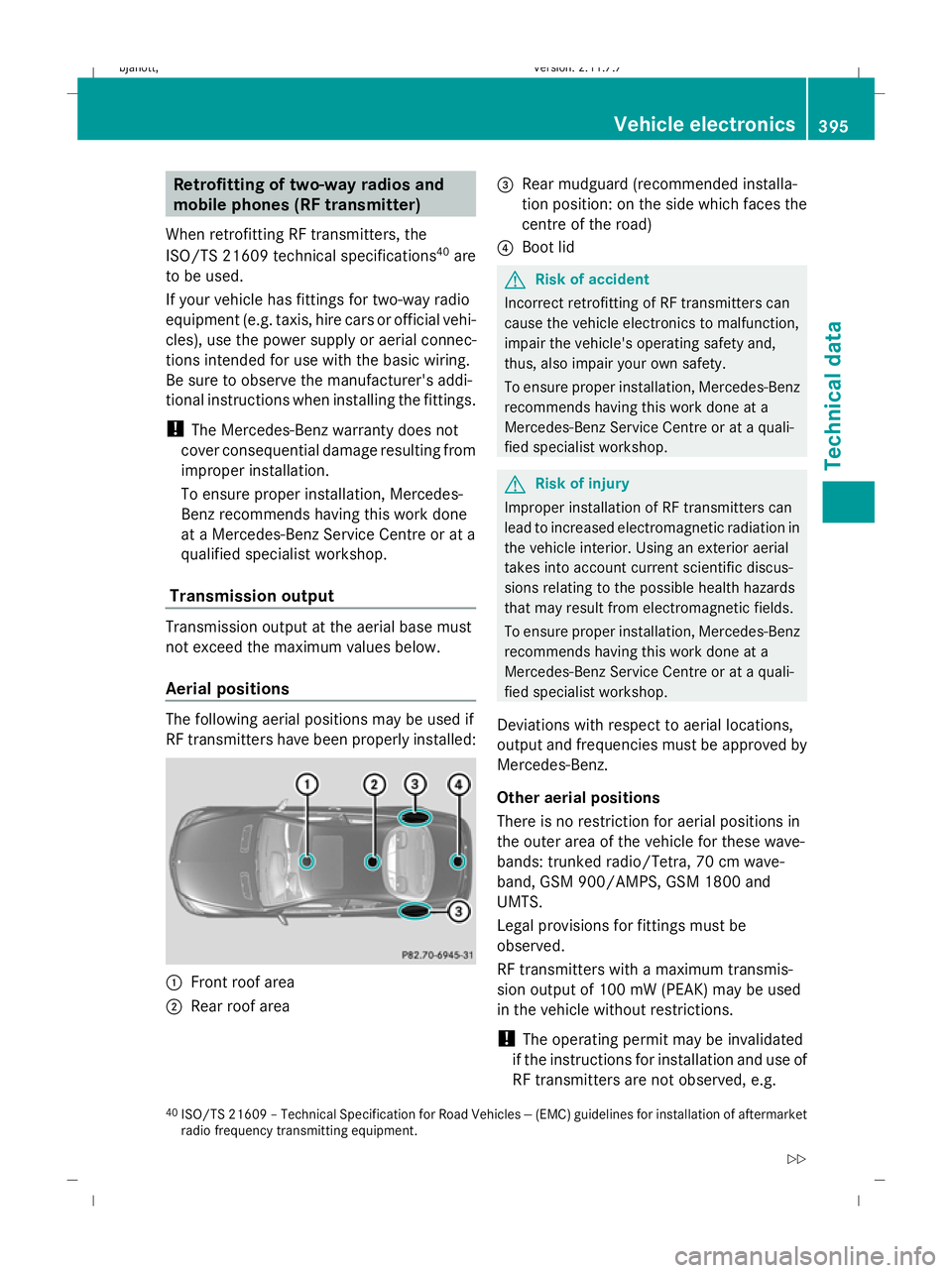
Aerial positions The following aerial positions may be used if
RF transmitters have been properly installed:
:
Front roof area
; Rear roof area =
Rear mudguard (recommended installa-
tion position: on the side which faces the
centre of the road)
? Boot lid G
Risk of accident
Incorrect retrofitting of RF transmitters can
cause the vehicle electronics to malfunction,
impair the vehicle's operating safety and,
thus, also impair your own safety.
To ensure proper installation, Mercedes-Benz
recommends having this work done at a
Mercedes-Benz Service Centre or at a quali-
fied specialist workshop. G
Risk of injury
Improper installation of RF transmitters can
lead to increased electromagnetic radiation in
the vehicle interior. Using an exterior aerial
takes into account current scientific discus-
sions relating to the possible health hazards
that may result from electromagnetic fields.
To ensure proper installation, Mercedes-Benz
recommends having this work done at a
Mercedes-Benz Service Centre or at a quali-
fied specialist workshop.
Deviations with respect to aerial locations,
output and frequencies must be approved by
Mercedes-Benz.
Other aerial positions
There is no restriction for aerial positions in
the outer area of the vehicle for these wave-
bands: trunked radio/Tetra, 70 cm wave-
band, GSM 900/AMPS, GSM 1800 and
UMTS.
Legal provisions for fittings must be
observed.
RF transmitters with a maximum transmis-
sion output of 100 mW (PEAK) may be used
in the vehicle without restrictions.
! The operating permit may be invalidated
if the instructions for installation and use of
RF transmitters are not observed, e.g.
40 ISO/TS 21609 – Technical Specification for Road Vehicles -- (EMC) guidelines for installation of aftermarket
radio frequency transmitting equipment. Vehicle electronics
395Technical data
216_AKB; 2; 3, en-GB
bjanott, Version: 2.11.7.7 2009-02-27T14:54:17+01:00 - Seite 395 Z
Dateiname: 6515230602_buchblock.pdf; erzeugt am 04. Mar 2009 11:16:57; WK
Page 399 of 421
approved wavebands, maximum output
and aerial positions on the vehicle.
Vehicle identification plates
Vehicle identification plate with vehi-
cle identification number (VIN) and
paint code number
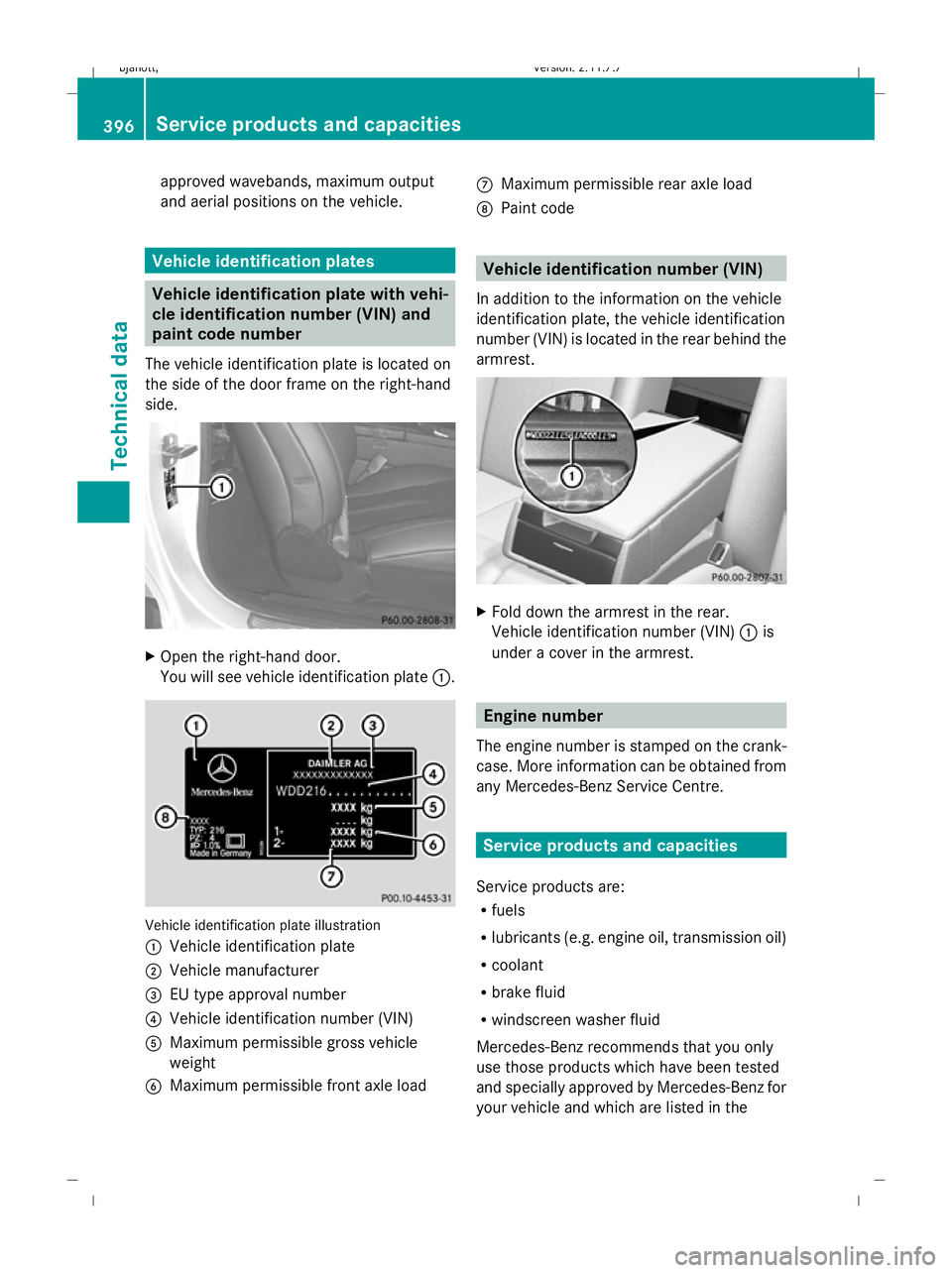
The vehicle identification plate is located on
the side of the door frame on the right-hand
side. X
Open the right-hand door.
You will see vehicle identification plate :.Vehicle identification plate illustration
:
Vehicle identification plate
; Vehicle manufacturer
= EU type approval number
? Vehicle identification number (VIN)
A Maximum permissible gross vehicle
weight
B Maximum permissible front axle load C
Maximum permissible rear axle load
D Paint code Vehicle identification number (VIN)
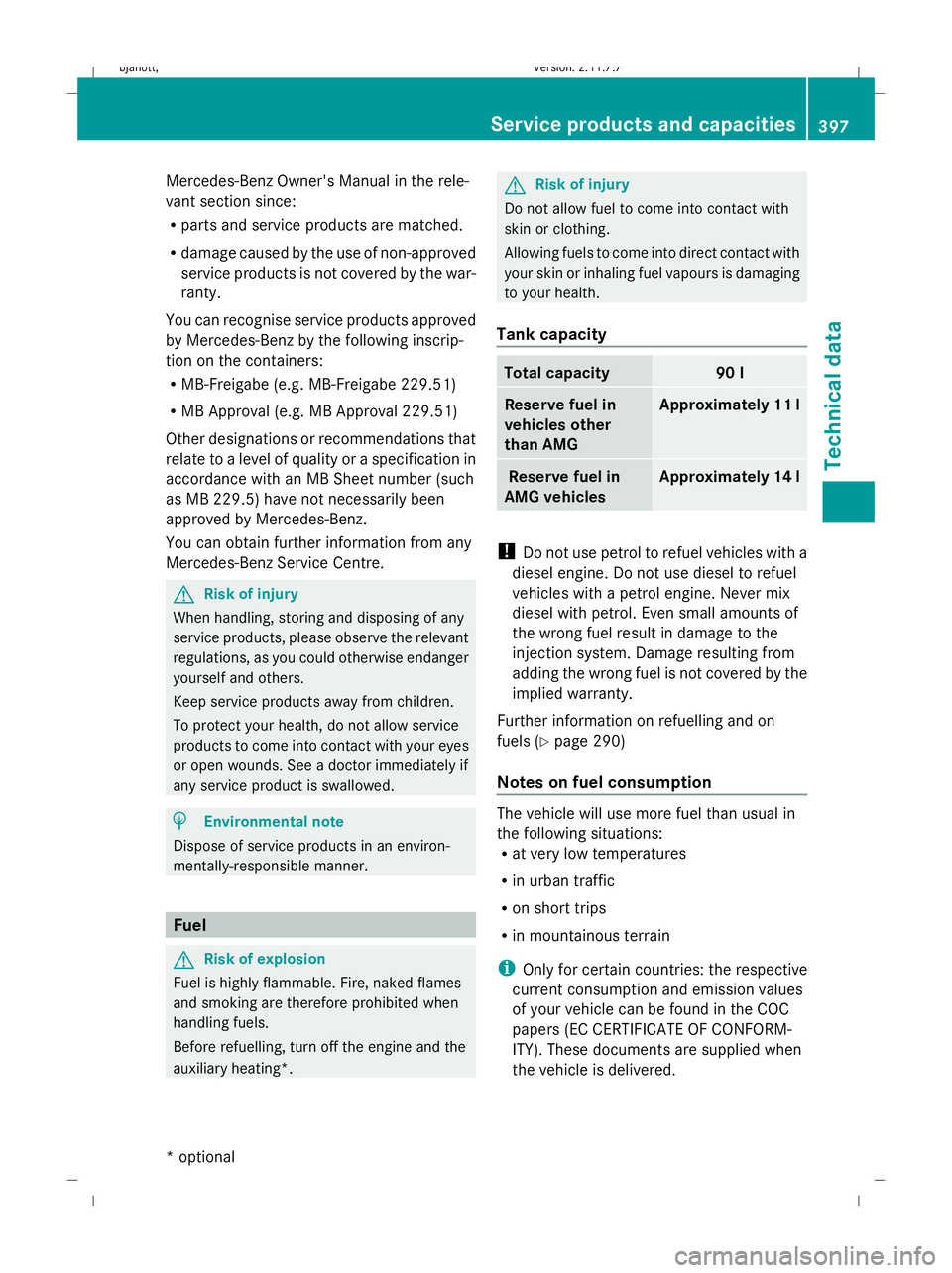
In addition to the information on the vehicle
identification plate, the vehicle identification
number (VIN) is located in the rear behind the
armrest. X
Fold down the armrest in the rear.
Vehicle identification number (VIN) 1is
under a cover in the armrest. Engine number
The engine number is stamped on the crank-
case. More information can be obtained from
any Mercedes-Benz Service Centre. Service products and capacities
Service products are:
R fuels
R lubricants (e.g. engine oil, transmission oil)
R coolant
R brake fluid
R windscreen washer fluid
Mercedes-Benz recommends that you only
use those products which have been tested
and specially approved by Mercedes-Benz for
your vehicle and which are listed in the 396
Service products and capacitiesTechnical data
216_AKB; 2; 3, en-GB
bjanott
,V ersion: 2.11.7.7
2009-02-27T14:54:17+01:00 - Seite 396
Dateiname: 6515230602_buchblock.pdf; erzeugt am 04. Mar 2009 11:16:57; WK
Page 400 of 421
Mercedes-Benz Owner's Manual in the rele-
vant section since:
R parts and service products are matched.
R damage caused by the use of non-approved
service products is not covered by the war-
ranty.
You can recognise service products approved
by Mercedes-Benz by the following inscrip-
tion on the containers:
R MB-Freigabe (e.g. MB-Freigabe 229.51)
R MB Approval (e.g. MB Approval 229.51)
Other designations or recommendations that
relate to a level of quality or a specification in
accordance with an MB Sheet number (such
as MB 229.5) have not necessarily been
approved by Mercedes-Benz.
You can obtain further information from any
Mercedes-Benz Service Centre. G
Risk of injury
When handling, storing and disposing of any
service products, please observe the relevant
regulations, as you could otherwise endanger
yourself and others.
Keep service products away from children.
To protect your health, do not allow service
products to come into contact with your eyes
or open wounds. See a doctor immediately if
any service product is swallowed. H
Environmental note
Dispose of service products in an environ-
mentally-responsible manner. Fuel
G
Risk of explosion
Fuel is highly flammable. Fire, naked flames
and smoking are therefore prohibited when
handling fuels.
Before refuelling, turn off the engine and the
auxiliary heating*. G
Risk of injury
Do not allow fuel to come into contact with
skin or clothing.
Allowing fuels to come into direct contact with
your skin or inhaling fuel vapours is damaging
to your health.
Tank capacity Total capacity 90 l
Reserve fuel in
vehicles other
than AMG Approximately 11 l
Reserve fuel in
AMG vehicles Approximately 14 l
!
Do not use petrol to refuel vehicles with a
diesel engine. Do not use diesel to refuel
vehicles with a petrol engine. Never mix
diesel with petrol. Even small amounts of
the wrong fuel result in damage to the
injection system. Damage resulting from
adding the wrong fuel is not covered by the
implied warranty.
Further information on refuelling and on
fuels (Y page 290)
Notes on fuel consumption The vehicle will use more fuel than usual in
the following situations:
R
at very low temperatures
R in urban traffic
R on short trips
R in mountainous terrain
i Only for certain countries: the respective
current consumption and emission values
of your vehicle can be found in the COC
papers (EC CERTIFICATE OF CONFORM-
ITY). These documents are supplied when
the vehicle is delivered. Service products and capacities
397Technical data
* optional
216_AKB; 2; 3, en-GB
bjanott,V
ersion: 2.11.7.7
2009-02-27T14:54:17+01:00 - Seite 397 Z
Dateiname: 6515230602_buchblock.pdf; erzeugt am 04. Mar 2009 11:16:58; WK
Page 401 of 421

!
Do not use any special additives, as they
can cause malfunctions and engine dam-
age. Damage resulting from the use of such
additives is not covered by the Mercedes-
Benz implied warranty. H
Environmental note
CO 2(carbon dioxide) is the gas which scien-
tists believe to be principally responsible for
global warming (the greenhouse effect). Your
vehicle's CO 2emissions are directly related to
fuel consumption and therefore depend on:
R efficient use of the fuel by the engine
R driving style
R other non-technical factors, such as envi-
ronmental influences or road conditions
You can minimise your vehicle's CO 2emis-
sions by driving carefully and having it serv-
iced regularly. Engine oil
Only Mercedes-Benz approved engine oils
may be used in Mercedes-Benz engines.
A list of the engine oils tested and approved
in accordance with the Mercedes-Benz Spec-
ifications for Service Products can be called
up by visiting http://bevo.daimler.com and
entering the MB Sheet number. Further infor-
mation on tested and approved engine oils
can be obtained from any Mercedes-Benz
Service Centre. Engine oils which have been
approved by Mercedes-Benz have the MB
Sheet number indicated on the oil container
under the "MB approval" notice. The table
shows which MB Sheet number applies to
which engine: CL 500
CL 500 4MATIC CL 600
CL 63 AMG 41
CL 65 AMG 41 MB Sheet number
229.3, 229.5 mm 229.5
i
In the event that the:
R engine oil brand
R grade (MB Sheet number)
R SAE classification (viscosity)
is not available, you can use another min-
eral or synthetic engine oil which has been
approved by Mercedes-Benz. You must
then have an oil change carried out at the
earliest possible opportunity.
Mixing oils reduces the benefits of high-
grade engine oil.
! Do not use lubricant additives, as they can
lead to increased wear and damage to
mechanical assemblies. The use of lubri- cant additives will result in a restriction of
your warranty. Engine oil viscosity
Viscosity describes the flow characteristics
of a fluid. If an engine oil has a high viscosity,
this means that it is thick; a low viscosity
means that it is thin.
Select the SAE classification (viscosity) of the
engine oil according to the outside tempera-
ture. The following table shows you the vis-
cosity classes to be used depending on the
average air temperature.
41 Restriction: only SAE 0W-40 engine oils may be used. 398
Service products and capacitiesTechnical data
216_AKB; 2; 3, en-GB
bjanott,
Version: 2.11.7.7 2009-02-27T14:54:17+01:00 - Seite 398
Dateiname: 6515230602_buchblock.pdf; erzeugt am 04. Mar 2009 11:16:58; WK