2009 MAZDA MODEL B4000 CAB PLUS 4 TRUCK engine
[x] Cancel search: enginePage 201 of 288
WARNING:When a wheel is installed, always remove any
corrosion, dirt or foreign materials present on the mounting
surfaces of the wheel or the surface of the wheel hub, brake drum or
brake disc that contacts the wheel. Ensure that any fasteners that
attach the rotor to the hub are secured so they do not interfere with
the mounting surfaces of the wheel. Installing wheels without correct
metal-to-metal contact at the wheel mounting surfaces can cause the
wheel nuts to loosen and the wheel to come off while the vehicle is in
motion, resulting in loss of control.
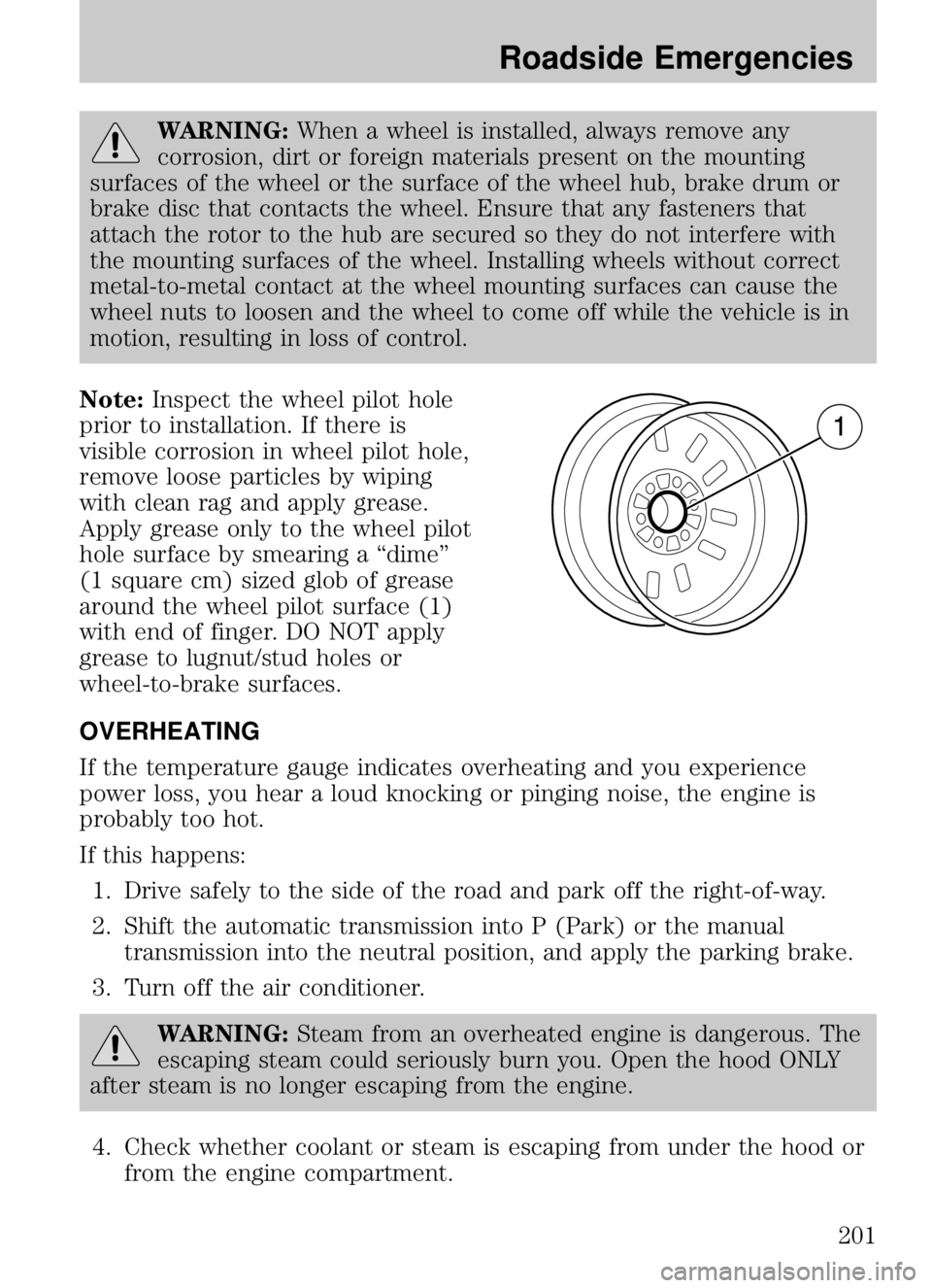
Note: Inspect the wheel pilot hole
prior to installation. If there is
visible corrosion in wheel pilot hole,
remove loose particles by wiping
with clean rag and apply grease.
Apply grease only to the wheel pilot
hole surface by smearing a “dime”
(1 square cm) sized glob of grease
around the wheel pilot surface (1)
with end of finger. DO NOT apply
grease to lugnut/stud holes or
wheel-to-brake surfaces.
OVERHEATING
If the temperature gauge indicates overheating and you experience
power loss, you hear a loud knocking or pinging noise, the engine is
probably too hot.
If this happens:
1. Drive safely to the side of the road and park off the right-of-way.
2. Shift the automatic transmission into P (Park) or the manual transmission into the neutral position, and apply the parking brake.
3. Turn off the air conditioner.
WARNING: Steam from an overheated engine is dangerous. The
escaping steam could seriously burn you. Open the hood ONLY
after steam is no longer escaping from the engine.
4. Check whether coolant or steam is escaping from under the hood or from the engine compartment.
2009 B-Series (mbs)
Owners Guide, 1st Printing
USA (fus)
Roadside Emergencies
201
Page 202 of 288

•If steam is coming from the engine compartment: do not go near
the front of the vehicle. Stop the engine, then turn the ignition switch
to the ON position without starting the engine. The radiator cooling
fans will start to cool the engine.
• If neither coolant nor steam is escaping: open the hood and idle
the engine until it cools. If this does not lower the temperature, stop
the engine and let it cool.
5. Check the coolant level. If it is low, look for leaks in the radiator hoses and connections, heater hoses and connections, radiator and
water pump.
If you find a leak or other damage, or if coolant is still leaking, stop the
engine and call an authorized dealer.
WARNING: When the engine and radiator are hot, scalding
coolant and steam may shoot out under pressure and cause
serious injury. Do not remove the cooling system cap when the engine
and radiator are hot.
See Adding coolant in theMaintenance and Specifications section. If
you find no problems, the engine is cool and no leaks are obvious,
carefully add coolant as required.
Note: If the engine continues to overheat or frequently overheats, have
the cooling system inspected. The engine could be seriously damaged
unless repairs are made.
JUMP STARTING
WARNING: The gases around the battery can explode if
exposed to flames, sparks, or lit cigarettes. An explosion could
result in injury or vehicle damage.
WARNING: Batteries contain sulfuric acid which can burn skin,
eyes and clothing, if contacted.
Do not attempt to push-start your automatic transmission
vehicle. Automatic transmissions do not have push-start
capability. Attempting to push-start a vehicle with an automatic
transmission may cause transmission damage.
Preparing your vehicle
When the battery is disconnected or a new battery is installed, the
automatic transmission must relearn its shift strategy. As a result, the
2009 B-Series (mbs)
Owners Guide, 1st Printing
USA (fus)
Roadside Emergencies
202
Page 205 of 288
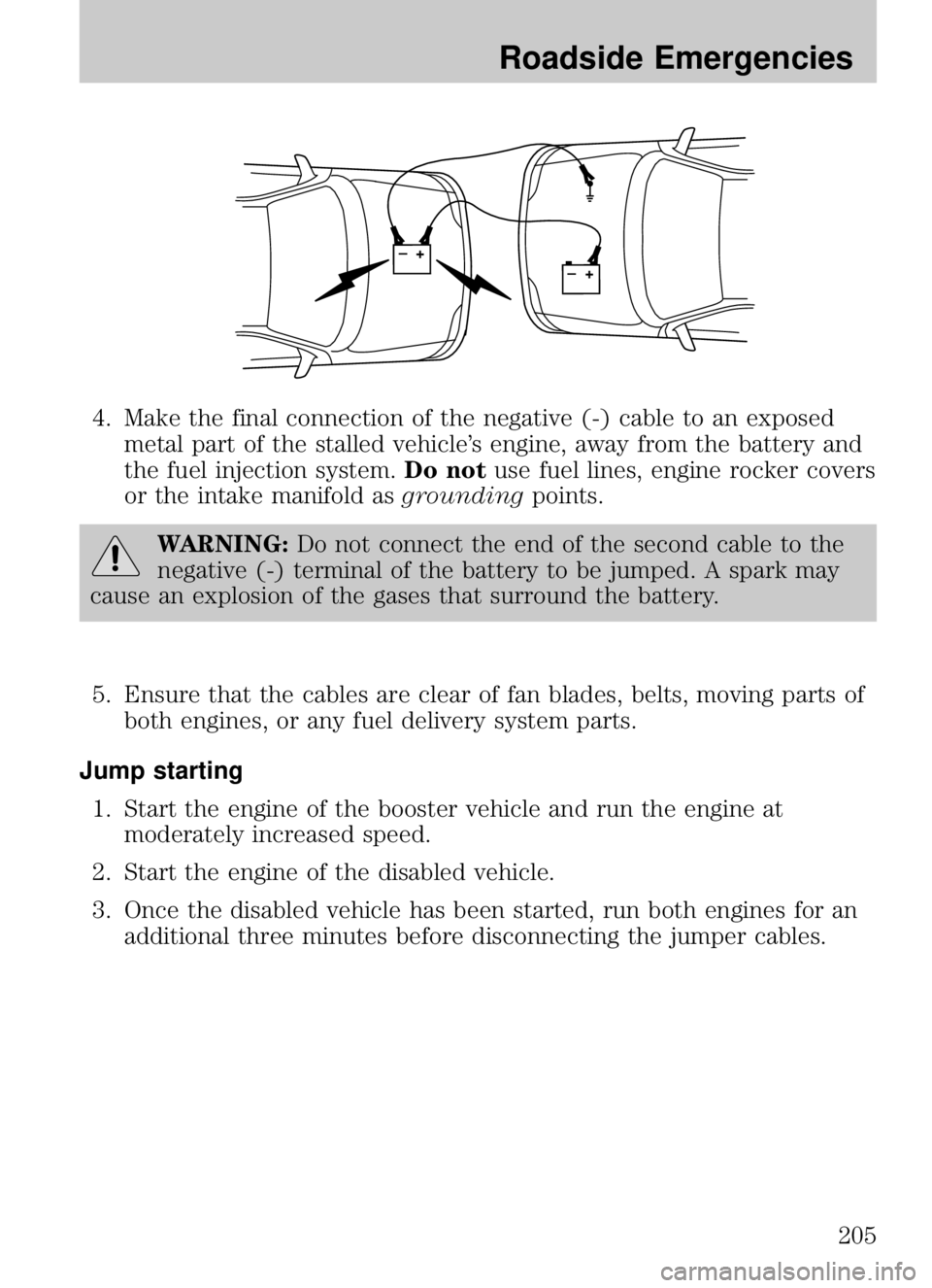
4. Make the final connection of the negative (-) cable to an exposedmetal part of the stalled vehicle’s engine, away from the battery and
the fuel injection system. Do notuse fuel lines, engine rocker covers
or the intake manifold as groundingpoints.
WARNING: Do not connect the end of the second cable to the
negative (-) terminal of the battery to be jumped. A spark may
cause an explosion of the gases that surround the battery.
5. Ensure that the cables are clear of fan blades, belts, moving parts of both engines, or any fuel delivery system parts.
Jump starting 1. Start the engine of the booster vehicle and run the engine at moderately increased speed.
2. Start the engine of the disabled vehicle.
3. Once the disabled vehicle has been started, run both engines for an additional three minutes before disconnecting the jumper cables.
+–+–
2009 B-Series (mbs)
Owners Guide, 1st Printing
USA (fus)
Roadside Emergencies
205
Page 219 of 288
Outside Canada
Government regulations in Canada require that automobiles meet specific
emission regulations and safety standards. Therefore, vehicles built for
use in Canada, may differ from those sold in other countries.
The differences may make it difficult or even impossible for your vehicle
to receive satisfactory servicing in other countries. We strongly
recommend that you NOT take your Mazda outside Canada. However, in
the event that you are moving to the United States permanently, Mazda
vehicles built for use in Canada could be eligible for exportation to the
United States with specific vehicle modifications to comply with the
United States Federal Motor Vehicle Safety requirements.
Special Note: The above is applicable for permanent import/export
situations and not related to travelers on vacation.
You may have the following problems if you do take your vehicle outside
of Canada:
•Recommended fuel may be unavailable. Any kind of leaded fuel or
low-octane fuel will affect vehicle performance and damage the
emission controls and engine.
• Proper repair facilities, tools, testing equipment, and replacement
parts may not be available.
Please refer to your manufacturers warranty booklet for more
information.
ADD-ON NON-GENUINE PARTS AND ACCESSORIES
Non-genuine parts and accessories for Mazda vehicles can be found in
stores. These may fit your vehicle, but they are not approved by the
manufacturer for use with Mazda vehicles. When you install non-genuine
parts or accessories, they could affect your vehicle’s performance or
safety system; the manufacturer’s warranty doesn’t cover this. Before you
install any non-genuine parts or accessories, consult an Authorized
Mazda Dealer.
WARNING: Installation of Non-Genuine Parts or Accessories:
Installation of non-genuine parts or accessories could be
dangerous. Improperly designed parts or accessories could seriously
affect your vehicle’s performance or safety system. This could cause
you to have an accident or increase your chances of injuries in an
accident. Always consult an Authorized Mazda Dealer before you install
non-genuine parts or accessories.
2009 B-Series (mbs)
Owners Guide, 1st Printing
USA (fus)
Customer Assistance
219
Page 220 of 288
WARNING:Add-On Electrical and Electronic Equipment:
Incorrectly choosing or installing improper add-on equipment or
choosing an improper installer could be dangerous. Essential systems
could be damaged, causing engine stalling, air-bag (SRS) activation,
ABS inactivation, or a fire in the vehicle. Be very careful in choosing
and installing add-on electrical equipment, such as mobile telephones,
two-way radios, stereo systems, and car alarm systems.
Mazda assumes no responsibility for death, injury, or expenses that may
result from the installation of add-on non-genuine parts or accessories.
SERVICE PUBLICATIONS
Factory-authorized Mazda service publications are available for owners
who wish to do some of their own maintenance and repair.
When requesting any of our publications through an Authorized Mazda
Dealer, refer to the chart below.
If they don’t have what you need in stock, they can order it for you.
PUBLICATION ORDER NUMBER PUBLICATION DESCRIPTION
9999 95 022B 09 WORKSHOP MANUAL
9999 95 020G 09 WIRING DIAGRAM
9999 95 023C 09 OWNER’S MANUAL
WORKSHOP MANUAL:
Covers recommended maintenance and repair procedures of the drive
train, body and chassis.
WIRING DIAGRAM:
Provides electrical schematics as well as component location for the
entire electrical system.
OWNER’S MANUAL:
This booklet contains information regarding the proper care and
operation of your vehicle. This is not a technician’s manual.
Please note that your Authorized Mazda Dealership has trained
personnel and special service tools to correctly and safely
maintain Mazda vehicles.
2009 B-Series (mbs)
Owners Guide, 1st Printing
USA (fus)
Customer Assistance
220
Page 228 of 288

CHART SYMBOLS
I: Inspect and if necessary, correct, clean or replace
AAdjust
R: Replace
L: Lubricate
Normal driving service intervals — perform at the months or distances
shown, whichever occurs first.
Maintenance Item Maintenance Interval (Number of months or Miles (km),
whichever comes first)
Months 4 8 12 16 20 24 28 32 36 40 44 48
x 1000 miles 5 10 15 20 25 30 35 40 45 50 55 60 (x 1000 km) (8) (16) (24) (32) (40) (48) (56) (64) (72) (80) (88) (96)
ENGINE
Engine oil RRRRRRRRRRR R
Oil filter RRRRRRRRRRR R
PCV valve *3
AIR CLEANER
Air cleaner filter RR
IGNITION SYSTEM
Spark plugs *4
COOLING SYSTEM
Engine Coolant (yellow) Replace at first 100,000 miles (160,000 km) or
72 months; after that, every 50,000 miles (80,000 km) or 36 months
Coolant condition and protection, hoses
and clamps — annually — prior to cold
weather every 12 monthsIII I
CHASSIS AND BODY
Wheel lug nut torque *1 IIIIIIIIIII I
Inspect tires for wear and rotate
(X = recommended interval for
optimal tire life) IXIXXIXXIXX I
Clutch reservoir fluid level I IIIII
Front wheel bearings (4x2) L
Disc brake system III I
2009 B-Series (mbs)
Owners Guide, 1st Printing
USA (fus)
Maintenance and Specifications
228
Page 230 of 288

Schedule 1 continued
MaintenanceItem Maintenance Interval (Number of months or Miles (km),
whichever comes first)
Months 52 56 60 64 68 72 76 80 84 88 92 96
x 1000 miles 65 70 75 80 85 90 95 100 105 110 115 120
(x 1000 km) (104) (112) (121) (128) (136) (144) (152) (160) (168) (176) (184) (192)
ENGINE
Engine oil RRRRRRRRRRRR
Oil filter RRRRRRRRRRRR
PCV valve *3
AIR CLEANER
Air cleaner filter RR
IGNITION SYSTEM
Spark plugs *4 R
COOLING SYSTEM
Engine Coolant
(yellow) Replace at first 100,000 miles (160,000 km) or 72 months;
after that, every 50,000 miles (80,000 km) or 36 months
Coolant condition and
protection, hoses and
clamps — annually —prior
to cold weather every
12 months IIII
CHASSIS AND BODY
Wheel lug
nut torque *1IIIIIIIIIIII
Inspect tires for wear and
rotate (X = recommended
interval for optimal tire
life) XXIXXIXXIXXI
Clutch reservoir fluid level IIIIII
Front wheel bearings (4x2) L
Disc brake system IIII
Caliper slide rails LLLL
Drum brake system, lines
and hoses IIII
Exhaust system for leaks,
damage, looseness II
2009 B-Series
(mbs)
Owners Guide, 1st Printing
USA (fus)
Maintenance and Specifications
230
Page 233 of 288

Special Operating
Conditions
Replace Engine Oil and Filter
Inspect Brake System
Replace Fuel Filter
Change Automatic Transmission Fluid
Replace Spark Plugs
Replace Engine Air Filter
Change Manual Transmission Fluid
Inspect and Lubricate U-Joints
Lubricate Front Wheel Bearing (4x2)
Change Transfer Case Fluid (4x4)
Suggested Maintenance
Interval3,000 miles
or 3 months5,000 miles 15,000
miles 30,000
miles 60,000
miles As
required As
required As
required 30,000
miles 60,000
miles
Towing a trailer or
using a camper or
car top carrier X XX
X
Extensive idling or
low-speed driving
for long distances
as in heavy
commercial use
such as delivery,
taxi or patrol car X XXXX
XX
Operating in dusty
conditions such as
unpaved or dusty
roads X XX X
Off road operation XXX
For specific recommendations see your authorized Mazda dealer or
qualified service professional.
OWNER MAINTENANCE
Owner Maintenance Schedule
The owner or a qualified service technician should make these vehicle
inspections at the indicated intervals to ensure safe and dependable
operation.
Bring any problem to the attention of an Authorized Mazda Dealer or
qualified service technician as soon as possible.
2009 B-Series (mbs)
Owners Guide, 1st Printing
USA (fus)
Maintenance and Specifications
233