2009 LINCOLN MKS warning lights
[x] Cancel search: warning lightsPage 205 of 323
Hitches
Do not use hitches that clamp onto the vehicle bumper. Use a load
carrying hitch. You must distribute the load in your trailer so that
10–15% of the total weight of the trailer is on the tongue.
Safety chains
Always connect the trailer’s safety chains to the frame or hook retainers
of the vehicle hitch. To connect the trailer’s safety chains, cross the
chains under the trailer tongue and allow slack for turning corners.
If you use a rental trailer, follow the instructions that the rental agency
gives to you.
Do not attach safety chains to the bumper.
Trailer brakes
Electric brakes and manual, automatic or surge-type trailer brakes are
safe if installed properly and adjusted to the manufacturer’s
specifications. The trailer brakes must meet local and Federal
regulations.
WARNING:Do not connect a trailer’s hydraulic brake system
directly to your vehicle’s brake system. Your vehicle may not
have enough braking power and your chances of having a collision
greatly increase.
WARNING:Do not operate Adaptive Cruise Control (ACC)
when towing a trailer equipped with brakes. Aftermarket trailer
brakes will not function properly when ACC is activated, which may
lead to loss of vehicle control, increasing the risk of serious injury.
The braking system of the tow vehicle is rated for operation at the
GVWR not GCWR.
Trailer lamps
Trailer lamps are required on most towed vehicles. Make sure all running
lights, brake lights, turn signals and hazard lights are working. Do not
connect trailer lamps directly to your vehicle’s tail lamps. This can cause
damage to your vehicle’s electrical system. See your authorized dealer or
trailer rental agency for proper instructions and equipment for hooking
up trailer lamps.
2009 MKS(mks)
Owners Guide (post-2002-fmt)
USA(fus)
Tires, Wheels and Loading
205
Page 208 of 323
STARTING
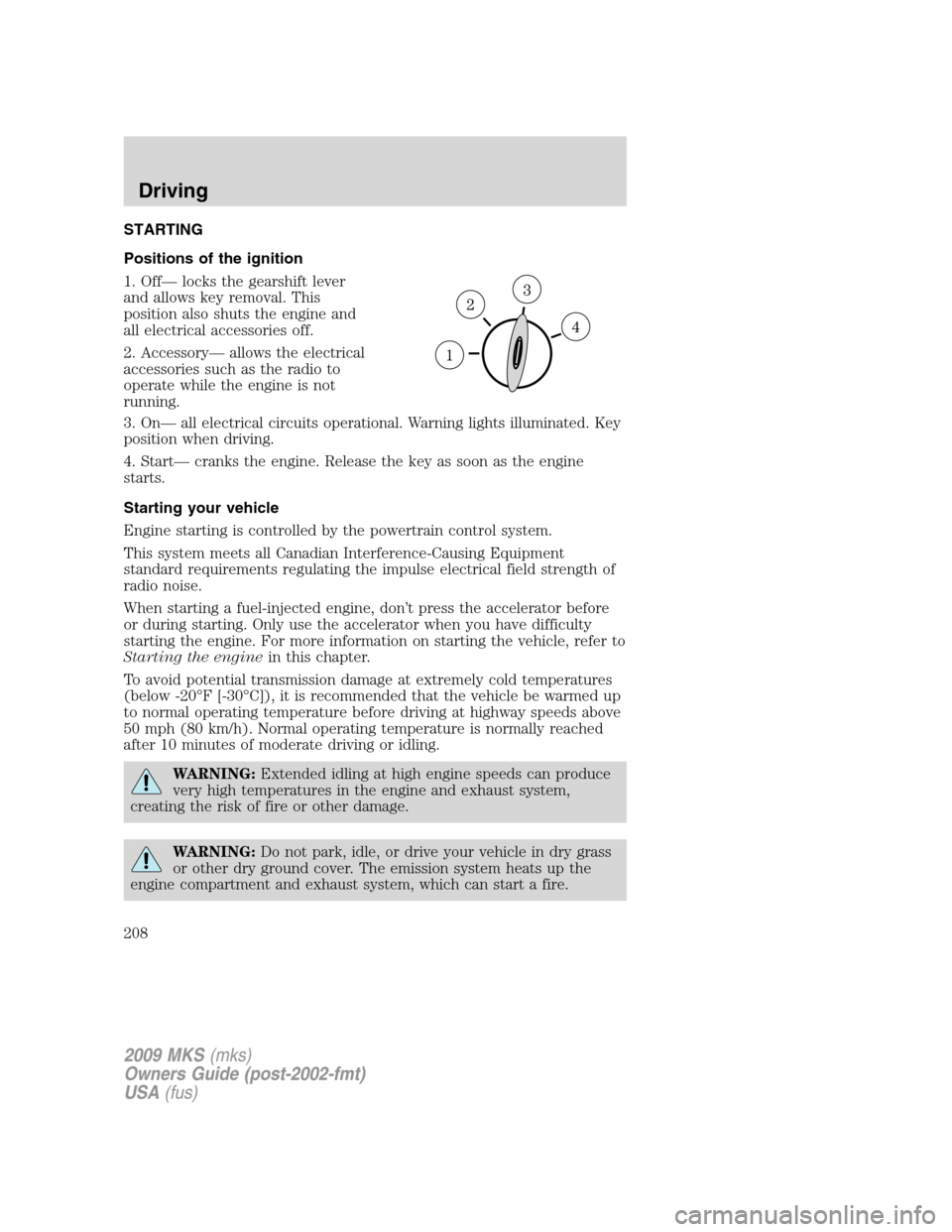
Positions of the ignition
1. Off— locks the gearshift lever
and allows key removal. This
position also shuts the engine and
all electrical accessories off.
2. Accessory— allows the electrical
accessories such as the radio to
operate while the engine is not
running.
3. On— all electrical circuits operational. Warning lights illuminated. Key
position when driving.
4. Start— cranks the engine. Release the key as soon as the engine
starts.
Starting your vehicle
Engine starting is controlled by the powertrain control system.
This system meets all Canadian Interference-Causing Equipment
standard requirements regulating the impulse electrical field strength of
radio noise.
When starting a fuel-injected engine, don’t press the accelerator before
or during starting. Only use the accelerator when you have difficulty
starting the engine. For more information on starting the vehicle, refer to
Starting the enginein this chapter.
To avoid potential transmission damage at extremely cold temperatures
(below -20°F [-30°C]), it is recommended that the vehicle be warmed up
to normal operating temperature before driving at highway speeds above
50 mph (80 km/h). Normal operating temperature is normally reached
after 10 minutes of moderate driving or idling.
WARNING:Extended idling at high engine speeds can produce
very high temperatures in the engine and exhaust system,
creating the risk of fire or other damage.
WARNING:Do not park, idle, or drive your vehicle in dry grass
or other dry ground cover. The emission system heats up the
engine compartment and exhaust system, which can start a fire.
2009 MKS(mks)
Owners Guide (post-2002-fmt)
USA(fus)
Driving
208
Page 210 of 323
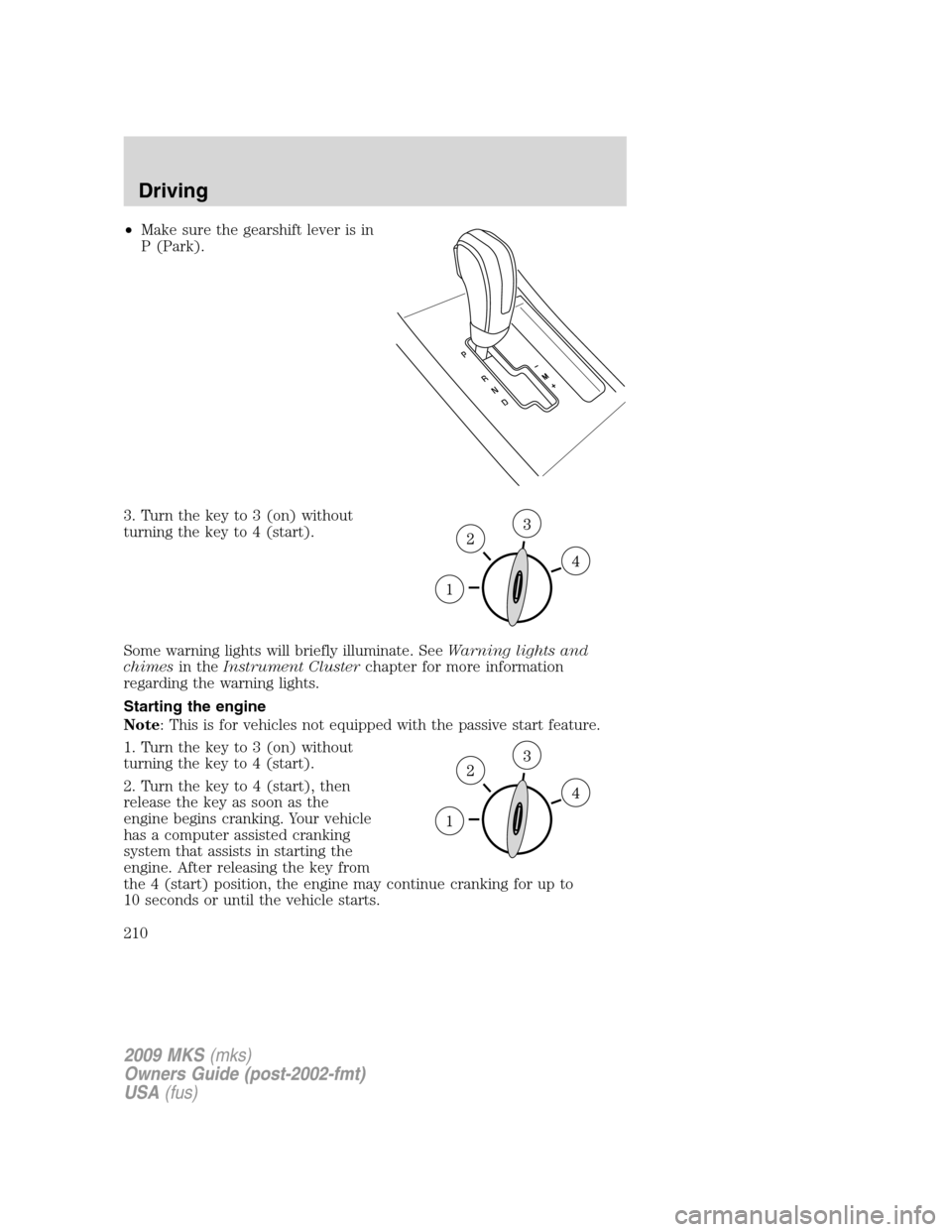
•Make sure the gearshift lever is in
P (Park).
3. Turn the key to 3 (on) without
turning the key to 4 (start).
Some warning lights will briefly illuminate. SeeWarning lights and
chimesin theInstrument Clusterchapter for more information
regarding the warning lights.
Starting the engine
Note: This is for vehicles not equipped with the passive start feature.
1. Turn the key to 3 (on) without
turning the key to 4 (start).
2. Turn the key to 4 (start), then
release the key as soon as the
engine begins cranking. Your vehicle
has a computer assisted cranking
system that assists in starting the
engine. After releasing the key from
the 4 (start) position, the engine may continue cranking for up to
10 seconds or until the vehicle starts.
2009 MKS(mks)
Owners Guide (post-2002-fmt)
USA(fus)
Driving
210
Page 211 of 323

3. After idling for a few seconds, apply the brake, shift into gear and
drive.
Note:If the engine does not start on the first try, turn the key to the off
position, wait 10 seconds and try step 2 again. If the engine still fails to
start, press the accelerator to the floor and try step 2 again, keeping the
accelerator on the floor until the engine begins to accelerate above
cranking speeds; this will allow the engine to crank with the fuel shut off
in case the engine is flooded with fuel.
Push button start system (if equipped)
If your vehicle is equipped with the
push button start system, you can
start your vehicle by pressing the
start button in combination with the
brake pedal rather than using a key.
The start button is located on the
instrument panel to right of the
steering wheel.
In order to operate the Push Button
Start system and start your vehicle,
your Intelligent Access Key (IA
Key) must be present inside the vehicle, either in the passenger
compartment or in the trunk.
1. To put the vehicle in Accessory mode, press and release the start/stop
button without applying the brake pedal. This allows electrical
accessories such as the radio to operate while the engine is not running.
“Accessory Power Active” and “Press Brake to Start” will be displayed in
the message center. Refer toMessage centerin theDriver Controls
chapter for more information.
2. To put the vehicle in on mode, press and hold the start/stop button for
at least one second without applying the brake pedal. This will power
your vehicle’s electrical system and the warning lights in the instrument
cluster will illuminate, but the engine will remain off.
Note:You cannot immediately start your vehicle from the on mode. If
you would like to start the vehicle and you are in on mode, you must
first switch the vehicle off by pressing the start/stop button.
3. To start your vehicle’s engine, press the start/stop button (for any
length of time) while applying the brake pedal.
4. To switch off your vehicle when it is in accessory or on modes or
when the engine is running, press and release the start/stop button.
2009 MKS(mks)
Owners Guide (post-2002-fmt)
USA(fus)
Driving
211
Page 299 of 323
•Normally, adding 1 gallon (3.8L) of fuel is enough to restart the
engine. If the vehicle is out of fuel and on a steep grade, more than
1 gallon (3.8L) may be required.
•Theservice engine soon
indicator may come on. For more
information on the “service engine soon” indicator, refer toWarning
lights and chimesin theInstrument Clusterchapter.
Refilling with a portable fuel container
With the Easy Fuel™ “no cap” fuel system, use the following directions
when filling from a portable fuel container:
WARNING:Do not insert the nozzle of portable fuel containers
or aftermarket funnels into the Easy Fuel™ system. This could
damage the fuel system and its seal, and may cause fuel to run onto
the ground instead of filling the tank, which could result in serious
personal injury.
WARNING:Do not try to pry open or push open the Easy
Fuel™ system with foreign objects. This could damage the fuel
system and its seal and cause injury to you or others.
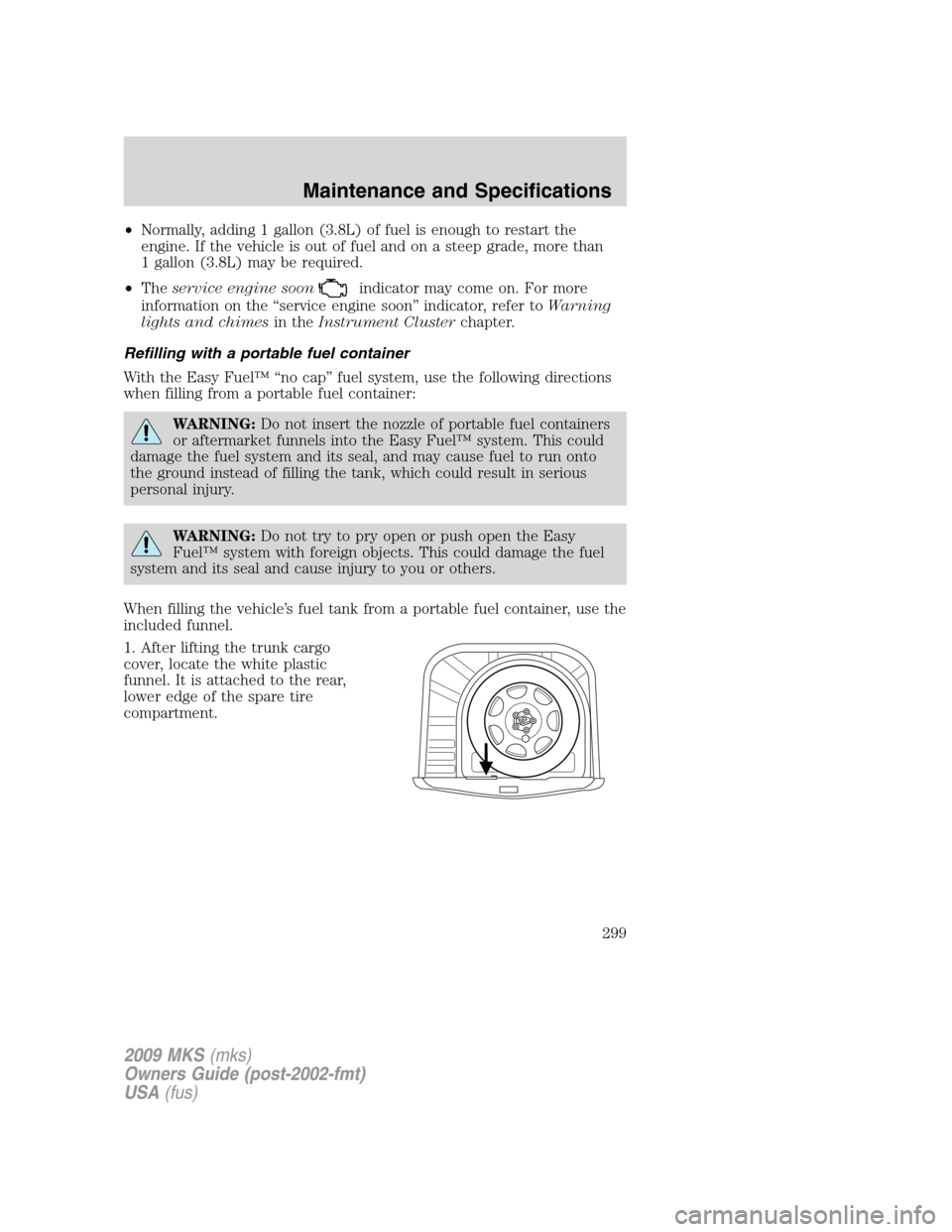
When filling the vehicle’s fuel tank from a portable fuel container, use the
included funnel.
1. After lifting the trunk cargo
cover, locate the white plastic
funnel. It is attached to the rear,
lower edge of the spare tire
compartment.
2009 MKS(mks)
Owners Guide (post-2002-fmt)
USA(fus)
Maintenance and Specifications
299
Page 320 of 323

refill capacities ........................311
service points ..................281–282
Engine block heater .................214
Engine oil ..................................283
change oil soon warning,
message center .......................283
checking and adding ..............283
dipstick ....................................283
filter, specifications ........285, 310
recommendations ...................285
refill capacities ........................311
specifications ..........................311
Event data recording ....................6
Exhaust fumes ..........................213
F
Fail safe cooling ........................293
Fluid capacities .........................311
Foglamps .....................................41
Four-Wheel Drive vehicles
driving off road .......................233
Fuel ............................................294
calculating fuel
economy ............................80, 300
cap ...........................................296
capacity ...................................311
choosing the right fuel ...........297
comparisons with EPA fuel
economy estimates .................303
detergent in fuel .....................298
filler funnel .............................298
filling your vehicle with
fuel ...........................294, 296, 300
filter, specifications ........294, 310
improving fuel economy ........300
octane rating ...................298, 313
quality ......................................298
running out of fuel .........256, 298safety information relating to
automotive fuels .....................294
Fuses ..........................................241
G
Gas cap (see Fuel cap) ............296
Gas mileage
(see Fuel economy) .................300
Gauges .........................................14
H
Hazard flashers .........................240
Headlamps ...................................40
aiming ........................................46
autolamp system .......................40
bulb specifications ....................48
daytime running lights .............45
flash to pass ..............................45
high beam .................................42
turning on and off ....................40
Heated Seats .....................125–126
Heating
heating and air conditioning
system .................................32, 35
Homelink wireless control
system ..........................................75
Hood ..........................................280
I
Ignition ...............................208, 313
Illuminated visor mirror .............53
Infant seats (see Safety seats)...164
Inspection/maintenance (I/M)
testing ........................................305
2009 MKS(mks)
Owners Guide (post-2002-fmt)
USA(fus)
Index
320
Page 321 of 323

Instrument panel
cleaning ...................................275
cluster ........................................10
lighting up panel and
interior .......................................46
Intelligent Access Key ................93
Intelligent Access with push
button start ...............................103
J
Jack ............................................248
positioning ...............................248
storage .....................................248
Jump-starting your vehicle ......256
K
Keyless entry system ...............111
autolock .....................................96
keypad .....................................111
locking and unlocking doors ..112
programming entry code .......111
Keys .....................................91, 114
positions of the ignition .........208
L
Lamps
autolamp system .......................40
bulb replacement
specifications chart ..................48
daytime running light ...............45
fog lamps ...................................41
headlamps .................................40
headlamps, flash to pass ..........45
instrument panel, dimming .....46
interior lamps .....................48–49
LATCH anchors .........................168
Lights, warning and indicator ....10anti-lock brakes (ABS) ..........216
Load limits .................................198
Locks
autolock .....................................96
childproof ................................100
doors ..........................................94
Lubricant specifications ...........311
Lug nuts ....................................255
Lumbar support, seats .............125
M
Message center .....................78–79
english/metric button ...............82
system check button ................81
warning messages .....................84
Mirrors ...................................58–59
automatic dimming rearview
mirror ........................................58
heated ............................32, 35, 60
programmable memory ..........106
side view mirrors (power) .......59
Moon roof ....................................73
Motorcraft parts ........278, 294, 310
N
Navigation system .......................31
O
Octane rating ............................298
Oil (see Engine oil) ..................283
P
Park Assist ................................227
Parking brake ............................217
Parts (see Motorcraft parts) ....310
2009 MKS(mks)
Owners Guide (post-2002-fmt)
USA(fus)
Index
321
Page 323 of 323

Starting your vehicle ........208–210
jump starting ..........................256
push button start system .......211
Steering wheel
controls ......................................72
tilting .........................................53
Stereo
6-CD in dash .............................16
CD-MP3 .....................................16
SYNC ............................................31
T
Tilt steering wheel ......................53
Tire Pressure Monitoring
System (TPMS)
Roadside Emergencies ...........248
Tires, Wheels and Loading ....192
Tires ...........................176–177, 248
alignment ................................184
care ..........................................180
changing ..........................248, 251
checking the pressure ............180
inflating ...................................178
label .........................................191
replacing ..................................182
rotating ....................................184
safety practices .......................183
sidewall information ...............186
snow tires and chains ............197
spare tire .................................249
terminology .............................177
tire grades ...............................177
treadwear ........................176, 181
Towing .......................................204
recreational towing .................207
trailer towing ..........................204wrecker ....................................262
Transaxle
fluid, refill capacities ..............311
lubricant specifications ..........311
Transmission .............................222
brake-shift interlock (BSI) ....222
fluid, checking and adding
(automatic) .............................307
Trunk .........................................100
remote release ..................90, 105
Turn signal ..................................47
U
USB port ......................................25
V
Vehicle Identification Number
(VIN) ..........................................314
Vehicle loading ..........................198
Ventilating your vehicle ...........213
W
Warning lights (see Lights) .......10
Washer fluid ..............................282
Water, Driving through .............238
Windows
power .........................................56
Windshield washer fluid and
wipers ..........................................52
checking and adding fluid .....282
replacing wiper blades ...........283
Wrecker towing .........................262
2009 MKS(mks)
Owners Guide (post-2002-fmt)
USA(fus)
Index
323