Page 351 of 371
Maintenance42
7
1
2
3
4
5
6
7
8
9
Example tire size designation:
(These numbers are provided as an
example only; your tire size designa-
tor could vary depending on your
vehicle.)
P215/65R16 96T
P - Applicable vehicle type (tires
marked with the prefix “P’’ are
intended for use on passenger
cars or light trucks; however, not
all tires have this marking).
215 - Tire width in millimeters.
65 - Aspect ratio. The tire’s section height as a percentage of its
width.
R - Tire construction code (Radial).
16 - Rim diameter in inches.
96 - Load Index, a numerical code associated with the maximum
load the tire can carry.
T - Speed Rating Symbol. See the speed rating chart in this section
for additional information. Wheel size designation
Wheels are also marked with impor-
tant information that you need if you
ever have to replace one. The follow-
ing explains what the letters and
numbers in the wheel size designa-
tion mean.
Example wheel size designation:
6.5 J×16
6.5 - Rim width in inches.
J - Rim contour designation.
16 - Rim diameter in inches.
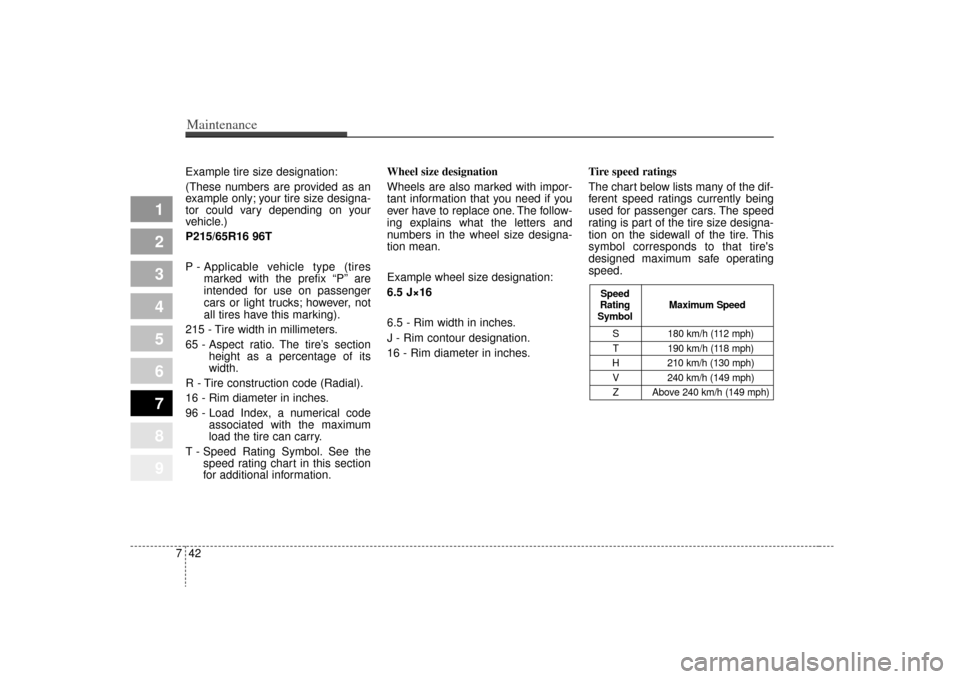
Tire speed ratings
The chart below lists many of the dif-
ferent speed ratings currently being
used for passenger cars. The speed
rating is part of the tire size designa-
tion on the sidewall of the tire. This
symbol corresponds to that tire's
designed maximum safe operating
speed.
S 180 km/h (112 mph)
T 190 km/h (118 mph)
H 210 km/h (130 mph) V 240 km/h (149 mph)Z Above 240 km/h (149 mph)
Maximum Speed
Speed
Rating
Symbol
Page 354 of 371
745
Maintenance
1
2
3
4
5
6
7
8
9
Tread wear
The tread wear grade is a compara-
tive rating based on the wear rate of
the tire when tested under controlled
conditions on a specified govern-
ment test course. For example, a tire
graded 150 would wear one-and-a-
half times as well on the government
course as a tire graded 100.
The relative performance of tires
depends upon the actual conditions
of their use. However, performance
may differ from the norm because of
variations in driving habits, service
practices and differences in road
characteristics and climate.
These grades are molded on the
side-walls of passenger vehicle tires.
The tires available as standard or
optional equipment on Kia vehicles
may vary with respect to grade.Traction - AA, A, B & C
The traction grades, from highest to
lowest, are AA, A, B and C. The
grades represent the tires ability to
stop on wet pavement as measured
under controlled conditions on spec-
ified government test surfaces of
asphalt and concrete. A tire marked
C may have poor traction perfor-
mance.
Temperature -A, B & C
The temperature grades are A (the
highest), B and C. The grades repre-
sent the tire’s resistance to the gen-
eration of heat and its ability to dissi-
pate heat when tested under con-
trolled conditions on a specified
indoor laboratory test wheel.
Sustained high temperature can
cause the material of the tires to
degenerate and reduce tires life, and
excessive temperature can lead to
sudden tires failure. Grades A and B
represent higher levels of perfor-
mance on the laboratory test wheel
than the minimum required by the
law.
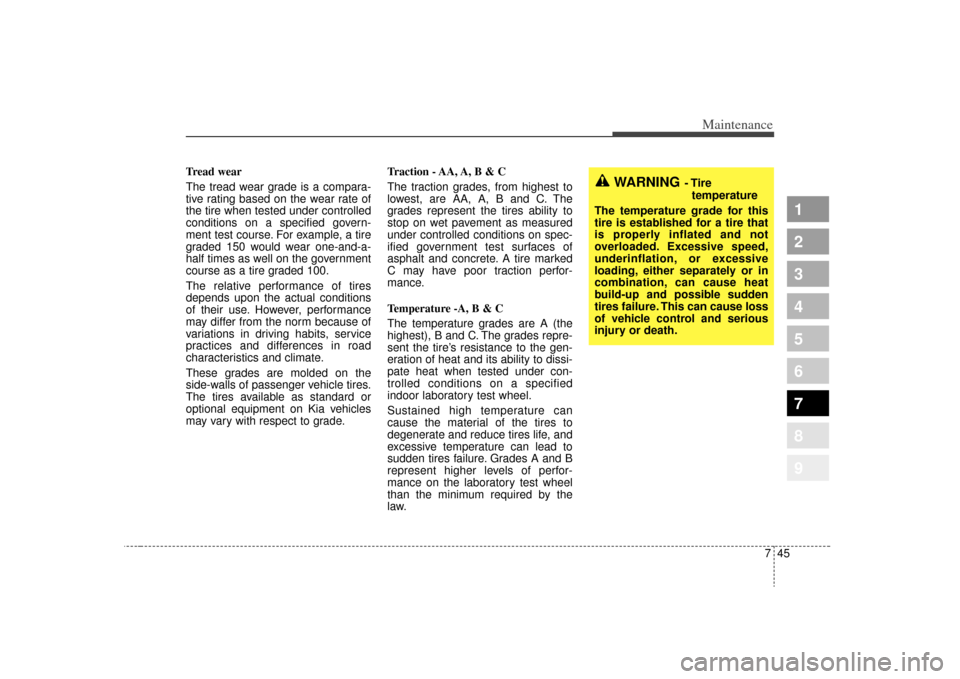
WARNING
- Tire
temperature
The temperature grade for this
tire is established for a tire that
is properly inflated and not
overloaded. Excessive speed,
underinflation, or excessive
loading, either separately or in
combination, can cause heat
build-up and possible sudden
tires failure. This can cause loss
of vehicle control and serious
injury or death.
Page 367 of 371
85
1
2
3
4
5
6
7
8
9
Specifications
Recommended SAE viscosity
number
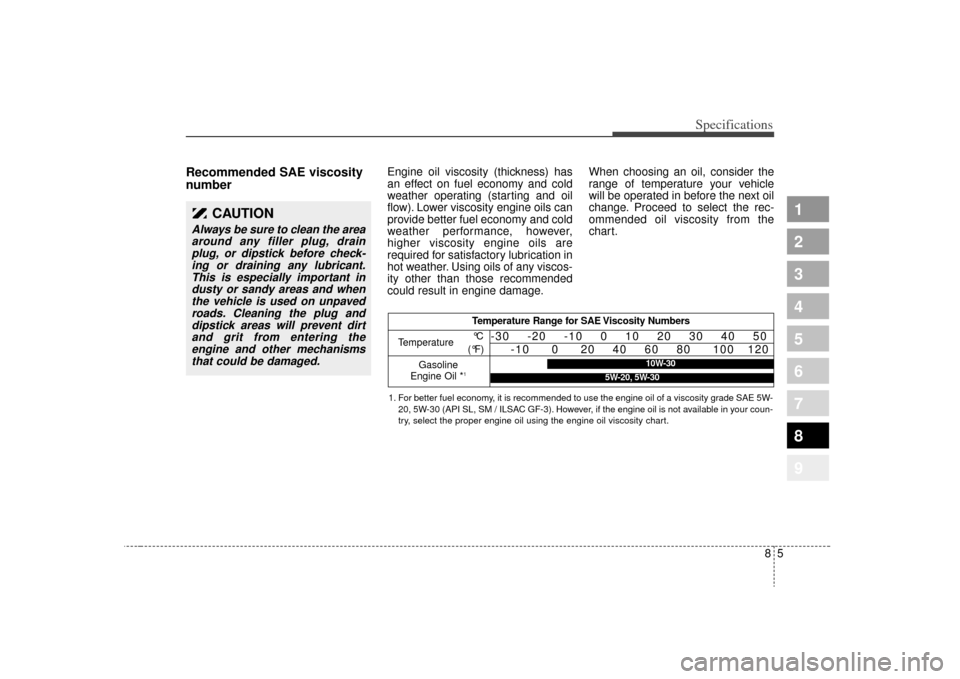
Engine oil viscosity (thickness) has
an effect on fuel economy and cold
weather operating (starting and oil
flow). Lower viscosity engine oils can
provide better fuel economy and cold
weather performance, however,
higher viscosity engine oils are
required for satisfactory lubrication in
hot weather. Using oils of any viscos-
ity other than those recommended
could result in engine damage.When choosing an oil, consider the
range of temperature your vehicle
will be operated in before the next oil
change. Proceed to select the rec-
ommended oil viscosity from the
chart.
Temperature Range for SAE Viscosity Numbers
Temperature
Gasoline
Engine Oil *
1°C
(°F)
-30 -20 -10 0 10 20 30 40 50 -10 0 20 40 60 80 100 120
10W-30
5W-20, 5W-30
1. For better fuel economy, it is recommended to use the engine oil of a viscosity grade SAE 5W-
20, 5W-30 (API SL, SM / ILSAC GF-3). However, if the engine oil is not available in your coun-
try, select the proper engine oil using the engine oil viscosity chart.
CAUTION
Always be sure to clean the areaaround any filler plug, drainplug, or dipstick before check-ing or draining any lubricant.This is especially important industy or sandy areas and whenthe vehicle is used on unpavedroads. Cleaning the plug anddipstick areas will prevent dirtand grit from entering theengine and other mechanismsthat could be damaged.