Page 24 of 327
315
Knowing your vehicle
Driver’s seat➀
Seat adjustment, forward /
backward
➁
Seatback recliner
➂
Seat adjustment, height
➃
Seat heater switch*
➄
Headrest adjustmentFront passenger seat\b
Seat adjustment, forward /
backward
➆
Seatback recliner
➇
Seat heater switch*
➈
Headrest adjustment
Rear seat
\f
ArmrestHeadrest adjustment
Split folding rear seat
* if equipped
SEAT
1112
OBL039016N
Page 26 of 327

317
Knowing your vehicle
WARNING
- Driver respon-
sibility for front seat pas-
senger
Riding in a vehicle with a front seat-
back reclined could lead to serious
or fatal injury in an accident. If a
front seat is reclined during an acci-
dent, the occupant’s hips may slide
under the lap portion of the safety
belt applying great force to the
unprotected abdomen or neck or a
passenger may be ejected in a
rollover. Serious or fatal internal
injuries could result. The driver
must advise the front passenger to
keep the seatback in a comfortably
upright position whenever the vehi-
cle is in motion.
Adjusting the seatback reclinerTo recline the seatback:
1. Lean forward slightly and lift up on the
seatback recline lever located on the
outside of the seat, at the rear.
2. Carefully lean back on the seat and adjust the seatback of the seat to the
position you desire.
3. Release the lever and make sure the seatback is locked in place. (The lever
MUST return to its original position for
the seatback to lock.)
Adjusting the height of seat cushion(for driver’s seat)To change the height of the seat cushion,
rotate the knob located on the outside of
the seat cushion.
OBL039309
OBL039310
Page 27 of 327

Knowing your vehicle18
3Front seat adjustment
(Electric type, if equipped)✽ ✽
NOTICE• Power seats are driven by the electric
motor. Stop operating if the adjust-
ment is completed. Excessive opera-
tion may damage the electrical equip-
ment.
• When in operation, the power seats consume large amount of electrical
power. To prevent unnecessary charg-
ing system drain, don’t adjust the
power seats longer than necessary
while the engine is not running.
• Do not operate two or more power seat control buttons at the same time.
Doing so may result in power seat
motor or electrical component mal-
function.
Adjusting the seat forward and back-
wardPush the control button forward or back-
ward to move the seat to the desired
position. Release the knob and the seat
will lock in the selected position.
Adjust the seat before driving, and make
sure the seat is locked securely by trying
to move forward and backward without
using the control knob. If the seat moves,
it is not locked properly.
Adjusting height of the driver’s seatcushion (if equipped)To raise or lower the seat cushion, pull up
or push down the corresponding switch.
Release the knob once the seat reaches
the desired position.
9BLA3019
9BLA3025
Page 30 of 327

321
Knowing your vehicle
HeadrestThe driver's and front passenger's seats
are equipped with a headrest for the
occupant's safety and comfort.
The headrest not only provides comfort
for the driver and front passenger, but
also helps protect the head and neck in
the event of a collision.Forward and backward adjustment
The headrest may be adjusted forward to
3 different positions by pulling the head-
rest forward to the desired detent. To
adjust the headrest to it’s furthest back-
ward position, pull it fully forward to the
farthest position and release it. Adjust the
headrest so that it properly supports the
head and neck.
OHM038049N
WARNING
For maximum effectiveness in
case of an accident, the headrest
should be adjusted so the middle
of the headrest is at the same
height of the center of gravity of
an occupant's head. Generally,
the center of gravity of most peo-
ple's head is similar with the
height of the top of their eyes.
Also, adjust the headrest as close
to your head as possible. For this
reason, the use of a cushion that
holds the body away from the
seatback is not recommended.
Do not operate the vehicle with the headrests removed. Severe
injury to the occupants may
occur in the event of an accident.
Headrests may provide protection
against neck injuries when prop-
erly adjusted.
Do not adjust the headrest posi- tion of the driver’s seat while the
vehicle is in motion.
Rear seat
OHM038048N
Front seat
*
* : if equipped
OFD037039
Page 31 of 327
Knowing your vehicle22
3Adjusting the height up and down
To raise the headrest, pull it up to the
desired position (1). To lower the head-
rest, push and hold the release button (2)
on the headrest support and lower the
headrest to the desired position (3). Removal
To remove the headrest, raise it as far as
it can go then press the release button
(1) while pulling the headrest up (2).
To reinstall the headrest, put the head-
rest poles (3) into the holes while press-
ing the release button (1). Then adjust it
to the appropriate height.
Active headrest
(Front seat only, if equipped)The active headrest is designed to move
forward and upward during a rear impact.
This helps to prevent the driver's and
front passenger’s head from moving
backward and thus helps prevent neck
injuries.
HNF2041-1
WARNING
Make sure the headrest locks in
position after adjusting it to proper-
ly protect the occupants.
OFD037037
OFD039038
Page 40 of 327
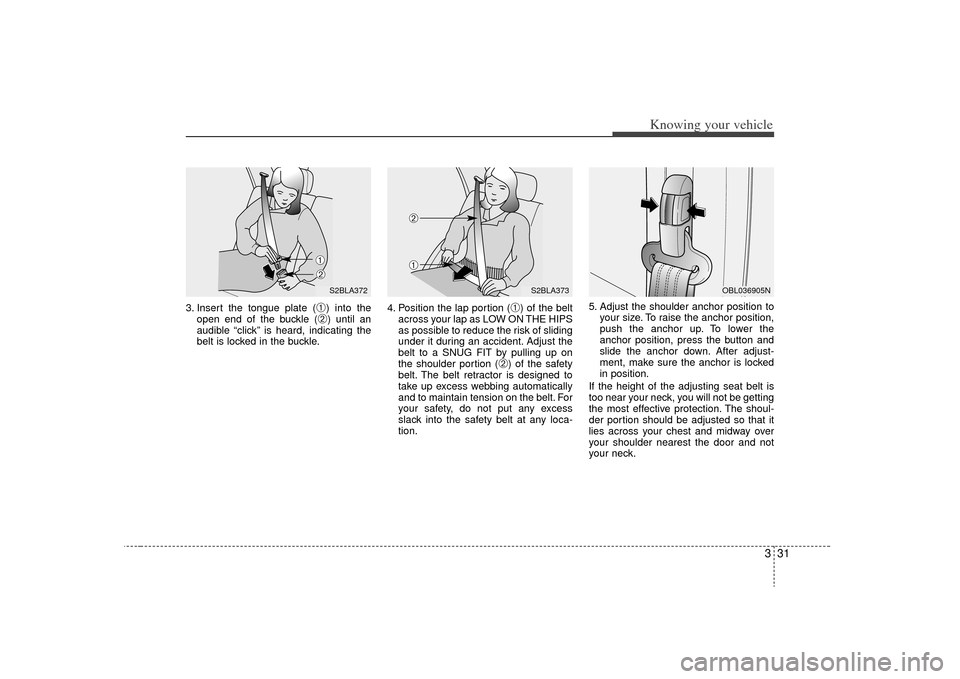
331
Knowing your vehicle
3. Insert the tongue plate (
➀) into the
open end of the buckle (➁) until an
audible “click” is heard, indicating the
belt is locked in the buckle. 4. Position the lap portion (
➀) of the belt
across your lap as LOW ON THE HIPS
as possible to reduce the risk of sliding
under it during an accident. Adjust the
belt to a SNUG FIT by pulling up on
the shoulder portion (
➁) of the safety
belt. The belt retractor is designed to
take up excess webbing automatically
and to maintain tension on the belt. For
your safety, do not put any excess
slack into the safety belt at any loca-
tion. 5. Adjust the shoulder anchor position to
your size. To raise the anchor position,
push the anchor up. To lower the
anchor position, press the button and
slide the anchor down. After adjust-
ment, make sure the anchor is locked
in position.
If the height of the adjusting seat belt is
too near your neck, you will not be getting
the most effective protection. The shoul-
der portion should be adjusted so that it
lies across your chest and midway over
your shoulder nearest the door and not
your neck.
S2BLA372
S2BLA373
OBL036905N
➀➁
➀➁
Page 41 of 327
Knowing your vehicle32
3
To unfasten the front lap/shoulder
belt:Press the release button on the buckle
and allow the belt to slowly retract.
Rear lap/shoulder belt To fasten the rear lap/shoulder belt:1. Grasp the buckle and tongue plate.
2. Slowly pull the lap/shoulder belt out.
3. Insert the tongue plate (
➀) into the
open end of the buckle (➁) until an
audible “click’’ is heard, indicating the
belt is locked in the buckle.
WARNING
The height adjuster must be in the locked position when the
vehicle is moving.
The misadjustment of height of the shoulder belt could reduce
the effectiveness of the seat belt
in a crash.
S2BLA374
S2BLA372
➀➁
Page 162 of 327

Driving your vehicle34
4Non-operational conditions of
rear parking assist systemRear parking assist system may not
operate normally when:1. Moisture is frozen to the sensor. (It will operate normally when moisture
melts.)
2. Sensor is covered with foreign matter, such as snow or water, or the sensor
cover is blocked. (It will operate nor-
mally when the material is removed or
the sensor is no longer blocked.)
3. Driving on uneven road surfaces (unpaved roads, gravel, bumps, gradi-
ent).
4. Objects generating excessive noise (vehicle horns, loud motorcycle
engines, or truck air brakes) are within
range of the sensor.
5. Heavy rain or water spray exists.
6. Wireless transmitters or mobile phones are within range of the sensor.
7. Sensor is covered with snow.
8. Trailer towing
Detecting range may decrease when:1. Sensor is coverd with foreign matter such as snow or water. (Sensing range
will return to normal when removed.)
2. Outside air temperature is extremely hot or cold.Following objects may not be recog-nized by the sensor:1. Sharp or slim objects such as ropes, chains or small poles.
2. Objects which tend to absorb sensor frequency such as clothes, spongy
material or snow.
3. Undetectable objects smaller than 1 m (40 in.) and narrower than 14 cm (6 in.)
in diameter.
CAUTION
1. The rear parking assist system may not sound sequentiallydepending on the speed andshapes of the objects detected.
2. The rear parking assist system may malfunction if the vehiclebumper height or sensor installa-tion has been modified or dam- aged. Any non-factory installedequipment or accessories mayalso interfere with the sensor per-formance.
3. Sensor may not recognize objects less than 40 cm (15 in.)from the sensor, or it may sensean incorrect distance. Use cau- tion.
4. When the sensor is covered with snow, dirt or water, sensor maybe inoperative until the debris isremoved using a soft cloth.
5. Do not push, scratch or strike the sensor. Sensor damage couldoccur.


